
Disclosure: As an Amazon Associate, The PC Audit earns from qualifying purchases. If you buy through links on this page, we may earn a small commission at no extra cost to you.
Debating the ryzen 7 7800x3d vs 9800x3d matchup comes down to two distinct 2026 buyer dilemmas on AMD’s AM5 socket. First, existing Ryzen 7 7800X3D owners want to know whether dropping a Ryzen 7 9800X3D into an existing motherboard delivers a meaningful real-world leap—or wasted upgrade budget better spent on a faster graphics card. Second, fresh PC builders eyeing our best gaming CPUs for 2026 guide must decide when paying extra for Zen 5 and 2nd-Generation 3D V-Cache makes financial sense over snagging a discounted 7800X3D.
On paper, both 8-core, 16-thread processors share a 120W TDP, a 162W PPT power limit, 104 MB total cache (including 96 MB of L3), and 24 usable PCIe 5.0 lanes. Underneath the integrated heatspreader, however, AMD re-engineered the physical cache stack, raised base clocks by 500 MHz, lifted the thermal ceiling from 89°C to 95°C, and unlocked Precision Boost Overdrive. Below, we audit both processors across our 100-point CPU evaluation rubric: Gaming Frame Rate & 1% Lows (35%), Platform Longevity & PCIe I/O (25%), Multi-Core Creator Headroom (20%), and Power Efficiency & Thermal Behavior (20%).
In This Comparison
- TL;DR Winner Matrix: Quick Verdict
- Side-by-Side Verified Spec Table
- Battleground 1: Zen 4 vs. Zen 5 IPC, Clocks & 1% Lows Scaling (35%)
- Battleground 2: 1st-Gen vs. 2nd-Gen 3D V-Cache Thermals, TjMax & PBO (20%)
- Battleground 3: AM5 Longevity, PCIe 5.0 Lanes, BIOS & DDR5-6000 CL30 (25%)
- Battleground 4: Shader Compilation, Creator Headroom & 2026 Alternatives (20%)
- Battleground 5: Should You Upgrade from 7800X3D or Buy Value in 2026?
- Decisive Verdict: Upgrade, Buy 9800X3D, or Choose 7800X3D Value?
- Audited Retail Picks & AM5 Platform Pairings on Amazon US
- Frequently Asked Questions
TL;DR Winner Matrix: Quick Verdict
Although both chips dominate memory-sensitive titles thanks to 96 MB of L3 cache, the architectural gap between Zen 4 and Zen 5 produces clear category winners—while strongly discouraging pointless same-socket upgrades for GPU-bound gamers.
| Evaluation Category | Declared Winner | Decisive Technical Reason |
|---|---|---|
| Overall Performance & Modern Build Pick | AMD Ryzen 7 9800X3D | Combines Zen 5 IPC, +500 MHz base clocks (4.7 vs. 4.2 GHz), +200 MHz boost (5.2 vs. 5.0 GHz), cooler under-CCD 3D V-Cache, and unlocked PBO tuning at a $479 Launch MSRP. |
| New-Build Value for Money (1440p/4K) | AMD Ryzen 7 7800X3D | Whenever street discounts place it $100+ beneath the 9800X3D inside $1,500–$1,800 builds, preserving 96 MB L3 cache frees vital budget for a higher GPU tier. |
| 1% Lows, 1080p Esports & Shader Compilation | AMD Ryzen 7 9800X3D | Both crush DRAM latency spikes with 96 MB L3, yet the 9800X3D’s wider Zen 5 front-end and higher sustained all-core clocks accelerate shader compilation and high-refresh CPU ceilings. |
| Thermal Topology & Overclocking Freedom | AMD Ryzen 7 9800X3D | Moving 2nd-Gen 3D V-Cache below the CCD removes the thermal blanket over the cores, raising TjMax from 89°C to 95°C and unlocking full PBO Boost Override. |
| Existing 7800X3D Owner Upgrade Verdict | Keep 7800X3D (Skip Upgrade) | Unless you run a flagship GPU at 1080p 360Hz–540Hz or sell your 7800X3D cleanly, GPU upgrades or waiting for late-AM5 X3D generations yield vastly better returns per dollar. |
Side-by-Side Verified Spec Table
Cross-checking the official AMD Ryzen Desktop Processor specifications exposes both what stayed identical on Socket AM5 and why the Zen 5 revision feels far less constrained under sustained load.
| Verified Hardware Specification | AMD Ryzen 7 7800X3D | AMD Ryzen 7 9800X3D |
|---|---|---|
| Release Date | April 6, 2023 | November 7, 2024 |
| Launch MSRP | $449 | $479 |
| CPU Architecture & Node | Zen 4 (Raphael), TSMC 5nm CCD / 6nm IOD | Zen 5 (Granite Ridge), TSMC 4nm CCD / 6nm IOD |
| Platform Socket | Socket AM5 (LGA 1718) | Socket AM5 (LGA 1718) |
| Cores / Threads (SMT) | 8 Cores / 16 Threads (Yes) | 8 Cores / 16 Threads (Yes) |
| Base / Max Boost Clock | 4.2 GHz Base / 5.0 GHz Boost | 4.7 GHz Base / 5.2 GHz Boost (+500 / +200 MHz) |
| Cache Hierarchy (L1 / L2 / L3) | 512 KB L1 / 8 MB L2 / 96 MB L3 (104 MB Total) | 640 KB L1 / 8 MB L2 / 96 MB L3 (104 MB Total) |
| 3D V-Cache Stacking Topology | 1st-Gen Above-CCD (cache stacked atop cores) | 2nd-Gen Under-CCD (cores sit directly under IHS) |
| Default TDP / Max Socket Power (PPT) | 120W TDP / 162W PPT | 120W TDP / 162W PPT |
| Max Operating Temperature (TjMax) | 89°C | 95°C |
| Multiplier & PBO Tuning | Multiplier Locked (Curve Optimizer & EXPO only) | Fully Unlocked (PBO +200 MHz, Manual Multiplier, EXPO) |
| JEDEC Memory / AM5 Sweet Spot | DDR5-5200 JEDEC (DDR5-6000 CL30 1:1 Optimal) | DDR5-5600 JEDEC (DDR5-6000 CL30 1:1 Optimal) |
| PCIe 5.0 Lanes (Total / Usable) | 28 Total / 24 Usable (x16 GPU + 2×4 NVMe) | 28 Total / 24 Usable (x16 GPU + 2×4 NVMe) |
| Integrated Graphics | AMD Radeon Graphics (2 CUs, 2200 MHz) | AMD Radeon Graphics (2 CUs, diagnostic ready) |
Battleground 1: Zen 4 vs. Zen 5 IPC, Clocks & 1% Lows Scaling (35%)
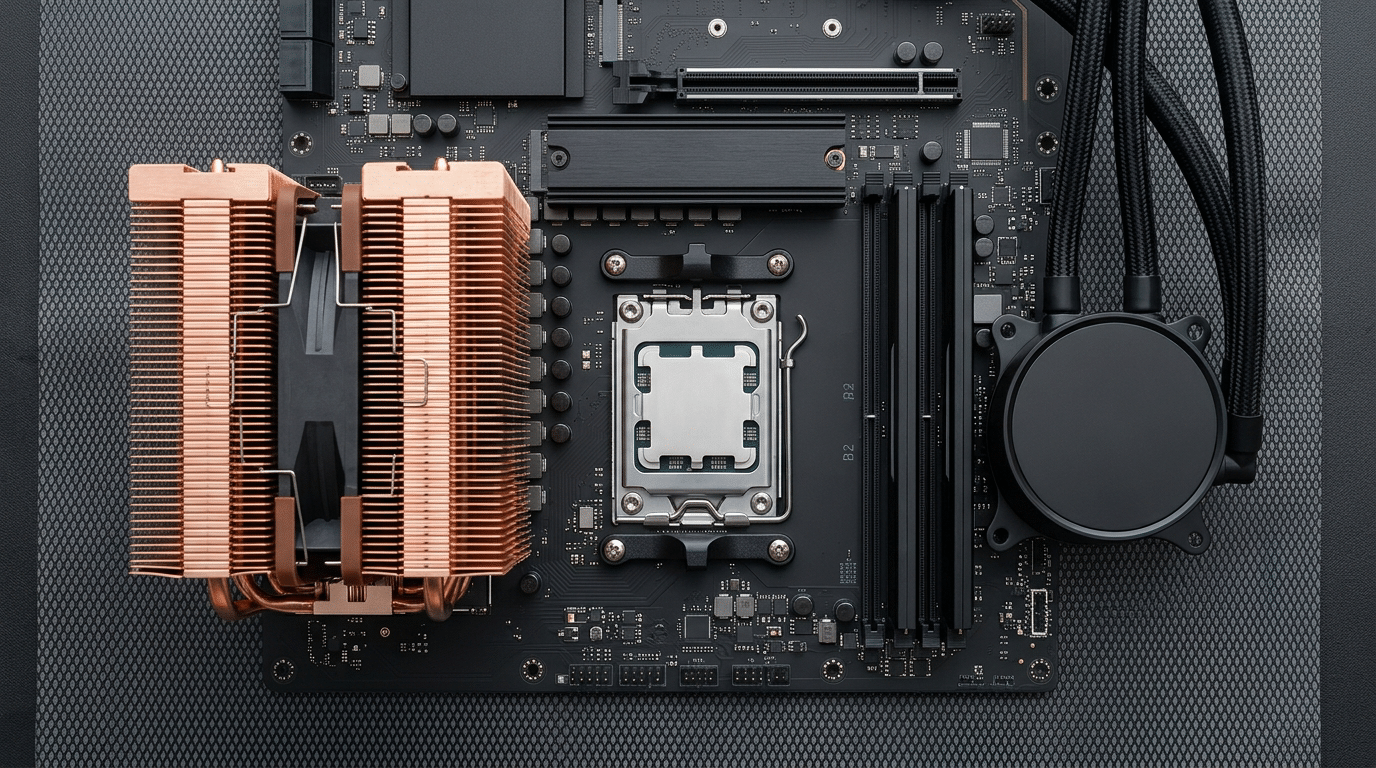
In pure gaming, the primary battleground in ryzen 7 7800x3d vs 9800x3d balances massive shared cache parity against generational core speedups. Both processors feed a single 8-core Core Complex Die (CCD) attached to 96 MB of L3 cache (32 MB on-die plus 64 MB vertically stacked SRAM), keeping all eight cores inside one ultra-low-latency cache pool without cross-CCD scheduling overhead. That unified 96 MB L3 pool is precisely why both chips still outclass traditional non-X3D processors on AMD’s 3D V-Cache architecture—minimizing slow system DRAM fetches whenever complex game worlds, AI pathfinding, or crowded MMO hubs explode with draw calls.
Where does the Ryzen 7 9800X3D pull ahead? Three architectural upgrades compound together inside Zen 5:
- Zen 5 Front-End & IPC Uplift: Granite Ridge widens instruction decode, branch prediction, and execution pipelines while increasing L1 data cache across the chip (640 KB total L1 vs. 512 KB on Zen 4), extracting more work out of every clock cycle even when data spills beyond L3.
- +500 MHz Base & +200 MHz Boost Frequency Floor: The 7800X3D had to run a restrained 4.2 GHz base and 5.0 GHz peak boost to respect its 1st-Gen stacked cache thermal boundary. By jumping to a 4.7 GHz base clock and 5.2 GHz boost ceiling, the 9800X3D sustains dramatically higher all-core clocks under heavy multi-threaded game engines rather than sagging under thermal pressure.
- Sharper 1% Lows in Draw-Call-Heavy Engines: Because 1% Lows dictate perceived smoothness during chaotic teamfights, higher Zen 5 IPC plus steadier sustained clock speeds stabilize frametime delivery in simulation games, strategy titles, and high-tick competitive shooters. Explore how that cache-plus-clock synergy operates in our explainer on how AMD 2nd-Gen 3D V-Cache improves 1% Lows and gaming frametimes.
Crucially, however, resolution and GPU pairing dictate whether you ever see that advantage. Ignore online “bottleneck percentage calculators”—no static percentage describes a CPU/GPU pairing, as explained in our breakdown of why bottleneck calculators mislead PC builders. Instead, watch real-time GPU utilization inside PresentMon or vendor overlays:
- CPU-Bound Scenarios (GPU Usage 60%–85%): Pairing an RTX 5080 or RTX 5090 with a 240Hz–540Hz 1080p competitive display—or playing simulation and strategy titles heavy on single-thread logic—lets the 9800X3D flex its Zen 5 IPC and higher sustained clocks for noticeably higher ceiling FPS and tighter 1% Lows.
- GPU-Bound Scenarios (GPU Usage 95%–100%): Playing modern AAA releases at 1440p Ultra or 4K with hardware ray tracing on an RTX 5070, RTX 5070 Ti, Radeon RX 9070 XT, or RTX 5080 pushes the bottleneck straight onto GPU shaders and VRAM bandwidth. Once the GPU stays pinned near 99% utilization, the Ryzen 7 7800X3D and Ryzen 7 9800X3D converge closely in average framerates, with the 9800X3D’s edge showing subtly in traversal minimums and background multitasking rather than night-and-day visual differences.
Battleground 2: 1st-Gen vs. 2nd-Gen 3D V-Cache Thermals, TjMax & PBO (20%)
The single smartest engineering revision between these two generations has nothing to do with core count and everything to do with vertical silicon geometry. On the Ryzen 7 7800X3D, AMD bonded its 64 MB 1st-Generation 3D V-Cache SRAM tile directly on top of the Zen 4 compute CCD, filling the surrounding height gap with structural silicon. That vertical stack meant heat generated by the eight hottest CPU execution cores had to travel upward through the sensitive SRAM cache layer before reaching the nickel-plated integrated heatspreader (IHS).
Because SRAM does not tolerate extreme temperatures or high core voltages well, AMD locked two guardrails onto the 7800X3D: a lower 89°C TjMax ceiling (compared with 95°C on standard Ryzen 7000 chips) and locked multiplier/voltage overclocking. Even though the 7800X3D pulls minimal wattage during actual gaming—well below its 162W PPT socket ceiling—thermal resistance across the top-mounted cache forces boost frequencies to back off more aggressively under sustained multi-core stress, and leaves builders limited to negative Curve Optimizer voltage offsets and memory EXPO tuning.
On the Ryzen 7 9800X3D, AMD flipped the stack upside down. By placing 2nd-Generation 3D V-Cache underneath the TSMC 4nm Zen 5 CCD, the compute cores sit directly beneath the solder interface and IHS:
- Restored 95°C TjMax & Lower Core Resistance: Heat flows straight out of the Zen 5 cores into your CPU cooler coldplate rather than soaking through stacked SRAM first, letting the 9800X3D hold 5.2 GHz across light and moderate workloads with markedly steadier acoustic fan curves.
- Full Precision Boost Overdrive (PBO) & Multiplier Unlock: Unlike the locked 7800X3D, the 9800X3D unlocks manual multiplier control and Precision Boost Overdrive +200 MHz Boost Override alongside negative Curve Optimizer offsets. Enthusiasts routinely tune a 9800X3D toward ~5.4 GHz while remaining inside its 120W TDP / 162W PPT envelope—getting surprisingly close to the factory-binned Ryzen 7 9850X3D ($499 Launch MSRP, 5.6 GHz boost).
- Cooler Sizing Discipline (PPT vs. TDP): Both AM5 X3D processors share a 120W base TDP and a conservative 162W PPT ceiling—dramatically easier to cool quietly than competing Intel LGA 1851 processors that advertise a 125W base TDP while pulling up to 250W MTP under sustained workloads. Never match either chip with an undersized 120mm single-fan liquid cooler; instead, install a quality dual-tower copper air cooler or a 240mm/360mm AIO sized for quiet 162W dissipation.
Battleground 3: AM5 Longevity, PCIe 5.0 Lanes, BIOS & DDR5-6000 CL30 (25%)
Whether you choose the 7800X3D or the 9800X3D, you buy directly into AMD’s long-runway AM5 socket—one of the decisive platform advantages over Intel’s shorter-runway LGA 1851 ecosystem housing Arrow Lake CPUs. Both AMD processors deliver identical 6nm I/O-die connectivity documented in the AMD Socket AM5 chipset specifications and PCI-SIG PCIe 5.0 interface standards: 28 total PCIe 5.0 lanes (24 usable lanes split cleanly into x16 for your graphics card plus two x4 links for NVMe storage or USB4).
That full PCIe 5.0 lane layout matters when comparing retail X3D chips against cut-down OEM prebuilt processors. As we documented in our Ryzen 7 8700F vs. Ryzen 7 9800X3D hardware audit, budget prebuilt CPUs like the 8700F strip L3 cache down to 16 MB and cap PCIe connectivity at 16 usable PCIe 4.0 lanes with no integrated GPU. By contrast, both the 7800X3D and 9800X3D preserve full 24-lane PCIe 5.0 bandwidth and include a 2-CU AMD Radeon iGPU for instant troubleshooting if a discrete graphics card fails to post.
Avoid three costly motherboard and memory mistakes when building around either chip:
- Lock Memory to 32GB (2x16GB) DDR5-6000 CL30: Although the 7800X3D rates JEDEC memory at DDR5-5200 and the 9800X3D bumps official support to DDR5-5600, both chips share the same 6nm I/O die memory controller architecture. Enabling AMD EXPO on a dual-channel DDR5-6000 CL30 kit locks the memory controller into its optimal 1:1 UCLK:MCLK ratio (~10.0ns latency). Pushing past 6400 MT/s triggers a 2:1 divider penalty, while installing four sticks causes severe frequency drops. Even though 96 MB of L3 cache shields X3D chips better than non-X3D silicon, prebuilt traps like single-stick 1x16GB or loose CL42–CL46 kits still degrade 1% Lows—review our DDR5-6000 CL30 vs. 6400 CUDIMM memory comparison before buying kits.
- Choose Unshared AMD B850 Over Lane-Splitting X870 Boards: For 95% of builds, an AMD B850 motherboard with a 12+2 stage (60A+ DrMOS) VRM, BIOS Flashback, and mandatory PCIe 5.0 M.2 support unlocks identical gaming performance and full PBO overclocking compared with $300+ X870E boards. Beware mid-tier X870 boards (such as the ASUS TUF Gaming X870-PLUS WiFi) where populating the second CPU-fed M.2 slot cuts your primary PCIe 5.0 x16 GPU slot down to x8 to feed mandatory USB4 controllers. Well-routed B850 boards like the GIGABYTE B850 AORUS Elite WIFI7 avoid that GPU lane-sharing trap entirely—compare full chipset routing in our AMD B850 vs. X870 vs. X870E guide.
- Verify BIOS Flashback for 7800X3D-to-9800X3D Drop-In Upgrades: If you already own a B650 or X670 motherboard running a 7800X3D, dropping in a 9800X3D requires updating to a Ryzen 9000X3D-compatible AGESA BIOS before swapping the silicon—or using BIOS Flashback if installing cold. B850 and X870 boards boot Ryzen 9000X3D processors natively out of the box.
Battleground 4: Shader Compilation, Creator Headroom & 2026 Alternatives (20%)
Historically, the biggest asterisk next to the Ryzen 7 7800X3D was non-gaming workstation behavior. Because its 1st-Gen top-mounted cache limited base clocks to 4.2 GHz and lowered thermal ceilings to 89°C, heavy multi-core workloads like Blender renders, software compiles, and Unreal Engine shader compilation noticeably trailed standard non-X3D Zen 4 processors.
The Ryzen 7 9800X3D closes that usability gap substantially without sacrificing gaming leadership. Raising base clocks by 500 MHz to 4.7 GHz, unlocking sustained all-core Zen 5 execution under a 95°C TjMax, and widening vector pipelines allows the 9800X3D to crunch initial game shader caches, background OBS capture, and lightweight 4K edits dramatically faster than the 7800X3D. That makes the 9800X3D feel noticeably snappier as an everyday desktop workhorse—not solely a dedicated gaming console.
Still, 8 cores and 16 threads have clear limits if half your PC time goes into heavy 3D rendering, multi-camera DaVinci Resolve timelines, or compiling huge codebases. Before locking in either 8-core X3D chip, weigh three wider 2026 alternatives:
- Pure Esports Flagship — AMD Ryzen 7 9850X3D ($499 Launch MSRP): Launches with identical Zen 5 + 2nd-Gen 3D V-Cache architecture and 162W PPT power budget, pushing peak factory boost clocks 400 MHz higher to 5.6 GHz. If street discounts bring the 9850X3D within $20–$30 of the 9800X3D, the 9850X3D is an easy upgrade—see our full Ryzen 7 9800X3D vs. 9850X3D clock audit.
- Multi-Core Creator Value — Intel Core Ultra 7 270K Plus (~$289–$300 Launch MSRP): Released in early 2026 on LGA 1851, this 24-core / 24-thread (8P + 16E) Arrow Lake refresh brings flagship rendering throughput and Intel Quick Sync hardware video acceleration down into the budget tier, though it draws up to 250W MTP and trails X3D chips in pure gaming—analyzed in our Ryzen 7 9800X3D vs. Core Ultra 7 270K Plus comparison. (Avoid Intel F/KF variants if your video editor relies on Quick Sync.)
- Uncompromised Dual-Threat AM5 — AMD Ryzen 9 9950X3D ($699 Launch MSRP): Pairs 16 Zen 5 cores / 32 threads (144 MB cache, 5.7 GHz boost, 170W TDP / 230W PPT) with 3D V-Cache when both maximum workstation speed and flagship gaming framerates sit inside budget.
Battleground 5: Should You Upgrade from 7800X3D or Buy Value in 2026?
Answering the core question in our headline—Should You Upgrade or Buy Value?—requires separating existing 7800X3D owners from first-time AM5 buyers, because the financial math looks completely different for each group.
1. If You Already Own a Ryzen 7 7800X3D (The Upgrade Question): For the vast majority of PC gamers, do not upgrade from a 7800X3D to a 9800X3D. Even though AM5 lets you swap the chip after a quick BIOS flash, dropping flagship CPU money for a single-generation 8-core bump yields poor returns per dollar unless two edge cases both apply: you compete at 1080p on a 360Hz–540Hz display with an RTX 5080/5090, and you can recoup most of the upgrade cost by selling or repurposing your 7800X3D cleanly. For everyone gaming at 1440p or 4K, putting that exact cash toward a stronger 16GB graphics card or an OLED gaming monitor transforms real-world visual smoothness vastly more than swapping a 7800X3D for a 9800X3D. Better yet, AM5’s platform longevity means current 7800X3D owners can patiently wait for next-generation AM5 X3D releases to capture a true two-generation leap.
2. If You Are Building a New AM5 PC in 2026 (The Value Question): When buying fresh, evaluate the live street spread alongside your GPU budget:
- When 7800X3D Wins Value ($100+ Street Spread in $1,500–$1,800 Builds): During heavy retail promotions that drop the Ryzen 7 7800X3D sharply beneath the 9800X3D’s $479 Launch MSRP, redirecting $100–$150+ into a higher GPU tier (for example, stepping up from a 12GB RTX 5070 to a 16GB Radeon RX 9070 XT or RTX 5070 Ti) delivers dramatically higher 1440p and 4K framerates than pairing a faster 9800X3D with a weaker GPU.
- When 9800X3D Wins Outright (Narrow $40–$70 Spread or $2,000+ Flagship Rigs): Whenever retail pricing puts the 9800X3D within roughly $40–$70 of the 7800X3D—or your build already locks in an RX 9070 XT, RTX 5070 Ti, RTX 5080, or RTX 5090—buy the Ryzen 7 9800X3D without hesitation. You gain cooler under-CCD silicon, unlocked PBO headroom, faster shader compilation, higher 1% Lows, and stronger multi-year resale value on AM5.
Decisive Verdict: Upgrade, Buy 9800X3D, or Choose 7800X3D Value?
Both Socket AM5 processors remain elite gaming engines in 2026 because 96 MB of L3 cache solves the memory-latency bottlenecks that cripple non-X3D chips. Lock in your choice using the direct buyer checklist below.
Choose AMD Ryzen 7 9800X3D ($479 Launch MSRP) If…
- You are building a new $1,800–$3,000+ AM5 gaming rig and street pricing sits within $40–$70 of the 7800X3D.
- You want cooler 2nd-Gen under-CCD 3D V-Cache, a 95°C TjMax ceiling, and unlocked PBO +200 MHz tuning.
- You compete on 240Hz–540Hz 1080p/1440p monitors or play simulation games where Zen 5 IPC boosts 1% Lows.
- You want notably faster shader compilation and everyday multi-core responsiveness alongside gaming.
Choose AMD Ryzen 7 7800X3D ($449 Launch MSRP) If…
- You already own a 7800X3D—skip the side-grade, keep your AM5 motherboard, and put upgrade money into your GPU or OLED display.
- Live Amazon US promotions drop the 7800X3D $100–$150+ below the 9800X3D for a value-driven $1,500–$1,800 build.
- Every dollar saved moves your build up a graphics tier (such as stepping up from a 12GB GPU to a 16GB RX 9070 XT or RTX 5070 Ti).
- You play GPU-bound 1440p Ultra or 4K titles where GPU utilization stays at 95%–100%.
Audited Retail Picks & AM5 Platform Pairings on Amazon US
Verify live Amazon US retail spread across both compared processors, AMD’s higher-clocked 2026 step-up option, and our recommended unshared-lane B850 motherboard before finalizing your Socket AM5 parts list.
1. AMD Ryzen 7 9800X3D — Best Overall AM5 Gaming & Thermal Architecture

Budget Tier: Enthusiast Tier ($479 Launch MSRP) | Audited Specs: Zen 5 (Granite Ridge) + 2nd-Gen Under-CCD 3D V-Cache | Socket AM5 | 8 Cores / 16 Threads | 4.7 GHz Base / 5.2 GHz Boost | 104MB Total Cache (8MB L2 + 96MB L3) | 120W TDP / 162W PPT | 95°C TjMax | Unlocked PBO & EXPO | 24 Usable PCIe 5.0 Lanes | 2-CU Radeon iGPU.
Comparison Audit: By relocating 3D V-Cache underneath the TSMC 4nm Zen 5 compute cores, AMD solved the 7800X3D’s thermal bottleneck and unlocked full Precision Boost Overdrive. With +500 MHz base clocks, Zen 5 IPC gains, and cool 162W PPT efficiency, the 9800X3D is the clear default recommendation for fresh upper-tier AM5 gaming builds whenever pricing sits within striking distance of Launch MSRP.
Pros: Superior Zen 5 IPC and +500 MHz base clock uplift; cooler under-CCD V-Cache raises TjMax to 95°C; fully unlocked multiplier and PBO +200 MHz tuning; full 24 usable PCIe 5.0 lanes.
Cons: Poor upgrade ROI for existing 7800X3D owners gaming at GPU-bound 1440p/4K; 8-core count trails 12–24 core chips in heavy 3D rendering.
2. AMD Ryzen 7 7800X3D — Best Discounted AM5 Value X3D Pick
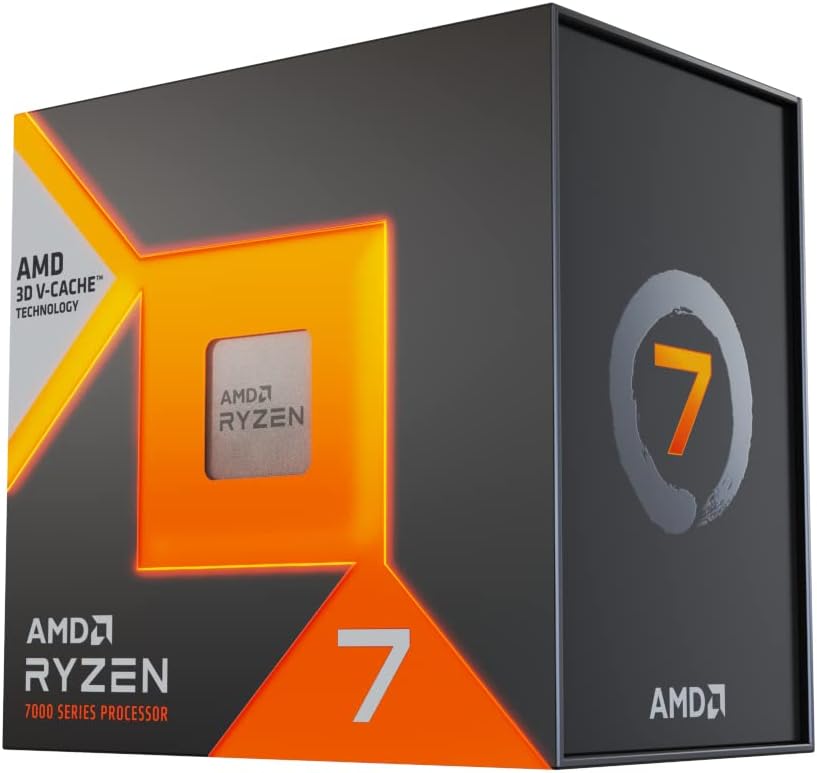
Budget Tier: Upper-Mid Retail Tier ($449 Launch MSRP) | Audited Specs: Zen 4 (Raphael) + 1st-Gen Above-CCD 3D V-Cache | Socket AM5 | 8 Cores / 16 Threads | 4.2 GHz Base / 5.0 GHz Boost | 104MB Total Cache (8MB L2 + 96MB L3) | 120W TDP / 162W PPT | 89°C TjMax | Multiplier Locked (Curve Optimizer & EXPO supported) | 24 Usable PCIe 5.0 Lanes | 2-CU Radeon iGPU.
Comparison Audit: Despite losing to Zen 5 in sustained frequencies and shader compilation, the Ryzen 7 7800X3D keeps the full 96 MB L3 cache advantage and full PCIe 5.0 routing on the upgradable AM5 platform—crushing cut-down budget parts like the 16 MB L3 Ryzen 7 8700F. Whenever deep retail discounts push it $100+ below the 9800X3D, it remains an unmatched value anchor for 1440p gaming builds.
Pros: Preserves 96 MB L3 3D V-Cache 1% Lows stability and full 24 PCIe 5.0 lanes on Socket AM5; exceptional FPS-per-dollar when discounted well below Zen 5 X3D chips.
Cons: 1st-Gen top-stacked cache caps TjMax at 89°C and locks manual overclocking; slower base clocks lag in shader compilation and productivity tasks.
3. AMD Ryzen 7 9850X3D Desktop Processor — Peak 5.6 GHz Step-Up Option

Budget Tier: $499 Launch MSRP ($400–$450 promotional tier) | Audited Specs: Zen 5 (Granite Ridge) + 2nd-Gen Under-CCD 3D V-Cache | Socket AM5 | 8 Cores / 16 Threads | 4.7 GHz Base / 5.6 GHz Max Boost | 104MB Total Cache | 120W TDP / ~162W PPT.
Comparison Audit: Released January 29, 2026 at $499 Launch MSRP—just $20 above the 9800X3D’s launch price—the Ryzen 7 9850X3D pushes boost clocks to 5.6 GHz (+400 MHz over 9800X3D, +600 MHz over 7800X3D). Always check its live Amazon listing alongside the 9800X3D: if seasonal promotions put the 9850X3D within $20–$30 of the 9800X3D, skip straight to the 9850X3D.
Pros: Highest 5.6 GHz stock pure-gaming clock on AM5 without raising 162W PPT power limits; effortless out-of-the-box peak esports headroom.
Cons: Offers minimal gains over the 9800X3D at GPU-bound 1440p/4K; poor value if retail shortages push its premium above $50.
4. GIGABYTE B850 AORUS Elite WIFI7 — Unshared-Lane AM5 Companion Board

Budget Tier: $200–$250 tier (~$230 Launch MSRP) | Audited Specs: ATX Socket AM5 (AMD B850) | 14+2+2 Digital Twin VRM (60A DrMOS) | 1x PCIe 5.0 x16 Unshared GPU Slot | 3x M.2 (1x PCIe 5.0 x4 + 2x PCIe 4.0 x4) | Wi-Fi 7 + 2.5GbE LAN | Q-Flash Plus BIOS Flashback & EZ-Latch.
Comparison Audit: Avoid overspending on $310+ X870/X870E motherboards—or getting burned by X870 boards that bifurcate your GPU slot down to x8 when multiple M.2 SSDs are installed. This AMD B850 board supports both the 7800X3D and 9800X3D natively, keeps all three M.2 drives completely free of GPU lane sharing, and supplies cool 14+2+2 VRM power for sustained PBO loads.
Pros: Zero GPU x8 lane sharing across all three M.2 slots; cool 14+2+2 60A DrMOS VRM; Wi-Fi 7, 2.5GbE LAN, and Q-Flash Plus.
Cons: Omits rear 40Gbps USB4 ports (uses 20Gbps front header and 10Gbps rear Type-C).
How We Audited This Guide
- Processors, motherboards, memory, and storage were compared by socket longevity, chipset lane allocation, VRM design, DDR5 EXPO/XMP support, and PCIe generation.
- Every specification claim was cross-checked against official OEM datasheets, platform vendor documentation, and published industry standards (PCI-SIG, JEDEC, VESA, Intel ATX) rather than marketplace listing copy.
- Recommendations were evaluated against our weighted audit rubric and documented compatibility rules; we do not publish fabricated FPS, thermal, or acoustic numbers.
Frequently Asked Questions
Should I upgrade from a Ryzen 7 7800X3D to a Ryzen 7 9800X3D?
For most 1440p and 4K gamers, no. Moving from the 7800X3D to the 9800X3D delivers poor upgrade value compared with putting that budget toward a higher-tier 16GB GPU or OLED display—unless you play competitive 1080p esports at 360Hz–540Hz with a flagship GPU and resell your 7800X3D.
How much faster is the Ryzen 7 9800X3D than the 7800X3D?
The 9800X3D combines Zen 5 architectural IPC gains with a +500 MHz higher base clock (4.7 vs. 4.2 GHz) and +200 MHz higher boost (5.2 vs. 5.0 GHz). Those upgrades lift CPU-bound 1080p framerates, 1% Lows, and shader compilation noticeably, though GPU-bound 1440p/4K games remain close.
Why does the Ryzen 7 9800X3D run cooler and allow overclocking unlike the 7800X3D?
The 7800X3D stacked 1st-Gen 3D V-Cache above the compute cores, trapping heat and forcing an 89°C TjMax cap with locked multipliers. The 9800X3D moves 2nd-Gen 3D V-Cache beneath the CCD so cores contact the heatspreader directly, restoring a 95°C TjMax and unlocking Precision Boost Overdrive.
Is the Ryzen 7 7800X3D still worth buying in 2026?
Yes—strictly when priced right. Whenever Amazon US promotions place the Ryzen 7 7800X3D at least $100 below the 9800X3D, its 96 MB L3 cache and full 24 usable PCIe 5.0 lanes make it an outstanding value anchor for $1,500–$1,800 AM5 gaming builds.
Do both the 7800X3D and 9800X3D use the same motherboard and DDR5 RAM?
Yes. Both use Socket AM5 and peak in gaming with 32GB (2x16GB) DDR5-6000 CL30 AMD EXPO memory running at a 1:1 UCLK:MCLK ratio on an unshared AMD B850 motherboard. Older B650/X670 boards require a BIOS update before dropping in a Ryzen 7 9800X3D.
Official Standards & Technical References
- AMD Ryzen Desktop Processors Family & Technical Specifications: amd.com/en/products/processors/desktops/ryzen.html
- AMD 3D V-Cache Technology Architecture Overview: amd.com/en/products/technologies/3d-v-cache
- AMD Socket AM5 Chipsets & PCIe 5.0 Platform Architecture: amd.com/en/products/processors/chipsets/am5.html
- PCI-SIG PCI Express 5.0 Interface Specifications: pcisig.com/specifications
Continue researching AM5 processors in our best gaming CPUs hub, compare clock-binned Zen 5 options in our Ryzen 7 9800X3D vs. 9850X3D matchup, study stacked SRAM gains in our AMD 2nd-Gen 3D V-Cache technical explainer, or browse all Processors & Platforms audits.


