
On This Page
Affiliate Disclosure: As an Amazon Associate, The PC Audit earns from qualifying purchases. Every hardware specification, platform comparison, and compatibility audit in this guide is verified independently without manufacturer sponsorship.
Comparing the ryzen 9 9950x3d vs core ultra 9 285k comes down to a clear architectural trade-off: maximum gaming frame-rate stability versus discounted multi-core media acceleration. AMD’s 16-core flagship pairs Zen 5 silicon with second-generation 3D V-Cache on Socket AM5 to anchor high-refresh esports and simulation titles without sacrificing 32-thread workstation speed. Intel counters on LGA 1851 with a 24-core Arrow Lake chiplet design featuring an integrated AI Boost NPU and Quick Sync media engine—and street pricing in the $350-$400 tier significantly undercuts AMD’s $550-$600 flagship bracket. Before locking in your motherboard, DDR5 memory, and cooling stack from our Best Gaming CPUs (2026) hub, audit how these two processors split across gaming, creator pipelines, and total platform cost.
TL;DR Winner Matrix: Ryzen 9 9950X3D vs. Core Ultra 9 285K
If your build splits its workload evenly between competitive gaming and heavy rendering, neither processor is strictly weak—yet each claims decisive wins in distinct technical areas.
| Evaluation Category | Declared Winner | Audit Rationale |
|---|---|---|
| Overall Hybrid Winner | AMD Ryzen 9 9950X3D | Combines peak 3D V-Cache gaming throughput with 16 Zen 5 cores (32 threads) and multi-generation AM5 longevity. |
| Raw Gaming & 1% Lows | AMD Ryzen 9 9950X3D | 144 MB of total on-die cache eliminates memory stalls in draw-call-heavy esports, MMOs, and physics simulations. |
| Media Engine & AI Acceleration | Intel Core Ultra 9 285K | Integrated Intel Quick Sync hardware encode/decode plus the SoC Tile Intel AI Boost NPU accelerate creator timelines. |
| Platform Longevity & Cooling Fit | AMD Ryzen 9 9950X3D | Socket AM5 supports CPU overclocking on value B850 boards and draws less power during gaming than 250W MTP chips. |
| Multi-Core Value for Money | Intel Core Ultra 9 285K | Street availability in the $350-$400 tier delivers 24 physical cores well below the 9950X3D’s $550-$600 tier. |
Side-by-Side Verified Hardware Specifications
All specifications below are cross-checked against official processor datasheets and the 2026 platform matrix. Pay special attention to Max Package Power (PPT and MTP) rather than base TDP when sizing power delivery and liquid cooling.
| Specification | AMD Ryzen 9 9950X3D | Intel Core Ultra 9 285K |
|---|---|---|
| Launch MSRP (USD) | $699 Launch MSRP | $589 Launch MSRP |
| Current Retail Budget Tier | $550-$600 tier | $350-$400 tier |
| Socket & Platform | Socket AM5 | LGA 1851 |
| Architecture | Zen 5 + 2nd Gen 3D V-Cache | Arrow Lake (TSMC N3B Tile Chiplet) |
| Cores / Threads | 16 Cores / 32 Threads (SMT) | 24 Cores (8P + 16E) / 24 Threads (No HT) |
| Base / Max Boost Clock | 4.3 GHz / 5.7 GHz | 3.7 GHz / 5.7 GHz |
| Total Cache (L2 + L3) | 144 MB Total Cache | 76 MB Total (36 MB Smart Cache + 40 MB L2) |
| Base TDP / Max Power | 170 W TDP / 230 W Max PPT | 125 W TDP / 250 W Max MTP |
| DDR5 Memory Sweet Spot | DDR5-6000 CL30 (1:1 UCLK:MCLK) | DDR5-6400 CL32 or CUDIMM 7200+ MT/s |
| Integrated Graphics & NPU | 2-CU Radeon Graphics (No NPU) | Intel Graphics (Quick Sync) + Intel AI Boost NPU |
| Recommended Chipset | AMD B850 / X870 / X870E (OC Unlocked) | Intel Z890 (CPU OC) / B860 (CPU OC Locked) |
Flagship Contenders Audited on Amazon US

AMD Ryzen 9 9950X3D 16-Core Processor
Category Verdict: Best Overall Hybrid Flagship | Budget Tier: $550-$600 tier ($699 Launch MSRP)
Verified Specs: Socket AM5 | 16 cores / 32 threads | 4.3 GHz base / up to 5.7 GHz boost | 144 MB total cache | 170W TDP (230W Max PPT) | 2nd Gen 3D V-Cache
Built on Zen 5 architecture with underneath-mounted second-generation 3D V-Cache, the Ryzen 9 9950X3D removes the thermal and clock-speed compromises of older dual-CCD X3D designs. It hits 5.7 GHz peak boost, supports full Precision Boost Overdrive tuning on affordable B850 boards, and avoids the gaming compromises found on non-cache chips.
Strengths
- 144 MB total cache delivers elite 1% Lows and frame pacing
- Unlocked PBO and Curve Optimizer undervolting headroom
- Multi-generation AM5 upgrade path with B850 and X870E support
- Runs smoothly on cost-effective DDR5-6000 CL30 kits
Trade-offs
- Commands a steeper $550-$600 tier price than Arrow Lake
- Basic 2-CU iGPU lacks Intel Quick Sync media acceleration
- 230W Max PPT still requires a serious dual-tower air or 360mm AIO cooler

Intel Core Ultra 9 285K Desktop Processor (Series 2)
Category Verdict: Best Value Creator Workstation CPU | Budget Tier: $350-$400 tier ($589 Launch MSRP)
Verified Specs: LGA 1851 | 24 cores (8P + 16E) / 24 threads | 3.7 GHz base / up to 5.7 GHz boost | 76 MB total cache (36 MB Smart Cache + 40 MB L2) | 125W TDP (250W Max MTP) | Integrated AI Boost NPU & iGPU
Intel’s Arrow Lake Series 2 flagship fabricates Compute, SoC, GPU, and I/O tiles on TSMC N3B while eliminating Hyper-Threading to curb idle and gaming power waste. Now discounted into the $350-$400 tier, it brings 24 physical cores, Quick Sync timeline scrubbing, and CUDIMM DDR5 bandwidth at an aggressive price-to-core ratio.
Strengths
- 24 physical cores at $350-$400 street tier undercut AMD significantly
- Quick Sync iGPU accelerates Premiere Pro and DaVinci Resolve exports
- Integrated Intel AI Boost NPU offloads local AI background tasks
- Supports high-speed DDR5-6400 and CUDIMM 7200+ MT/s memory
Trade-offs
- Trails 3D V-Cache rivals in CPU-bound 1080p/1440p gaming and 1% Lows
- LGA 1851 socket offers shorter upgrade longevity than AM5
- 250W Max MTP demands 360mm liquid cooling and Z890 for CPU overclocking
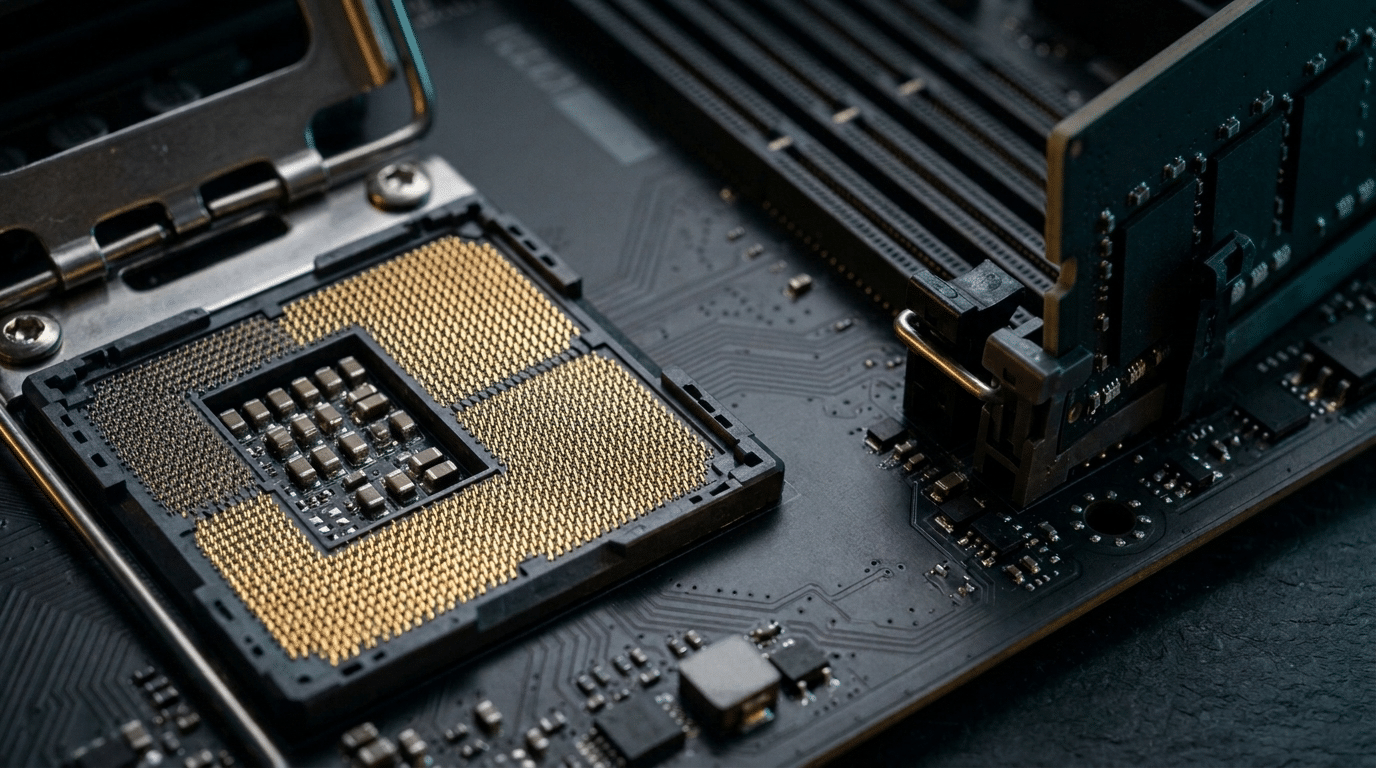
1. Silicon Architecture & Gaming Frame Pacing: 3D V-Cache vs. Arrow Lake Tiles
Modern gaming workloads depend on two bottlenecks before a graphics card draws a single pixel: game logic simulation (AI NPCs, physics, audio) and GPU draw-call preparation. When a processor stalls waiting for textures or world state from system RAM, average framerates may look acceptable while 1% Lows dip into noticeable micro-stutters during team fights or crowded open-world city hubs.
AMD solves that memory-latency bottleneck with second-generation 3D V-Cache on the Zen 5 architecture. Unlike earlier Ryzen 7000X3D chips that stacked extra L3 cache above the compute cores—insulating the cores and capping thermal boost headroom—the Ryzen 9 9950X3D places the extra cache stack underneath the CCD. Because the Zen 5 compute die now contacts the integrated heatspreader directly, thermal resistance drops dramatically. That physical layout enables up to 5.7 GHz boost clocks and full Precision Boost Overdrive (PBO) tuning alongside 144 MB of total cache, per AMD Ryzen desktop processor architecture documentation.
Intel’s Arrow Lake design takes a fundamentally different chiplet route on TSMC’s N3B process node. The Core Ultra 9 285K partitions silicon across distinct Compute, SoC, GPU, and I/O tiles while dropping Hyper-Threading so physical core count equals thread count (8 Performance cores + 16 Efficiency cores = 24 threads). Removing Hyper-Threading improves power efficiency compared to older Raptor Lake chips, yet cross-tile interconnect latency and a smaller 76 MB cache pool (36 MB Intel Smart Cache + 40 MB L2) mean the 285K accesses system DRAM more frequently during rapid game-state updates. As a result, the 9950X3D consistently sustains tighter 1% Lows in CPU-bound esports (Counter-Strike 2, Valorant), strategy sims, and MMO raids at 1080p and 1440p.
Both chips handle heavy shader compilation and asset decompression cleanly, drastically reducing traversal stutter when loading new levels. Still, buyers should ignore generic online “bottleneck percentage calculators.” No fixed bottleneck percentage exists between a CPU and GPU: pairing a fast GPU at 1080p Low is CPU-bound, whereas running Cyberpunk 2077 at 4K Ultra with Path Tracing shifts nearly 99–100% of the workload onto the graphics card, shrinking the framerate gap between these two CPUs.
2. Creator Workflows, Quick Sync & Multi-Threaded Productivity
Step outside pure gaming into video editing, 3D rendering, code compilation, and simultaneous OBS streaming, and the Core Ultra 9 285K fights back aggressively—especially given its street price drop into the $350-$400 tier. According to Intel Core Ultra Series 2 specifications, the 285K pairs high single-core IPC on its 8 P-cores with 16 capable Arrow Lake E-cores for 24-thread sustained throughput.
Intel’s decisive workflow weapon for video editors is hardware media acceleration. The Core Ultra 9 285K includes an integrated GPU tile featuring Quick Sync video engines alongside the dedicated Intel AI Boost NPU on the SoC tile. In timeline-heavy applications such as Adobe Premiere Pro and DaVinci Resolve, Quick Sync accelerates H.264, HEVC, and 4:2:2 chroma subsampling scrubbing and exports without monopolizing your discrete GPU. Note that Intel’s F and KF SKUs (such as the Core Ultra 7 265F or 265KF) strip out that integrated GPU entirely—costing you both Quick Sync acceleration and backup display output during GPU troubleshooting.
The Ryzen 9 9950X3D answers with 32 full Zen 5 threads (16 cores with SMT), holding an edge in heavily parallelized CPU renders (Blender, V-Ray, Cinebench-class compute), software builds, and simultaneous high-refresh gaming plus software encoding. Its integrated 2-CU Radeon Graphics block handles basic desktop display duties and diagnostic fallback, though creators editing multi-cam video streams will rely on their discrete GPU’s NVENC or AMD VCN hardware encoders rather than Quick Sync.
Builders evaluating Intel’s value stack should also keep an eye on Intel’s own internal lineup shift: the Q1 2026 Core Ultra 7 270K Plus packs the exact same 24C/24T (8P + 16E) core count and 76 MB total cache at a ~$289–$300 Launch MSRP with 5.5 GHz boost. That release compresses the 285K’s premium, making the 285K sensible only when its $350-$400 tier street price stays close enough to justify the extra 200 MHz peak boost ceiling.
3. Platform Longevity, Motherboard Chipsets & PCIe 5.0 Lane Routing
A processor audit never ends at the CPU box; total cost of ownership (TCO) depends heavily on motherboard pricing, PCIe 5.0 lane distribution, and future upgrade flexibility.
- Socket AM5 Runway & B850 Value: AMD’s AM5 socket supports Ryzen 7000, Ryzen 9000, and subsequent drop-in AM5 releases without swapping motherboards or memory. Even better, mainstream AMD B850 boards keep full CPU overclocking, PBO undervolting, and RAM EXPO support unlocked while mandating a PCIe 5.0 M.2 slot. Pairing the 9950X3D with a well-cooled 14+2+2 phase board from our Best AMD B850 Motherboards (2026) guide avoids unnecessary X870E premiums unless you explicitly require dual USB4 40Gbps ports.
- LGA 1851 Runway & Z890 Requirement: Intel’s LGA 1851 socket faces a shorter upgrade runway than AM5, meaning future architecture shifts are likely to demand a fresh motherboard. Furthermore, Intel’s mainstream B860 chipset locks CPU multiplier overclocking completely. Buying an unlocked Core Ultra 9 285K requires stepping up to an Intel Z890 motherboard if you want full CPU multiplier tuning and native Thunderbolt 4 / USB4 connectivity—eating into the CPU’s street-price savings.
- PCIe 5.0 Lane-Sharing Discipline: Both CPUs expose high-speed PCIe 5.0 lanes conforming to PCI-SIG PCIe 5.0 bandwidth standards. Always verify your chosen motherboard’s block diagram before installing multiple Gen 5 NVMe drives: several enthusiast boards still bifurcate the primary GPU slot from x16 down to x8 when secondary CPU-wired Gen 5 M.2 slots are populated. For pure gaming responsiveness, a DRAM-equipped PCIe 4.0 TLC SSD delivers identical real-world load speeds to Gen 5 without lane-sharing conflicts or extreme thermal armor requirements.
4. DDR5 Memory Scaling: AM5 1:1 Sweet Spot vs. Arrow Lake CUDIMM
Memory configuration separates smooth frametimes from erratic stutters across both flagship sockets, yet AMD and Intel reward very different DIMM targets.
On the Ryzen 9 9950X3D, the undisputed memory sweet spot remains DDR5-6000 CL30 (2x16GB for gaming or 2x32GB for heavy creator workloads) validated with AMD EXPO profiles. Running 6000 MT/s keeps the memory controller locked in a crisp 1:1 UCLK:MCLK ratio near 10.0ns first-word latency. Attempting to push AM5 past 6400 MT/s drops the controller into a 2:1 divider, adding latency for minimal real-world return unless manually tuned. Moreover, massive 144 MB on-die cache insulates the 9950X3D from external RAM speed differences.
The Core Ultra 9 285K behaves oppositely. Because Arrow Lake relies on a smaller 36 MB L3 Smart Cache and tile interconnects, memory bandwidth and latency matter more in both games and media timelines. Intel specifies native DDR5-6400 CL32 support and scales cleanly with CUDIMM 7200+ MT/s kits featuring an onboard clock driver (CKD), verified against G.Skill DDR5 EXPO and XMP memory validation standards. Whichever platform you choose, follow two strict hardware audit rules: never populate four DDR5 sticks if you value rated XMP/EXPO speeds (4 DIMMs force severe clock drops on both IMC designs), and never run single-channel 1x16GB or loose CL42-CL46 kits that cripple 1% Lows.
5. Power Envelopes (PPT vs. MTP) & Cooling Requirements
One of the most common build traps when comparing flagship CPUs is sizing cooling hardware to base TDP rather than sustained turbo power limits.
Although the Core Ultra 9 285K lists a modest 125W base TDP on spec sheets, its sustained all-core MTP (Maximum Turbo Power) climbs straight to 250W under rendering or compilation loads. Likewise, the Ryzen 9 9950X3D carries a 170W TDP rating and pulls up to 230W PPT (Package Power Tracking) when all 16 Zen 5 cores saturate—even though real-world gaming draws substantially less power on AMD’s 3D V-Cache silicon.
Pairing either processor with a thin 120mm liquid cooler or budget single-tower air heatsink guarantees immediate thermal throttling and aggressive fan noise. For quiet acoustic headroom and sustained 5.5–5.7 GHz boost behavior across multi-hour creator renders, budget for a proven radiator from our Best 360mm AIO Liquid Coolers (2026) audit inside a mesh-front or dual-chamber airflow case. Additionally, avoid prebuilt desktops that advertise a “Ryzen 9” or “Core Ultra 9” inside choked solid-glass front panels or throttle PL1/PL2 limits in locked OEM BIOS menus—stripping away the exact sustained wattage you paid for.
Ecosystem Alternatives Worth Auditing Before You Buy
Flagship 16-core and 24-core CPUs deliver immense headroom, yet two adjacent retail processors often deliver smarter value depending on whether your rig leans purely toward high-refresh esports or cost-efficient hybrid creation.

AMD Ryzen 7 9800X3D (Pure Gaming Sweet Spot)
Role: Pure High-Refresh Gaming Alternative | Budget Tier: $479 Launch MSRP (Enthusiast Tier)
Verified Specs: Socket AM5 | 8 Cores / 16 Threads (4.7 GHz Base / 5.2 GHz Boost) | 104 MB Total Cache (8 MB L2 + 96 MB L3) | 120W TDP / 162W Max PPT | PCIe 5.0 (24 usable lanes) | 2-CU Radeon iGPU
If your PC spends 90% of its hours in games rather than Blender or 4K video rendering, the Ryzen 7 9800X3D eliminates the second CCD of the 9950X3D—saving $220 off Launch MSRP while matching gaming framerates and staying far easier to cool at 162W Max PPT. (Competitive esports players seeking peak single-CCD clocks can also evaluate the newer Ryzen 7 9850X3D at $499 Launch MSRP.)
Strengths
- Matches 9950X3D gaming FPS with zero dual-CCD scheduling overhead
- 162W Max PPT runs cool on dual-tower air or 240mm/360mm AIO coolers
- Drops effortlessly onto value AM5 B850 boards
Trade-offs
- Half the thread count (16T vs 32T) slows heavy CPU rendering
- Lower value for dedicated multi-track video workstation builds

Intel Core Ultra 7 Desktop Processor 265K (Value Hybrid Alternative)
Role: Mid-High Hybrid Creator Alternative | Budget Tier: $300-$350 tier ($394 Launch MSRP)
Verified Specs: LGA 1851 | 20 Cores (8P + 12E) / 20 Threads | 3.9 GHz Base / up to 5.5 GHz Boost | 66 MB Total Cache (30 MB Smart Cache + 36 MB L2) | 125W TDP (250W Max MTP) | Integrated iGPU (Quick Sync) & NPU
For creator rigs watching every dollar, the Core Ultra 7 265K retains all 8 Arrow Lake P-cores, Quick Sync acceleration, and the AI Boost NPU while trimming 4 E-cores relative to the 285K. Just verify street pricing against the newer 24-core Core Ultra 7 270K Plus (~$289-$300 Launch MSRP) and discounted 285K listings before checking out.
Strengths
- Keeps Quick Sync iGPU and NPU intact (unlike F/KF variants)
- Same 8 P-cores as 285K at a lower $300-$350 street tier
- Full PCIe 5.0 and DDR5-6400+ CUDIMM support on LGA 1851
Trade-offs
- Closely challenged by Intel’s own 24-core 270K Plus refresh
- Still hits 250W MTP under sustained render loads
Decisive Verdict: Which Flagship CPU Should You Buy?
Choose AMD Ryzen 9 9950X3D If…
- You want uncompromised 1080p/1440p high-refresh gaming framerates and elite 1% Lows alongside 16-core/32-thread workstation compute.
- You value AM5 socket multi-generation upgrade longevity and want full CPU/PBO overclocking on affordable AMD B850 motherboards.
- You prefer pairing your CPU with standard, cost-effective DDR5-6000 CL30 EXPO kits without chasing expensive CUDIMM memory.
Choose Intel Core Ultra 9 285K If…
- Video editing in Premiere Pro/Resolve with hardware Quick Sync and local AI workflows on the Intel AI Boost NPU outweigh pure gaming FPS.
- You game primarily at GPU-bound 4K Ultra settings where 3D V-Cache deltas narrow, and want 24 physical cores in the $350-$400 tier.
- You are already building on Intel Z890 for Thunderbolt 4/USB4 I/O and pairing with high-speed DDR5-6400 or CUDIMM 7200+ modules.
How We Audited This Guide
- Processors, motherboards, memory, and storage were compared by socket longevity, chipset lane allocation, VRM design, DDR5 EXPO/XMP support, and PCIe generation.
- Every specification claim was cross-checked against official OEM datasheets, platform vendor documentation, and published industry standards (PCI-SIG, JEDEC, VESA, Intel ATX) rather than marketplace listing copy.
- Recommendations were evaluated against our weighted audit rubric and documented compatibility rules; we do not publish fabricated FPS, thermal, or acoustic numbers.
Frequently Asked Questions
Is the Ryzen 9 9950X3D faster than the Core Ultra 9 285K for gaming?
Yes. Thanks to 144 MB of total cache with second-generation 3D V-Cache, the Ryzen 9 9950X3D delivers higher average framerates and significantly tighter 1% Lows than the Core Ultra 9 285K, particularly in 1080p and 1440p CPU-bound esports, simulation, and open-world games.
Should video editors pick the Core Ultra 9 285K for Intel Quick Sync?
Yes, if your timeline relies heavily on H.264, HEVC, or 4:2:2 codecs inside Adobe Premiere Pro or DaVinci Resolve. The 285K includes Quick Sync media engines plus an integrated NPU, whereas the 9950X3D leaves hardware encoding to your discrete graphics card.
What DDR5 RAM speed works best for the 9950X3D vs. 285K?
Pair the Ryzen 9 9950X3D with a two-stick 32GB or 64GB DDR5-6000 CL30 EXPO kit to preserve AM5’s optimal 1:1 UCLK:MCLK ratio. The Core Ultra 9 285K targets DDR5-6400 CL32 or CUDIMM 7200+ MT/s two-DIMM kits for extra memory bandwidth.
Do both flagship CPUs require a 360mm AIO liquid cooler?
For sustained all-core creator workloads, yes. The Ryzen 9 9950X3D pulls up to 230W Max PPT and the Core Ultra 9 285K pulls 250W Max MTP—far above its 125W base TDP. A 360mm AIO prevents thermal throttling and keeps fan acoustics controlled.
Which motherboard chipset offers the smartest pairing for AM5 vs. LGA 1851?
For the Ryzen 9 9950X3D, a well-built AMD B850 board with 14+2+2 power stages unlocks full PBO tuning and PCIe 5.0 M.2 without X870E pricing bloat. For the Core Ultra 9 285K, Intel Z890 is mandatory if you want unlocked CPU overclocking, as B860 locks CPU multipliers.
Related Platform & Cooling Audits
- Best Gaming CPUs (2026): Audited Ryzen 9000X3D vs. Intel Core Ultra 200S — Full processor hierarchy across budget, midrange, and flagship tiers.
- Best AMD B850 Motherboards (2026): Sweet-Spot Boards for Ryzen 9800X3D — VRM, PCIe 5.0 lane-sharing, and Wi-Fi 7 audits for Socket AM5 builders.
- Best 360mm AIO Liquid Coolers (2026): Audited Picks for Dual-Chamber Rigs — Radiator and pump sizing for 230W PPT and 250W MTP desktop processors.


