
On This Page
Affiliate Disclosure: The PC Audit is a participant in the Amazon Services LLC Associates Program. As an Amazon Associate, we earn from qualifying purchases made through verified Amazon US links on this page at no additional cost to you.
Evaluating amd am5 vs intel lga 1851 in late 2026 comes down to far more than comparing raw processor clock speeds. Every motherboard socket locks your gaming rig into a distinct multi-year upgrade roadmap, chipset feature floor, DDR5 memory sweet spot, and thermal ceiling. AMD’s AM5 ecosystem now anchors three generations of Ryzen processors topped by 2nd Gen 3D V-Cache silicon, while Intel’s LGA 1851 platform pairs Series 2 Arrow Lake chiplet CPUs and the March 2026 Plus refresh with Z890 and B860 boards. Before choosing silicon from our Best Gaming CPUs (2026) hub, audit how total platform cost, chipset overclocking locks, and upgrade longevity separate these two sockets.
TL;DR Winner Matrix: Quick Verdict by Platform Category
Platform architecture dictates long-term value across every component bolted onto your motherboard. Based on verified socket lifespans, chipset routing rules, memory controller behavior, and power limits, each category declares an unambiguous winner below.
| Evaluation Category | Clear Winner | Decisive Platform Reason |
|---|---|---|
| Overall Platform Winner (Gaming & Value) | AMD Socket AM5 | Pairs unmatched 3D V-Cache gaming 1% Lows with unlocked B850 motherboards, affordable dual-tower air cooling, and multi-generation CPU upgradability. |
| Socket Upgrade Longevity | AMD Socket AM5 | Supports Ryzen 7000, Ryzen 9000/9000X3D, and future AM5 drops without swapping your board or DDR5 kit, whereas LGA 1851 nears the end of its lifecycle. |
| Chipset Value & Overclocking Freedom | AMD Socket AM5 (B850) | Mainstream AMD B850 boards mandate PCIe 5.0 M.2 and unlock full CPU PBO tuning, while Intel B860 locks CPU multiplier overclocking to force Z890 upgrades. |
| Multi-Core Creator Value & Media I/O | Intel Socket LGA 1851 | Aggressive Arrow Lake pricing—led by 20-core 265K and 24-core 270K Plus tiers—plus Intel Quick Sync and an integrated NPU accelerate heavy rendering and video edits. |
| Thermal Efficiency & Cooling Cost | AMD Socket AM5 | AM5 gaming CPUs top out at 88W–162W Max PPT with 2nd Gen X3D cache under the CCD, avoiding the 250W MTP cooling burden of high-core LGA 1851 chips. |
Side-by-Side Verified Platform Specification Comparison
All architectural figures below are audited directly against official AMD Ryzen Desktop Processor specifications, Intel Core Ultra Series 2 platform documentation, and PCI-SIG PCIe 5.0 specifications. Pay special attention to chipset overclocking locks and peak CPU power envelopes (PPT versus MTP), because both change your real checkout price once a motherboard and cooler enter the cart.
| Platform Attribute | AMD Socket AM5 | Intel Socket LGA 1851 |
|---|---|---|
| Active CPU Generations | Ryzen 7000, Ryzen 8000G/F, Ryzen 9000 & 9000X3D (2026) | Core Ultra 200S Arrow Lake & Core Ultra 200S Plus Refresh (2026) |
| Upgrade Runway | Multi-generation forward socket runway on 600/800 boards | Short runway; Arrow Lake Refresh marks late-cycle LGA 1851 support |
| Architecture & Process | Zen 4 / Zen 5 Chiplet + 2nd Gen 3D V-Cache (Under-CCD) | Tile-Based Chiplet (TSMC N3B Compute, SoC NPU, Xe GPU, I/O Tiles) |
| Flagship Gaming Silicon | Ryzen 7 9850X3D ($499 Launch MSRP) / 9800X3D ($479 Launch MSRP) | Core Ultra 9 285K ($589 Launch MSRP) / 270K Plus ($299 Launch MSRP) |
| Mainstream Sweet-Spot Chipset | AMD B850 ($200–$250 ATX / $150–$200 mATX tier) | Intel B860 ($140–$180 ATX / $220–$260 ITX tier) |
| Enthusiast Full-Feature Chipset | AMD X870 & Dual-Chipset X870E | Intel Z890 ($240–$280+ ATX tier) |
| CPU Overclocking Support | Unlocked on B850, X870, X870E, and B650 (PBO + Multiplier) | Z890 Only for K-Series Multiplier OC; Locked on B860 |
| DDR5 Memory Sweet Spot | 32GB (2x16GB) DDR5-6000 CL30 (1:1 UCLK:MCLK, ~10.0ns) | 32GB (2x16GB) DDR5-6400 CL32 or DDR5-7200+ CUDIMM |
| CPU PCIe 5.0 Lanes | 28 Total / 24 Usable (x16 GPU + 2×4 Direct NVMe; 16 PCIe 4.0 on 8700F) | PCIe 5.0 x16 GPU + Direct PCIe 5.0 & PCIe 4.0 NVMe Lanes |
| USB4 / Thunderbolt 4 | Mandatory on X870 & X870E; Optional on B850 | Standard TB4/USB4 on Z890; Optional on B860 |
| Peak Power Envelope | 88W Max PPT (9600X) / 162W Max PPT (9800X3D) / 230W (9950X3D) | 159W MTP (245K) / 182W MTP (265F) / 250W MTP (265K, 270K Plus, 285K) |
| Integrated Media & NPU | 2-CU Radeon iGPU (Display Fallback; omitted on 8700F) | Xe iGPU with Intel Quick Sync + AI Boost NPU (iGPU omitted on F/KF) |
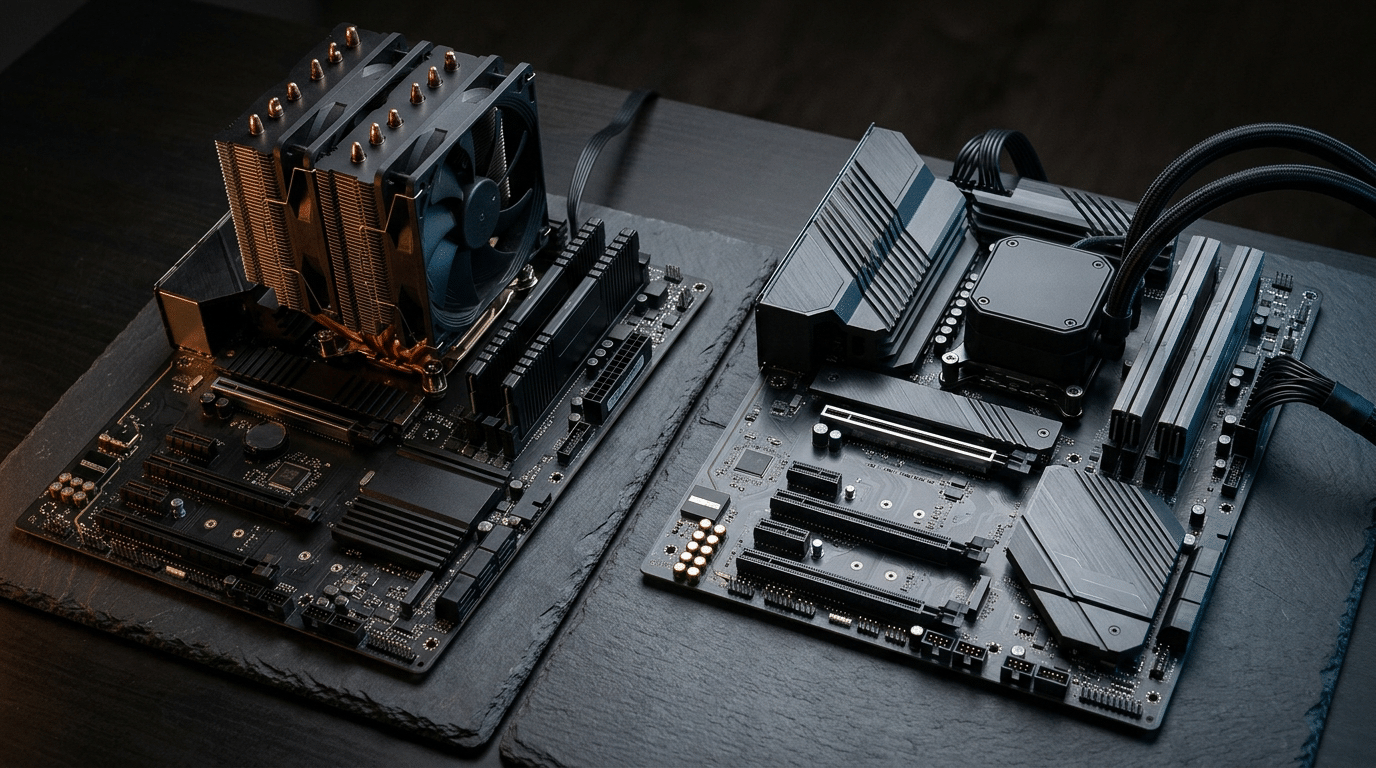
Battleground 1: Socket Lifespan & Multi-Generation Upgrade Runway
The single sharpest divide in the amd am5 vs intel lga 1851 debate is how much of your motherboard and memory investment survives your next processor upgrade. Building around a dead-end socket forces you to tear out your entire core—unplugging every front-panel header, removing coolers, reinstalling motherboards, and often troubleshooting fresh OS activation—just to gain a single architectural generation of CPU uplift.
AMD Socket AM5 delivers the longest, cleanest upgrade path in desktop gaming. Introduced alongside Zen 4 Ryzen 7000 processors, AM5 cleanly absorbed Zen 5 Ryzen 9000 chips, the Ryzen 7 9800X3D, and the January 2026 Ryzen 7 9850X3D (5.6 GHz boost, $499 Launch MSRP), with ongoing platform support across existing 600-series and 800-series motherboards. In practical buyer terms, a builder on a strict budget can purchase an entry-to-midrange AMD B850 board with a 65W AMD Ryzen 5 9600X today, pair it with 32GB of DDR5-6000 CL30 RAM, and drop a flagship X3D processor straight into that same socket two or three years down the road after a quick USB BIOS update.
Intel LGA 1851 follows a far shorter trajectory. LGA 1851 launched with Core Ultra 200S Arrow Lake processors (245K, 265K, 285K) and saw its primary milestone refresh in March 2026 with the 24-core Core Ultra 7 270K Plus ($299 Launch MSRP). Because LGA 1851 lacks a comparable multi-generation forward CPU cadence after Arrow Lake Refresh, buying into Z890 or B860 today is essentially a one-and-done platform purchase. If you buy a Core Ultra 5 245K on B860 now, upgrading in 2028 to a future architecture means replacing both CPU and motherboard.
Shoppers browsing Amazon prebuilts also run into a sneaky legacy trap here: dozens of discounted towers still ship on older Intel LGA 1700 boards (B760 paired with Core i5-14600K or Core i9-14900KF) alongside 2026 graphics cards. While LGA 1700 shares high core counts on paper, it is a discontinued predecessor to LGA 1851 with zero modern socket future—and pairing an unlocked i9-14900KF with a budget B760 board introduces VRM throttling and locked multiplier limits. Always verify the exact socket name (AM5 versus LGA 1851) before checking out.
Battleground 2: Chipset Pricing & Feature Matrix (B850 / X870E vs. B860 / Z890)
Comparing CPU sticker numbers without auditing the matching motherboard chipset distorts real-world value. Both platforms split their 800-series lineup into mainstream and enthusiast tiers, yet AMD and Intel draw the feature line in very different places.
| Chipset & Socket | Typical Street Tier | PCIe 5.0 GPU & M.2 | CPU OC & RAM OC | USB4 / Networking Floor | Best Use Case |
|---|---|---|---|---|---|
| AMD B850 (AM5) | $150–$250 tier | M.2 Mandatory; GPU Optional (Often Included) | CPU + PBO + EXPO Unlocked | Optional USB4; 2.5GbE + Wi-Fi 6E/7 Common | Sweet spot for 95% of AM5 gaming builds |
| AMD X870 (AM5) | $230–$300 tier | Both Mandatory | CPU + PBO + EXPO Unlocked | Mandatory USB4 40Gbps; Wi-Fi 7 Common | Creators needing native USB4 (check lane sharing) |
| AMD X870E (AM5) | $320–$450+ tier | Both Mandatory (Dual-Chipset) | CPU + PBO + EXPO Unlocked | Mandatory USB4; 2.5G/5GbE + Wi-Fi 7 | Max M.2 & I/O builds without lane cuts |
| Intel B860 (LGA 1851) | $140–$220 ATX ($220–$260 ITX) | PCIe 5.0 Supported (Fewer Lanes) | CPU OC Locked; RAM XMP/CUDIMM Unlocked | Optional USB4; Wi-Fi 6E/7 + 2.5GbE | Locked non-OC Intel 245K/265F value rigs |
| Intel Z890 (LGA 1851) | $240–$380+ tier | Full PCIe 5.0 GPU & M.2 Supported | Full K-Series Multiplier + RAM OC | Thunderbolt 4 / USB4 + Wi-Fi 7 Common | Mandatory for unlocked Intel K CPU tuning |
The biggest hidden catch sits inside Intel’s mainstream chipset. Value ATX boards like the ASRock B860 Steel Legend WiFi 6E and GIGABYTE B860 Gaming X WIFI6E sit nicely in the $140–$180 tier with PCIe 5.0 support, 3 to 4 M.2 slots, and Wi-Fi 6E, while compact SFF options like the ASUS ROG STRIX B860-I Gaming WiFi occupy the $220–$260 tier with Wi-Fi 7. However, Intel locks CPU multiplier overclocking completely on B860. If you buy an unlocked K-series processor—such as the Core Ultra 7 265K, 270K Plus, or 285K—and bolt it onto a B860 board, you lose CPU multiplier tuning even though XMP memory overclocking still works. Unlocking full K-series tuning pushes you onto an Intel Z890 motherboard like the ASUS TUF Gaming Z890-PLUS WiFi ($240–$280 tier), adding 4 M.2 slots, Thunderbolt 4 / USB4, and Wi-Fi 7—and erasing much of Intel’s apparent CPU savings. Explore full board picks in our Best Intel Z890 & B860 Motherboards (2026) audit.
By contrast, AMD B850 is the cleanest mainstream sweet spot on the market. Every B850 board guarantees at least one PCIe 5.0 M.2 NVMe slot, unlocked CPU multiplier and Precision Boost Overdrive (PBO) tuning, and full AMD EXPO memory overclocking—at prices that let gamers dump more budget into their GPU. Only step up to AMD X870E if you demand dual-chipset PCIe expansion and mandatory dual 40Gbps USB4 ports without tradeoffs. Notice a critical warning on single-chipset X870 boards and heavily loaded mid-range boards from partners like ASUS motherboard specifications and ASRock chipset block diagrams: populating secondary PCIe 5.0 M.2 slots can trigger PCIe lane sharing that slices your primary graphics slot from PCIe 5.0 x16 down to x8. Always audit a board’s block diagram, look for at least 12+2 VRM phases rated at 60A–80A DrMOS, confirm BIOS Flashback for drop-in CPU upgrades, verify 2.5GbE LAN and Wi-Fi 7 support, and double-check BTF back-connect chassis compatibility if building in cable-hidden cases. See our full Best AM5 Motherboards for Gaming (2026) and AMD B850 vs. X870 vs. X870E breakdowns for vetted zero-compromise layouts.
Battleground 3: Gaming Frame Rates, 3D V-Cache & Multi-Core Creator Tradeoffs
Every frame your GPU draws starts on the CPU: game-world logic, AI pathfinding, physics, spatial audio, and draw-call dispatch. When CPU cache misses stall draw calls, GPU utilization drops below 95% and frametimes spike—manifesting directly as jagged 1% Lows during crowded firefights, MMO raids, and open-world city traversal.
On Socket AM5, AMD dominates high-refresh gaming through 2nd Gen 3D V-Cache on the Zen 5 architecture. Whereas earlier Ryzen 7000X3D chips (Ryzen 7 7800X3D) placed the extra 64 MB L3 SRAM on top of the compute die—trapping heat and capping clocks—Zen 5 X3D processors like the Ryzen 7 9800X3D ($479 Launch MSRP, 5.2 GHz boost) and Ryzen 7 9850X3D ($499 Launch MSRP, 5.6 GHz boost) invert the stack. Placing the 64 MB 3D V-Cache underneath the compute CCD puts the hottest cores directly against the heat spreader, elevating effective IPC, holding higher sustained boost clocks, and unlocking full PBO tuning. With 104 MB of combined cache (96 MB L3 on 8-core X3D parts, scaling to 140 MB on the 12-core 9900X3D and 144 MB on the 16-core 9950X3D), AM5 X3D chips slash external DRAM trips and lead decisively at 1080p and 1440p high-refresh gaming.
Intel’s LGA 1851 Arrow Lake architecture trades single-die cache density for high-core productivity value. Built across disaggregated TSMC N3B compute, SoC, GPU, and I/O tiles, Series 2 chips drop Hyper-Threading so physical cores match threads (20C/20T on the 265K; 24C/24T with 8P + 16E on both the 270K Plus and 285K). Cross-tile interconnect latency and smaller 30–36 MB Smart Cache L3 pools leave LGA 1851 trailing AM5 X3D in latency-sensitive games—though at 4K Ultra with heavy ray tracing, GPU saturation narrows the gap.
Where LGA 1851 hits back hard is heavy multi-core rendering, Unreal Engine shader compilation, and video production. Intel’s March 2026 Core Ultra 7 270K Plus brings full 24-core / 76 MB silicon down to a $299 Launch MSRP, while the 20-core Core Ultra 7 265K sits comfortably in the $300–$350 tier. Both include Intel’s integrated Xe media engine with Intel Quick Sync plus the SoC AI Boost NPU, accelerating 10-bit 4:2:2 timeline scrubbing in Premiere Pro and DaVinci Resolve independently of your discrete GPU. On AM5, matching 24-thread to 32-thread creator throughput requires stepping up to the $599 Launch MSRP Ryzen 9 9900X3D or $699 Launch MSRP Ryzen 9 9950X3D—while strictly avoiding two notorious suffix traps:
- AM5 Prebuilt Trap (Ryzen 7 8700F): Frequent in budget retail towers, the 8700F cuts L3 cache down to 16 MB (24 MB total), removes the integrated GPU, and restricts usable expansion to 16 PCIe 4.0 lanes. Even so, its AM5 socket preserves an easy future upgrade path to a 9800X3D.
- Intel Suffix Trap (
FandKFSKUs): Intel’s Core Ultra 7 265F, 265KF, and 245KF disable integrated graphics entirely—stripping away Intel Quick Sync video acceleration and backup display output for GPU troubleshooting. Creators should stick strictly to non-FKor non-F Plus models.
Battleground 4: DDR5 Memory Scaling, CUDIMM & PCIe Lane Routing Traps
Both Socket AM5 and Socket LGA 1851 are strictly DDR5 platforms—DDR4 is completely off the table. Yet their memory controllers behave differently enough that buying the wrong memory kit wastes money or actively slows your 1% Lows.
Evaluating DDR5 requires calculating First Word Latency using the formula Latency (ns) = (CAS Latency × 2000) / Data Rate (MT/s). On AMD AM5, the absolute sweet spot is 32GB (2x16GB) DDR5-6000 CL30 (10.0ns latency) tuned via an AMD EXPO profile. That frequency locks AMD’s memory controller into a synchronous 1:1 UCLK ratio (UCLK = MCLK). Pushing RAM kits above 6400 MT/s forces AM5 into a 2:1 divider (UCLK = MCLK/2), adding memory latency that frequently degrades gaming framerates compared to well-timed 6000 CL30 sticks—even though you paid more for higher megatransfers.
Intel LGA 1851 scales higher without hitting that same 6000 MT/s wall. Arrow Lake’s memory controller pairs cleanly with 32GB (2x16GB) DDR5-6400 CL32 (10.0ns latency) via Intel XMP 3.0, and supports CUDIMM (Clocked Unbuffered DIMM) kits running 7200–8400+ MT/s thanks to an onboard clock driver (CKD) chip stabilizing high-frequency signaling. While enthusiast Z890 builders pushing memory-bandwidth workloads can tap CUDIMM speed, everyday gamers get far better value sticking to standard 6400 CL32 or 6000 CL30 dual-channel kits. Explore the full memory latency math in our DDR5-6000 CL30 vs. DDR5-6400 & CUDIMM comparison.
On both platforms, follow two non-negotiable rules: first, enforce the 2-DIMM rule (2x16GB for 32GB, or 2x32GB for 64GB creator rigs) in primary slots A2 and B2. Populating four DDR5 sticks stresses the integrated memory controller on both AM5 and LGA 1851, dropping stable speeds back toward 4800–5200 MT/s—and single-stick 1x16GB or loose CL42–CL46 OEM kits slash 1% Lows. Second, check DIMM heatsink height before pairing tall RGB modules with dual-tower air coolers, opting for low-profile kits (Flare X5, standard Corsair Vengeance, or Kingston Fury Beast) when using bulky air heatsinks.
Battleground 5: Full-Platform TCO, Power (PPT vs. MTP), Cooling & Storage
Sticker price on a CPU box hides two downstream costs that sway real-world Total Cost of Ownership (TCO): cooling capacity and storage balance. On thermal output, retail TDP ratings mislead builders constantly. AMD’s Ryzen 5 9600X carries a 65W base TDP (88W Max PPT), while the Ryzen 7 9800X3D lists 120W base TDP (162W Max PPT). Because Zen 5 X3D places cache beneath the core, a modest dual-tower air cooler ($35–$60 budget tier) handles full gaming and rendering loads quietly with zero thermal throttling.
Intel’s Arrow Lake desktop processors advertise a comparable 125W base TDP, yet the Core Ultra 7 265K, 270K Plus, and Core Ultra 9 285K all permit up to 250W Max Turbo Power (MTP) under sustained multi-core loads (with the 245K scaling up to 159W MTP). Even though removing Hyper-Threading and adopting TSMC N3B improved gaming power draw over 14th Gen Intel silicon, creators pushing 250W sustained workloads must budget for a heavy dual-tower air cooler or a 360mm AIO liquid cooler inside a high-airflow mesh or dual-chamber chassis—never a choked front-glass case or weak 120mm AIO. On both platforms, pair your discrete GPU with an ATX 3.1 80+ Gold power supply featuring a native 12V-2×6 cable to handle modern transient power spikes safely.
Storage economics are identical on both sockets: skip expensive, hot PCIe 5.0 x4 SSDs (12,000–14,800 MB/s) on gaming builds. Instead, slot a 2TB PCIe 4.0 x4 drive using TLC NAND and dedicated DRAM cache (7,000–7,450 MB/s, such as a WD Black SN850X or Samsung 990 Pro) under your motherboard’s built-in M.2 heatsink. Real-world game frame rates change by 0 FPS, DirectStorage loads stay virtually identical, and you keep SSD temperatures low without stealing budget from your graphics card.
| Platform Build Tier | AMD AM5 Core (CPU + Board + Cooling + RAM) | Intel LGA 1851 Core (CPU + Board + Cooling + RAM) | TCO & Value Takeaway |
|---|---|---|---|
| Entry-to-Mid Gaming Core | Ryzen 5 9600X + AMD B850 ($150–$200 tier) + Single/Dual Air Cooler + 32GB DDR5-6000 CL30 | Core Ultra 5 245K (under $200 tier) + Intel B860 ($140–$180 tier) + Dual Air Cooler + 32GB DDR5-6400 CL32 | Near-tie upfront cost, but AM5 B850 keeps CPU OC unlocked and lets you drop in an X3D CPU later. |
| Enthusiast Gaming Core | Ryzen 7 9800X3D ($479 Launch MSRP) + AMD B850 ($200–$250 tier) + Dual-Tower Air + 32GB DDR5-6000 CL30 | Core Ultra 7 265K ($300–$350 tier) + Intel Z890 ($240–$280 tier) + Dual Air / 360mm AIO + 32GB DDR5-6400 CL32 | LGA 1851 costs less upfront if skipping Z890/AIO, but AM5 dominates 1% Lows and preserves future upgrade value. |
| Hybrid Creator + Gaming Core | Ryzen 9 9950X3D ($699 Launch MSRP) + B850/X870E + 360mm AIO + 64GB DDR5-6000 CL30 | Core Ultra 7 270K Plus ($299 Launch MSRP) or 285K + Intel Z890 + 360mm AIO + 64GB DDR5-6400/7200 | LGA 1851 wins aggressive multi-core TCO per dollar when 24-core rendering and Quick Sync outrank pure esports FPS. |
Verified Amazon US Platform Contenders (2026 Catalog)
To ground this comparison in actual retail hardware, we verified four representative in-stock Amazon US components spanning both platforms: two AM5 processors demonstrating AMD’s budget-entry-to-X3D upgrade ladder, alongside Intel’s 20-core LGA 1851 workhorse and a full-featured Z890 motherboard foundation. When ordering on Amazon, always set your Condition filter strictly to New, confirm the exact CPU suffix letter (K versus KF or F) inside variant selectors, and read product titles carefully rather than relying on ambiguous sidebar filters or pooled parent reviews.

1. AMD Ryzen 5 9600X — Best Entry-to-Mid AM5 Platform Starter
Budget Tier: Budget-to-Mid AM5 Tier | Socket: AM5
Verified Specs: Zen 5 (Granite Ridge) | 6 Cores / 12 Threads (3.9 GHz Base / 5.4 GHz Boost) | 38 MB Total Cache (6 MB L2 + 32 MB L3) | PCIe 5.0 (28 Total / 24 Usable Lanes: x16 GPU + 2×4 NVMe) | 65W TDP / 88W Max PPT | 2-CU Radeon iGPU.
Platform Role: Pairs effortlessly with an affordable AMD B850 motherboard and modest air cooler today, delivering crisp 1440p gaming performance while keeping your AM5 socket open for a future flagship X3D upgrade.

2. AMD Ryzen 7 9800X3D — Best Pure Gaming AM5 Destination CPU
Budget Tier: $479 Launch MSRP (Enthusiast Tier) | Socket: AM5
Verified Specs: Zen 5 (Granite Ridge) + 2nd Gen 3D V-Cache | 8 Cores / 16 Threads (4.7 GHz Base / 5.2 GHz Boost) | 104 MB Total Cache (8 MB L2 + 96 MB L3) | PCIe 5.0 (28 Total / 24 Usable Lanes) | 120W TDP / 162W Max PPT | 2-CU Radeon iGPU.
Platform Role: Proves why AM5 longevity pays off: whether bought on day one with a B850 board or dropped in years later, 96 MB of under-CCD L3 cache delivers class-leading 1080p/1440p frame rates and 1% Lows under simple dual-tower air cooling.

3. Intel Core Ultra 7 265K — Verified 20-Core LGA 1851 Hybrid Contender
Budget Tier: $300–$350 tier (Launch MSRP: $394) | Socket: LGA 1851
Verified Specs: Arrow Lake Series 2 (TSMC N3B) | 20 Cores (8P + 12E) / 20 Threads | Up to 5.5 GHz Boost | 66 MB Total Cache (30 MB Smart Cache L3 + 36 MB L2) | 125W Base TDP / 250W Max MTP | Integrated Xe iGPU (Quick Sync) + AI Boost NPU.
Platform Role: Targets hybrid gamers and video creators who want 20 physical cores, Quick Sync acceleration, and PCIe 5.0 connectivity on LGA 1851 at a mid-range processor bracket—paired with Z890 if multiplier tuning is desired.

4. ASUS TUF Gaming Z890-PLUS WiFi — Verified LGA 1851 Z890 Platform Foundation
Budget Tier: $240–$280 tier | Socket & Chipset: LGA 1851 / Intel Z890 (ATX)
Verified Specs: ATX Form Factor | 1x PCIe 5.0 x16 GPU Slot | 4x M.2 NVMe Slots with Armor Heatsinks | Wi-Fi 7 + High-Speed Ethernet | Full Unlocked Intel K-Series CPU Multiplier & XMP/CUDIMM Memory Overclocking.
Platform Role: Eliminates B860’s CPU multiplier lock while equipping your LGA 1851 build with Wi-Fi 7, four M.2 bays, and robust VRM power delivery built to sustain 250W MTP Arrow Lake loads cleanly.
Decisive Verdict: Which Platform Should You Build On?
When weighing amd am5 vs intel lga 1851, AMD earns the clear default recommendation for pure gaming, long-term upgrade flexibility, and lower cooling overhead, while Intel LGA 1851 makes compelling tactical sense only when multi-core creator savings and Intel Quick Sync outweigh future socket upgrades.
Choose AMD Socket AM5 If…
- You want the fastest gaming frame rates and tightest 1% Lows powered by 2nd Gen 3D V-Cache silicon.
- You value multi-generation socket longevity—starting on a B850 board with a Ryzen 5 9600X and upgrading to an X3D chip later without replacing your board or RAM.
- You prefer cooler, quieter builds (88W–162W Max PPT) powered by a straightforward dual-tower air cooler.
- You want unlocked CPU PBO tuning and mandatory PCIe 5.0 M.2 storage on affordable AMD B850 motherboards paired with 32GB DDR5-6000 CL30.
Choose Intel Socket LGA 1851 If…
- You prioritize heavy rendering, compiling, and 20-to-24-core workstation throughput near mid-tier CPU pricing (Core Ultra 7 265K or 270K Plus).
- Your video editing workflow leans directly on Intel Quick Sync hardware acceleration and the integrated AI Boost NPU.
- You are comfortable buying a complete platform once without expecting future-generation CPU drop-in upgrades years later.
- You pair an unlocked K-series processor with a proper Intel Z890 board, DDR5-6400+ or CUDIMM memory, and cooling built for 250W MTP.
How We Audited This Guide
- Processors, motherboards, memory, and storage were compared by socket longevity, chipset lane allocation, VRM design, DDR5 EXPO/XMP support, and PCIe generation.
- Every specification claim was cross-checked against official OEM datasheets, platform vendor documentation, and published industry standards (PCI-SIG, JEDEC, VESA, Intel ATX) rather than marketplace listing copy.
- Recommendations were evaluated against our weighted audit rubric and documented compatibility rules; we do not publish fabricated FPS, thermal, or acoustic numbers.
Frequently Asked Questions
Does AMD AM5 have a longer upgrade path than Intel LGA 1851?
Yes, Socket AM5 offers significantly better upgrade longevity than LGA 1851. AM5 supports Ryzen 7000, Ryzen 9000, 9000X3D, and future AM5 releases on existing B850 or X870 boards, whereas LGA 1851 reaches late-lifecycle status after Intel’s Core Ultra 200S Plus refresh.
Can you overclock an Intel Core Ultra K CPU on a B860 motherboard?
No, Intel B860 motherboards lock CPU multiplier overclocking completely, even though XMP and CUDIMM memory overclocking remain unlocked. Builders buying unlocked K-series chips like the Core Ultra 7 265K or 270K Plus need an Intel Z890 motherboard for CPU tuning, whereas AMD B850 leaves CPU PBO unlocked.
What is the best DDR5 RAM speed for AM5 compared to LGA 1851?
For AMD AM5, choose a two-stick 32GB (2x16GB) DDR5-6000 CL30 EXPO kit to preserve a synchronous 1:1 memory controller ratio at roughly 10.0ns latency. For Intel LGA 1851, target 32GB (2x16GB) DDR5-6400 CL32 XMP kits, or step up to DDR5-7200+ CUDIMM on Z890.
Is Intel LGA 1851 cheaper than AMD AM5 for a complete PC build?
At the entry tier, a Core Ultra 5 245K and B860 motherboard match AM5 B850 pricing closely, while the 24-core Core Ultra 7 270K Plus ($299 Launch MSRP) beats Ryzen 9 workstation pricing. However, needing a Z890 board and 360mm AIO for 250W MTP narrows Intel’s overall TCO lead.
Should I buy an F or KF Intel CPU or Ryzen 7 8700F to save money?
Approach both carefully. Intel F and KF chips (such as the Core Ultra 7 265F) disable integrated graphics and strip out Intel Quick Sync video acceleration. Meanwhile, the AM5 Ryzen 7 8700F cuts L3 cache down to 16 MB and limits usable PCIe lanes to 16 PCIe 4.0 lanes.
Related Guides & Platform Deep Dives
- Parent Hub: Best Gaming CPUs (2026): Audited Ryzen 9000X3D vs. Intel Core Ultra 200S — Complete tier rankings across pure gaming, hybrid creation, and budget AM5 chips.
- AM5 Motherboards: Best AM5 Motherboards for Gaming (2026): B850, X870 & X870E Audited — Vetted Socket AM5 boards with clean PCIe 5.0 lane routing and strong VRMs.
- LGA 1851 Motherboards: Best Intel Z890 & B860 Motherboards (2026): Audited LGA 1851 Picks — Full chipset comparisons covering Z890 overclocking, B860 value, and Wi-Fi 7 I/O.
- AM5 Chipset Comparison: AMD B850 vs. X870 vs. X870E: Which AM5 Chipset Should Gamers Buy? — Avoid PCIe lane-sharing traps and unnecessary USB4 markups.
- DDR5 Tuning Guide: DDR5-6000 CL30 vs. DDR5-6400 & CUDIMM (2026): Latency & Platform Sweet Spots — Understand 1:1 UCLK ratios, First Word Latency, and two-DIMM stability.


