Disclosure: As an Amazon Associate, The PC Audit earns from qualifying purchases. Buying hardware through links on this page may earn us a small commission at no extra cost to you.
Picking an enthusiast gaming CPU in 2026 means looking past headline clock speeds to evaluate silicon layout and platform value. In this AMD Ryzen 7 9800X3D audit, we examine whether AMD’s $479 Launch MSRP eight-core processor stays the smartest pure gaming purchase on the AM5 socket alongside the faster-binned Ryzen 7 9850X3D and Intel’s Arrow Lake refresh.
By relocating its 64 MB 3D V-Cache tile underneath the Zen 5 compute die, the 9800X3D unlocks direct IHS contact, higher sustained clocks, and full PBO overclocking. Here is how its 104 MB cache, 162W PPT cooling envelope, and DDR5-6000 CL30 sweet spot compare across our Best Gaming CPUs (2026) hierarchy.
In This Hardware Audit
AMD Ryzen 7 9800X3D Audit Verdict & Weighted Scorecard
Evaluated across silicon architecture, thermal dissipation, and AM5 longevity, the AMD Ryzen 7 9800X3D remains our benchmark enthusiast gaming sweet spot. It solves the thermal and multiplier limits of the Ryzen 7 7800X3D while avoiding the premiums often attached to peak-binned 9850X3D or dual-CCD Ryzen 9 models.
Overall Audit Score: 9.4 / 10 — The PC Audit CPU Rubric (100% Weighted)
- Gaming Frame Rate & 1% Lows (35%): 9.8 / 10 — 104 MB cache curbs DRAM stalls and anchors frametime stability.
- Platform Longevity & PCIe I/O (25%): 9.6 / 10 — 24 usable PCIe 5.0 lanes and AM5 runway outlast LGA 1851.
- Multi-Core Creator Headroom (20%): 8.3 / 10 — 5.2 GHz Zen 5 cores handle streaming well, though 8C/16T trails 24-core CPUs.
- Power Efficiency & Thermal Behavior (20%): 9.5 / 10 — 162W PPT ceiling and direct IHS contact cool quietly on air.
Verified Strengths (Pros)
- Inverted 2nd-gen 3D V-Cache puts Zen 5 cores directly against the IHS for cooler boost sustain
- Unlocked multiplier, Precision Boost Overdrive (PBO), and Curve Optimizer tuning
- Single 8C/16T CCD eliminates dual-die core-parking scheduling issues
- Modest 162W PPT ceiling avoids the 250W MTP cooling burden of rival hybrid chips
Documented Trade-Offs (Cons)
- 8C/16T throughput trails 16- and 24-core CPUs in heavy 3D rendering
- No Intel Quick Sync hardware media engine for multi-stream timeline acceleration
- Markups above $479 Launch MSRP erase its value advantage over the 9850X3D
Buy It If: You want elite gaming responsiveness, stable 1% Lows, low-noise cooling under 162W PPT, and multi-year AM5 upgrade headroom near MSRP. Skip It If: Your workflow centers on heavy 24-thread rendering or Quick Sync editing, or if a discounted 7800X3D or closely priced 9850X3D shifts the value math.
Verified Silicon Specifications: 9800X3D vs. AM5 Siblings
Every metric below is verified against official AMD processor specifications. Placing the 9800X3D beside the 2026 Ryzen 7 9850X3D and older Ryzen 7 7800X3D clarifies which traits changed under Zen 5 and which AM5 fundamentals stayed constant.
| Specification | AMD Ryzen 7 9800X3D (Audited) | AMD Ryzen 7 9850X3D | AMD Ryzen 7 7800X3D |
|---|---|---|---|
| Architecture & Cores | Zen 5 (Single 8C / 16T CCD) | Zen 5 (Single 8C / 16T CCD) | Zen 4 (Single 8C / 16T CCD) |
| Base / Boost Clock | 4.7 GHz / 5.2 GHz | 4.7 GHz / 5.6 GHz | 4.2 GHz / 5.0 GHz |
| Total Cache (L2+L3) | 104 MB (8MB L2 + 32MB L3 + 64MB V-Cache) | 104 MB (8MB L2 + 32MB L3 + 64MB V-Cache) | 104 MB (8MB L2 + 32MB L3 + 64MB V-Cache) |
| V-Cache Placement | 2nd-Gen Stacked UNDER CCD | 2nd-Gen Stacked UNDER CCD | 1st-Gen Stacked ABOVE CCD |
| Overclocking Support | Unlocked Multiplier + PBO + CO | Unlocked Multiplier + PBO + CO | Locked Multiplier (CO only) |
| Base TDP / Max PPT | 120W TDP / 162W PPT | 120W TDP / ~162W PPT | 120W TDP / 162W PPT |
| CPU PCIe 5.0 Lanes | 24 Usable (+4 Chipset Link) | 24 Usable (+4 Chipset Link) | 24 Usable (+4 Chipset Link) |
| Memory Sweet Spot | DDR5-5600 JEDEC / DDR5-6000 CL30 1:1 | DDR5-5600 JEDEC / DDR5-6000 CL30 1:1 | DDR5-5200 JEDEC / DDR5-6000 CL30 1:1 |
| Launch MSRP Tier | $479 Launch MSRP | $499 Launch MSRP (Jan 2026) | Upper-Mid Retail Tier |
All three chips use a single 8C/16T CCD and 104 MB total cache (8 MB L2 + 32 MB base L3 + 64 MB 3D V-Cache), avoiding cross-CCD latency present on dual-CCD Ryzen 9 parts (9900X3D and 9950X3D). The 9800X3D pulls ahead of the 7800X3D via Zen 5 IPC, +200 MHz boost (+500 MHz base), unlocked tuning, and inverted stacking.
2nd-Gen Inverted 3D V-Cache, AM5 PCIe 5.0 & Cooling Architecture
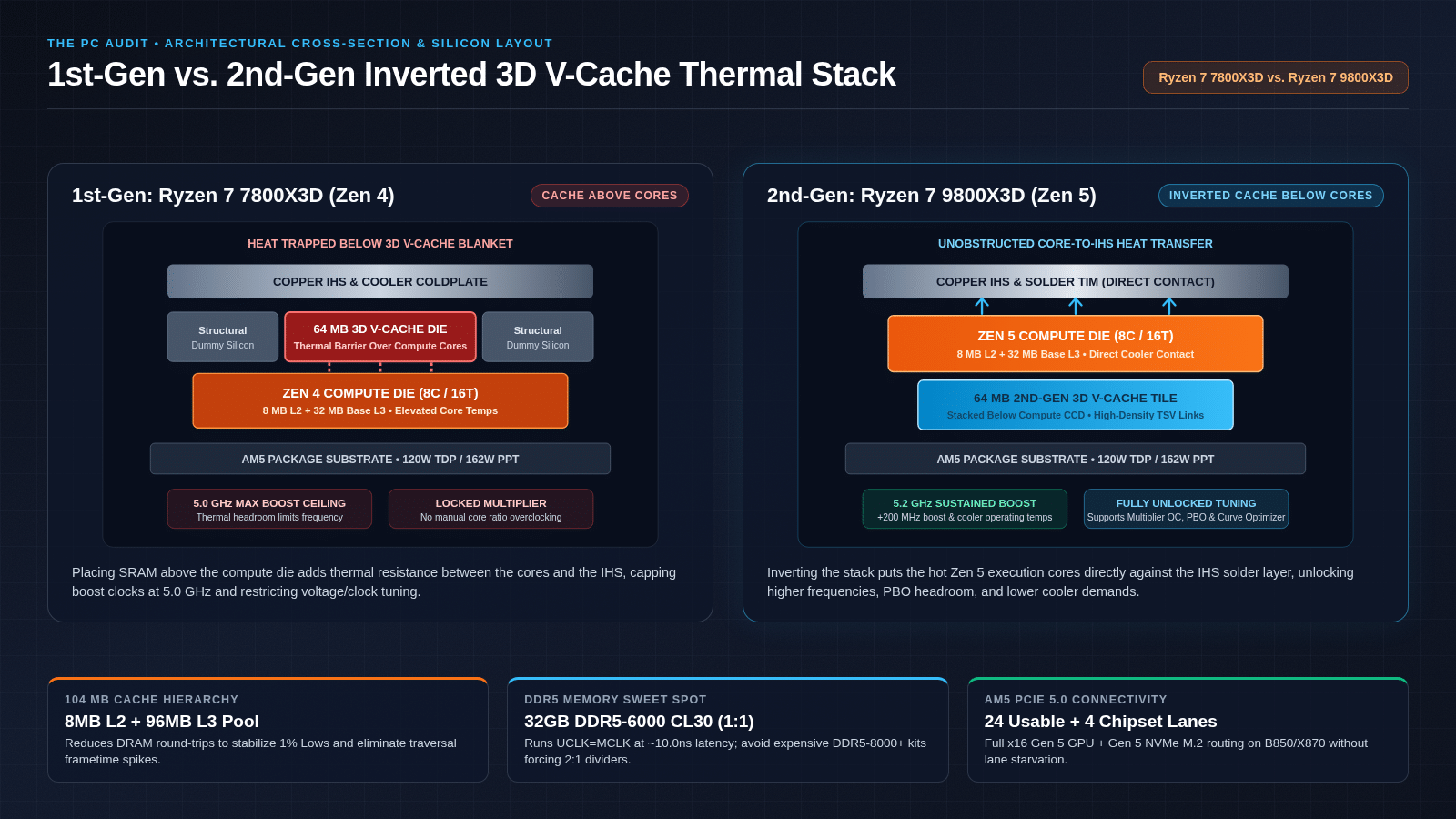
To understand why the 9800X3D clocks higher and stays cooler than first-generation X3D parts, inspect the vertical silicon stack. On the 7800X3D, AMD bonded the 64 MB SRAM tile atop the Zen 4 compute die alongside dummy silicon. Because SRAM conducts heat poorly compared to bare compute silicon, that upper cache layer insulated cores from the Integrated Heat Spreader (IHS).
For 2nd-gen 3D V-Cache, AMD placed the 64 MB cache die underneath the Zen 5 CCD, closer to the substrate and TSV links. Putting compute cores directly against the solder TIM and copper IHS restores unimpeded cooling transfer—examined further in our AMD 2nd-Gen 3D V-Cache guide.
Unlocked Clocks & Precision Boost Overdrive
Removing that thermal insulator let AMD raise base clocks to 4.7 GHz, lift boost to 5.2 GHz, and unlock the multiplier alongside Precision Boost Overdrive (PBO) and Curve Optimizer undervolting. Tuners can apply negative voltage curves to lower fan noise or sustain higher all-core clocks without hitting early thermal ceilings.
AM5 PCIe 5.0 Lanes & DDR5-6000 CL30 1:1 Memory Topology
The AM5 I/O die exposes 28 total PCIe 5.0 lanes per PCI-SIG PCI Express 5.0 specifications: 24 usable lanes for an x16 GPU slot and direct NVMe drives, plus 4 dedicated chipset lanes. Compare that to OEM Ryzen 7 8700F silicon (16 usable PCIe 4.0 lanes, 16 MB L3). An AMD B850 board secures mandatory Gen 5 M.2 routing and full overclocking without X870E price premiums unless you need USB4.
On the AM5 socket, tight timings beat raw frequency chasing. Above AMD’s DDR5-5600 JEDEC baseline, G.Skill AM5 EXPO memory profiles validate 32GB (2x16GB) DDR5-6000 CL30 as optimal because UCLK remains locked 1:1 with MCLK (~10.0ns latency). Exceeding 6400 MT/s (like DDR5-8000+ kits) forces a 2:1 divider that adds latency while 104 MB of cache already absorbs memory misses—see our DDR5-6000 CL30 vs. 6400 & CUDIMM comparison.
120W TDP vs. 162W PPT Cooling Reality
Always size cooling to peak power rather than box TDP. The 9800X3D carries a 120W base TDP and 162W PPT ceiling—far easier to cool than Intel LGA 1851 chips (Core Ultra 7 270K Plus and 285K) hitting 250W MTP. A dual-tower air cooler following Noctua thermal design guidelines or a 240mm/360mm AIO handles 162W PPT quietly; compare options in our Best CPU Coolers for Ryzen 7 9800X3D guide.
Real-World Workload Ceilings: 1080p, 1440p, 4K & Creator Tasks
Skip online “bottleneck percentage calculators.” No fixed percentage exists for any CPU-GPU pairing because bottlenecks shift continuously with game engines, ray tracing density, and monitor resolution.
- 1080p Esports & Simulation Titles: High-refresh 240Hz–540Hz gaming stresses CPU IPC and cache latency. The 9800X3D’s 96 MB L3 pool minimizes memory stalls and protects 1% Lows where non-X3D CPUs (Ryzen 7 9700X or 8700F) dip noticeably.
- 1440p Enthusiast Sweet Spot: Paired with an RTX 5070 Ti, RX 9070 XT, or RTX 5080, 1440p moves shading work onto the GPU while the 9800X3D handles BVH ray-tracing setup, asset streaming, and shader compilation without traversal hitching.
- 4K Ultra & Upscaled Rendering: Native 4K saturates the GPU near 99%, narrowing average FPS gaps versus the 9850X3D or 7800X3D. Enabling DLSS or FSR lowers internal render resolution, letting 3D V-Cache keep minimum frametimes steady.
- Creator & Multi-Core Workloads: Eight Zen 5 cores handle streaming smoothly, but heavy Blender renders or multi-stream 4K/8K edits favor 16-core Ryzen 9 9950X3D silicon or Intel Arrow Lake desktop processors like the Core Ultra 7 270K Plus (~$289–$300 Launch MSRP) and Core Ultra 9 285K ($589 Launch MSRP) featuring 24C/24T density and hardware Quick Sync engines.
Compatibility & Buyer Verification Alerts
Pre-Purchase Compatibility & Marketplace Verification Checklist:
- Avoid Scalper & Third-Party Markups: Never pay third-party premiums above the $479 Launch MSRP tier. When street pricing pushes the 9800X3D close to the $499 Launch MSRP Ryzen 7 9850X3D, step up to the 5.6 GHz bin—see our Ryzen 7 9800X3D vs. 9850X3D comparison.
- Flash AM5 AGESA BIOS Before Upgrading: Upgrading an older B650 or X670 board requires flashing a Ryzen 9000X3D AGESA firmware update before installation; use USB BIOS Flashback if no older AM5 CPU is installed.
- Skip Overpriced DDR5-8000+ & 4-DIMM Kits: Paying extra for DDR5-8000+ triggers a 2:1 divider penalty on AM5, and four DIMMs degrade stability. Run two sticks (2x16GB or 2x32GB) of DDR5-6000 CL30 EXPO memory.
- Audit Cooler & Prebuilt Listings: Size cooling to 162W PPT, skip 120mm AIOs, and confirm prebuilt 9800X3D systems explicitly include a B850/X870 board and dual-channel DDR5-6000 RAM.
AMD Ryzen 7 9800X3D Audit: Best System Pairings & Top Alternatives
Anchor the 9800X3D inside this balanced AM5 platform specification so memory latency, PCIe routing, and cooler sizing never limit its silicon gains.
| Component | Audited Sweet-Spot Pairing | Engineering Rationale |
|---|---|---|
| Motherboard | AMD B850 (12+2 60A+ DrMOS VRM) | Mandates PCIe 5.0 M.2, PBO/EXPO tuning, and BIOS Flashback without X870E bloat. |
| Memory (RAM) | 32GB (2x16GB) DDR5-6000 CL30 EXPO | Locks UCLK=MCLK at 1:1 (~10.0ns latency) with clean 2-DIMM stability. |
| CPU Cooler | Dual-Tower Air or 240mm/360mm AIO | Tames 162W PPT quietly; verify dual-tower front fan clearance over RAM. |
| NVMe SSD | 2TB PCIe 4.0 DRAM + TLC Drive | Matches Gen 5 game loads with cooler thermals and double the capacity per dollar. |
| Power Supply | 750W–1000W ATX 3.1 (80+ Gold) | Native 12V-2×6 handles RTX 5070/RX 9070 XT (750W–850W) or RTX 5080 (1000W). |
1. AMD Ryzen 7 9800X3D — Audited Gaming Sweet Spot

Specs: 8C/16T Zen 5 | 4.7 / 5.2 GHz | 104 MB L2+L3 | 120W TDP / 162W PPT | AM5 | Tier: $479 Launch MSRP (Enthusiast Tier)
The 9800X3D remains our primary recommendation for dedicated gaming rigs. Relocating 2nd-gen 3D V-Cache below the Zen 5 CCD eliminates the 7800X3D’s thermal barrier, adding +200 MHz boost and unlocked PBO tuning while undercutting the 9850X3D’s top bin near Launch MSRP.
Pros
- Direct CCD-to-IHS cooling supports quiet fan curves
- Unlocked multiplier and Curve Optimizer tuning on B850 boards
- Top-tier 1% Lows without dual-CCD scheduling complications
Cons
- 8C/16T trails Ryzen 9 and Arrow Lake in heavy rendering
- Poor value if resellers push above $479 Launch MSRP
Verdict: Buy it near Launch MSRP for top gaming frametimes and cool acoustics. Skip it if the 9850X3D sits at a tiny premium.
2. AMD Ryzen 7 9850X3D Desktop Processor — Peak Pure Gaming Bin

Specs: 8C/16T Zen 5 | 4.7 / 5.6 GHz | 104 MB L2+L3 | 120W TDP / ~162W PPT | AM5 | Tier: $400-$450 tier ($499 Launch MSRP)
Launched in January 2026 at $499 Launch MSRP, the 9850X3D pushes identical 2nd-gen 3D V-Cache silicon to 5.6 GHz (+400 MHz over the 9800X3D). When Amazon promotions land in the $400-$450 tier or tight against the 9800X3D, it becomes the superior 1080p/1440p high-refresh buy.
Pros
- 5.6 GHz boost leads AM5 pure-gaming clock ceilings
- Identical ~162W PPT envelope and inverted thermal stack
- Strongest pick whenever discounted into the $400-$450 tier
Cons
- Slim margin over 9800X3D in GPU-bound 4K titles
- Same 8C/16T ceiling for heavy workstation rendering
Verdict: Buy it if promotions narrow the gap to the 9800X3D or you run 360Hz–540Hz esports panels. Skip it if paying extra cuts GPU budget.
3. AMD Ryzen 7 7800X3D 8-Core Desktop Processor — Previous-Gen X3D Value
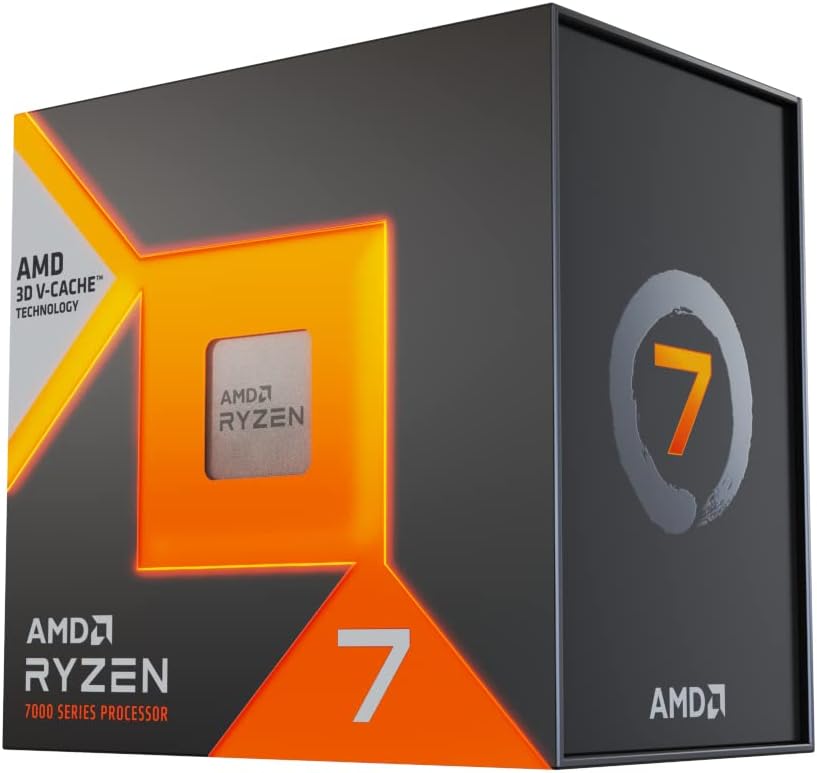
Specs: 8C/16T Zen 4 | 4.2 / 5.0 GHz | 104 MB L2+L3 | 120W TDP / 162W PPT | AM5 | Tier: Upper-Mid Retail Tier
Built on Zen 4 with 1st-gen cache stacked above the cores, the 7800X3D tops out at 5.0 GHz with a locked multiplier. Still, its 104 MB cache and AM5 PCIe 5.0 support make it a smart Upper-Mid Retail Tier bargain if savings fund a stronger GPU.
Pros
- 96 MB L3 V-Cache beats non-X3D chips in 1% Lows
- Drops into B850 boards with DDR5-6000 CL30 memory
- High value-per-frame when discounted below the 9800X3D
Cons
- Top-stacked SRAM raises temps and locks multipliers at 5.0 GHz
- Trails 9800X3D in single-thread Zen 5 IPC and creator speed
Verdict: Buy it during steep Upper-Mid Retail Tier discounts to fund an RX 9070 XT or RTX 5070 Ti upgrade. Skip it near 9800X3D pricing.
4. AMD Ryzen 7 9700X 8-Core, 16-Thread Unlocked Desktop Processor — 65W Efficiency Pick

Specs: 8C/16T Zen 5 | 3.8 / 5.5 GHz | 40 MB Cache (32MB L3) | 65W Default TDP | AM5 | Tier: $250-$300 tier
For mid-range 1440p builds using an RTX 5070 or RX 9070, X3D CPU spending can squeeze graphics budgets. In the $250-$300 tier, the Ryzen 7 9700X pairs 65W efficiency with full 32 MB L3 cache and 24 PCIe 5.0 lanes—far cleaner than the crippled OEM Ryzen 7 8700F.
Pros
- Quiet 65W TDP keeps cooler costs minimal
- Frees budget for 1440p GPUs on an upgradable AM5 socket
- Full PCIe 5.0 lanes and 32 MB L3 beat OEM 8700F specs
Cons
- Lacks 64 MB 3D V-Cache, trailing X3D CPUs in 1% Lows
- Trails Core Ultra 7 270K Plus in multi-core creator work
Verdict: Buy it under $300 to maximize GPU spending at 1440p while keeping AM5 drop-in upgrades open. Skip it if esports 1% Lows come first.
How We Audited This Guide
- Processors, motherboards, memory, and storage were compared by socket longevity, chipset lane allocation, VRM design, DDR5 EXPO/XMP support, and PCIe generation.
- Every specification claim was cross-checked against official OEM datasheets, platform vendor documentation, and published industry standards (PCI-SIG, JEDEC, VESA, Intel ATX) rather than marketplace listing copy.
- Recommendations were evaluated against our weighted audit rubric and documented compatibility rules; we do not publish fabricated FPS, thermal, or acoustic numbers.
Frequently Asked Questions About the Ryzen 7 9800X3D
Is the Ryzen 7 9800X3D still worth buying over the Ryzen 7 9850X3D?
Yes, whenever street pricing clearly favors the 9800X3D. Both share identical 8C/16T Zen 5 silicon, 104 MB cache, and ~162W PPT power limits. The 9850X3D adds +400 MHz peak boost (5.6 GHz), so pick the 9850X3D only when retail pricing sits very close.
Do I need a 360mm AIO liquid cooler for the Ryzen 7 9800X3D?
No, a dual-tower air cooler handles it effortlessly. Relocating 2nd-gen 3D V-Cache beneath the CCD puts cores directly against the IHS, keeping 162W PPT thermals manageable on quality dual-tower air coolers or 240mm/360mm AIOs; avoid weak 120mm AIOs.
What RAM speed works best with the Ryzen 7 9800X3D?
Two sticks of 32GB (2x16GB) DDR5-6000 CL30 EXPO are optimal. That speed locks the AM5 controller at a 1:1 UCLK=MCLK ratio (~10.0ns latency). Expensive DDR5-8000+ kits trigger a 2:1 divider penalty, while four DIMMs lower stability.
Can I install a Ryzen 7 9800X3D on an older B650 motherboard?
Yes, after updating the motherboard BIOS first. Older B650 boards need a Zen 5 / 9800X3D AGESA firmware update before first POST via USB BIOS Flashback. For fresh builds, AMD B850 guarantees native support and mandatory PCIe 5.0 M.2 lanes.
Should heavy video creators buy the 9800X3D or an Intel Core Ultra / Ryzen 9 X3D?
Heavy creators should step up in core count or Quick Sync support. Eight Zen 5 cores handle streaming smoothly, but heavy 3D rendering and 4K/8K timelines favor the 16-core Ryzen 9 9950X3D or 24-core Intel Core Ultra 7 270K Plus and 285K.
Final Verdict from This AMD Ryzen 7 9800X3D Audit
Concluding our AMD Ryzen 7 9800X3D audit, inverting 2nd-gen 3D V-Cache beneath the Zen 5 CCD turns a specialized cache chip into a thoroughly balanced gaming CPU. Direct IHS contact sustains 5.2 GHz boosts and unlocked PBO tuning inside an easy-to-cool 162W PPT ceiling while 104 MB cache protects 1% Lows. Paired with an AMD B850 board and 32GB DDR5-6000 CL30 memory near its $479 Launch MSRP tier, it remains our top AM5 gaming pick in our Best Gaming CPUs guide.


