
Disclosure: As an Amazon Associate, The PC Audit earns from qualifying purchases. If you buy through links on this page, we may earn a small commission at no extra cost to you.
Settling the ryzen 7 9800x3d vs 9850x3d decision puts high-refresh PC builders face to face with one of the tightest intra-generational matchups on Socket AM5. Both processors share the exact same 8-core, 16-thread Zen 5 compute die, identical 104 MB total cache with 96 MB of 2nd-Generation 3D V-Cache, and the same 120W TDP / 162W PPT power envelope—differing solely by a 400 MHz peak boost ceiling (5.2 GHz vs. 5.6 GHz) and a modest $20 Launch MSRP gap ($479 vs. $499).
Positioned at the top of our broader best gaming CPUs for 2026 guide, both Ryzen 7 X3D chips dominate esports and demanding single-CCD gaming workloads. To determine when that extra 400 MHz boost justifies spending more—and when street discounts flip the verdict—this head-to-head audit evaluates both processors against our 100-point CPU rubric: Gaming Frame Rate & 1% Lows (35%), Platform Longevity & PCIe I/O (25%), Multi-Core Creator Headroom (20%), and Power Efficiency & Thermal Behavior (20%).
In This Comparison
- TL;DR Winner Matrix: Quick Verdict
- Side-by-Side Verified Spec Table
- Battleground 1: Gaming Frame Rate, +400 MHz Boost Math & 1% Lows (35%)
- Battleground 2: 2nd-Gen 3D V-Cache Thermals, PBO Tuning & Cooler Sizing (20%)
- Battleground 3: AM5 Platform Runway, PCIe 5.0 Lanes & DDR5-6000 CL30 (25%)
- Battleground 4: Creator Headroom, Shader Compilation & 2026 Alternatives (20%)
- Battleground 5: Street Pricing Economics & GPU Budget Allocation
- Decisive Verdict: Which AM5 X3D Processor Should You Buy?
- Audited Retail Picks & AM5 Platform Pairings on Amazon US
- Frequently Asked Questions
TL;DR Winner Matrix: Quick Verdict
Because both processors share identical core counts, Zen 5 IPC, and 96 MB of stacked L3 cache, neither chip renders the other obsolete. Still, clear category winners emerge depending on whether you run stock settings at high refresh rates or prioritize price-to-performance discipline.
| Evaluation Category | Declared Winner | Decisive Technical Reason |
|---|---|---|
| Overall Gaming Value & Sweet Spot | AMD Ryzen 7 9800X3D | Matches 104 MB total cache and unlocked PBO tuning at $479 Launch MSRP, allowing enthusiast builders to recover much of the clock delta without paying a premium when street discounts widen. |
| Peak Pure Gaming Speed (Out of Box) | AMD Ryzen 7 9850X3D | Factory-binned to reach 5.6 GHz (+400 MHz / +7.7% boost ceiling), holding a decisive frequency edge in lightly threaded 1080p esports and simulation loops without manual tuning. |
| 1% Lows & Frametime Consistency | Tie (9850X3D Edge at Stock) | Both rely on the same 96 MB 2nd-Gen 3D V-Cache to crush DRAM latency spikes; the 9850X3D nudges ahead slightly only in strictly CPU-bound single-thread bottlenecks. |
| Power Efficiency & Cooling Simplicity | Tie (120W TDP / 162W PPT) | Identical 120W base TDP, 162W PPT ceiling, and 95°C TjMax mean both chips cool quietly on quality dual-tower air coolers or 240mm/360mm AIOs—vastly cooler than 250W MTP competitors. |
| Creator Productivity & Multi-Thread | AMD Ryzen 7 9850X3D | Shared 8C/16T count caps heavy rendering relative to 12–24 core chips, yet higher sustained Zen 5 boost clocks give the 9850X3D slightly snappier shader compilation and code builds. |
Side-by-Side Verified Spec Table
Examining the official AMD Ryzen Desktop Processor specifications confirms how closely related these two Granite Ridge SKUs truly are. Every architectural block—compute cores, cache geometry, I/O die, integrated graphics, and power limits—stays constant except the upper Precision Boost ceiling and release timeline.
| Verified Hardware Specification | AMD Ryzen 7 9800X3D | AMD Ryzen 7 9850X3D |
|---|---|---|
| Release Window | November 2024 | January 29, 2026 |
| Launch MSRP | $479 | $499 |
| CPU Architecture & Process | Zen 5 (Granite Ridge), TSMC 4nm CCD / 6nm IOD | Zen 5 (Granite Ridge), TSMC 4nm CCD / 6nm IOD |
| Platform Socket | Socket AM5 (LGA 1718) | Socket AM5 (LGA 1718) |
| Cores / Threads (SMT) | 8 Cores / 16 Threads (Yes) | 8 Cores / 16 Threads (Yes) |
| Base / Max Boost Clock | 4.7 GHz Base / 5.2 GHz Boost | 4.7 GHz Base / 5.6 GHz Boost (+400 MHz) |
| Cache Hierarchy (L1 / L2 / L3) | 640 KB L1 / 8 MB L2 / 96 MB L3 (104 MB Total) | 640 KB L1 / 8 MB L2 / 96 MB L3 (104 MB Total) |
| 3D V-Cache Topology | 2nd-Gen Under-CCD Vertical Stacking | 2nd-Gen Under-CCD Vertical Stacking |
| Default TDP / Max Socket Power (PPT) | 120W TDP / 162W PPT | 120W TDP / ~162W PPT |
| Max Operating Temp (TjMax) | 95°C | 95°C |
| Multiplier & PBO Tuning | Fully Unlocked (PBO + Curve Optimizer + EXPO) | Fully Unlocked (PBO + Curve Optimizer + EXPO) |
| Memory Support & Sweet Spot | Dual-Channel DDR5-5600 JEDEC (DDR5-6000 CL30 1:1 Optimal) | Dual-Channel DDR5-5600 JEDEC (DDR5-6000 CL30 1:1 Optimal) |
| PCIe 5.0 Lanes (Total / Usable) | 28 Total / 24 Usable (x16 GPU + 2×4 NVMe) | 28 Total / 24 Usable (x16 GPU + 2×4 NVMe) |
| Integrated Graphics | AMD Radeon Graphics (2 CUs, diagnostic display ready) | AMD Radeon Graphics (2 CUs, diagnostic display ready) |
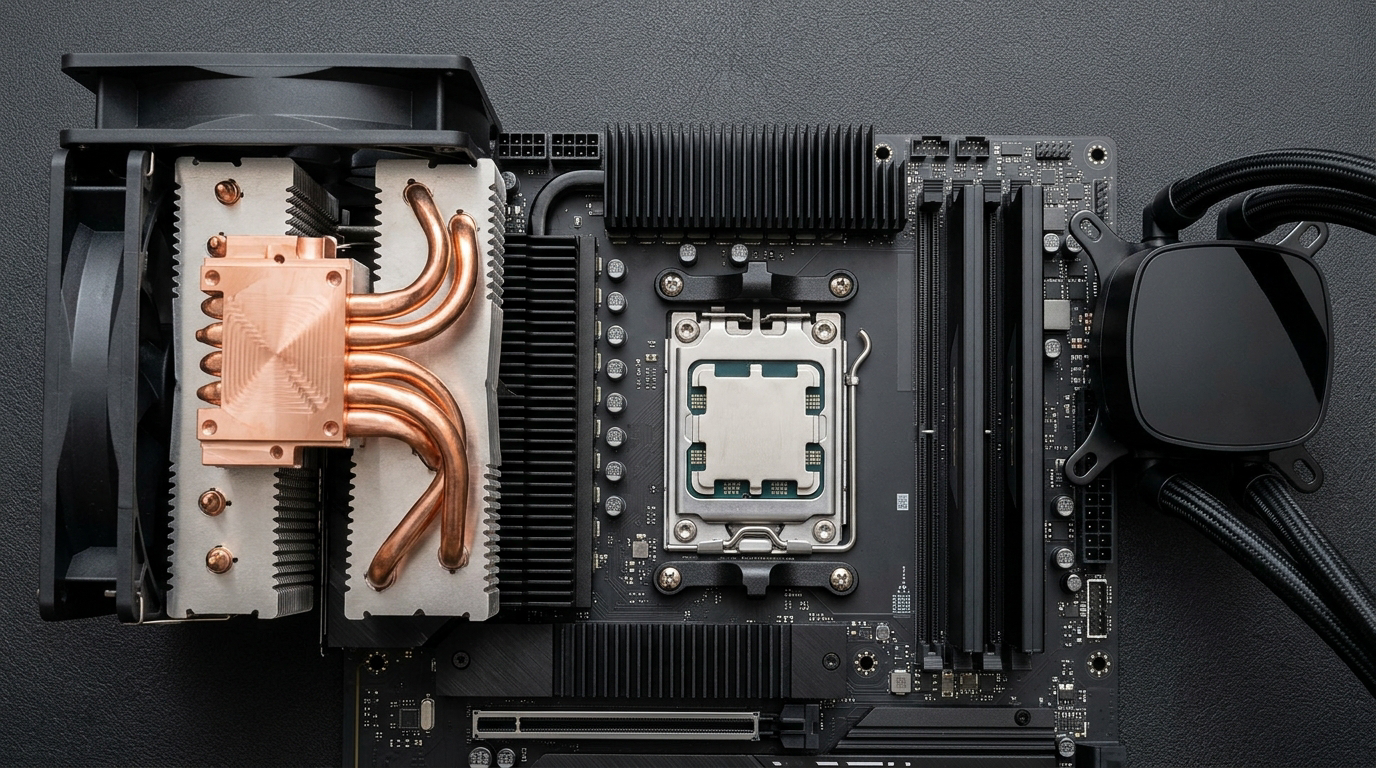
Battleground 1: Gaming Frame Rate, +400 MHz Boost Math & 1% Lows (35%)
Evaluating the ryzen 7 9800x3d vs 9850x3d in pure gaming starts with simple arithmetic. Moving from a 5.2 GHz maximum boost clock to 5.6 GHz raises the theoretical frequency ceiling by exactly 7.69% while keeping identical Zen 5 instructions-per-clock (IPC), identical 4.7 GHz base clocks, and identical 96 MB of L3 cache. In real game engines, however, frame rate rarely scales linearly with peak CPU frequency because render time splits between CPU draw-call preparation and GPU pixel shading.
Where does that extra 400 MHz actually show up? Look specifically at extreme CPU-bound scenarios paired with a flagship GPU (such as an RTX 5080 or RTX 5090) driving 1080p competitive shooters on 360Hz to 540Hz OLED panels, simulation titles with heavy AI pathing, or physics-dense MMO hubs. When GPU utilization drops into the 55% to 80% range without an active frame cap, single-thread and light-thread game loops gain directly from the Ryzen 7 9850X3D’s higher 5.6 GHz boost bin—pushing peak ceiling frames higher and subtly lifting 1% Lows during chaotic particle bursts.
Flip the scenario to 1440p Ultra or 4K gaming with hardware ray tracing enabled—the sweet spot for GPUs like the RTX 5070 Ti, Radeon RX 9070 XT, or RTX 5080—and the equation collapses toward parity. Once your graphics card sits pinned at 95% to 100% GPU utilization, neither the 5.2 GHz 9800X3D nor the 5.6 GHz 9850X3D dictates average frame rates; your GPU pixel throughput and VRAM capacity do. At those resolutions, the decisive gaming hero inside both chips is the shared 96 MB of L3 AMD 3D V-Cache technology, which eliminates massive amounts of slow system-RAM round trips so frametime graphs stay remarkably flat.
If you prefer buying a turnkey system rather than assembling parts yourself, pay attention to prebuilt integration traps too. Our roundup of the best Ryzen 7 9800X3D prebuilt gaming PCs highlights how system builders frequently pair X3D chips with slow single-stick RAM or restrictive BIOS power curves that erase far more performance than a 400 MHz bin difference ever creates.
Battleground 2: 2nd-Gen 3D V-Cache Thermals, PBO Tuning & Cooler Sizing (20%)
Older 1st-Generation X3D processors (like the Ryzen 7 7800X3D) stacked the extra 64 MB SRAM tile directly on top of the CPU cores, acting as an insulating thermal blanket that forced lower boost clocks and locked manual voltage/frequency multipliers. On both the Ryzen 7 9800X3D and Ryzen 7 9850X3D, AMD inverted that physical geometry by placing the 2nd-Generation 3D V-Cache die underneath the TSMC 4nm Zen 5 CCD.
That structural shift changes two critical behaviors for PC builders:
- Direct Heat Transfer to the IHS: Because the hottest Zen 5 execution cores now sit directly beneath the nickel-plated integrated heatspreader, heat exits rapidly into your cooler coldplate before approaching the 95°C TjMax limit.
- Unlocked Precision Boost Overdrive (PBO): Both processors support full multiplier adjustments, Curve Optimizer negative voltage offsets, and +200 MHz Boost Override inside BIOS or Ryzen Master—turning silicon lottery into a central factor in this comparison.
Here is the enthusiast insight buyers need to hear: an unlocked Ryzen 7 9800X3D tuned with a conservative Curve Optimizer undervolt (-15 to -25 all-core) and +200 MHz PBO Override routinely targets ~5.4 GHz—cutting the stock 400 MHz deficit to the 9850X3D roughly in half without raising socket power above its 162W PPT ceiling. Conversely, the Ryzen 7 9850X3D gives builders higher factory-binned silicon guaranteed to reach 5.6 GHz out of the box with zero BIOS tweaking, plus slightly higher absolute ceiling potential if you apply PBO tuning to the 9850X3D itself.
Crucially, never judge CPU cooling requirements by base TDP alone. While Intel’s competing Arrow Lake processors advertise a 125W base TDP while pulling up to 250W MTP under full multi-core stress, both the 9800X3D and 9850X3D share a modest 162W PPT ceiling—and pull dramatically less wattage during typical gaming loops. Always size your heatsink to handle sustained 162W loads quietly: skip weak 120mm single-fan AIOs and stock-style downdraft coolers, and select either a high-density dual-tower air cooler or a 240mm/360mm AIO. Review specific heatsink fits and RAM offset measurements in our dedicated best CPU coolers for Ryzen 7 9800X3D and 9850X3D guide.
Battleground 3: AM5 Platform Runway, PCIe 5.0 Lanes & DDR5-6000 CL30 (25%)
Both processors plug directly into AMD’s AM5 socket, tying this comparison into platform longevity and total cost of ownership (TCO). Unlike Intel’s competing LGA 1851 ecosystem—home to Arrow Lake desktop chips such as the Core Ultra 7 270K Plus and Core Ultra 9 285K—Socket AM5 maintains multi-generation upgrade compatibility from Ryzen 7000 through Ryzen 9000X3D and upcoming AM5 revisions on a single motherboard.
PCIe connectivity is identical between the 9800X3D and 9850X3D. According to the AMD Socket AM5 platform architecture and PCI-SIG PCIe 5.0 specifications, each processor provides 28 total PCIe 5.0 lanes (24 usable): x16 dedicated directly to your primary graphics slot plus two x4 links for CPU-attached NVMe SSDs or USB4 controllers. That stands in stark contrast to stripped-down OEM chips like the Ryzen 7 8700F, which carries only 16 MB of L3 cache and 16 usable PCIe 4.0 lanes—a bottleneck detailed in our Ryzen 7 8700F vs. Ryzen 7 9800X3D hardware audit.
Avoid two expensive platform traps when pairing either CPU with memory and a motherboard:
- Memory Sweet Spot — Stick to 2x16GB DDR5-6000 CL30: While AMD rates both chips for DDR5-5600 officially, running a dual-channel 32GB (2x16GB) DDR5-6000 CL30 kit with AMD EXPO keeps the memory controller locked in a 1:1 UCLK:MCLK ratio (~10.0ns first-word latency). Pushing above 6400 MT/s typically forces a 2:1 divider latency penalty, and populating four DIMM slots forces steep frequency downclocking. Note that X3D cache masks slow memory better than non-X3D chips, yet single-stick 1x16GB or loose CL42-46 prebuilt kits still damage 1% Lows.
- Motherboard Selection — Choose Unshared B850 Over Lane-Splitting X870: For 95% of gaming builds, an AMD B850 board with at least a 12+2 stage (60A+ DrMOS) VRM, BIOS Flashback, and mandatory PCIe 5.0 M.2 support delivers identical CPU boost behavior to flagship X870E boards. Even better, well-engineered B850 boards like the GIGABYTE B850 AORUS Elite WIFI7 avoid the PCIe lane-sharing compromises seen on many mid-tier X870 boards (such as the ASUS TUF Gaming X870-PLUS WiFi, where populating M.2_2 drops the primary PCIe 5.0 x16 GPU slot to x8 to feed USB4 controllers). Compare full chipset routing in our AMD B850 vs. X870 vs. X870E chipset guide.
Battleground 4: Creator Headroom, Shader Compilation & 2026 Alternatives (20%)
Neither the Ryzen 7 9800X3D nor the Ryzen 7 9850X3D pretends to be a workstation powerhouse. Eight Zen 5 cores and 16 threads fly through daily multitasking, Discord, OBS capture via GPU hardware encoders, and initial game shader compilation—where the 9850X3D’s +400 MHz ceiling trims a small percentage off sustained multi-thread loads when thermal headroom holds. Both chips also include integrated 2-CU AMD Radeon graphics, giving builders essential display diagnostics if a discrete GPU ever needs troubleshooting.
Still, if your desktop splits time evenly between competitive gaming and heavy Blender rendering, 4K multi-stream video timelines, or large software builds, evaluate three wider 2026 alternatives before locking in an 8-core X3D chip:
- Heavy Creators Demanding X3D Gaming — AMD Ryzen 9 9950X3D ($699 Launch MSRP): Doubles core count to 16C/32T with 144 MB total cache and a 5.7 GHz max boost (170W TDP / 230W PPT), delivering flagship workstation throughput without sacrificing single-CCD X3D gaming frame rates. (Its 12-core sibling, the Ryzen 9 9900X3D at $599 Launch MSRP, suits mixed gaming/streaming if budget sits shy of the 9950X3D.)
- Multi-Core Value & Video Editing — Intel Core Ultra 7 270K Plus (~$289–$300 Launch MSRP) & Core Ultra 9 285K ($589 Launch MSRP): Offering 24 cores / 24 threads (8P + 16E), CUDIMM DDR5-7200+ memory support, and Intel Quick Sync media acceleration on non-F/KF models, these Arrow Lake processors deliver tremendous multi-core value for Premiere Pro timelines. However, they fall behind Ryzen X3D in pure gaming frame rates, draw up to 250W MTP under sustained creator loads, and sit on the shorter-runway LGA 1851 socket.
- Budget-Conscious AM5 Gamers — Ryzen 7 7800X3D & Ryzen 5 9600X: If you game at 1440p or 4K with an upper-mid GPU and street pricing pushes both 9000X3D chips far above Launch MSRP, dropping down to the previous-gen Zen 4 Ryzen 7 7800X3D preserves 96 MB of 3D V-Cache on the exact same AM5 motherboard, while the 65W Ryzen 5 9600X serves as a crisp entry point ready for a future X3D swap.
Battleground 5: Street Pricing Economics & GPU Budget Allocation
On paper, AMD priced these processors almost identically: $479 Launch MSRP for the Ryzen 7 9800X3D versus $499 Launch MSRP for the Ryzen 7 9850X3D. Paying $20 extra (~4.2%) for a +7.7% boost clock bump (400 MHz) and guaranteed higher-binned silicon makes straightforward financial sense when both chips sell near Launch MSRP—or even better, during Amazon US promotional cycles that bring the Ryzen 7 9850X3D down into the $400–$450 retail tier.
Where buyers go wrong is treating Launch MSRP as static. Supply cycles frequently widen the retail gap between the older 9800X3D and newer 9850X3D into a $50 to $90 spread—or push total CPU spend too high relative to the graphics card. Apply two strict allocation rules before clicking buy:
- The $30 Parity Threshold: Whenever live Amazon US pricing puts the Ryzen 7 9850X3D within $20–$30 of the Ryzen 7 9800X3D (or drops it inside the same $400–$450 tier), buy the 9850X3D immediately. You lock in the 5.6 GHz boost ceiling with zero manual tuning.
- The GPU-First Allocation Rule: If the Ryzen 7 9850X3D carries a $50+ street premium over the 9800X3D—and redirecting those dollars upgrades your graphics card tier (for instance, stepping up from a 12GB RTX 5070 to a 16GB Radeon RX 9070 XT or RTX 5070 Ti)—never sacrifice GPU horsepower for 400 MHz of CPU clock. A stronger 16GB GPU with a 9800X3D outperforms a weaker GPU paired with a 9850X3D in nearly every modern 1440p and 4K release.
Decisive Verdict: Which AM5 X3D Processor Should You Buy?
Because both processors sit on identical Zen 5 + 2nd-Gen 3D V-Cache foundations, you cannot buy a bad gaming CPU here. Your choice hinges strictly on live retail spread and whether you prefer manual PBO tuning or out-of-the-box peak clocks.
Choose AMD Ryzen 7 9800X3D ($479 Launch MSRP) If…
- Live Amazon US discounts place it $35–$80+ beneath the 9850X3D, keeping your FPS-per-dollar ratio unbeatable.
- You play primarily at 1440p Ultra or 4K where GPU throughput—not CPU boost above 5.2 GHz—sets your framerate ceiling.
- You are comfortable enabling PBO +200 MHz and Curve Optimizer in BIOS to narrow the stock frequency gap for free.
- Every dollar saved goes directly into a faster 16GB GPU or a clean 2TB PCIe 4.0 TLC NVMe SSD.
Choose AMD Ryzen 7 9850X3D ($499 Launch MSRP) If…
- Current street pricing sits within $20–$30 of the 9800X3D—or drops into the $400–$450 promotional tier.
- You compete on 360Hz–540Hz OLED displays in CPU-bound esports or heavy simulation titles at 1080p.
- You want factory-binned 5.6 GHz peak single-core and light-thread clocks out of the box with zero manual overclocking.
- You already own a flagship GPU (RTX 5080 or RTX 5090) and refuse to leave any AM5 gaming speed on the table.
Audited Retail Picks & AM5 Platform Pairings on Amazon US
Before finalizing your Socket AM5 parts list, compare verified Amazon US availability across both head-to-head processors, AMD’s value-oriented previous-generation X3D fallback, and our top unshared-lane B850 motherboard companion.
1. AMD Ryzen 7 9800X3D — Best Overall AM5 Gaming Sweet Spot

Budget Tier: Enthusiast Tier ($479 Launch MSRP) | Audited Specs: Zen 5 (Granite Ridge) + 2nd Gen 3D V-Cache | Socket AM5 | 8 Cores / 16 Threads | 4.7 GHz Base / 5.2 GHz Boost | 104MB Cache (8MB L2 + 96MB L3) | 120W TDP / 162W PPT | Unlocked PBO & EXPO | 24 Usable PCIe 5.0 Lanes (x16 GPU + 2×4 NVMe) | 2-CU Radeon iGPU.
Comparison Audit: The Ryzen 7 9800X3D delivers virtually identical frametime consistency and 1440p/4K gaming headroom to the 9850X3D thanks to its shared 96 MB under-CCD 3D V-Cache and unlocked PBO tuning. When promotions place it comfortably beneath the 9850X3D, it remains the smart value anchor for custom AM5 gaming builds.
Pros: Identical 104 MB cache and 24 PCIe 5.0 lanes at lower $479 Launch MSRP; cool 162W PPT thermals work cleanly with dual-tower air coolers; unlocked PBO + Curve Optimizer headroom.
Cons: Peaks 400 MHz lower out of the box (5.2 GHz vs. 5.6 GHz) in single-thread CPU-bound games; eight cores trail 12- to 24-core CPUs in heavy 3D rendering.
2. AMD Ryzen 7 9850X3D Desktop Processor — Peak 5.6 GHz Pure Gaming Clock Pick

Budget Tier: $499 Launch MSRP (frequently found in $400-$450 promotional tier) | Audited Specs: Zen 5 (Granite Ridge) + 2nd Gen 3D V-Cache | Socket AM5 | 8 Cores / 16 Threads | 4.7 GHz Base / 5.6 GHz Max Boost | 104MB Cache (8MB L2 + 96MB L3) | 120W TDP / ~162W PPT | Unlocked PBO & EXPO | 24 Usable PCIe 5.0 Lanes | 2-CU Radeon iGPU.
Comparison Audit: Released January 29, 2026 as AMD’s fastest pure-gaming 8-core bin, the Ryzen 7 9850X3D pushes Precision Boost up to 5.6 GHz without sacrificing the 120W TDP / 162W PPT efficiency envelope. Whenever Amazon US stock sits within $20–$30 of the 9800X3D (or hits the $400–$450 promotional tier), it is the unambiguous pure-gaming upgrade.
Pros: Highest 5.6 GHz stock boost clock (+400 MHz over 9800X3D) in the AM5 X3D lineup; zero manual tuning required for peak 1080p esports ceilings; cool under-CCD 2nd-Gen 3D V-Cache design.
Cons: Negligible framerate advantage at GPU-bound 1440p Ultra/4K settings; poor value if seasonal pricing pushes it $60+ above the 9800X3D.
3. AMD Ryzen 7 7800X3D — Best Value X3D Step-Down Alternative
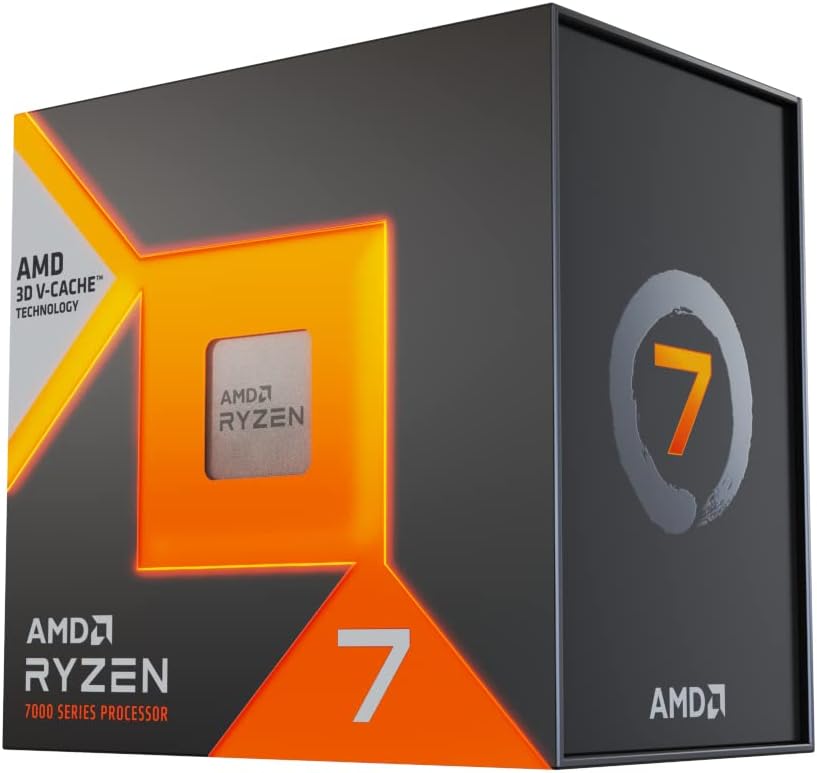
Budget Tier: Upper-Mid Retail Tier | Audited Specs: Zen 4 (Raphael) + 1st Gen 3D V-Cache | Socket AM5 | 8 Cores / 16 Threads | 4.2 GHz Base / 5.0 GHz Boost | 104MB Cache (8MB L2 + 96MB L3) | 120W TDP / 162W PPT | PCIe 5.0 (24 Usable Lanes) | Integrated 2-CU Radeon Graphics.
Comparison Audit: If both Zen 5 X3D models sit well above your target CPU budget in a $1,500–$1,800 build, the Ryzen 7 7800X3D remains miles ahead of budget non-X3D alternatives like the 8700F—preserving 96 MB of L3 cache and full PCIe 5.0 x16 routing while keeping money free for a stronger GPU.
Pros: Retains full 96 MB L3 3D V-Cache and 24 PCIe 5.0 lanes on Socket AM5; exceptional 1% Lows stability when discounted sharply below Ryzen 9000X3D.
Cons: 1st-Gen stacked cache limits thermal headroom and locks manual multiplier overclocking; trails Zen 5 in IPC and creator speed.
4. GIGABYTE B850 AORUS Elite WIFI7 — Recommended Unshared-Lane AM5 Motherboard

Budget Tier: $200-$250 tier (~$230 Launch MSRP) | Audited Specs: ATX Socket AM5 (AMD B850) | 14+2+2 Digital Twin VRM (60A DrMOS) | 1x PCIe 5.0 x16 Unshared GPU Slot | 3x M.2 (1x PCIe 5.0 x4 + 2x PCIe 4.0 x4) | Wi-Fi 7 + 2.5GbE LAN | Q-Flash Plus BIOS Flashback & EZ-Latch.
Comparison Audit: Pairing either the 9800X3D or 9850X3D with a $310–$395 X870/X870E board wastes budget unless you strictly require dual rear USB4 40Gbps ports—and many X870 boards cut your GPU slot to x8 when M.2_2 is populated. This B850 board runs full 162W PPT PBO loads coolly while keeping all 3 M.2 slots free of GPU lane sharing.
Pros: Zero GPU x8 lane sharing across all three M.2 drives; robust 14+2+2 60A VRM handles X3D PBO boosts easily; includes Wi-Fi 7, 2.5GbE LAN, and tool-less Q-Flash Plus.
Cons: Skips rear USB4 40Gbps Type-C ports (provides 20Gbps front header and 10Gbps rear USB-C instead).
How We Audited This Guide
- Processors, motherboards, memory, and storage were compared by socket longevity, chipset lane allocation, VRM design, DDR5 EXPO/XMP support, and PCIe generation.
- Every specification claim was cross-checked against official OEM datasheets, platform vendor documentation, and published industry standards (PCI-SIG, JEDEC, VESA, Intel ATX) rather than marketplace listing copy.
- Recommendations were evaluated against our weighted audit rubric and documented compatibility rules; we do not publish fabricated FPS, thermal, or acoustic numbers.
Frequently Asked Questions
What is the exact difference between the Ryzen 7 9800X3D and Ryzen 7 9850X3D?
Both CPUs share identical 8-core/16-thread Zen 5 silicon, 4.7 GHz base clock, 104 MB total cache (96 MB 2nd-Gen 3D V-Cache), 120W TDP / 162W PPT, and 24 usable PCIe 5.0 lanes. Only the maximum boost clock increases from 5.2 GHz on the 9800X3D to 5.6 GHz on the 9850X3D.
Can a Ryzen 7 9800X3D match the 9850X3D using Precision Boost Overdrive?
Partially. Applying +200 MHz PBO Override with Curve Optimizer negative voltage offsets lets most Ryzen 7 9800X3D chips sustain roughly 5.4 GHz, cutting the stock 400 MHz deficit in half. However, the factory-binned 9850X3D reaches 5.6 GHz out of the box and keeps higher ceiling headroom.
Do I need a 360mm liquid AIO cooler for the Ryzen 7 9850X3D?
No. Both the 9800X3D and 9850X3D cap socket power at 162W PPT and place 2nd-Gen 3D V-Cache beneath the compute die for improved heat transfer. A quality dual-tower copper air cooler handles gaming loads quietly, though 240mm or 360mm AIOs suit dual-chamber panoramic cases and quiet PBO builds.
Does the Ryzen 7 9850X3D make a noticeable difference at 1440p or 4K?
In GPU-bound 1440p Ultra or 4K ray-traced games where your graphics card stays at 95%–100% utilization, both chips deliver virtually identical average frame rates. The 9850X3D’s extra 400 MHz primarily benefits CPU-bound 1080p competitive esports on 360Hz–540Hz monitors and single-thread simulation engines.
What motherboard chipset and DDR5 RAM work best with both X3D CPUs?
Pair either CPU with an AMD B850 motherboard featuring BIOS Flashback, at least 12+2 stage 60A+ VRMs, and unshared PCIe 5.0 GPU lanes, alongside 32GB (2x16GB) DDR5-6000 CL30 AMD EXPO memory running at a tight 1:1 UCLK:MCLK ratio.
Official Standards & Technical References
- AMD Ryzen Desktop Processors Family & Technical Specifications: amd.com/en/products/processors/desktops/ryzen.html
- AMD 3D V-Cache Technology Architecture Overview: amd.com/en/products/technologies/3d-v-cache
- AMD Socket AM5 Chipsets & PCIe 5.0 Platform Architecture: amd.com/en/products/processors/chipsets/am5.html
- PCI-SIG PCI Express 5.0 Interface Specifications: pcisig.com/specifications
Continue exploring Socket AM5 builds in our best gaming CPUs hub, inspect turnkey tower builds in our best Ryzen 7 9800X3D prebuilt gaming PCs roundup, check thermal pairings in our best coolers for Ryzen 7 9800X3D & 9850X3D guide, or browse all Processors & Platforms audits.


