
Disclosure: As an Amazon Associate, I earn from qualifying purchases. If you buy through links on this page, we may earn a small commission at no extra cost to you.
Shopping for the best ryzen 7 9800x3d prebuilt gaming pc should be straightforward, yet Amazon’s 2026 desktop catalog frequently pairs AMD’s premier gaming silicon with lopsided 8GB graphics cards, sluggish single-stick memory, or undisclosed power supplies. With 96MB of Gen 2 L3 3D V-Cache sitting directly beneath eight Zen 5 cores, the Ryzen 7 9800X3D leads our 2026 gaming CPU hierarchy for frame-time consistency—provided the rest of the chassis does not choke it.
To separate genuine enthusiast builds from marketing traps, we audited every current-generation 9800X3D system available on Amazon US against manufacturer datasheets and our complete audited prebuilt gaming PCs hub. Below are the nine verified ATX towers and compact Mini-ITX desktops that earned our recommendation, spanning true 4K RTX 5080 flagships, high-value 16GB RX 9070 XT and RTX 5070 Ti towers, and sub-$1,900 esports entries.
In This Guide
- Quick Picks: Best Ryzen 7 9800X3D Prebuilt Gaming PCs
- Side-by-Side Comparison (All 9 Audited Rigs)
- Match Your Use Case
- Detailed Hardware Audits (1–9)
- 1. STORMCRAFT Phantom (RTX 5080 16GB & B850)
- 2. Lenovo Legion Tower 5 (RX 9070 XT 16GB & Wi-Fi 7)
- 3. Cooler Master NR2 Pro Mini-ITX (RTX 5070 Ti 16GB)
- 4. Skytech Prism 5 (RTX 5070 Ti 16GB & 360mm AIO)
- 5. HP Omen Max 45L (RTX 5080 16GB & 1200W Gold)
- 6. XIDAX Prebuilt (RX 9070 XT 16GB & 2TB SSD)
- 7. MSI Vision ZS (RTX 5070 12GB & 2TB SSD)
- 8. LAN Gamer 8.1L Mini-ITX SFF (RTX 5080 16GB)
- 9. Astral Plus (RX 9060 XT 16GB Esports Entry)
- Buying Guide & Upgrade Roadmap
- Scoring Methodology & Rejected Models
- Frequently Asked Questions
- Final Verdict
Quick Picks: Best Ryzen 7 9800X3D Prebuilt Gaming PCs at a Glance
#1 Best Overall 4K Flagship
STORMCRAFT Phantom
Pairs RTX 5080 16GB GDDR7 graphics with a transparent AMD B850 board, 32GB DDR5-6000, 2TB Gen4 NVMe, 360mm AIO, and 850W 80+ Gold power. (Jump to audit)
#2 Best Value 1440p & 4K Enthusiast
Lenovo Legion Tower 5 (2026)
Combines the 9800X3D with a 16GB RX 9070 XT, 32GB DDR5, 850W PSU, and Wi-Fi 7 around the $2,250–$2,350 sweet spot. (Jump to audit)
#3 Best Compact Mini-ITX Build
Cooler Master NR2 Pro
Houses an RTX 5070 Ti 16GB, Gigabyte B850I AORUS PRO board, 280mm AIO, 32GB DDR5-6000, and 850W Gold SFX PSU in 18.25L. (Jump to audit)
Side-by-Side Comparison: Top 9 Ryzen 7 9800X3D Prebuilt Gaming PCs
| Product & Award | Best For | GPU & VRAM | RAM, SSD & Cooling | Link |
|---|---|---|---|---|
| 1. STORMCRAFT Phantom Best Overall 4K Flagship | Uncompromised 4K RT & B850 transparency | RTX 5080 (16GB GDDR7) | 32GB DDR5-6000 / 2TB Gen4 / 360mm AIO | View on Amazon |
| 2. Lenovo Legion Tower 5 Best Value 1440p & 4K | 1440p Ultra, 4K FSR 4 & Wi-Fi 7 | RX 9070 XT (16GB GDDR6) | 32GB DDR5 / 1TB NVMe / 850W PSU | View on Amazon |
| 3. Cooler Master NR2 Pro Best Compact Mini-ITX | Small-footprint 18.25L quiet SFF | RTX 5070 Ti (16GB GDDR7) | 32GB DDR5-6000 / 2TB / 280mm AIO | View on Amazon |
| 4. Skytech Prism 5 Best Full-Size RTX 5070 Ti | Dual-chamber showcase & 2TB storage | RTX 5070 Ti (16GB GDDR7) | 32GB DDR5-6000 / 2TB Gen4 / 360mm AIO | View on Amazon |
| 5. HP Omen Max 45L Best High-Wattage OEM | 1200W Gold PSU & Cryo Chamber cooling | RTX 5080 (16GB GDDR7) | 32GB DDR5 / 2TB Gen4 / Cryo Liquid | View on Amazon |
| 6. XIDAX Prebuilt Best 2TB RDNA 4 Rig | Turnkey 2TB RX 9070 XT gaming | RX 9070 XT (16GB GDDR6) | 32GB DDR5 / 2TB SSD / 360mm AIO | View on Amazon |
| 7. MSI Vision ZS Best 1440p Showcase | Curved glass 1440p DLSS 4 gaming | RTX 5070 (12GB GDDR7) | 32GB DDR5 / 2TB Gen4 / 360mm AIO | View on Amazon |
| 8. LAN Gamer 8.1L SFF Best Ultra-Compact Travel | Backpack-sized 8.1L 4K LAN rig | RTX 5080 (16GB GDDR7) | 24GB DDR5 / 2TB Gen5 / 60mm Air Cap | View on Amazon |
| 9. Astral Plus Best 16GB Esports Entry | High-FPS 1080p/1440p esports value | RX 9060 XT (16GB GDDR6) | 16GB DDR5 / 1TB SSD / AM5 Platform | View on Amazon |
Match Your Use Case: Which Ryzen 7 9800X3D Prebuilt Fits Your Setup?
| Buyer Scenario | Best Match | Why & Expected Outcome |
|---|---|---|
| Uncompromised 4K High-Refresh & Ray Tracing (Standard B850 ATX) | #1 STORMCRAFT Phantom | Full 16GB GDDR7 RTX 5080 power, verified AMD B850 board, 32GB DDR5-6000, 360mm AIO, and 850W 80+ Gold PSU with zero proprietary lock-in. |
| Best Price-to-Performance 1440p Ultra & 4K FSR 4 | #2 Lenovo Legion Tower 5 | True 16GB VRAM on RDNA 4, 32GB DDR5, 850W PSU, and Wi-Fi 7 around the $2,250–$2,350 tier without sacrificing gaming frame pacing. |
| Small-Footprint Mini-ITX Desk Build (No Thermal Choking) | #3 Cooler Master NR2 Pro | 18.25L Mini-ITX footprint cooled by a 280mm AIO and 850W Gold SFX PSU on a retail Gigabyte B850I AORUS PRO board. |
| Full-Tower RTX 5070 Ti 16GB With 360mm AIO & 2TB SSD | #4 Skytech Prism 5 | Dual-chamber panoramic cooling, 32GB DDR5-6000, 2TB Gen4 NVMe, and Blackwell DLSS 4 Multi-Frame Generation. |
| High-Wattage 1200W OEM Flagship With Cryo Cooling | #5 HP Omen Max 45L | Massive 1200W 80+ Gold modular headroom, Wi-Fi 7, and Cryo Chamber top radiator bay for sustained 4K sessions. |
| Competitive Esports & 16GB VRAM Value Under $1,900 | #9 Astral Plus | Peak 9800X3D 1% Lows for 240Hz–480Hz esports paired with 16GB VRAM at an accessible entry tier (plan a prompt 32GB RAM upgrade). |
Detailed Hardware Audits: Best Ryzen 7 9800X3D Prebuilt Gaming PCs (1–9)
1. STORMCRAFT Phantom — Best Overall 4K Flagship

Quick Specs: AMD Ryzen 7 9800X3D (8C/16T, up to 5.2 GHz, 96MB L3) | NVIDIA GeForce RTX 5080 16GB GDDR7 | AMD B850 Motherboard | 32GB DDR5-6000 RGB | 2TB NVMe Gen4 SSD | 360mm AIO + 7x ARGB Fans | 850W 80+ Gold PSU | Price Tier: Flagship tier (over $3,500)
Audit Score: 9.4 / 10
- GPU & VRAM Headroom (35%): 9.6 / 10
- CPU & Platform Runway (25%): 9.5 / 10
- Memory & Storage Balance (20%): 9.4 / 10
- Cooling, PSU & Warranty Support (20%): 9.0 / 10
Flagship prebuilts routinely hide motherboard chipsets and memory speeds behind flashy tempered glass, yet STORMCRAFT Phantom does the exact opposite. Built around the AMD Ryzen 7 9800X3D official 120W AM5 architecture and an NVIDIA GeForce RTX 5080 16GB GDDR7 graphics card, this tower spells out almost every component enthusiasts verify before buying: a genuine AMD B850 chipset board, fast 32GB DDR5-6000 memory tuned for AM5’s 1:1 controller ratio, a spacious 2TB NVMe Gen4 SSD, a 360mm AIO liquid cooler supported by seven ARGB case fans, and an 850W 80+ Gold PSU backed by a 2-Year Parts and 3-Year Labor warranty.
In side-by-side comparison with #5 HP Omen Max 45L, which matches the 9800X3D and RTX 5080 core pairing, STORMCRAFT Phantom earns #1 overall honors by using standard retail ATX B850 hardware instead of a custom OEM micro-ATX motherboard. While HP includes a larger 1200W PSU, STORMCRAFT keeps every BIOS option, M.2 slot, fan header, and case mount cleanly upgradeable across future AM5 processor cycles without proprietary dead ends.
Buyer Verification Alert: Inspect the RTX 5080’s 12V-2×6 power connector after shipping to ensure the latch sits completely flush with at least 35mm of straight cable clearance before bending toward the side panel, and confirm AMD EXPO is active at 6000 MT/s in BIOS.
Pros
- Full spec transparency naming the AMD B850 motherboard, DDR5-6000 speed, and 850W 80+ Gold PSU
- 360mm AIO cooler plus seven ARGB fans let the 9800X3D sustain 5.2 GHz boost clocks quietly
- 2TB Gen4 NVMe SSD and 32GB DDR5 require zero day-one capacity upgrades
- Standard ATX layout plus 2-Year Parts / 3-Year Labor coverage simplifies future swaps
Cons
- Positioned in the premium over-$3,500 flagship tier
- 850W PSU leaves less electrical cushion for future 500W+ flagship GPUs than 1000W–1200W units
Verdict: Buy it if you want true 4K gaming headroom, RTX 5080 16GB GDDR7 performance, and transparent standard ATX B850 engineering with zero guesswork. Skip it if you want stronger value under $2,400 or prefer a compact Mini-ITX desk footprint.
2. Lenovo Legion Tower 5 (2026) — Best Value 1440p & 4K Enthusiast

Quick Specs: AMD Ryzen 7 9800X3D (8C/16T, 96MB L3 3D V-Cache) | AMD Radeon RX 9070 XT 16GB GDDR6 | 32GB DDR5 | 1TB NVMe SSD | 850W PSU | Wi-Fi 7 (802.11be) + 2.5GbE LAN | Price Tier: Enthusiast tier (around $2,250–$2,350)
Audit Score: 9.2 / 10
- GPU & VRAM Headroom (35%): 9.1 / 10
- CPU & Platform Runway (25%): 9.5 / 10
- Memory & Storage Balance (20%): 8.7 / 10
- Cooling, PSU & Warranty Support (20%): 9.3 / 10
For the vast majority of enthusiasts targeting 1440p gaming at ultra settings or smooth 4K gaming with AMD FSR 4, the Lenovo Legion Tower 5 hits the performance-per-dollar sweet spot of the entire 9800X3D market. Pairing the Ryzen 7 9800X3D with the AMD Radeon RX 9070 XT 16GB RDNA 4 architecture delivers 64 Compute Units, a full 256-bit memory bus, and DisplayPort 2.1a output—all around the $2,250–$2,350 tier, saving well over $1,000 compared with over-$3,500 RTX 5080 towers.
Unlike many mid-upper system integrators that quietly cut corners on networking or conceal PSU wattage, Lenovo specifies an 850W power supply alongside Wi-Fi 7 (802.11be) and 2.5GbE Ethernet inside its well-ventilated Eclipse Black Tower 5 chassis. Compared directly with #6 XIDAX (which doubles stock SSD capacity to 2TB on the same 9800X3D + RX 9070 XT pairing), Lenovo retains our higher #2 ranking because its verified Wi-Fi 7 adapter, 850W PSU disclosure, and accessible price bracket leave plenty of budget room to drop in a secondary 2TB PCIe 4.0 drive yourself.
Buyer Verification Alert: Check Lenovo Vantage and Windows Display Settings on first boot to verify AMD Smart Access Memory (Resizable BAR) is active and confirm your monitor runs at its full native 144Hz–240Hz+ refresh rate rather than Windows’ default 60Hz.
Pros
- 16GB RX 9070 XT plus 9800X3D delivers top-tier 1440p Ultra and 4K FSR 4 frame pacing around $2,250–$2,350
- Includes verified Wi-Fi 7, 2.5GbE LAN, 32GB DDR5, and a documented 850W PSU
- Standard Eclipse Black Tower 5 internal layout avoids restrictive proprietary dead-end mounting
Cons
- 1TB NVMe SSD fills quickly once modern 120GB+ AAA titles pile up
- Lacks NVIDIA DLSS 4 Multi-Frame Generation and dual NVENC encoders for CUDA-heavy creation
Verdict: Buy it if you want the strongest price-to-performance 16GB VRAM + Ryzen 7 9800X3D tower with verified Wi-Fi 7 and 850W power headroom. Skip it if you specifically need NVIDIA DLSS 4 Multi-Frame Generation or refuse to install a secondary M.2 SSD later.
3. Cooler Master NR2 Pro Mini-ITX — Best Compact Mini-ITX Build

Quick Specs: AMD Ryzen 7 9800X3D (8C/16T, 96MB L3) | NVIDIA GeForce RTX 5070 Ti 16GB GDDR7 | Gigabyte B850I AORUS PRO (Mini-ITX) | 32GB DDR5-6000 | 2TB M.2 SSD | 280mm AIO (2x 140mm PWM) + 850W 80+ Gold SFX PSU | Price Tier: Upper enthusiast tier (above $2,500)
Audit Score: 9.1 / 10
- GPU & VRAM Headroom (35%): 9.2 / 10
- CPU & Platform Runway (25%): 9.4 / 10
- Memory & Storage Balance (20%): 9.3 / 10
- Cooling, PSU & Warranty Support (20%): 8.6 / 10
Most compact prebuilts trade away cooling capacity or hide cheap proprietary motherboards inside cramped enclosures, which is why the Cooler Master NR2 Pro is an engineering standout. Built inside Cooler Master’s ~18.25L NR200P V2 Mini-ITX architecture, it pairs a retail Gigabyte B850I AORUS PRO AM5 motherboard with a custom-integrated 280mm liquid radiator cooled by twin 140mm PWM fans and an 850W 80+ Gold SFX power supply. Out of the box, you get 32GB of dual-channel DDR5-6000 memory and a 2TB M.2 NVMe SSD driving a 16GB GDDR7 RTX 5070 Ti with full NVIDIA DLSS 4 Multi-Frame Generation and Reflex support.
Against #8 LAN Gamer 8.1L SFF, Cooler Master adds roughly ten liters of internal volume—and uses every bit of it wisely. Whereas ultra-tiny 8.1L cases cap CPU coolers at 60mm low-profile air units, the NR2 Pro’s 280mm AIO absorbs 162W PPT boost spikes from the 9800X3D quietly while keeping GPU airflow clean through perforated side panels.
Buyer Verification Alert: Mini-ITX AM5 motherboards carry two DDR5 DIMM slots rather than four; your stock 32GB (2x16GB) DDR5-6000 setup already runs optimally, so scaling to 64GB later requires swapping both sticks for a 2x32GB kit.
Pros
- Genuine retail Gigabyte B850I AORUS PRO Mini-ITX board rather than proprietary OEM silicon
- Custom 280mm AIO (2x 140mm PWM fans) and 850W 80+ Gold SFX PSU inside 18.25 liters
- Confirmed 32GB DDR5-6000 memory, 2TB Gen4 SSD, and RTX 5070 Ti 16GB GDDR7
Cons
- Mini-ITX layout omits extra PCIe expansion slots and requires tight vertical GPU clearance checks later
- Less internal workspace for DIY disassembly than full dual-chamber ATX towers like #4 Skytech Prism 5
Verdict: Buy it if you want desktop flagship acoustics, 16GB RTX 5070 Ti power, and retail B850I quality inside an 18.25L Mini-ITX footprint. Skip it if you prefer a spacious ATX showcase chassis or multiple PCIe add-in cards.
4. Skytech Prism 5 — Best Full-Size RTX 5070 Ti Tower

Quick Specs: AMD Ryzen 7 9800X3D (8C/16T, 4.7–5.2 GHz) | NVIDIA GeForce RTX 5070 Ti 16GB GDDR7 | AMD B850 Motherboard | 32GB DDR5-6000 RGB | 2TB Gen4 NVMe SSD | 360mm ARGB AIO | 850W 80+ Gold PSU | Wi-Fi 6 | Price Tier: Upper enthusiast tier (around $2,400–$2,700)
Audit Score: 8.9 / 10
- GPU & VRAM Headroom (35%): 9.2 / 10
- CPU & Platform Runway (25%): 8.9 / 10
- Memory & Storage Balance (20%): 9.3 / 10
- Cooling, PSU & Warranty Support (20%): 8.0 / 10
Skytech Prism 5 delivers everything panoramic dual-chamber builders love without shrinking storage or memory speeds. Its spacious showcase enclosure gives a 360mm ARGB AIO liquid cooler plenty of radiator breathing room above an AMD B850 motherboard, while pairing the Ryzen 7 9800X3D with 32GB of DDR5-6000 RGB RAM, a 2TB Gen4 NVMe M.2 SSD, an 850W Gold PSU, and an RTX 5070 Ti 16GB GDDR7 GPU built for maxed-out 1440p gaming and 4K DLSS 4 upscaling.
When cross-shopped against #3 Cooler Master NR2 Pro, Skytech trades Mini-ITX compactness and fixed Gigabyte B850I motherboard sourcing for full ATX expandability and 360mm liquid cooling. Why does it land at #4 instead of higher? Skytech’s build relies on Wi-Fi 6 rather than Wi-Fi 7, and AIB GPU or motherboard partner models vary slightly by production batch.
Buyer Verification Alert: Verify the exact Amazon storage selector before checkout so you purchase the 2TB Gen4 NVMe configuration (ASIN B0HJGNNF9K) rather than its 1TB sibling, and inspect HWiNFO64 after setup to confirm DDR5-6000 EXPO timings are active.
Pros
- Dual-chamber ATX showcase layout pairs 360mm ARGB AIO cooling with generous GPU length clearance
- 32GB DDR5-6000 RGB and 2TB Gen4 NVMe SSD provide balanced capacity out of the box
- 850W 80+ Gold PSU and AMD B850 AM5 board keep future upgrades completely standard
Cons
- Includes Wi-Fi 6 rather than Wi-Fi 7 found on #2 Lenovo Legion Tower 5 and #5 HP Omen Max 45L
- Exact AIB GPU and motherboard partner brands vary across assembly batches
Verdict: Buy it if you want a roomy dual-chamber RTX 5070 Ti 16GB build with 360mm liquid cooling, DDR5-6000, and 2TB Gen4 storage. Skip it if you demand guaranteed Wi-Fi 7 out of the box or prefer a compact Mini-ITX chassis.
5. HP Omen Max 45L — Best High-Wattage OEM RTX 5080 Tower

Quick Specs: AMD Ryzen 7 9800X3D (8C/16T, 96MB L3) | NVIDIA GeForce RTX 5080 16GB GDDR7 | HP OEM Micro-ATX AM5 | 32GB DDR5 | 2TB Gen4 SSD | Cryo Chamber Liquid Cooler | 1200W 80+ Gold Modular PSU | Wi-Fi 7 + 2.5GbE | Price Tier: Flagship tier (over $3,500)
Audit Score: 8.8 / 10
- GPU & VRAM Headroom (35%): 9.6 / 10
- CPU & Platform Runway (25%): 8.1 / 10
- Memory & Storage Balance (20%): 8.9 / 10
- Cooling, PSU & Warranty Support (20%): 8.3 / 10
HP’s Omen Max 45L tackles the biggest thermal flaw of closed OEM desktops through its patented Cryo Chamber—an isolated top housing that pulls fresh ambient air exclusively across the liquid cooler radiator before exhausting it out of the chassis. Underneath sits an RTX 5080 16GB GDDR7 GPU, 32GB DDR5 RAM, a 2TB Gen4 SSD, Wi-Fi 7 with 2.5GbE LAN, and an oversized 1200W 80+ Gold modular PSU built to absorb severe GPU transient spikes certified under Cybenetics ATX 3.1 efficiency and noise standards.
Even with that massive 1200W PSU advantage, the Omen Max 45L trails #1 STORMCRAFT Phantom in our Platform Runway pillar because HP utilizes a custom OEM micro-ATX motherboard and proprietary BIOS environment. While GPU, NVMe, and RAM upgrades stay accessible, enthusiasts who want full AGESA PBO tuning or retail ATX board swaps down the line are better served by STORMCRAFT’s off-the-shelf B850 layout.
Buyer Verification Alert: Uninstall unwanted OEM trial utilities inside Windows after initial setup, verify memory transfer speeds inside HP OMEN Gaming Hub or Task Manager, and confirm your chassis power mode isn’t throttled by Quiet defaults.
Pros
- Oversized 1200W 80+ Gold modular PSU easily handles future flagship GPU transients
- Top-mounted Cryo Chamber isolates radiator cooling from internal GPU exhaust
- Includes Wi-Fi 7, Bluetooth 5.4, 2.5GbE LAN, and 2TB Gen4 NVMe storage
Cons
- Custom HP OEM micro-ATX motherboard and locked BIOS firmware limit enthusiast tuning
- Large 45L chassis and proprietary front I/O headers reduce aftermarket board swap flexibility
Verdict: Buy it if you want a major OEM 4K tower with 1200W 80+ Gold power headroom, Wi-Fi 7, and Cryo Chamber cooling. Skip it if you value retail B850 ATX BIOS flexibility over OEM wattage overhead.
6. XIDAX Prebuilt Gaming PC — Best 2TB RDNA 4 Boutique Rig

Quick Specs: AMD Ryzen 7 9800X3D (8C/16T, 96MB L3) | AMD Radeon RX 9070 XT 16GB GDDR6 | 32GB DDR5 | 2TB NVMe SSD | 360mm AIO Cooler | 850W 80+ Gold PSU | Price Tier: Enthusiast tier (around $2,300–$2,600)
Audit Score: 8.7 / 10
- GPU & VRAM Headroom (35%): 9.1 / 10
- CPU & Platform Runway (25%): 8.6 / 10
- Memory & Storage Balance (20%): 9.0 / 10
- Cooling, PSU & Warranty Support (20%): 7.9 / 10
XIDAX’s Ryzen 7 9800X3D and RX 9070 XT 16GB configuration appeals directly to buyers who refuse to open a brand-new desktop on day one just to install a second SSD. Doubling the storage capacity of #2 Lenovo Legion Tower 5 to 2TB out of the box, XIDAX also bundles a 360mm AIO liquid cooler and an 850W 80+ Gold PSU inside a serviceable mid-tower ATX chassis built for sustained 1440p Ultra and 4K FSR 4 sessions.
However, compared with Lenovo’s fully documented spec table, XIDAX’s Amazon storefront omits exact AM5 motherboard chipset naming, DDR5 MT/s transfer speed, and Wi-Fi generation details. Unless you specifically prioritize XIDAX’s 2TB single-drive convenience and 360mm AIO cooling over Lenovo’s verified Wi-Fi 7 radio and lower price bracket, the Legion Tower 5 remains the cleaner value play.
Buyer Verification Alert: Check HWiNFO64 upon first boot to verify the installed motherboard chipset, confirm dual-channel 2x16GB RAM population, and ensure EXPO memory profiles are enabled rather than running at JEDEC DDR5-4800 speeds.
Pros
- Includes 2TB NVMe storage and 32GB DDR5 out of the box with zero immediate space bottlenecks
- 360mm AIO liquid cooler and 850W 80+ Gold PSU support sustained 9800X3D boost headroom
- Standard ATX component layout makes future M.2 or GPU swaps straightforward
Cons
- Amazon product description omits exact AM5 motherboard chipset and Wi-Fi tier
- DDR5 latency/speed and SSD DRAM cache controller specs are unstated in the headline listing
Verdict: Buy it if you want 2TB storage, 360mm liquid cooling, and 16GB RX 9070 XT horsepower in a standard boutique ATX tower. Skip it if guaranteed Wi-Fi 7 transparency matters more than pre-installed 2TB capacity.
7. MSI Vision ZS — Best 1440p Panoramic Showcase

Quick Specs: AMD Ryzen 7 9800X3D (8C/16T, 96MB L3) | NVIDIA GeForce RTX 5070 12GB GDDR7 | 32GB DDR5 | 2TB M.2 Gen4 NVMe SSD | 360mm AIO Liquid Cooler | Wi-Fi 6E + 2.5GbE LAN | Price Tier: Mid-upper enthusiast tier (around $1,900–$2,300)
Audit Score: 8.5 / 10
- GPU & VRAM Headroom (35%): 8.1 / 10
- CPU & Platform Runway (25%): 8.9 / 10
- Memory & Storage Balance (20%): 9.1 / 10
- Cooling, PSU & Warranty Support (20%): 8.2 / 10
Built around MSI’s panoramic curved tempered-glass showcase chassis, the Vision ZS pairs a Ryzen 7 9800X3D and 360mm liquid cooler with 32GB of DDR5, a 2TB Gen4 NVMe SSD, and NVIDIA’s RTX 5070 12GB GDDR7 GPU. For high-refresh 1440p gaming on 240Hz–360Hz OLED displays, the Vision ZS balances DLSS 4 Multi-Frame Generation, NVIDIA Reflex latency reduction, Wi-Fi 6E, and standard retail MSI ATX expandability cleanly.
The clear trade-off explaining its #7 placement against #2 Lenovo Legion Tower 5 and #4 Skytech Prism 5 is video memory: 12GB GDDR7 sits comfortably at 1440p today, yet lacks the 16GB buffer of the RX 9070 XT and RTX 5070 Ti when pushing native 4K Ultra textures alongside Frame Generation. Still, if you prioritize NVIDIA’s feature stack and 2TB storage under $2,300, MSI delivers a clean showcase build.
Buyer Verification Alert: Check the PSU shroud rating label on arrival before ever planning a future 360W+ RTX 5080 upgrade, as headline Amazon listings for Vision ZS configurations do not always specify whether a 750W or 850W 80+ Gold unit is fitted.
Pros
- Standard MSI ATX components paired with 360mm AIO cooling, 32GB DDR5, and a 2TB Gen4 NVMe SSD
- RTX 5070 12GB brings DLSS 4 Multi-Frame Generation and DisplayPort 2.1b at a friendlier tier than 5070 Ti rigs
- Wi-Fi 6E and 2.5GbE LAN provide fast wireless and wired throughput
Cons
- 12GB VRAM trails 16GB RX 9070 XT (#2) and RTX 5070 Ti (#4) rigs for heavy 4K texture packs
- Exact PSU wattage and ATX 3.1 certification are omitted from headline Amazon specs
Verdict: Buy it if you play primarily at 1440p and want MSI’s curved-glass showcase aesthetic with 2TB storage and 32GB DDR5. Skip it if you run native 4K Ultra textures or want 16GB VRAM at a similar budget via #2 Lenovo Legion Tower 5.
8. LAN Gamer 8.1L Mini-ITX SFF — Best Ultra-Compact 8.1L Travel Rig

Quick Specs: AMD Ryzen 7 9800X3D (8C/16T, 96MB L3) | NVIDIA GeForce RTX 5080 16GB GDDR7 | 8.1L Sandwich Mini-ITX SFF | 24GB DDR5 | 2TB PCIe Gen5 NVMe SSD | Max 60mm Low-Profile Air Cooler | Price Tier: Flagship compact tier (over $3,000)
Audit Score: 8.2 / 10
- GPU & VRAM Headroom (35%): 9.4 / 10
- CPU & Platform Runway (25%): 8.2 / 10
- Memory & Storage Balance (20%): 8.0 / 10
- Cooling, PSU & Warranty Support (20%): 6.5 / 10
Cramming an RTX 5080 16GB GDDR7 GPU, a Ryzen 7 9800X3D, and a 2TB PCIe Gen5 NVMe SSD inside an 8.1-liter sandwich-style enclosure makes the LAN Gamer desktop one of the highest-density retail prebuilts on Amazon. Built in the spirit of backpack-friendly carry-on SFF builds with full perforated mesh side panels, it outperforms laptops many times over while taking up less desk space than a gaming console.
Physics still enforces strict compromises at 8.1 liters, which explains why it sits behind #3 Cooler Master NR2 Pro (18.25L) in our audit. Liquid radiators cannot fit, leaving CPU cooling capped at 60mm low-profile air units, while memory ships in an unusual 24GB non-binary DDR5 configuration and Amazon omits exact SFX PSU wattage and motherboard details.
Buyer Verification Alert: Check exact SFX PSU wattage and internal cable bends upon unboxing, and apply a modest AMD PBO Curve Optimizer negative offset (-15 to -20) in BIOS to keep boost clocks steady and fan RPMs civilized under the 60mm cooler limit.
Pros
- Full RTX 5080 16GB and Ryzen 7 9800X3D performance inside an ultra-portable 8.1L SFF shell
- Fast 2TB PCIe Gen5 NVMe SSD and ventilated dual-sided mesh intake panels
- Fits comfortably in travel backpacks or minimalist micro-desk setups
Cons
- 60mm low-profile air cooler cap generates noticeably louder fan curves than 280mm/360mm AIO towers
- Unusual 24GB DDR5 allocation falls short of the 32GB standard on #1–#7 systems
- Amazon listing omits SFX PSU wattage/80+ Gold badge and exact ITX motherboard model
Verdict: Buy it if extreme sub-9L portability with full RTX 5080 16GB power outweighs acoustic and memory compromises. Skip it if quiet thermals and documented 32GB DDR5-6000 specs matter more—#3 Cooler Master NR2 Pro stays far cooler and quieter.
9. Astral Plus Prebuilt Gaming PC — Best Value 16GB Esports Entry

Quick Specs: AMD Ryzen 7 9800X3D (8C/16T, 96MB L3) | AMD Radeon RX 9060 XT 16GB GDDR6 | 16GB DDR5 | 1TB PCIe NVMe SSD | Price Tier: Upper-midrange tier (around $1,500–$1,900)
Audit Score: 7.8 / 10
- GPU & VRAM Headroom (35%): 7.7 / 10
- CPU & Platform Runway (25%): 8.6 / 10
- Memory & Storage Balance (20%): 7.3 / 10
- Cooling, PSU & Warranty Support (20%): 7.4 / 10
Competitive 1080p and 1440p esports players often want the Ryzen 7 9800X3D’s unbeatable 96MB L3 1% Lows stability without paying over $2,300 for flagship graphics horsepower. Astral Plus hits that exact niche by pairing the 9800X3D with AMD’s 16GB RX 9060 XT—smartly dodging the disqualified 8GB RTX 5060 bottleneck that plagues budget X3D listings elsewhere on Amazon.
Compared with #2 Lenovo Legion Tower 5 or #7 MSI Vision ZS, Astral Plus lands at #9 because the RX 9060 XT’s 128-bit bus targets 1080p/1440p rather than 4K Ultra, stock memory stops at 16GB DDR5, and Amazon’s storefront omits PSU wattage, motherboard chipset, and CPU cooler specifics. Still, if you plan an inexpensive day-one swap to a 2x16GB DDR5-6000 CL30 kit, this AM5 chassis delivers legitimate X3D tournament responsiveness at a friendlier tier.
Buyer Verification Alert: Check Task Manager or HWiNFO64 immediately after setup to confirm whether the 16GB RAM uses a single 1x16GB stick or 2x8GB sticks—single-channel DDR5 cuts 9800X3D 1% Lows significantly until upgraded to a 2x16GB DDR5-6000 CL30 kit.
Pros
- Full 9800X3D 3D V-Cache frametime consistency at an accessible upper-midrange price tier
- Uses the 16GB RX 9060 XT variant rather than 8GB RTX 5060 / 8GB RX 9060 XT compromises
- Standard AM5 chassis permits easy future RAM, storage, and GPU upgrades
Cons
- 16GB stock DDR5 memory requires a prompt upgrade to 32GB for demanding open-world titles
- Omitted PSU wattage, 80+ efficiency certification, motherboard model, and cooler size on Amazon
- 128-bit RX 9060 XT targets 1080p/1440p esports rather than native 4K Ultra
Verdict: Buy it if you play CPU-bound 1080p/1440p esports and want 9800X3D 1% Lows with 16GB VRAM under $1,900, and plan to drop in a 32GB DDR5-6000 kit. Skip it if you want native 4K capability or fully disclosed PSU/board specs out of the box.
Buying Guide: How to Choose the Best Ryzen 7 9800X3D Prebuilt Gaming PC
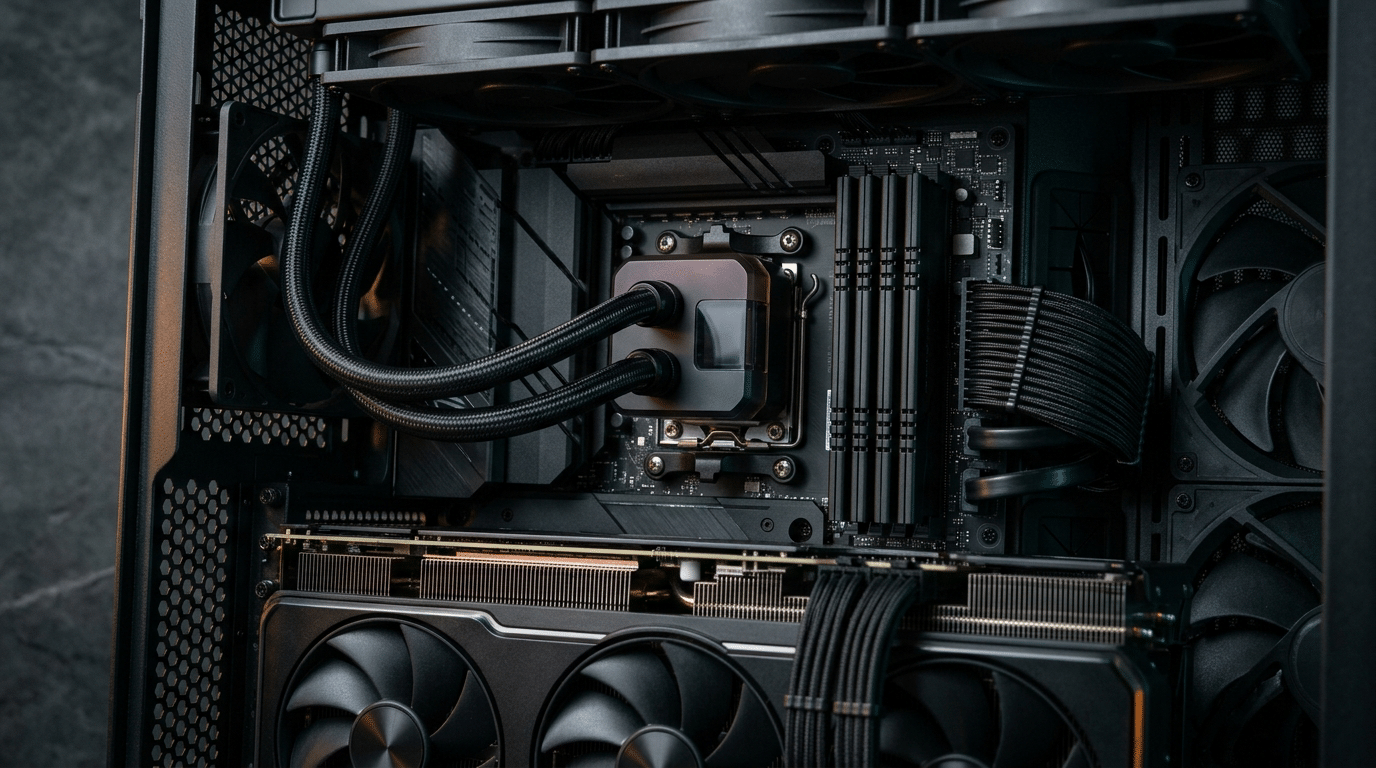
Choosing the best ryzen 7 9800x3d prebuilt gaming pc comes down to verifying that the graphics card, motherboard, memory ratio, cooling topology, and power supply actually match AMD’s Zen 5 flagship. Because system integrators allocate most of a rig’s headline marketing to the CPU and GPU names, auditing five core engineering layers keeps you from overpaying for imbalanced hardware.
1. GPU & VRAM Pairing: 16GB vs. 12GB vs. Disqualified 8GB Cards
Unless you compete exclusively at 1080p low settings in esports titles, never pair a Ryzen 7 9800X3D (Launch MSRP around $479) with an 8GB graphics card. Modern Unreal Engine 5 open-world games and ray-traced texture packs exceed 8GB VRAM buffers quickly—causing micro-stutter that completely undermines the smoothness you paid for with 3D V-Cache. For 1440p gaming at Ultra settings and comfortable 4K gaming with upscaling, aim squarely for 16GB GPUs like the RX 9070 XT (#2 Lenovo, #6 XIDAX), RTX 5070 Ti (#3 Cooler Master, #4 Skytech), or RTX 5080 (#1 STORMCRAFT, #5 HP Omen, #8 LAN Gamer).
When evaluating Blackwell RTX 50-series cards with DLSS 4 Multi-Frame Generation, remember that generated frames smooth motion rather than lowering input latency. Maintain at least 50–60 native base FPS with NVIDIA Reflex (or AMD Anti-Lag 2 on RDNA 4) active before enabling Frame Generation. Additionally, ignore any retailer or forum rumor advising you to wait for unreleased “RTX 5070 Super” or “RTX 5080 Super” configurations—both remain strictly unannounced rumors as of November 2026.
2. Gen 2 3D V-Cache, AM5 Motherboards & Avoiding 8700F Lookalikes
Unlike older 7000X3D chips that stacked cache on top of the compute die, the 9800X3D places 64MB of 3D V-Cache underneath the Zen 5 CCD so the cores sit directly against the integrated heat spreader. That inverted Gen 2 stack enables full 5.2 GHz boosts and unlocked PBO tuning at a 120W TDP (162W PPT). Curious whether stepping up to AMD’s newer 5.6 GHz chip justifies paying more? Read our Ryzen 7 9800X3D vs. Ryzen 7 9850X3D comparison—for most prebuilt shoppers, investing the savings into a higher GPU tier pays vastly larger dividends.
On the motherboard side, prioritize transparent retail AM5 chipsets like AMD B850 (#1 STORMCRAFT Phantom, #3 Cooler Master NR2 Pro, #4 Skytech Prism 5) over custom OEM micro-ATX PCBs (#5 HP Omen Max 45L). And double-check Amazon processor dropdowns closely: several prebuilt pages lump the OEM Ryzen 7 8700F—which carries just 16MB of L3 cache and 16 usable PCIe 4.0 lanes—under generic “AMD Ryzen 7” menus right beside 96MB L3 9800X3D configurations.
3. Dual-Channel DDR5-6000, PCIe 4.0 SSDs & ATX 3.1 Power Safety
AM5 processors achieve peak memory controller efficiency at a 1:1 UCLK:MCLK ratio using 32GB (2x16GB) of DDR5-6000 CL30. Pushing past DDR5-6400 drops the controller into a higher-latency 2:1 divider, while populating four sticks destabilizes EXPO speeds and single-channel 1x16GB configurations slash 1% Lows. On #9 Astral Plus (16GB) or #8 LAN Gamer (24GB), inspect stick count via HWiNFO64 immediately and upgrade to a clean 2x16GB DDR5-6000 pair if needed.
For storage, 2TB PCIe 4.0 TLC NVMe drives with dedicated DRAM cache deliver virtually identical game load times to hotter PCIe 5.0 drives. Finally, demand 850W to 1200W 80+ Gold power supplies supporting ATX 3.1 / PCIe 5.1 transient handling on RTX 5070 Ti, RX 9070 XT, and RTX 5080 systems—and make sure native 12V-2×6 GPU cables maintain at least 35mm of unbent clearance away from tempered-glass side panels.
4. Cooling Topology: 360mm AIO Towers vs. Mini-ITX & 8.1L SFF
Although a 9800X3D pulls far less sustained wattage than 250W Intel flagships, radiator and chassis airflow dictate noise levels. Dual-chamber and ATX towers like #1 STORMCRAFT Phantom, #4 Skytech Prism 5, #6 XIDAX, and #7 MSI Vision ZS leverage 360mm AIO liquid coolers to hold low fan curves during multi-hour gaming. Compact builders stepping down to #3 Cooler Master NR2 Pro retain quiet liquid performance via a 280mm radiator, whereas ultra-dense 8.1L rigs like #8 LAN Gamer hit a 60mm air-cooler ceiling that rewards a light Curve Optimizer undervolt.
5. Upgrade Roadmap & Hidden Ownership Costs
Even top prebuilt rigs benefit from targeted post-purchase tweaks and budget planning:
- Secondary 2TB PCIe 4.0 TLC NVMe SSD (Roughly $120–$170 Tier): Essential for 1TB rigs like #2 Lenovo Legion Tower 5 and #9 Astral Plus once game libraries exceed six modern AAA installs.
- 32GB (2x16GB) DDR5-6000 CL30 Kit (Roughly $90–$120 Tier): High-impact day-one swap for #9 Astral Plus (16GB) or #8 LAN Gamer (24GB) if HWiNFO64 reveals single-stick or loose JEDEC timings.
- BIOS & Windows Setup Checklist: Enable AMD EXPO, confirm Resizable BAR is turned on, set 4-pin fans to PWM curves with 2–3 second ramp hysteresis, and uninstall OEM bloatware. If your total rig budget must remain strictly below $2,000 before buying monitors or upgrades, compare options in our Best Prebuilt Gaming PC Under $2,000 guide.
6. Navigating Amazon Filters, Review Pooling & Omitted Specs
Do not rely on Amazon’s left-sidebar filters when browsing 9800X3D systems. Amazon’s Graphics Memory filter still caps at “8 GB & above,” mixing 8GB entry cards alongside 16GB RTX 5080s, while search results blend Renewed units unless Condition is locked to New. Watch closely for multi-variant parent ASINs that inherit thousands of older GTX-era reviews onto new 2026 builds, and double-check that Wi-Fi 7 or Wi-Fi 6E networking and PSU ratings aren’t quietly omitted in upper-tier listings.
How We Audited, Scored & Filtered These 9800X3D Models
Every configuration on this page underwent a structured specification and compatibility audit grounded in AMD, NVIDIA, PCI-SIG, and Cybenetics documentation under The PC Audit’s evaluation methodology—with zero paid placements or fabricated benchmark numbers. Each desktop is scored out of 10 using four weighted hardware pillars summing to 100%:
| Evaluation Criterion | Weight | What We Audited |
|---|---|---|
| GPU & VRAM Headroom | 35% | 16GB vs. 12GB VRAM capacity across RTX 5080, RTX 5070 Ti, RX 9070 XT, RTX 5070, and RX 9060 XT GPUs, bus width, and DLSS 4 / FSR 4 feature support. |
| CPU & Platform Runway | 25% | Sustained 9800X3D Gen 2 3D V-Cache thermal headroom, retail AMD B850/X870 board transparency vs. OEM PCBs, and AM5 upgrade runway. |
| Memory & Storage Balance | 20% | Dual-channel 32GB DDR5-6000 vs. 24GB/16GB starter configurations and 1TB vs. 2TB PCIe Gen4/Gen5 NVMe SSD capacity. |
| Cooling, PSU & Warranty Support | 20% | 360mm/280mm AIO vs. 60mm low-profile cooling, 850W–1200W 80+ Gold ATX 3.1 clarity, Wi-Fi 7/6E networking, and warranty terms. |
Models We Audited & Rejected (And Why)
- Macaron Gaming PC Desktop (Ryzen 7 9800X3D & RTX 5060 8GB): Disqualified under our GPU balance audit rule. Pairing a flagship 9800X3D with an 8GB RTX 5060 and 16GB DDR5 bottlenecks modern 1440p textures severely—whereas #9 Astral Plus delivers 16GB VRAM on the RX 9060 XT 16GB.
- Skytech Azure 3 Batch Variants & Omitted-Chipset Listings: Flagged under our catalog transparency rules because multi-variant parent ASINs mix legacy reviews onto current configs while documenting batch motherboard omissions and Wi-Fi 5 radios in over-$2,000 brackets—making verified B850 builds like #1 STORMCRAFT Phantom and #4 Skytech Prism 5 cleaner buys.
- 1TB Entry-Storage Duplicates (1TB Skytech Prism 5 & 1TB KOTIN Variants): Excluded to keep the shortlist focused where 2TB Gen4 NVMe variants (#4 Skytech Prism 5 2TB and #7 MSI Vision ZS 2TB) offer materially stronger value for modern 120GB+ AAA game installs.
- Generic “AMD Ryzen 7” 8700F Prebuilt Lookalikes: Excluded because Amazon processor dropdowns blend the OEM Ryzen 7 8700F (just 16MB L3 cache and 16 usable PCIe 4.0 lanes) right beside authentic 9800X3D builds packing 96MB of L3 3D V-Cache.
Frequently Asked Questions About Ryzen 7 9800X3D Prebuilt Gaming PCs
What is the best GPU to pair with the Ryzen 7 9800X3D in a prebuilt gaming PC?
For 1440p Ultra and entry 4K gaming, target 16GB cards like the AMD Radeon RX 9070 XT or NVIDIA RTX 5070 Ti. If you prioritize native 4K High-Refresh with Ray Tracing, step up to the RTX 5080 16GB GDDR7, while avoiding 8GB GPUs that waste X3D headroom.
Is a Ryzen 7 9800X3D prebuilt worth buying over a Ryzen 7 9850X3D rig?
Yes for most buyers. While the Ryzen 7 9850X3D raises max boost from 5.2 GHz to 5.6 GHz, both share the same 8-core Zen 5 layout and 96MB L3 3D V-Cache. Unless pricing is nearly identical, a 9800X3D rig lets you allocate more budget to a 16GB GPU.
How much RAM should a Ryzen 7 9800X3D prebuilt have in 2026?
Aim for 32GB (2x16GB) of dual-channel DDR5-6000 CL30, which runs at an optimal 1:1 memory controller ratio on AM5. Avoid 1x16GB single-channel kits or populating all four DIMM slots, as both degrade 1% Lows and lower stable DDR5 clock speeds.
Can a compact Mini-ITX prebuilt handle Ryzen 7 9800X3D temperatures cleanly?
Yes when properly cooled. Systems like the Cooler Master NR2 Pro pair the 120W TDP (162W PPT) 9800X3D with a 280mm liquid radiator and retail B850I board. Ultra-tiny 8.1L air-cooled SFF rigs need a light PBO Curve Optimizer negative offset to prevent fan noise.
Why did we disqualify 8GB RTX 5060 prebuilts paired with the 9800X3D?
Pairing a flagship Ryzen 7 9800X3D (Launch MSRP around $479) with an 8GB RTX 5060 creates an immediate GPU VRAM ceiling at 1440p Ultra and modern ray-traced titles. Spending similar money on an RX 9060 XT 16GB, RTX 5070 12GB, or RX 9070 XT 16GB delivers far better longevity.
What hidden compromises should you audit on Amazon 9800X3D listings?
Watch for parent-ASIN review pooling merging older rigs with 2026 builds, omitted PSU wattage or ATX 3.1 status, 16GB single-channel DDR5-4800 memory, Wi-Fi 5 radios, and OEM lookalike CPUs like the 16MB-cache Ryzen 7 8700F grouped under generic Ryzen 7 labels.
Final Verdict: Which Is the Best Ryzen 7 9800X3D Prebuilt Gaming PC for You?
Across November 2026 retail builds, the STORMCRAFT Phantom stands as the best ryzen 7 9800x3d prebuilt gaming pc overall for buyers wanting zero compromises at 4K—combining an RTX 5080 16GB GPU, a transparent AMD B850 motherboard, 32GB DDR5-6000, a 2TB Gen4 SSD, a 360mm AIO, and an 850W 80+ Gold PSU in an upgrade-friendly ATX tower.
For stronger value in the around-$2,250–$2,350 enthusiast tier, pick the Lenovo Legion Tower 5 (2026) to get 16GB RX 9070 XT power, 32GB DDR5, 850W headroom, and Wi-Fi 7—or choose the Cooler Master NR2 Pro if you want quiet 280mm liquid-cooled RTX 5070 Ti 16GB performance in an 18.25L Mini-ITX desk footprint.


