Disclosure: As an Amazon Associate, The PC Audit earns from qualifying purchases. If you buy hardware through links on this page, we may earn a small commission at no extra cost to you.
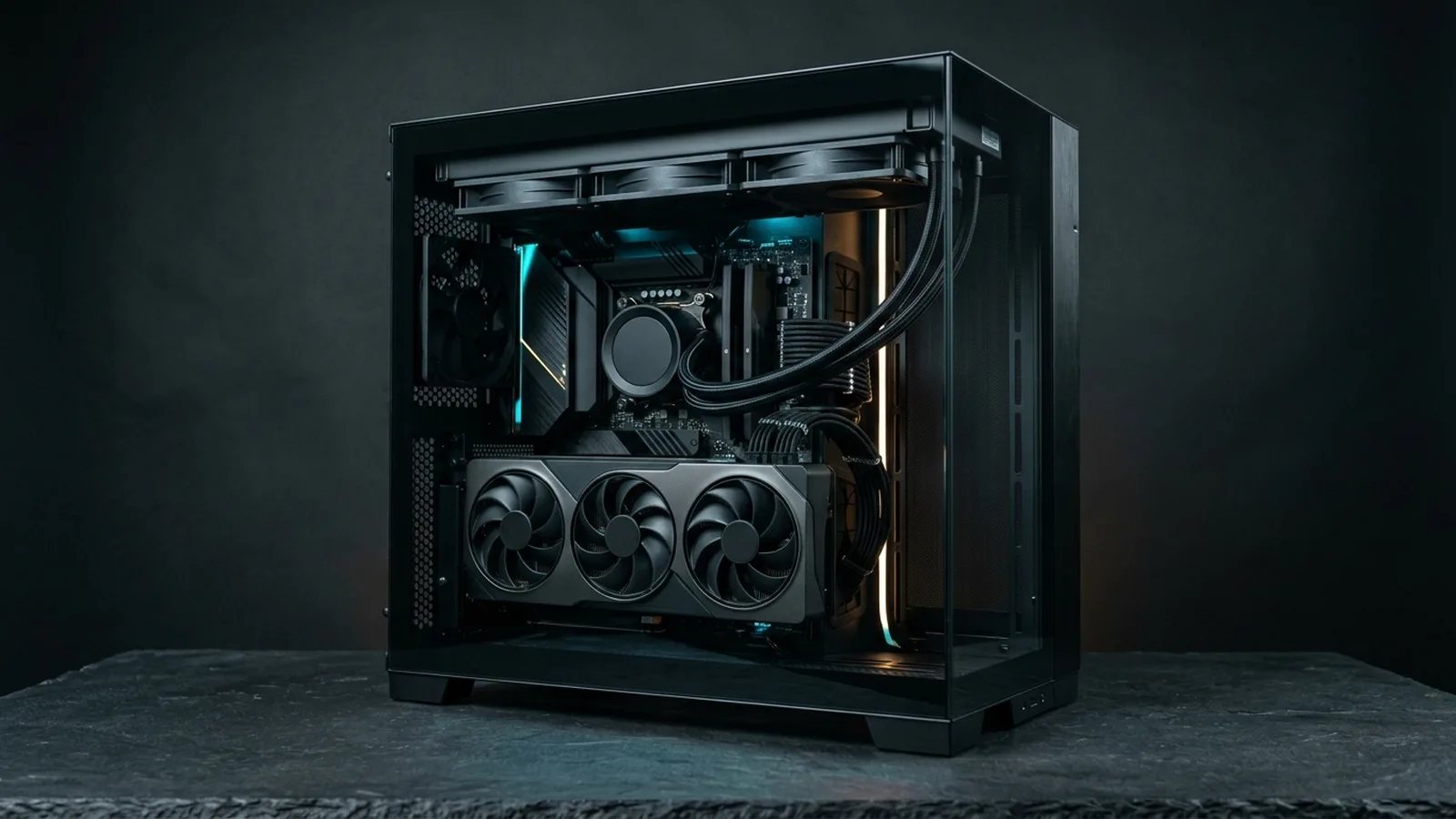
This skytech azure 3 gaming pc audit evaluates Skytech Gaming’s flagship mid-tower and panoramic prebuilt desktop lineup across its two core 2026 configurations: the Ryzen 7 9800X3D + NVIDIA GeForce RTX 5080 build and the Ryzen 7 9850X3D + AMD Radeon RX 9070 XT build. While headline CPU and GPU specs dominate Amazon storefront cards, real value in our Best Prebuilt Gaming PC pillar guide depends on unprinted subsystems: motherboard chipsets, dual-channel DDR5 timings, ATX 3.1 power safety, and wireless networking.
Unlike big-box OEM towers built around a proprietary motherboard or custom power harness, Skytech assembles the Azure 3 line using standard commercial ATX parts on AMD’s Socket AM5 platform. Even so, our catalog audit flagged critical listing omissions—unstated chipsets, Wi-Fi 5 adapters inside systems between $1,500 and $3,000, and shared Parent ASIN review pooling—that buyers must verify before ordering. Compare integrator strategies in our CyberPowerPC vs. iBUYPOWER vs. Skytech guide.
In This Audit
Skytech Azure 3 Gaming PC Audit Verdict & Weighted Scorecard
On compute silicon and upgradeability, the Skytech Azure 3 scores well for turnkey 1440p high-refresh and 4K ray-traced gaming. Both builds pair Zen 5 3D V-Cache CPUs with 16GB 256-bit GPUs, 360mm AIO liquid cooling, 32GB DDR5 RAM, and a 2TB NVMe SSD inside a standard ATX case. Deductions reflect missing motherboard chipset, PSU ATX 3.1, RAM timing, and Wi-Fi 5 disclosures.
Skytech Azure 3 Series Audit Score: 9.0 / 10 (Weighted Prebuilt Rubric)
- GPU & VRAM Headroom (35%): 9.4 / 10 — 16GB 256-bit silicon (RTX 5080 GDDR7 or RX 9070 XT GDDR6) clears 8GB/12GB VRAM ceilings.
- CPU & Platform Runway (25%): 9.5 / 10 — Ryzen 7 9800X3D and 9850X3D deliver 96MB L3 V-Cache and Socket AM5 longevity.
- Memory & Storage Balance (20%): 8.5 / 10 — 32GB DDR5 and 2TB NVMe SSD hit target capacities; timings require inspection.
- Cooling, PSU & Warranty Support (20%): 8.2 / 10 — 360mm AIO and ATX parts shine; PSU labels and Wi-Fi 5 cuts require verification.
Pros
- Commercial ATX parts avoid proprietary lock-in
- Zen 5 3D V-Cache stabilizes 1% Lows
- 16GB VRAM across RTX 5080 and RX 9070 XT SKUs
- 360mm AIO and 2TB NVMe SSD out of the box
Cons
- Listings omit chipset, PSU ATX 3.1, and RAM latency
- Select variants ship Wi-Fi 5 instead of Wi-Fi 6E/7
- Parent ASIN pooling merges old and 2026 reviews
Buy It If / Skip It If: Buy the Skytech Azure 3 for 3D V-Cache gaming stability, 16GB VRAM headroom, and standard ATX upgradeability under one warranty. Skip it if pre-disclosed Wi-Fi 7 and X870E telemetry are mandatory or your work relies heavily on 12-core and 16-core CPU rendering.
Skytech Azure 3 Gaming PC Audit: Verified Specs & Silicon Architecture
Evaluating the Azure 3 line accurately separates confirmed silicon characteristics from batch-variable parts. Below is the architectural breakdown comparing Skytech’s 9800X3D + RTX 5080 SKU (B0F6MY44CT) against the 9850X3D + RX 9070 XT SKU (B0GRGCQMXW).
| Subsystem | Azure 3 (9800X3D + RTX 5080) | Azure (9850X3D + RX 9070 XT) | Audit Status |
|---|---|---|---|
| CPU Silicon | Ryzen 7 9800X3D (8C/16T, 5.2 GHz) | Ryzen 7 9850X3D (8C/16T, 5.6 GHz) | Zen 5 AM5, 104MB cache, 120W TDP / 162W PPT |
| GPU Silicon | RTX 5080 (Blackwell, 360W TBP) | RX 9070 XT (RDNA 4, ~304W TBP) | Official 2025–2026 SKUs (Brand may vary) |
| VRAM & Bus | 16GB GDDR7 (256-bit) | 16GB GDDR6 (256-bit) | Clears 8GB / 12GB texture bottlenecks |
| Upscaling | DLSS 4 MFG + NVIDIA Reflex | AMD FSR 4 ML + Anti-Lag 2 | Requires >=50–60 base FPS for Frame Gen |
| Display I/O | DisplayPort 2.1 UHBR20 + HDMI 2.1 | DisplayPort 2.1 + HDMI 2.1 | Supports 4K 240Hz OLED panels |
| Platform | Standard ATX / mATX AM5 | Standard ATX / mATX AM5 | Verify chipset (B850 / B650 / X870) on arrival |
| Memory & SSD | 32GB DDR5 + 2TB NVMe SSD | 32GB DDR5 + 2TB NVMe SSD | Confirm 2x16GB EXPO & TLC NAND |
| Cooling & PSU | 360mm AIO + 850W–1000W Gold target | 360mm AIO + 750W–850W Gold target | Verify ATX 3.1 label & Wi-Fi 5 vs 6E/7 |
CPU & 3D V-Cache: Ryzen 7 9800X3D vs. Ryzen 7 9850X3D
Both builds run AMD Socket AM5 Ryzen CPUs with second-generation 3D V-Cache stacked beneath the compute die under a 120W TDP / 162W PPT envelope. The 9800X3D boosts to 5.2 GHz, while the January 2026 9850X3D reaches 5.6 GHz with matching 104MB cache (96MB L3). Both dramatically outclass OEM AM5 prebuilts using the Ryzen 7 8700F (16MB L3, 16 PCIe 4.0 lanes) or Intel Core Ultra 7 265F rigs without Quick Sync. See our Ryzen 7 9800X3D prebuilt guide for deeper X3D comparisons.
GPU Silicon: Blackwell RTX 5080 vs. RDNA 4 RX 9070 XT
On B0F6MY44CT, NVIDIA’s Blackwell RTX 5080 pairs 16GB GDDR7 (256-bit, 360W TBP) with DisplayPort 2.1 UHBR20 (80Gbps), hardware ray tracing, and DLSS 4 Multi-Frame Generation—requiring >=50–60 base FPS plus NVIDIA Reflex. On B0GRGCQMXW, AMD’s RDNA 4 RX 9070 XT combines 16GB GDDR6 (~304W TBP) with FSR 4 ML and Anti-Lag 2. Both clear 12GB RTX 5070 and RX 9070 GRE limits; compare peers in our RTX 5080 prebuilt guide and RX 9070 XT prebuilt guide.
Airflow Mesh Chassis & 360mm AIO Thermal Envelope
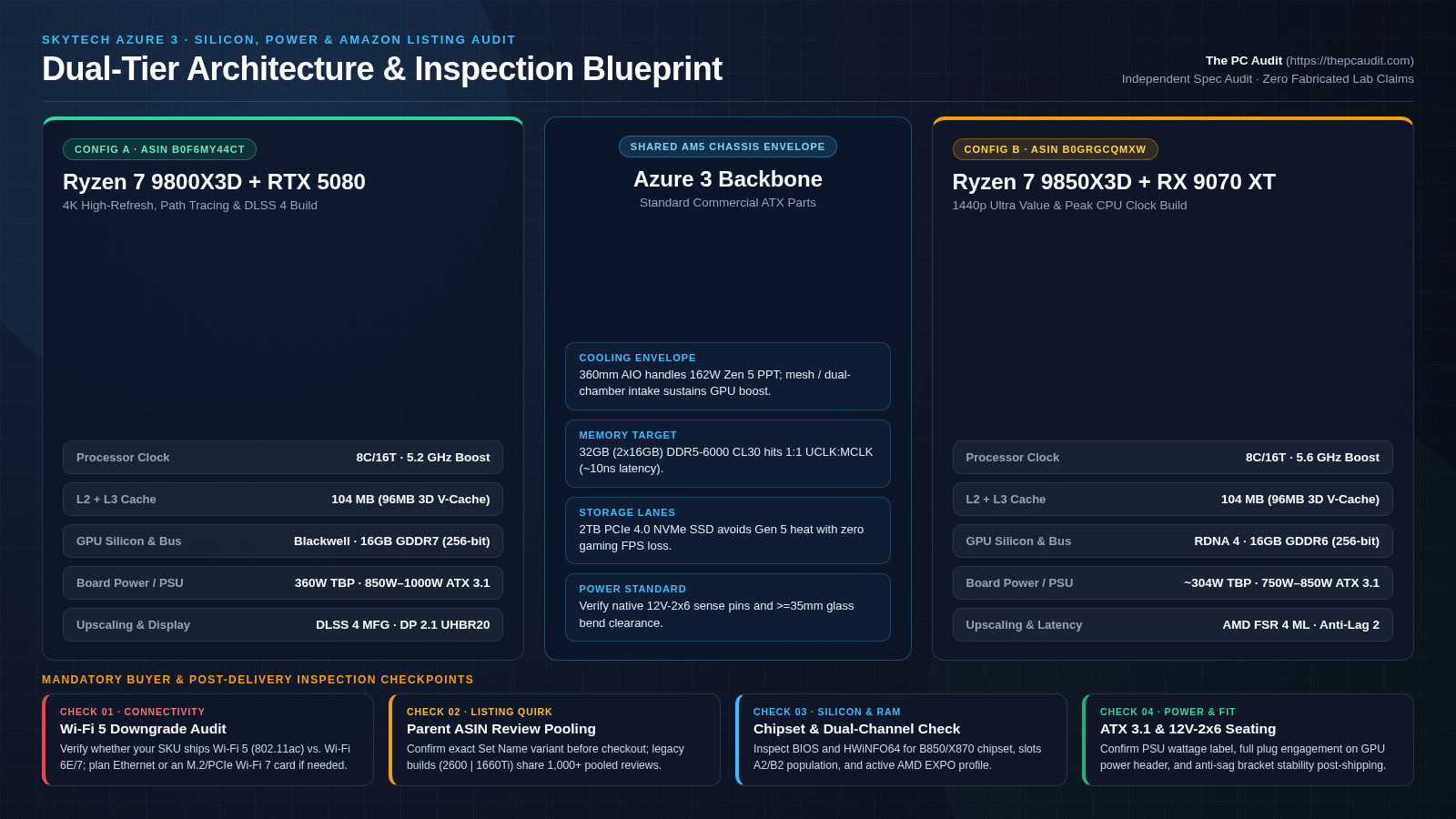
Skytech houses both systems in a ventilated mesh or dual-chamber panoramic chassis with a top-exhaust 360mm ARGB AIO. Unlike solid-front-glass cases that choke intakes, positive-pressure airflow cools the GPU shroud directly while the 360mm radiator handles the 162W PPT load quietly with headroom for PBO Curve Optimizer (-15 to -20) tuning.
ATX 3.1 Power Supply & 12V-2×6 Connector Inspection
High-wattage GPUs trigger 200%–300% transient spikes. Per PCI-SIG CEM specs and Cybenetics standards, a 360W RTX 5080 calls for an 850W–1000W ATX 3.1 80+ Gold PSU (750W–850W for RX 9070 XT). Native 12V-2×6 recessed sense pins protect against partial seating; confirm full latching and >=35mm straight cable clearance.
DDR5-6000 Dual-Channel & PCIe Storage Lanes
AM5 hits its 1:1 UCLK:MCLK sweet spot at DDR5-6000 CL30 (~10.0ns); single-stick 1x16GB or DDR5-4800 RAM drops 1% Lows by 15%–30%, and four DIMMs cut clocks. Confirm slots A2/B2 run a 2x16GB 32GB DDR5 kit with AMD EXPO active, and verify extra M.2 SSDs won’t split the primary GPU x16 slot to x8.
Real-World Workload & Resolution Ceiling (1080p, 1440p, 4K & Creator)
Target monitor resolution dictates hardware bottlenecks far more reliably than synthetic bottleneck percentage tools:
- 1080p Gaming (240Hz–540Hz): CPU L3 cache and RAM latency dominate; the 9850X3D’s 5.6 GHz clock edges out the 9800X3D in esports engines.
- 1440p Gaming (165Hz–360Hz OLED): Both 16GB GPUs excel; RX 9070 XT delivers peak raster value while RTX 5080 leads heavy ray tracing.
- 4K Gaming (120Hz–240Hz QD-OLED): Compute and GDDR7 bandwidth favor the RTX 5080, DLSS 4, and DP 2.1 UHBR20 output.
- Creator Multitasking: 8C/16T handles AV1 streaming smoothly, though heavy Blender or video exports scale quicker on 12-core Ryzen 9 9900X rigs.
| Buyer Scenario | Best Match | Expected Architectural Outcome |
|---|---|---|
| 4K Path Tracing & DLSS 4 | Skytech Azure 3 (9800X3D + RTX 5080) | 16GB GDDR7 and DP 2.1 UHBR20 maximize 4K high-refresh OLED clarity. |
| 1440p Ultra & Esports Clocks | Skytech Azure (9850X3D + RX 9070 XT) | 5.6 GHz X3D boost plus 16GB RDNA 4 prioritizes 1% Lows stability. |
| 4K Gaming + Video / 3D Creation | MSI Aegis ZS (9900X + RTX 5080) | 12C/24T Ryzen 9 accelerates multi-core renders alongside RTX 5080. |
| Pure 1440p X3D Value | STORMCRAFT Skyhawk PRO (9800X3D + RX 9070 XT) | Keeps 9800X3D + RX 9070 XT balance when 9850X3D pricing climbs. |
Compatibility, Hidden Downgrades & Amazon Buyer Alerts
Amazon Buyer Alert — Inspect These Four Listing Details Before Checkout:
- Wi-Fi 5 Downgrade: Select Skytech Azure 3 builds between $1,500 and $3,000 still bundle Wi-Fi 5 (802.11ac) instead of Wi-Fi 6E or Wi-Fi 7; plan wired Ethernet or a quick Wi-Fi 7 card swap.
- Omitted Subsystems: Amazon listings omit exact B850/B650/X870 chipsets, PSU ATX 3.1 status, SSD DRAM/TLC specs, and warn GPU “Brand may vary.”
- Parent ASIN Pooling & Filters: Set name selectors merge legacy SKUs (2600 | 1660Ti) with 9850X3D | 9070XT listings under 1,000+ pooled reviews, while sidebar Graphics Memory filters cap at “8 GB & above” and mix Renewed stock unless Condition: New is locked.
- RAM Verification: Confirm 2x16GB dual-channel installation and CAS timings rather than slow JEDEC defaults.
Post-Delivery Inspection Checklist
- Shipping & Power Fit: Remove packing foam, verify GPU anti-sag support, and ensure the 12V-2×6 plug latches flush with >=35mm straight cable clearance.
- BIOS Settings: Enable AMD EXPO and Resizable BAR (ReBAR), and set a 2–3s PWM fan delay; allow 45 seconds to 3 minutes for first-boot AM5 DDR5 memory training.
- Display & Telemetry: Plug display cables into the GPU (never the motherboard), enable full monitor Hz plus HAGS, and audit chipset, A2/B2 RAM, and thermals in HWiNFO64 alongside Cinebench 2024 or OCCT stability checks.
Buying Guide: Best System Pairings & Top Alternatives
Because Skytech builds on commercial ATX standards, upgrades remain open: step into an AMD B850 or X870 motherboard for native USB4 and PCIe 5.0 M.2 lanes, swap in a 32GB (2x16GB) DDR5-6000 CL30 EXPO kit if needed, or add a 2TB PCIe 4.0 DRAM+TLC SSD (WD Black SN850X / Samsung 990 Pro). Externally, pair the RTX 5080 with a 4K 240Hz QD-OLED DP 2.1 monitor (ASUS PG32UCDM3 / MSI MPG 322UR) or match the RX 9070 XT with a 1440p 360Hz OLED display, Hall Effect keyboard, and sub-55g 8K mouse.
| Audited System & Role | CPU (AM5) | GPU & VRAM | RAM & SSD | Link |
|---|---|---|---|---|
| 1. Skytech Azure 3 (B0F6MY44CT) Best 4K Blackwell Config | Ryzen 7 9800X3D | RTX 5080 16GB GDDR7 | 32GB DDR5, 2TB NVMe | View on Amazon |
| 2. Skytech Gaming Azure (B0GRGCQMXW) Best 1440p Peak-Clock Config | Ryzen 7 9850X3D | RX 9070 XT 16GB GDDR6 | 32GB DDR5, 2TB NVMe | View on Amazon |
| 3. MSI Aegis ZS (B0FLVRS6GB) Best Creator + 4K Alternative | Ryzen 9 9900X | RTX 5080 16GB GDDR7 | 32GB DDR5, 2TB SSD | View on Amazon |
| 4. STORMCRAFT Skyhawk PRO (B0GL8XHR4Y) Best Value X3D + 9070 XT Alt | Ryzen 7 9800X3D | RX 9070 XT 16GB GDDR6 | 32GB DDR5, 2TB SSD | View on Amazon |
1. Skytech Azure 3 Gaming Desktop PC (Ryzen 7 9800X3D & RTX 5080 16GB) — Best 4K Blackwell Configuration
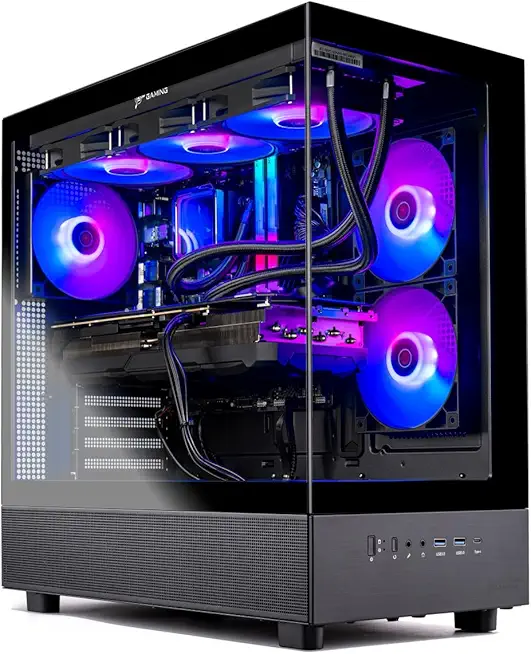
Quick Specs: Ryzen 7 9800X3D (8C/16T, 5.2 GHz) | RTX 5080 16GB GDDR7 | 32GB DDR5 | 2TB NVMe SSD | 360mm AIO | Audit Score: 9.1 / 10 | Price Tier: Enthusiast tier (above $900)
Combining the Ryzen 7 9800X3D with NVIDIA’s Blackwell RTX 5080 creates Skytech’s strongest prebuilt for 4K ray tracing, DLSS 4 Multi-Frame Generation, and DP 2.1 UHBR20 OLED panels. Compared to the RX 9070 XT Azure (B0GRGCQMXW), it holds decisive 4K path-tracing and AV1 encoding advantages, while beating the Ryzen 9 9900X MSI Aegis ZS (B0FLVRS6GB) in gaming 1% Lows via 96MB of 3D V-Cache.
Buyer Alert: Confirm HWiNFO64 telemetry after unboxing for motherboard chipset, native 12V-2×6 PSU compliance, and Wi-Fi 5 vs. Wi-Fi 6E/7 status.
Pros
- Ideal 9800X3D + RTX 5080 balance for 4K and ray tracing
- 16GB GDDR7, DLSS 4, and DP 2.1 UHBR20 support
- Commercial ATX hardware on Socket AM5
Cons
- Listing omits chipset, ATX 3.1 PSU badge, and RAM latency
- Select units include Wi-Fi 5 requiring Ethernet or card upgrade
Verdict: Buy it for 4K high-refresh ray tracing with standard ATX upgradeability. Skip it if 1440p value matters more or pre-disclosed Wi-Fi 7 is mandatory.
2. Skytech Gaming Azure (Ryzen 7 9850X3D & RX 9070 XT 16GB) — Best 1440p Peak-Clock RDNA 4 Configuration

Quick Specs: Ryzen 7 9850X3D (8C/16T, 5.6 GHz) | RX 9070 XT 16GB GDDR6 | 32GB DDR5 | 2TB NVMe SSD | 360mm AIO | Audit Score: 8.9 / 10 | Price Tier: Enthusiast tier (around $2,850–$2,950)
Featuring AMD’s 5.6 GHz Ryzen 7 9850X3D and 16GB Radeon RX 9070 XT (~304W TBP, FSR 4, Anti-Lag 2), this Azure variant targets high-refresh 1080p and 1440p setups. Positioned around $2,850–$2,950, cross-check live pricing against the RTX 5080 B0F6MY44CT and Stormcraft’s 9800X3D + RX 9070 XT rig (B0GL8XHR4Y) before paying extra solely for the 400 MHz clock bin.
Buyer Alert: Confirm the Set name selector reads 9850X3D | 9070XT rather than relying on 1,000+ pooled reviews from older 2600 | 1660Ti SKUs, and apply the newest AGESA BIOS update.
Pros
- 5.6 GHz Ryzen 7 9850X3D leads 1080p/1440p CPU-bound frames
- 16GB RDNA 4 GPU supports FSR 4 and Anti-Lag 2
- 360mm AIO handles 162W PPT quietly
Cons
- Around $2,850–$2,950 tier overlaps closely with RTX 5080 builds
- Trails RTX 5080 in 4K path tracing and DLSS 4 MFG
Verdict: Buy it for peak 1080p/1440p CPU clocks and RDNA 4 rasterization. Skip it for 4K path tracing or when an RTX 5080 configuration undercuts it.
3. MSI Aegis ZS Gaming Desktop (Ryzen 9 9900X & RTX 5080 16GB) — Best Creator & Multitasking Alternative

Quick Specs: Ryzen 9 9900X (12C/24T, AM5) | RTX 5080 16GB GDDR7 | 32GB DDR5 | 2TB SSD | Audit Score: 8.8 / 10 | Price Tier: Enthusiast tier (above $900)
If your workload splits between 4K gaming and heavy video editing, 3D rendering, or virtual machines, the MSI Aegis ZS trades Skytech’s 8-core X3D chip for a 12-core, 24-thread Ryzen 9 9900X paired with the same RTX 5080 16GB GPU and commercial MSI ATX parts. It completes multi-threaded renders quicker than B0F6MY44CT while conceding 1080p/1440p gaming 1% Lows without 3D V-Cache.
Buyer Alert: Confirm sub-SKU motherboard chipset (B850 vs. B650), Wi-Fi tier, and ATX 3.1 PSU rating in MSI’s specification list.
Pros
- 12C/24T Ryzen 9 9900X accelerates rendering and multitasking
- RTX 5080 16GB GDDR7 inside standard MSI ATX chassis
- 32GB DDR5 and 2TB SSD support large creator files
Cons
- No 3D V-Cache, trailing 9800X3D in CPU-bound 1% Lows
- Higher all-core power draw than single-CCD X3D chips
Verdict: Buy it for hybrid 4K RTX 5080 gaming and creator workloads. Skip it if pure gaming framerates lead—choose B0F6MY44CT instead.
4. STORMCRAFT Skyhawk PRO Gaming Desktop (Ryzen 7 9800X3D & RX 9070 XT 16GB) — Best Value X3D + RDNA 4 Alternative

Quick Specs: Ryzen 7 9800X3D (8C/16T, 5.2 GHz) | RX 9070 XT 16GB GDDR6 | 32GB DDR5 | 2TB SSD | Audit Score: 8.8 / 10 | Price Tier: Enthusiast tier (above $900)
When Skytech’s 9850X3D Azure SKU sits near $2,950, the STORMCRAFT Skyhawk PRO preserves 104MB 3D V-Cache and RX 9070 XT 16GB graphics via the Ryzen 7 9800X3D, 32GB DDR5, and a 2TB SSD on standard ATX AM5 hardware, trading only 400 MHz of peak boost clock.
Buyer Alert: Verify cooler size, ATX 3.1 PSU wattage, and Wi-Fi 6E/7 specs in the listing details before purchase.
Pros
- Sweet-spot 9800X3D + 16GB RX 9070 XT 1440p pairing
- Commercial ATX AM5 hardware preserves future upgrades
- 32GB DDR5 and 2TB SSD ready out of the box
Cons
- Smaller support network than Skytech or MSI
- RX 9070 XT lags RTX 5080 in heavy 4K ray tracing
Verdict: Buy it for 1440p X3D + RDNA 4 value when priced below 9850X3D models. Skip it if major-brand support or RTX 5080 4K performance is essential.
Audit Methodology, Weighted Rubric & Excluded Configurations
Every prebuilt audit at The PC Audit applies our 100% specification rubric anchored to official AMD, NVIDIA, PCI-SIG, and Cybenetics datasheets—never fabricated frame-rate charts.
| Criterion | Weight | What We Audited |
|---|---|---|
| GPU & VRAM Headroom | 35% | 16GB vs 8GB/12GB VRAM capacity, DLSS 4 / FSR 4, and DP 2.1 output. |
| CPU & Platform Runway | 25% | 3D V-Cache, AM5 upgrade longevity, and unsplit PCIe x16 lane routing. |
| Memory & Storage Balance | 20% | Dual-channel 32GB DDR5 (6000 CL30 target) and 2TB NVMe SSD capacity. |
| Cooling, PSU & Warranty Support | 20% | Mesh airflow, 360mm AIO sizing, ATX 3.1 80+ Gold / 12V-2×6 safety, and ATX parts. |
Models We Audited & Rejected at This Price Tier
- Unlocked i9-14900KF + Intel B760 Prebuilts: Excluded for locking CPU multiplier tuning while stressing entry B760 VRMs.
- Proprietary OEM Towers (proprietary motherboard/PSU lock-in): Disqualified because custom connectors block ATX 3.1 PSU and motherboard swaps.
- Systems Above $1,100 With 8GB GPUs or 1x16GB DDR5-4800: Disqualified for VRAM saturation and 15%–30% single-channel 1% Lows drops.
Our complete scoring rubric and source standards are documented in the The PC Audit Hardware Audit Methodology.
Frequently Asked Questions: Skytech Azure 3 Gaming PC Audit
Does the Skytech Azure 3 use a proprietary motherboard or standard ATX parts?
Skytech builds the Azure 3 using standard ATX or micro-ATX motherboards, standard ATX power supplies, and standard 360mm AIO mounts rather than proprietary OEM parts, enabling straightforward RAM, SSD, PSU, and AM5 CPU upgrades.
Should I buy the 9800X3D + RTX 5080 or 9850X3D + RX 9070 XT Azure build?
Buy the 9800X3D + RTX 5080 (B0F6MY44CT) for 4K gaming, heavy ray tracing, DLSS 4, and DP 2.1 UHBR20 OLED panels. Buy the 9850X3D + RX 9070 XT (B0GRGCQMXW) for 1440p high-refresh gaming prioritizing 5.6 GHz clocks.
Why do some Skytech Azure 3 listings ship Wi-Fi 5 or omit the chipset?
Integrators often leave chipsets (B850 vs. B650) open for batch inventory flexibility and sometimes ship Wi-Fi 5 in builds between $1,500 and $3,000. Inspect networking in HWiNFO64 upon arrival and use Ethernet or upgrade to Wi-Fi 7.
Why do Skytech Azure pages on Amazon show over 1,000 older reviews?
Amazon lets sellers group legacy and 2026 configurations under one Parent ASIN Set name, merging reviews from older Ryzen 5 2600 + GTX 1660 Ti systems onto 9850X3D + RX 9070 XT listings. Filter reviews strictly by exact variant.
Should I wait for rumored RTX 5070 Super or RTX 5080 Super prebuilts?
No—both the RTX 5070 Super and RTX 5080 Super remain unconfirmed, unreleased rumors projected for late 2026 or Q1 2027 and are excluded from retail recommendations. Shipping RTX 5080 and RX 9070 XT builds already include 16GB VRAM.
Final Verdict: Should You Buy the Skytech Azure 3?
Concluding this skytech azure 3 gaming pc audit, Skytech delivers the prebuilt essentials that matter: Zen 5 3D V-Cache CPUs, 16GB GPUs, 360mm AIO cooling, and zero proprietary ATX lock-in. For 4K OLED monitors and ray tracing, the Ryzen 7 9800X3D + RTX 5080 Azure 3 (B0F6MY44CT) ranks highest overall. For 1440p high-refresh gaming, the Ryzen 7 9850X3D + RX 9070 XT Azure (B0GRGCQMXW) excels whenever priced competitively against RTX 5080 peers and rivals like the STORMCRAFT Skyhawk PRO. Verify EXPO, 12V-2×6 seating, and Wi-Fi on arrival, or compare picks in our Best Prebuilt Gaming PC hub.


