
Disclosure: As an Amazon Associate, The PC Audit earns from qualifying purchases. If you buy through links on this page, we may earn a small commission at no extra cost to you.
Comparing cyberpowerpc vs ibuypower vs skytech in 2026 comes down to one critical distinction beneath the tempered glass: while all three System Integrators assemble off-the-shelf ATX towers rather than locking buyers inside a proprietary motherboard or non-standard power harness, each brand hides starkly different compromises in its spec sheets. One builder prints explicit AMD B850 motherboard chipsets while leaving power supply wattage blank, another advertises bloatware-free Windows 11 while shipping single-stick DDR5-4800 memory, and the third puts 80+ Gold power ratings and 360mm liquid coolers up front while bundling legacy Wi-Fi 5 adapters and pooled Amazon reviews.
Across our broader evaluations in the best prebuilt gaming PC hub and our 10 prebuilt gaming PC red flags audit, we grade every desktop using our weighted 100-point rubric: GPU & VRAM Headroom (35%), CPU & Platform Runway (25%), Memory & Storage Balance (20%), and Cooling, PSU & Warranty Support (20%). Applying that parts-level audit across live 2026 retail listings exposes which standard ATX builder delivers clean upgrade headroom—and which listing traps cost you real framerate stability.
In This Brand Showdown
- TL;DR Winner Matrix: Quick Verdict
- Side-by-Side Standard ATX Parts Disclosure Audit
- Battleground 1: GPU, VRAM Ceilings & “Brand May Vary” Clauses (35%)
- Battleground 2: CPU Pairings, Cache Traps & Chipset Disclosure (25%)
- Battleground 3: DDR5 Channels, NVMe SSDs & Wi-Fi 5 Downgrades (20%)
- Battleground 4: ATX 3.1 PSUs, Airflow Cases & Thermal Clearance (20%)
- Battleground 5: Amazon Review Pooling, Variant Noise & Bloatware
- Audited Retail Benchmarks: Representative 2026 Systems
- Decisive Verdict: CyberPowerPC vs. iBUYPOWER vs. Skytech
- Frequently Asked Questions
TL;DR Winner Matrix: Quick Verdict
If you want the direct verdict before auditing motherboard chipsets, power supply ratings, and Amazon catalog pitfalls, here is how CyberPowerPC, iBUYPOWER, and Skytech Gaming separate across five core buying criteria.
| Evaluation Category | Declared Category Winner | Decisive Technical Reason |
|---|---|---|
| Overall Standard ATX Build Quality | Skytech Gaming (Mid-Upper & Enthusiast) | Explicitly specifies 650W 80+ Gold PSUs on mid-range rigs, 32GB DDR5 capacity, 360mm AIO cooling on flagship X3D builds, and zero OS bloatware. |
| Motherboard Chipset & Fulfillment Clarity | CyberPowerPC | Frequently documents exact AMD B850 or Intel B760 chipsets plus Wi-Fi 6 on mainstream Shipped & Sold by Amazon models, outscoring peers on board clarity. |
| Clean Budget OS & Entry AM5 Access | iBUYPOWER (With Mandatory RAM Upgrade) | Delivers bloatware-free Windows 11 Home on upgradeable AM5 chassis, but requires immediate audit fixes for single-stick 1x16GB DDR5-4800 and Wi-Fi 5. |
| Cooling & Power Disclosure | Skytech Gaming | Prints 80+ Gold PSU ratings on mainstream Nebula and Crystal models and pairs mesh or dual-chamber towers with properly scaled 360mm AIO radiators. |
| Amazon Listing Transparency | Tie: CyberPowerPC (Board Specs) / Skytech (PSU Specs) | Both avoid proprietary lock-in, yet buyers must dodge CyberPowerPC omitted PSUs and duplicate CPU labels alongside Skytech Parent ASIN review pooling. |
Side-by-Side Standard ATX Parts Disclosure Audit
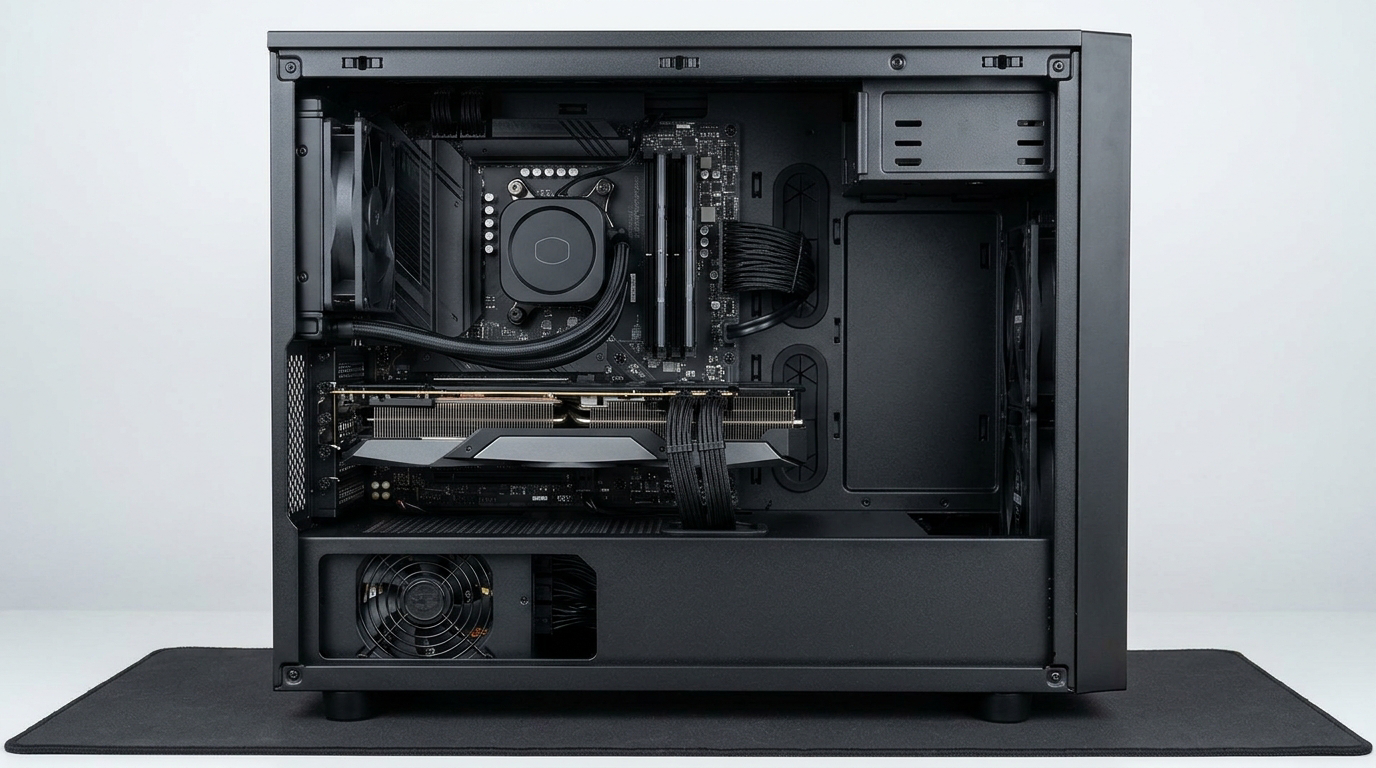
Unlike major OEM lines from Dell Alienware, HP OMEN, or Acer Nitro—which routinely deploy custom-shaped motherboards and non-standard 10-pin or 12-pin PSU connectors—CyberPowerPC, iBUYPOWER, and Skytech Gaming all build inside standardized retail ATX or micro-ATX footprints. That shared foundation means any buyer can later swap in a retail graphics card, dual-tower air cooler, or Cybenetics-certified ATX 3.1 power supply. Still, their out-of-the-box part disclosures differ dramatically across ten audited specifications.
| Standard ATX Audit Axis | CyberPowerPC (Gamer Master / Gamer Xtreme) | iBUYPOWER (Element SE / Slate / Trace) | Skytech Gaming (Nebula / Crystal / Azure) |
|---|---|---|---|
| Form Factor & Upgradability | 100% standard ATX / mATX cases and retail power mounts; zero proprietary motherboard lock-in. | 100% standard ATX / mATX layout; standard 24-pin motherboard and ATX PSU bays. | 100% standard ATX / mATX and dual-chamber tempered glass towers; full DIY part compatibility. |
| Motherboard Chipset Clarity | Strong on core SKUs: explicitly documents AMD B850 (AM5) or Intel B760 on mainstream listings. | Frequently omitted on entry and mid-range listings (must verify exact socket and VRM via photos). | Routinely omitted even on high-end Azure 3 systems; rarely specifies B850 vs. X870 or B650. |
| Common 2026 CPU Pairings | Ryzen 5 5500 (AM4), Ryzen 7 8700F (AM5), Core i5-14400F, Core i7-14700F, up to 9800X3D. | Ryzen 5 8400F, Ryzen 7 8700F, Intel Core i5/i7 LGA 1700, up to Ryzen 7 9800X3D. | Ryzen 5 5500 (Nebula), Ryzen 7 7700 (Crystal), up to Ryzen 7 9850X3D (Azure). |
| GPU Tiering & “Brand May Vary” | Broad coverage from legacy RX 6500 XT 4GB to RTX 5060 / 5060 Ti 8GB and RTX 5070 / 5080; AIB partner rotates. | Mix of RTX 3050 6GB entry rigs up to RTX 5060 Ti, RTX 5070, and RX 9070 XT; AIB partner rotates. | RTX 3050 6GB (Nebula) to RTX 5060 Ti 8GB (Crystal) and RX 9070 XT 16GB (Azure); AIB partner rotates. |
| RAM Capacity & Channel Risk | 8GB DDR4 on sub-$700 units; 16GB DDR5 on $1,100–$1,400 units (stick count and timings unstated). | Explicit single-channel trap on Element SE: 16GB DDR5-4800 (1x16GB); 32GB on upper tiers. | 16GB DDR4-3200 (Nebula) or 32GB DDR5-5600 (Crystal / Azure); rarely hits DDR5-6000 CL30. |
| NVMe SSD Transparency | 500GB to 1TB–2TB PCIe 4.0 NVMe SSD; controller, TLC/QLC NAND, and DRAM cache omitted. | 1TB–2TB NVMe SSD; drive brand, DRAM cache presence, and NAND flash type unstated. | 1TB–2TB Gen4 NVMe M.2 SSD; capacity generous on high-end Azure, though TLC/DRAM unconfirmed. |
| PSU Wattage & ATX 3.1 Clarity | Often omitted completely (wattage and 80+ tier missing) on $1,000–$1,500 Amazon listings. | Wattage and 80+ certification frequently omitted on budget/mid-tier pages; ATX 3.1 rarely confirmed. | Frequently states 650W 80+ Gold (Nebula / Crystal) and Gold-rated units; ATX 3.1 / 12V-2×6 rarely itemized. |
| Thermal & Case Topology | Mixed airflow: ventilated mesh mid-towers alongside closed-front RGB show cases; cooler specs vary. | Dual-glass and mesh Element/Slate designs; entry systems often include basic single-tower coolers. | Strong contrast: mesh Nebula tower, triple-glass Crystal, and 360mm AIO cooling on Azure flagship builds. |
| Wi-Fi & LAN Standard | Wi-Fi 5 on sub-$700 AM4 rigs; Wi-Fi 6 on Intel B760 units; occasional Wi-Fi 6E/7 on top tiers. | Persistent Wi-Fi 5 (802.11ac) downgrade on budget/mid Element SKUs; Gigabit LAN standard. | Widespread Wi-Fi 5 stealth downgrade even on $1,500–$3,000 Crystal and Azure 3 configurations. |
| Amazon Catalog & OS Hygiene | Shipped & Sold by Amazon widely available; duplicate CPU variant naming noise; 1-yr warranty + lifetime support. | Windows 11 Home explicitly bloatware-free; variable third-party/Amazon fulfillment; 1-yr warranty. | Explicitly zero bloatware Windows 11 Home; aggressive Parent ASIN review pooling via “Set name”; 1-yr US warranty. |
Battleground 1: GPU, VRAM Ceilings & “Brand May Vary” Clauses (35%)
Graphics silicon dictates 35% of our system evaluation rubric because VRAM capacity and memory bus width define your playable ceiling across 1080p gaming, 1440p gaming, and 4K gaming. All three builders pull from the exact same 2025–2026 retail GPU roster—NVIDIA Blackwell (RTX 5060, RTX 5060 Ti 8GB/16GB, RTX 5070 12GB, RTX 5070 Ti 16GB, and RTX 5080 16GB) alongside AMD RDNA 4 (RX 9060 XT 8GB/16GB, RX 9070 16GB, RX 9070 GRE 12GB, and RX 9070 XT 16GB)—so the deciding factor is how aggressively each brand rations VRAM at each budget rung.
1. The 8GB VRAM Trap Above $1,100 & Page-1 Legacy Cards
Under our hardware audit rules, any mid-range prebuilt priced above $1,100 carrying an 8GB graphics card triggers a formal VRAM ceiling warning. Across Amazon’s bestselling configurations, both CyberPowerPC and Skytech lean heavily on the 8GB RTX 5060 ($299 Launch MSRP) and 8GB RTX 5060 Ti ($379 Launch MSRP) across $1,200 to $1,700 tiers instead of stepping up to the 16GB RTX 5060 Ti ($429 Launch MSRP) or 16GB RX 9060 XT ($349 Launch MSRP). While an 8GB Blackwell GPU handles 1080p esports effortlessly, modern AAA engines with Ultra textures, hardware ray tracing, and DLSS 4 Multi-Frame Generation rapidly saturate an 8GB buffer at 1440p—causing sudden frametime spikes and muddy texture streaming.
At the entry level under $1,000, the traps grow sharper across all three catalogs:
- CyberPowerPC Entry Traps: Page-1 listings such as the sub-$700 Gamer Master GMA3100A3 still circulate with an aging 4GB Radeon RX 6500 XT paired with 8GB DDR4 and a 500GB SSD—insufficient for modern 1080p AAA titles.
- iBUYPOWER & Skytech 6GB Holdovers: Entry systems like the iBUYPOWER Element SE (ESA5N3501) and Skytech Nebula Series frequently rely on the legacy 6GB GeForce RTX 3050, which trails modern 10GB–12GB entry silicon like the Intel Arc B570 ($219 Launch MSRP) or Arc B580 ($249 Launch MSRP) by a wide margin once Resizable BAR is enabled.
- OEM-Targeted 12GB Variants: In the $1,500–$2,000 bracket, keep a close eye on prebuilt listings carrying the AMD RX 9070 GRE (48 Compute Units, 12GB GDDR6 on a 192-bit bus, 220W TBP) versus the full 16GB RX 9070 ($549 Launch MSRP) or 16GB RX 9070 XT ($599 Launch MSRP). Always verify exact 12GB vs. 16GB capacity before comparing sticker prices.
2. Understanding “Brand May Vary” & Feature Parity
All three builders embed a “Brand may vary” disclaimer on graphics cards inside volume prebuilts—documented in depth in our guide to omitted PSU ratings and Brand May Vary GPUs. Because CyberPowerPC, iBUYPOWER, and Skytech source AIB graphics cards in bulk from ASUS, MSI, Gigabyte, ASRock, Zotac, PNY, and PowerColor depending on weekly inventory, two buyers ordering the same SKU may receive a compact dual-fan model or a beefier triple-fan card. Neither alters core GPU silicon or standard PCIe x16 compatibility, yet triple-fan AIB models naturally run cooler and quieter under sustained 250W–360W loads than twin-fan value SKUs.
Where Skytech pulls slightly ahead in enthusiast tiers is flagship allocation: configurations like the Skytech Azure pair the 16GB RX 9070 XT ($599 Launch MSRP) directly with high-airflow cases, while CyberPowerPC and iBUYPOWER offer wider mid-range RTX 5060 Ti and RTX 5070 ($549 Launch MSRP) 12GB variety—and top-tier RTX 5080 ($999 Launch MSRP) systems across all three unlock 4K high-refresh performance. Regardless of brand, remember two hard 2026 rules: enable NVIDIA Reflex or AMD Anti-Lag 2 while maintaining a 50–60 native base FPS floor whenever activating DLSS 4 Multi-Frame Generation or FSR 4 Frame Gen, and avoid delaying a purchase for rumored, unreleased refreshes like the unconfirmed RTX 5070 Super or RTX 5080 Super.
Battleground 2: CPU Pairings, Cache Traps & Chipset Disclosure (25%)
Processor selection and motherboard chipset transparency represent 25% of our rubric—and expose the sharpest philosophical divide between CyberPowerPC, iBUYPOWER, and Skytech Gaming. Because standard ATX cases let you drop in a faster CPU years later, socket longevity and chipset disclosure determine whether a $1,300 tower stays relevant through 2028 or stalls on day one.
1. The Ryzen 7 8700F Cache Compromise vs. Full-Cache & X3D Silicon
Shoppers comparing mid-range CyberPowerPC and iBUYPOWER listings frequently encounter the OEM-heavy Ryzen 7 8700F—an 8-core, 16-thread AM5 processor rated at 65W TDP with up to 5.0 GHz boost and no integrated graphics. While its “Ryzen 7” badge looks equal to retail chips in search titles, the Phoenix-derived silicon shrinks L3 cache down to 16MB and caps usable PCIe 4.0 connectivity at 16 lanes. Compare that against standard retail AM5 processors:
- Ryzen 7 7700 (32MB L3): Found inside mid-upper Skytech builds like the Crystal Series, doubling L3 cache over the 8700F and preserving full PCIe lane routing plus an integrated iGPU for troubleshooting.
- Ryzen 7 9800X3D & 9850X3D (96MB L3 3D V-Cache): Offering six times the L3 cache of the 8700F—104MB total cache across L2+L3, with the 9800X3D ($479 Launch MSRP) boosting to 5.2 GHz and the January 2026 Ryzen 7 9850X3D ($499 Launch MSRP) reaching 5.6 GHz—3D V-Cache eliminates CPU-bound micro-stutters and elevates 1% Low framerates in competitive shooters and simulation engines.
- Why AM5 Still Protects 8700F Buyers: Despite weaker 1% Lows out of the box, an 8700F prebuilt sitting on a documented AM5 motherboard still allows a painless drop-in upgrade to a Ryzen 7 9800X3D or 9850X3D later without replacing the board or RAM.
2. Intel Hybrid Pairings, Core Ultra 7 265F & B760 VRM Traps
On the Intel side, CyberPowerPC remains aggressive on LGA 1700 value—pairing 10-core Core i5-14400F and 20-core Core i7-14700F processors with explicit B760 motherboards—while upper prebuilts from all three occasionally transition to Arrow Lake LGA 1851 silicon such as the OEM-oriented Core Ultra 7 265F (20 cores: 8P+12E, 5.3 GHz max turbo, 65W base / 182W max turbo, 66MB total cache). Note that any F-suffix processor—including the 265F, 8700F, 14400F, and 14700F—removes integrated graphics, which strips Intel Quick Sync hardware video transcoding from creator workflows and eliminates backup display output if your discrete GPU ever requires RMA service.
Watch out for one persistent Intel prebuilt trap across volume builders: dropping an unlocked Core i9-14900KF onto a budget Intel B760 motherboard. Because B-series chipsets lock CPU multiplier overclocking and budget B760 boards frequently skimp on VRM phase cooling, high-wattage K chips can throttle under sustained all-core workloads. Similarly, if stepping onto LGA 1851 with an unlocked Core Ultra 7 270K Plus ($299 Launch MSRP) or Core Ultra 9 285K ($589 Launch MSRP), an Intel Z890 board is mandatory for CPU multiplier tuning, whereas B860 locks CPU multipliers.
3. Motherboard Chipset Transparency Scorecard
This is where CyberPowerPC earns a clear lead. Mainstream Amazon configurations like the CyberPowerPC Gamer Master GMA2900A3 explicitly list an AMD B850 chipset—guaranteeing PCIe 5.0 M.2 support, unlocked CPU/RAM tuning, and full AM5 future-proofing—while Intel Gamer Xtreme units openly document Intel B760. By contrast, Skytech Gaming routinely omits the exact motherboard chipset even on flagship Azure 3 listings, and iBUYPOWER’s Element SE product sheet leaves the AM5 chipset completely unspecified. Without a printed B850 or X870 guarantee, buyers risk receiving entry-level A620 or legacy B650 boards with bare VRM heatsinks or limited M.2 expansion.
Battleground 3: DDR5 Channels, NVMe SSDs & Wi-Fi 5 Downgrades (20%)
Hidden compromises in system memory, storage flash, and wireless networking decide 20% of our system balance score—and reveal why headline CPU/GPU specs alone mislead prebuilt shoppers.
1. Single-Channel 1x16GB DDR5-4800 vs. 32GB Dual-Channel DDR5
Nothing cripples an otherwise modern gaming rig faster than memory bandwidth starvation:
- iBUYPOWER’s Explicit 1x16GB Penalty: The iBUYPOWER Element SE (ESA5N3501) ships with 16GB DDR5-4800 (1x16GB). Running a single DIMM halves memory bus bandwidth to single-channel operation and runs at baseline JEDEC 4800 MT/s speeds, slashing 1% Low framerates by 15% to 30% in open-world and multiplayer titles.
- CyberPowerPC’s Unstated Channel Spec: Mainstream CyberPowerPC $1,100–$1,400 systems list “16GB DDR5” without clarifying whether the tray holds two 8GB sticks or a lone 16GB stick, nor confirming CAS latency (avoid loose CL40–CL46 modules whenever upgrading).
- Skytech’s Capacity Lead—Short of Sweet Spot Speed: Mid-upper and flagship Skytech builds such as the Crystal and Azure step up to 32GB DDR5-5600, doubling capacity for streaming and heavy textures. While far safer than 16GB single-channel rigs, DDR5-5600 still trails the optimal AM5 1:1 UCLK:MCLK sweet spot of 32GB (2x16GB) DDR5-6000 CL30. And remember: if you upgrade RAM later, swap to a clean 2-DIMM kit (slots A2/B2) rather than populating all 4 DDR5 slots, which forces memory controllers to drop speed.
2. NVMe SSD Opacity & Capacity Traps
All three System Integrators share the same storage blind spot: listings specify “1TB PCIe 4.0 NVMe SSD” or “2TB Gen4 NVMe M.2 SSD” without identifying the controller, whether the drive carries dedicated DRAM cache versus DRAM-less Host Memory Buffer (HMB), or whether it uses durable TLC NAND rather than lower-endurance QLC flash. On sub-$700 units like CyberPowerPC’s GMA3100A3, a 500GB drive leaves room for barely three modern AAA installs before hitting performance-degrading capacity walls. Flagship Skytech Azure units mitigate capacity pain with 2TB Gen4 drives out of the box—and buyers upgrading storage later should target a 2TB PCIe 4.0 DRAM+TLC drive (like WD Black SN850X or Samsung 990 Pro class units), which delivers virtually identical game load times and zero FPS penalty compared to hot, costly PCIe 5.0 SSDs.
3. The Stealth Wi-Fi 5 Downgrade in $1,500–$3,000 Builds
One of the most overlooked cost-cutting moves in 2026 Amazon catalogs hits wireless networking. Both iBUYPOWER (Element SE) and Skytech Gaming (Nebula, Crystal, and even $1,500–$3,000 Azure 3 configurations) repeatedly ship aging Wi-Fi 5 (802.11ac) adapters instead of Wi-Fi 6E or Wi-Fi 7 with 2.5GbE LAN. Meanwhile, mainstream Intel CyberPowerPC builds such as the Gamer Xtreme GXiVR8040A19 and GXiVR8060A47 routinely move up to Wi-Fi 6. Unless your desktop connects exclusively via Ethernet cable, factor a $30–$45 M.2 Wi-Fi 6E/7 card or PCIe adapter upgrade into any Wi-Fi 5 tower.
Battleground 4: ATX 3.1 PSUs, Airflow Cases & Thermal Clearance (20%)
Power delivery safety, sustained CPU boost cooling, and physical chassis geometry determine long-term hardware reliability and account for the remaining 20% of our audit rubric.
1. PSU Transparency: Skytech Prints 80+ Gold While Peers Stay Silent
Power supply disclosure separates Skytech Gaming cleanly from CyberPowerPC and iBUYPOWER in mainstream shopping tiers:
- Skytech’s Explicit Rating Policy: Even sub-$950 Nebula and mid-upper Crystal listings explicitly print 650W 80+ Gold PSU specifications, giving buyers baseline confidence in conversion efficiency compared to unknown non-modular Bronze units.
- CyberPowerPC & iBUYPOWER Omissions: Across $1,000–$1,500 Amazon configurations, both CyberPowerPC and iBUYPOWER routinely leave PSU wattage and 80 Plus certification blank—forcing shoppers to inspect case-window photos or user Q&As to verify capacity.
- The Missing ATX 3.1 & 12V-2×6 Confirmation: None of the three builders consistently specifies ATX 3.1 / PCIe 5.1 compliance or native 12V-2×6 cables with recessed sense pins on Amazon listings. Native ATX 3.1 PSUs are engineered to absorb 200%–300% GPU transient power excursions—targeting 650W for entry 1080p cards, 750W–850W for 1440p RTX 5070 / RX 9070 XT rigs, and 1000W for RTX 5080 systems. Whenever upgrading a prebuilt PSU, never reuse modular cables from the factory power supply on a replacement brand, as pinout mismatches can cause immediate short circuits.
2. Mesh vs. Triple-Glass Airflow & Cooler Sizing
Physical cooling topology varies just as widely within each brand’s lineup as between brands. Skytech demonstrates both extremes: its entry Nebula series uses an unobstructed front-mesh ARGB intake ideal for steady airflow, whereas its Crystal series wraps components in a triple-glass panoramic shell that relies heavily on side/bottom intake fans to keep GPUs below thermal throttling thresholds. At the high end, Skytech Azure desktops pair panoramic tempered glass with 360mm AIO liquid coolers capable of taming high-boost Ryzen 7 9850X3D chips quietly.
Across CyberPowerPC and iBUYPOWER mid-range towers, avoid sealed solid-front glass panels lacking wide side vents, and reject any configuration pairing a high-wattage processor (170W–250W MTP) with a tiny 120mm AIO or thin 92mm air cooler. When installing a longer RTX 5070 Ti or RTX 5080 upgrade later inside any of these standard ATX towers, confirm horizontal GPU length clearance and verify at least 35mm of straight clearance between the GPU’s 12V-2×6 header and the tempered glass side panel to avoid hazardous connector bending.
Battleground 5: Amazon Review Pooling, Variant Noise & Bloatware
Evaluating hardware specs is only half the job when buying CyberPowerPC, iBUYPOWER, or Skytech online—navigating Amazon’s catalog structure is equally critical, as detailed in our 10-axis guide to auditing PC components on Amazon.
1. Three Marketplace Traps Unique to These Three Brands
- Skytech Parent ASIN Review Pooling: Multiple Skytech product pages bundle legacy 2019-era builds (such as “2600 | 1660Ti”) alongside current 2026 flagship configs (“9850X3D | 9070XT”) under one Parent ASIN “Set name” selector. That merges 1,000+ historical star ratings onto brand-new hardware combinations—meaning a 4.6-star badge does not guarantee verified feedback on the exact 2026 GPU, cooler, or PSU variant in your cart.
- CyberPowerPC Variant String Noise & Collapsed Spec Glitches: CyberPowerPC listings often generate duplicate CPU dropdown labels (splitting identical silicon into separate “AMD Ryzen 7”, “8700 F”, and “8700F” choices), while Amazon’s automated technical detail boxes show catalog noise like “Screen Size: 0.01” or “Cache Size: 8”. Always audit the exact model code (such as GMA2900A3) rather than trusting collapsed Amazon spec rows.
- Broken Sidebar Facets & Renewed Mixing: Amazon’s left-hand “Graphics Memory” filter caps out at “8 GB & above,” hiding 12GB, 16GB, and 32GB tiers altogether, while “Graphics Processor” surfaces legacy RX 500, Vega, and Intel HD labels. Lock the Condition filter strictly to New and verify “Shipped & Sold by Amazon” (an area where CyberPowerPC inventory excels) to prevent refurbished returns from masquerading as factory-new deals.
2. OS Bloatware & Warranty Coverage
Once unboxed, software hygiene favors Skytech and iBUYPOWER: both explicitly market bloatware-free Windows 11 Home installations free of trial antivirus nags and resource-hogging OEM suites. CyberPowerPC delivers clean retail Windows builds with minimal extras, though buyers should still check Startup Apps and verify motherboard EXPO/XMP profiles in BIOS right out of the box. On warranty coverage, all three settle on a standard 1-year US parts and labor warranty (with CyberPowerPC advertising lifetime technical support), trading the 3-to-10-year individual component warranties of DIY builds for single-point RMA convenience during year one.
Audited Retail Benchmarks: Representative 2026 Systems
To translate brand patterns into concrete buying decisions, we audited four representative, officially released 2025–2026 standard ATX systems across CyberPowerPC, iBUYPOWER, and Skytech Gaming on Amazon US.
1. CyberPowerPC Gamer Master (GMA2900A3) — Best Chipset Disclosure Under $1,400

Budget Tier: Mid-upper tier (under $1,400; roughly $1,200–$1,350) | Audited Specs: AMD Ryzen 7 8700F (8C/16T, up to 5.0 GHz, 16MB L3, AM5) | AMD B850 Chipset | NVIDIA GeForce RTX 5060 Ti 8GB GDDR7 | 16GB DDR5 | 1TB PCIe 4.0 NVMe SSD | Windows 11 Home, RGB KB & Mouse | Shipped & Sold by Amazon.
Standard ATX Brand Audit: The GMA2900A3 highlights CyberPowerPC’s biggest strength and its most common omission side by side. Explicitly documenting an AMD B850 AM5 motherboard guarantees modern PCIe 5.0 M.2 support and an open upgrade lane to future 3D V-Cache processors, backed by direct Amazon fulfillment. However, buyers must account for the Ryzen 7 8700F’s trimmed 16MB L3 cache and 16 usable PCIe 4.0 lanes, the 8GB VRAM ceiling of the RTX 5060 Ti 8GB ($379 GPU Launch MSRP) above $1,100, and unlisted PSU wattage and RAM stick counts.
Pros: Explicitly discloses upgradeable AMD B850 AM5 motherboard; Shipped & Sold by Amazon fulfillment; clean standard ATX chassis.
Cons: PSU wattage and 80+ rating omitted; 8GB VRAM limits 1440p Ultra textures; Ryzen 7 8700F carries half the L3 cache of retail Zen 5 chips; RAM stick count unstated.
2. iBUYPOWER Element SE (ESA5N3501) — Clean OS Entry AM5 Rig Requiring RAM Audit

Budget Tier: Upper budget (under $1,000) | Audited Specs: AMD Ryzen 5 8400F (up to 4.2 GHz, AM5) | NVIDIA GeForce RTX 3050 6GB | 16GB DDR5-4800 (1x16GB) | 1TB NVMe SSD | 802.11AC Wi-Fi 5 | Gigabit LAN | 6x USB 3.1 | Windows 11 Home (bloatware-free) + RGB KB & Mouse.
Standard ATX Brand Audit: This entry configuration captures iBUYPOWER’s exact retail formula. Unlike sub-$1,000 rivals still stuck on dead-end AM4 DDR4 boards, the Element SE provides a modern AM5 socket, a 1TB NVMe SSD, standard ATX upgrade space, and a genuinely bloatware-free Windows 11 Home install. Yet its component balance shows why auditing fine print matters: shipping a single 1x16GB DDR5-4800 module halves memory bandwidth and depresses 1% Lows, the legacy 6GB RTX 3050 restricts modern 1080p settings, and Wi-Fi 5 plus an unlisted motherboard chipset/PSU rating demand upgrades over time.
Pros: True AM5 and DDR5 entry platform with 1TB NVMe SSD; explicitly bloatware-free Windows 11 Home; standard ATX chassis accepts full GPU and PSU swaps.
Cons: Single-channel 1x16GB DDR5-4800 throttles 1% Low framerates; legacy RTX 3050 6GB GPU; Wi-Fi 5 wireless card; PSU wattage and motherboard chipset omitted.
3. Skytech Crystal Series (Ryzen 7 7700 / RTX 5060 Ti) — Gold PSU & 32GB RAM Clarity
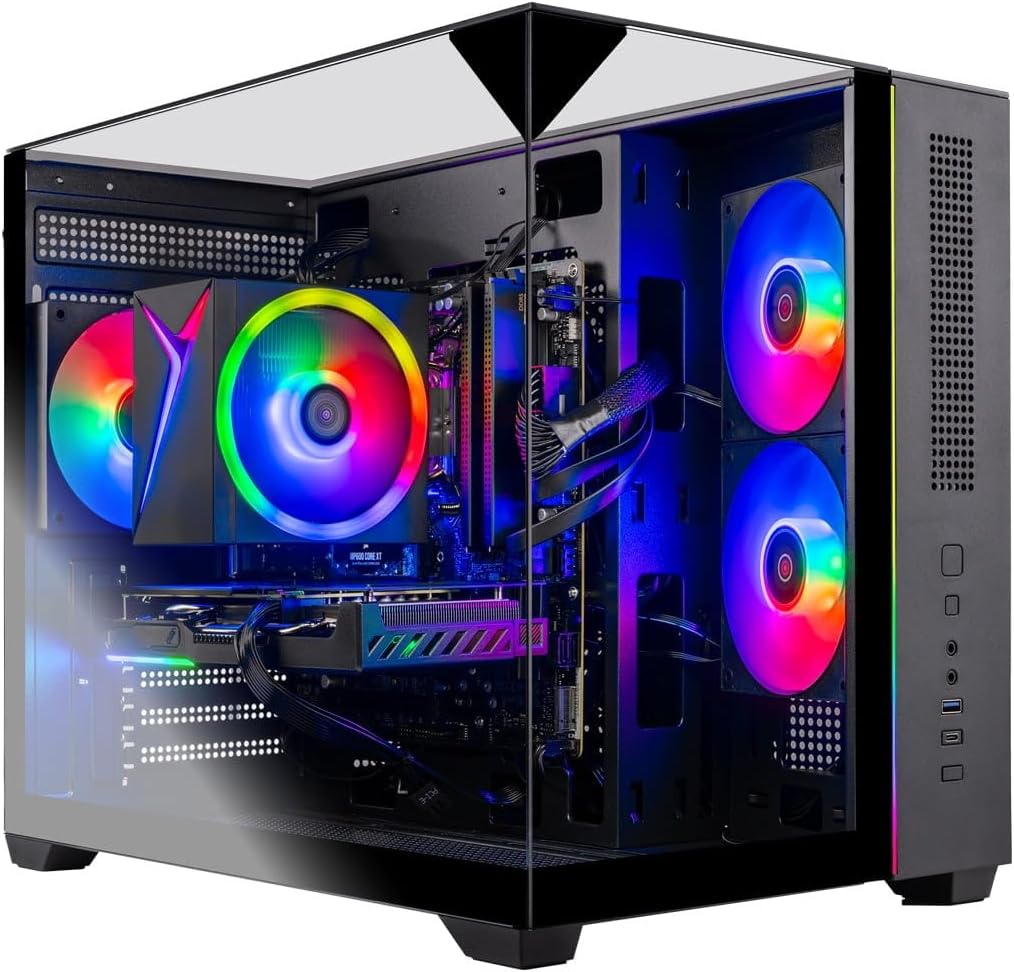
Budget Tier: Mid-upper tier (under $1,700) | Audited Specs: AMD Ryzen 7 7700 (3.8–5.3 GHz, 32MB L3, AM5) | NVIDIA GeForce RTX 5060 Ti 8GB GDDR7 | 32GB DDR5-5600 | 1TB NVMe M.2 SSD | 650W 80+ Gold PSU | Triple-Glass Crystal Case | Wi-Fi 5 | KB & Mouse.
Standard ATX Brand Audit: Compared directly against mid-range CyberPowerPC and iBUYPOWER builds, the Skytech Crystal showcases why Skytech earns higher marks for power and memory completeness: it pairs a full-cache 32MB L3 Ryzen 7 7700 with 32GB DDR5-5600 and explicitly documents a 650W 80+ Gold power supply. Still, two compromises keep it short of perfection under $1,700—the RTX 5060 Ti remains the 8GB variant rather than the 16GB tier ($429 GPU Launch MSRP), and the chassis retains a stealth Wi-Fi 5 adapter plus unlisted motherboard chipset.
Pros: Explicit 650W 80+ Gold PSU certification; 32GB DDR5 capacity out of the box; full-cache Ryzen 7 7700 avoids 8700F cache cuts.
Cons: Ships Wi-Fi 5 in a mid-upper price bracket; 8GB RTX 5060 Ti limits 1440p Ultra longevity; motherboard chipset and ATX 3.1 PSU spec omitted.
4. Skytech Gaming Azure (Ryzen 7 9850X3D & RX 9070 XT) — Enthusiast Standard ATX Benchmark

Budget Tier: Enthusiast tier (around $2,850–$2,950) | Audited Specs: AMD Ryzen 7 9850X3D (4.7 GHz base / up to 5.6 GHz Turbo, AM5) | AMD Radeon RX 9070 XT 16GB GDDR6 | 32GB DDR5-5600 | 2TB Gen4 NVMe M.2 SSD | 360mm AIO Liquid CPU Cooler | Skytech Azure Tempered Glass ATX Case | Zero Bloatware, Windows 11 Home.
Standard ATX Brand Audit: Representing the upper ceiling of off-the-shelf prebuilts, the Skytech Azure delivers true flagship gaming silicon without OEM lock-in: a 5.6 GHz 3D V-Cache Ryzen 7 9850X3D ($499 CPU Launch MSRP), 16GB Radeon RX 9070 XT ($599 GPU Launch MSRP), a full 360mm AIO radiator, 2TB Gen4 storage, and zero OS bloatware. Even at nearly three grand, however, audit rules flag two minor omissions: DDR5-5600 leaves slight latency on the table compared to DDR5-6000 CL30, and Skytech still leaves the motherboard chipset and exact ATX 3.1 PSU wattage unspecified on the product header.
Pros: True Ryzen 7 9850X3D + 16GB RX 9070 XT 1440p/4K powerhouse; 360mm AIO liquid cooler; generous 2TB Gen4 SSD; zero bloatware.
Cons: DDR5-5600 instead of optimal DDR5-6000 CL30; motherboard chipset and exact PSU wattage/ATX 3.1 rating omitted; watch Parent ASIN review pooling.
Decisive Verdict: CyberPowerPC vs. iBUYPOWER vs. Skytech
Choosing between these three standard ATX System Integrators depends on whether you prioritize documented motherboard chipsets, bloatware-free entry AM5 pricing, or explicit 80+ Gold PSU and 32GB RAM completeness out of the box.
Choose CyberPowerPC If…
- You want explicit motherboard chipset disclosure (AMD B850 or Intel B760) plus Wi-Fi 6 on mainstream Intel models.
- You prefer “Shipped & Sold by Amazon” fulfillment and lifetime technical support alongside a 1-year parts warranty.
- You inspect the exact CPU model code to avoid sub-$700 4GB GPU traps and confirm dual-channel RAM.
Choose iBUYPOWER If…
- You want a bloatware-free Windows 11 Home install on a modern AM5 standard ATX entry tower under $1,000.
- You plan an immediate DIY swap to a 2x16GB DDR5-6000 CL30 RAM kit (fixing 1x16GB DDR5-4800 bottlenecks).
- You game primarily on wired Ethernet or don’t mind adding an updated Wi-Fi 6E/7 adapter later.
Choose Skytech Gaming If…
- You prioritize explicit 80+ Gold PSU disclosures, 32GB DDR5 capacity, and zero OS bloatware out of the box.
- You are buying an enthusiast Ryzen 7 9850X3D + RX 9070 XT build equipped with a proper 360mm AIO liquid cooler.
- You double-check the exact selected variant (avoiding Parent ASIN review pooling) and confirm Wi-Fi speed before checkout.
Ready to widen your search beyond these three standard ATX builders? Review every vetted tier winner in our best prebuilt gaming PC guide, check all 10 prebuilt gaming PC red flags, decode omitted PSU ratings and Brand May Vary listings, or audit every filter manually using our 10-axis Amazon component guide inside the Gaming PCs hub.
How We Audited This Guide
- Prebuilt configurations were audited for GPU tier and VRAM, CPU platform runway, memory channel layout, SSD class, PSU brand and rating disclosure, and case airflow before inclusion.
- Every specification claim was cross-checked against official OEM datasheets, platform vendor documentation, and published industry standards (PCI-SIG, JEDEC, VESA, Intel ATX) rather than marketplace listing copy.
- Recommendations were evaluated against our weighted audit rubric and documented compatibility rules; we do not publish fabricated FPS, thermal, or acoustic numbers.
Frequently Asked Questions
Which brand uses the highest quality standard ATX parts: CyberPowerPC, iBUYPOWER, or Skytech?
Skytech Gaming edges ahead across mid-upper and enthusiast tiers by explicitly disclosing 80+ Gold power supplies, equipping 32GB DDR5 memory, fitting 360mm AIO coolers on high-TDP X3D builds, and shipping zero bloatware—though CyberPowerPC beats it on motherboard chipset disclosure.
Do CyberPowerPC, iBUYPOWER, and Skytech use proprietary motherboards or power supplies?
No. Unlike Dell Alienware or HP OMEN desktops that frequently deploy custom chassis layouts and proprietary 10-pin or 12-pin power harnesses, CyberPowerPC, iBUYPOWER, and Skytech build with standard ATX or micro-ATX motherboards, retail PCIe graphics slots, and standard ATX PSUs.
Why do some $1,500+ Skytech and iBUYPOWER builds still include Wi-Fi 5 or DDR5-4800 RAM?
System integrators protect profit margins by cutting secondary components shoppers overlook in headline titles. Dropping wireless cards to Wi-Fi 5 (802.11ac) or installing single-stick 1x16GB DDR5-4800 saves build cost while forcing buyers to upgrade networking or dual-channel memory later.
How do you spot Amazon review pooling on Skytech and CyberPowerPC product pages?
Click the “Set name” or processor variant selectors above the Add to Cart button and read older customer reviews. If a 2026 Ryzen 7 9850X3D page displays 1,000+ reviews mentioning legacy Ryzen 2600 or GTX 1660 Ti hardware, old ratings are pooled under one Parent ASIN.
Is a Ryzen 7 8700F prebuilt from CyberPowerPC worth upgrading later?
Yes, provided the build uses a documented AMD B850 or standard AM5 motherboard. Even though the Ryzen 7 8700F trims L3 cache to 16MB and PCIe 4.0 lanes to 16, standard AM5 socket compatibility lets you drop in a Ryzen 7 9800X3D or 9850X3D later.
Official Standards & Technical References
- AMD Socket AM5 Chipset & Processor Documentation: amd.com/en/products/processors/chipsets/am5.html
- NVIDIA GeForce RTX 50-Series Architecture & System Guidelines: nvidia.com/en-us/geforce/graphics-cards/50-series/
- Intel Core Ultra Desktop Processors Series 2 Specs: intel.com/content/www/us/en/products/details/processors/core-ultra.html
- PCI-SIG PCIe CEM 5.1 & 12V-2×6 Specifications: pcisig.com/specifications
- Cybenetics PSU Efficiency & Noise Certifications: cybenetics.com


