
Affiliate & Editorial Disclosure: As an Amazon Associate, The PC Audit earns from qualifying purchases. If you buy through verified affiliate links on this page, we may earn a small commission at no extra cost to you. Every Amazon catalog pattern, power supply standard, and specification rule below is audited independently with zero paid brand placements.
Direct Buyer Alert: Decoding Omitted PSU Specs & “Brand May Vary” GPUs
When auditing omitted PSU specs and “Brand may vary” GPU disclaimers on Amazon gaming PC listings, never assume modern power safety or flagship cooling comes included. Mid-range product pages routinely hide PSU wattage, 80+ efficiency, ATX 3.1 / 12V-2×6 compliance, and AIB GPU cooler sizes. Verify exact VRAM, standard ATX bays, and recent buyer interior photos before clicking Buy Now.
Open almost any bestseller prebuilt desktop listing on Amazon in the $1,000 to $1,500 bracket, and the headline reads like a straightforward value win: a current-generation graphics chip, an eight-core processor, bright RGB fans behind panoramic glass, and a tempting discount badge. Scroll halfway down the bullet points, however, and the fine print turns conspicuously vague. Power supply wattage disappears completely, efficiency ratings vanish, motherboard chipsets go unmentioned, and a short disclaimer quietly warns that the “Graphics card brand may vary based on availability.”
Those omissions are rarely accidental formatting slips. As documented across our 10-axis Amazon PC component audit hub and our 10 prebuilt gaming PC red flags checklist, leaving secondary specifications blank gives system integrators flexibility to swap wholesale parts between production batches—while shifting transient power risk, acoustic tradeoffs, and future upgrade bottlenecks directly onto unsuspecting shoppers. Below, we decode exactly what Amazon sellers omit, what “Brand may vary” actually changes inside your tower, and four specification-transparent builds that lay their cards on the table upfront.
Inside This Amazon Listing & Spec Omission Decoder
- Listing Headline vs. Hidden Reality: 10-Axis Omission Table
- Why Omitted PSU Specs & Missing ATX 3.1 Labels Matter in 2026
- 2026 PSU Wattage, Efficiency & 12V-2×6 Verification Table
- What “Brand May Vary” Really Means for Amazon Prebuilt GPUs
- Five Companion Traps Hidden Alongside Omitted PSUs (R-AMZ-01 to R-AMZ-06)
- The 60-Second Pre-Checkout Verification Checklist
- Clean Alternatives: 4 Specification-Transparent Amazon Builds
- Audit Verdict Matrix & Related Guides
- Frequently Asked Questions
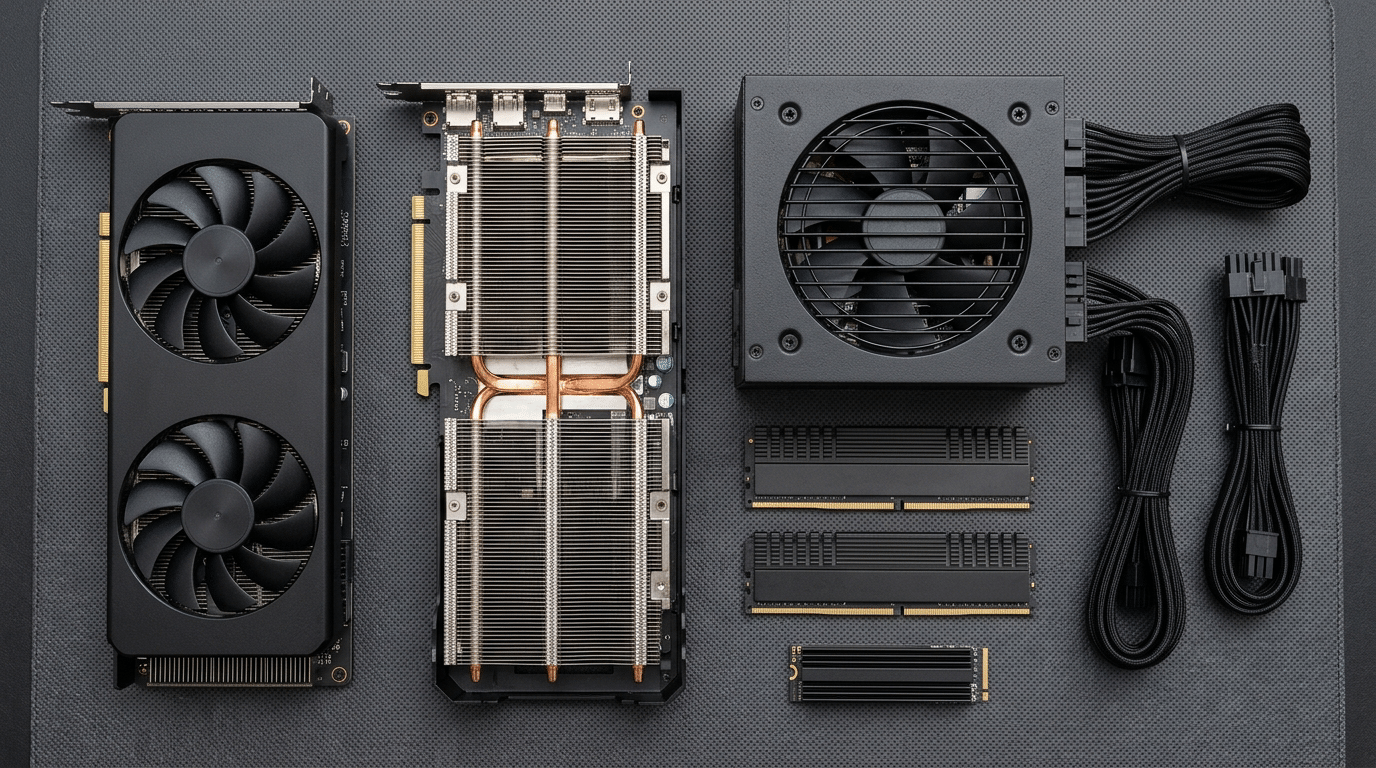
Listing Headline vs. Hidden Reality: 10-Axis Omission Table
Before dissecting power supplies and variable graphics card partners in depth, map the complete pattern across Amazon’s 2026 desktop catalog. Every listing lives on ten selectable hardware axes—and the gap between the bold title and what actually ships inside the chassis is entirely predictable once you know where builders trim costs.
| Component / Listing Element | What Amazon Headline Shows | What Is Often Hidden / Omitted | How to Verify in 30 Seconds |
|---|---|---|---|
| 1. GPU & Partner Card | “RTX 5060 Ti”, “RX 9070”, or sidebar “8 GB & above” | “Brand may vary” AIB heatsink swaps, 8GB vs. 16GB splits, OEM 12GB RX 9070 GRE, legacy 4GB–6GB cards | Confirm exact VRAM capacity in bullets; check recent buyer photos for 2-fan vs. 3-fan AIB cards and sag brackets |
| 2. Power Supply (PSU) | Omitted entirely or vague “80+ Gold PSU” / “ATX 3” | Exact wattage, ATX 3.1 vs. ATX 2.x group regulation, native 12V-2×6 cable, Cybenetics ETA/Lambda noise grade | Inspect Q&A and buyer teardown photos for PSU shroud labels; demand explicit 650W–1000W 80+ Gold ATX 3.1 specs |
| 3. CPU & Variant Code | “Ryzen 7”, “Core Ultra 7”, or messy duplicate dropdowns | Ryzen 7 8700F 16MB L3 cache trim, Core Ultra 7 265F iGPU removal, or legacy AM4 Ryzen 5 5500 | Match full processor SKU (e.g., 9800X3D vs. 8700F vs. 265F) on the active selector before checking star ratings |
| 4. Motherboard Chipset | “Gaming Motherboard” or completely omitted | Entry bare-VRM boards, unlocked i9-14900KF paired with locked B760, or proprietary OEM layouts | Look for explicit AMD B850/X870 or Z-series ATX boards and standard 24-pin ATX power headers in interior photos |
| 5. System Memory (RAM) | “16GB DDR5” or “32GB DDR5” | Single-stick 1x16GB layout, slow DDR5-4800 CL42–46, DDR5-5600 cuts, or 4-DIMM speed penalties | Check buyer interior photos for two spaced sticks in slots A2/B2; target 32GB (2x16GB) DDR5-6000+ |
| 6. NVMe SSD Storage | “1TB NVMe SSD”, “2TB Gen4”, or “5TB” hybrid bundles | Cramped 500GB primary OS drives, DRAM-less QLC NAND write-cliffs, or missing spare M.2 slots | Require 1TB NVMe minimum (2TB ideal) and inspect motherboard photos for an open second M.2 slot with heatsink |
| 7. CPU Cooler Sizing | “ARGB Air Cooler” or “Liquid Cooled” | Undersized 92mm downdraft fans or single-fan 120mm AIOs mounted onto 170W–250W processors | Verify dual-tower air cooling (≤160W CPUs) or 240mm/360mm AIO radiators in chassis images |
| 8. Networking & Wi-Fi | “Wi-Fi Ready” or buried “802.11ac” | Stealth Wi-Fi 5 adapters inside $1,500–$3,000 gaming desktops instead of Wi-Fi 6E/7 | Verify explicit Wi-Fi 6E or Wi-Fi 7 plus 2.5GbE/5GbE Ethernet in specs or factor in a sub-$45 PCIe/M.2 swap |
| 9. Case & Clearances | Panoramic tempered glass, 11.3″ LCDs, bundled KB/Mouse | Choked solid front glass blocking intake fans, <35mm 12V-2×6 bend clearance, or 25%+ price markups | Confirm perforated front mesh or angled side vents, ≥35mm side glass clearance, and standard ATX parts |
| 10. Condition & Reviews | “4.5 stars (1,200+ reviews)” with deal badges | Parent ASIN Set name review pooling across years and Renewed rigs mixed into search | Lock sidebar Condition to New, click “This format only” in reviews, and prefer Shipped & Sold by Amazon |
Why Omitted PSU Specs & Missing ATX 3.1 Labels Matter in 2026
Across live Amazon catalog evaluations, the power supply is the single most omitted component in the $1,000 to $1,500 mainstream segment—and frequently remains only half-documented up to $2,000. Many listings skip wattage entirely, list wattage without an efficiency tier, or advertise a generic “650W 80+ Gold” or “850W PSU” sticker without disclosing the OEM model, modularity, capacitor grade, or ATX 3.1 / PCIe 5.1 compliance. Even worse, collapsed #prodDetails specification grids rarely include a structured field for power supply wattage or connector revision, leaving buyers to guess whether an internal unit belongs on a 2026 gaming desk or inside a 2016 office workstation.
Why is an omitted PSU spec far riskier today than it was five years ago? Two hardware engineering shifts explain the urgency:
1. Microsecond Transient Power Excursions (200%–300% Spikes)
Modern graphics architectures—including NVIDIA Blackwell (RTX 5070, RTX 5070 Ti, RTX 5080, RTX 5090) and AMD RDNA 4 (Radeon RX 9070 XT)—dynamically scale boost clocks and voltage in fractions of a millisecond. During sudden scene transitions or shader loads, these cards generate brief transient power excursions reaching 200% to 300% of nominal board power. Under the official PCI-SIG PCIe CEM 5.1 and ATX 3.1 specifications, compliant power supplies are engineered to absorb those microsecond spikes smoothly without collapsing voltage rails or tripping false over-current shutdowns.
By contrast, anonymous non-modular Bronze units or legacy ATX 2.x group-regulated supplies—often hidden beneath solid PSU shrouds when wattage and certification are omitted—lack dedicated DC-to-DC secondary regulation and tightened transient hold-up tolerances. The symptom shoppers experience months later is classic and maddening: sudden black screens with GPU fans ramping to 100%, or abrupt mid-match reboots right as demanding 1440p or 4K ray-traced frames hit peak draw.
2. Native 12V-2×6 Connector Safety vs. Multi-Adapter Bundles
If an Amazon prebuilt above the entry tier relies on an older ATX 2.x power supply, integrators have no choice except to bridge legacy 8-pin PCIe plugs into a graphics card’s 16-pin socket using chunky dongle adapters. Genuine ATX 3.1 / PCIe 5.1 power supplies replace the troublesome early 12VHPWR design with native dual-ended 12V-2×6 cables. Although physically identical in outer pin layout, 12V-2×6 recesses the four sense pins deeper inside the housing while extending the power delivery terminals. If a cable backs out slightly during shipping or presses awkwardly against a glass panel, the recessed sense pins lose contact immediately and cap or cut power before localized resistance can heat the plug.
For buyers evaluating prebuilts with high-wattage Blackwell GPUs, pairing native 12V-2×6 cabling with at least 35mm of unobstructed straight cable bend clearance from the GPU power header to the side glass panel is non-negotiable. Explore our full breakdown in ATX 3.1 and 12V-2×6 explained and compare retail replacements inside our audited ATX 3.1 gaming power supplies roundup.
3. 80 Plus Gold vs. Cybenetics ETA & Lambda: What a Missing Rating Hides
Even when a seller prints “80+ Gold” in a bullet list, remember what that legacy badge measures—and what it ignores. Standard 80 Plus certification checks AC-to-DC conversion efficiency strictly at 20%, 50%, and 100% load intervals; it does not grade capacitor longevity (such as Japanese 105°C primary/secondary caps), voltage ripple suppression, acoustic dBA output, or comprehensive protection circuits (OCP, OVP, UVP, OPP, SCP, OTP). Modern independent databases such as Cybenetics ETA and Lambda audit efficiency across thousands of real-world load points alongside standby efficiency and noise ratings from Standard through A++. Whenever an Amazon listing skips even basic 80+ Bronze/Gold wattage labeling, treat it as an immediate warning flag and inspect buyer teardown photos—or plan a future upgrade using our gaming PC PSU wattage sizing guide.
2026 PSU Wattage, Efficiency & 12V-2×6 Verification Table
Power supplies achieve peak electrical efficiency and lowest fan acoustics when actual gaming power draw sits near 50% to 60% of the PSU’s rated wattage. Use this verification table whenever an Amazon listing either omits PSU details or prints a bare wattage figure without context:
| System Tier & Target | Typical Amazon GPU + CPU Pairing | Minimum Verified PSU Wattage | Mandatory Safety & Efficiency Standard |
|---|---|---|---|
| Entry 1080p | RTX 5060 (145W), RX 9060 XT (150W–160W), Arc B580 (190W) + Ryzen 5 9600X / Core i5-14400F | 650W | 80+ Gold minimum (verify Tier C+ or better ATX 3.1 when upgrading later) |
| Mid-Range 1080p / 1440p | RTX 5060 Ti (180W), RX 9070 (220W) + Ryzen 7 8700F / 7800X3D / Core Ultra 5 245K | 750W | ATX 3.1 / 80+ Gold / native 12V-2×6 or clean dedicated dual 8-pin rails |
| Performance 1440p | RTX 5070 (250W), RTX 5070 Ti (300W), RX 9070 XT (304W) + Ryzen 7 9800X3D / Core Ultra 7 265F | 750W – 850W (target 850W for 9070 XT / 5070 Ti) | ATX 3.1 / PCIe 5.1 / 80+ Gold or Cybenetics Gold+ / full protections |
| High-End 4K | RTX 5080 (360W) + Ryzen 7 9800X3D / 9850X3D / Core Ultra 9 285K | 850W – 1000W (1000W ideal) | ATX 3.1 / Cybenetics Gold–Platinum / 105°C capacitors / native 12V-2×6 |
| Flagship 4K & AI | RTX 5090 (575W) + Ryzen 9 9950X3D / Core Ultra 9 285K | 1200W+ | ATX 3.1 / Cybenetics Platinum–Titanium / Lambda A+ / ≥35mm plug clearance |
Crucial DIY Warning: If you later replace an omitted or underpowered PSU inside an Amazon prebuilt, never reuse old modular power cables from the factory unit on a brand-new power supply—even within the same brand family. Modular pinouts on the PSU housing are not standardized across models, and mixing harnesses causes immediate short-circuit damage to storage drives, motherboards, and graphics cards.
What “Brand May Vary” Really Means for Amazon Prebuilt GPUs
Right alongside omitted power supply ratings, shoppers regularly encounter a subtle disclaimer buried inside CyberPowerPC, Skytech Gaming, iBUYPOWER, and value integrator pages: “Graphics card brand may vary based on stock” (or “actual component brand and model may vary” for RAM and SSDs). Unlike omitted PSU specs—which can signal actual electrical undersizing—a “Brand may vary” GPU clause is not automatically a scam, provided you distinguish between locked silicon specifications and variable board-partner execution.
What Stays Fixed vs. What Actually Changes in Your Box
When an Amazon system integrator builds a standard ATX desktop under a “Brand may vary” policy, the underlying GPU processor and memory specification advertised in the active configuration remain fixed. An RTX 5070 listing must still deliver a 12GB GDDR7 Blackwell GPU on a 192-bit bus, and an RX 9070 XT listing must still deliver a 16GB RDNA 4 chip. What changes between shipping weeks is the add-in-board (AIB) partner card—for example, receiving a ZOTAC Twin Edge, MSI Ventus 2X, Gigabyte Windforce, or ASUS Prime variant depending on wholesale inventory.
- Heatsink Mass & Fan Count (Dual-Fan vs. Triple-Fan): One batch may receive a thick 3-fan triple-slot cooler that runs whisper-quiet under sustained 1440p loads, while the next week’s batch ships a compact 2-fan dual-slot card that runs several degrees warmer and noticeably louder at higher fan RPMs.
- VRM Acoustics & Coil Whine Variance: Entry-tier AIB cards often omit extra thermal pads behind the backplate or use lighter inductor damping, increasing audible coil whine when menus jump to uncapped framerates.
- Shipping Protection & Anti-Sag Brackets: Long triple-fan RTX 5070 Ti or RTX 5080 cards shipped across the country via parcel carriers can strain PCIe x16 slots without expanding foam packing inserts and metal support brackets—especially when AIB card lengths swap unpredictably between batches.
Watch the 8GB VRAM Split, OEM 12GB Variants & Rumored Silicon
Where “Brand may vary” becomes dangerous is when vague phrasing hides VRAM capacity or OEM silicon trims. In 2026, both NVIDIA and AMD sell identically named midrange GPUs with radically different memory pools: the RTX 5060 Ti ships in both an 8GB version ($379 Launch MSRP) and a 16GB version ($429 Launch MSRP), while AMD’s RX 9060 XT splits between 8GB ($299 Launch MSRP) and 16GB ($349 Launch MSRP) on a 128-bit bus. Paying over $1,100 on Amazon for an 8GB card—without verifying whether a listing ships the 8GB or 16GB tier—invites texture pop-in and frametime hitches in 1440p Ultra and ray-traced titles. Similarly, confirm whether an AMD prebuilt carries the OEM-focused Radeon RX 9070 GRE (48 CUs, 12GB GDDR6, 192-bit, 220W TBP) versus the full 16GB RX 9070 ($549 Launch MSRP) or RX 9070 XT ($599 Launch MSRP).
Be equally skeptical of upscaling marketing bullets or speculative pre-order chatter. Frame generation features such as NVIDIA DLSS 4 Multi-Frame Generation, AMD FSR 4, and Intel XeSS 2 require at least 50 to 60 base FPS paired with NVIDIA Reflex or Anti-Lag 2 to avoid sluggish input response; they never rescue an 8GB VRAM overflow. Meanwhile, rumored refreshes like the RTX 5070 Super and RTX 5080 Super remain unannounced and unreleased—any marketplace mention implying upcoming Super inventory should be ignored when evaluating active retail towers.
Why Standard ATX Builders Beat Proprietary OEMs Under Component Lotteries
Here is the critical distinction that separates recoverable quirks from expensive dead ends: standard off-the-shelf ATX builds versus proprietary OEM boxes. System integrators including CyberPowerPC, MSI (Codex / Vision), Skytech Gaming, ZOTAC (MEK), iBUYPOWER, Thermaltake LCGS, ASUS ROG G700, and STORMCRAFT assemble around standard ATX/mATX motherboard standoffs, standard 24-pin power harnesses, and standard rectangular PSU bays—as audited in our MSI Codex Z2 vs. CyberPowerPC Gamer Master comparison. Even if a batch-swapped SSD or unbranded PSU disappoints two years later, dropping in a retail ATX 3.1 power supply or upgraded GPU takes twenty minutes with a Phillips screwdriver.
Conversely, proprietary OEM towers from Alienware, Dell, HP, or Acer sometimes deploy custom-shaped motherboards, non-standard 10-pin or 12-pin PSU headers, and riveted power brackets. When a proprietary OEM box omits PSU wattage or restricts GPU length clearance, future upgrades hit an immovable wall—making pre-purchase transparency mandatory.
Five Companion Traps Hidden Alongside Omitted PSUs
Listings that conceal power supply ratings or GPU partners rarely stop at one omission. Across our 2026 marketplace audits (R-AMZ-01 through R-AMZ-06), five additional storefront distortions routinely travel alongside vague PSU specs:
1. Broken Left-Sidebar Facets & Mixed Renewed Inventory (R-AMZ-01)
Amazon’s left-hand shopping sidebar cannot reliably filter modern PC specs. The Graphics Memory filter caps out at “8 GB & above”—lumping 8GB entry cards into the same bucket as 12GB, 16GB, and 32GB GPUs—while the Graphics Processor menu still surfaces obsolete tags like Radeon RX 500, Vega, and Intel HD Graphics. Worse, search results intermix Amazon Renewed and used listings alongside factory-new PCs unless you manually lock Condition: New, exposing unwary buyers to 90-day refurbished warranties instead of full 1-year to 3-year OEM coverage.
2. Parent ASIN Review Pooling & Cloned Selector Labels (R-AMZ-02)
Many high-volume /dp/ pages combine years of unrelated builds into one shared Parent ASIN using the Set name or Configuration dropdown—for example, pooling legacy 2600 | 1660Ti customer stars alongside current 9850X3D | 9070XT rigs so new configurations inherit 1,000+ historical reviews overnight. Other pages publish messy, duplicated CPU dropdown buttons such as "AMD Ryzen 7", "AMD Ryzen 7 8700 F", and "AMD Ryzen 7 8700F". Never judge a PSU’s reliability or GPU cooler acoustics from aggregate stars until you click your exact configuration and switch reviews to “This format only.”
3. Cache-Trimmed OEM CPUs, Unlocked K + B760 Pairings & Page-1 Legacy Cards (R-AMZ-03 & R-AMZ-04)
Watch two pervasive processor shortcuts on Amazon. First, the AM5 Ryzen 7 8700F (8C/16T, up to 5.0 GHz, 65W) offers an upgradeable AM5 socket, yet cuts L3 cache down to 16MB (half that of a Ryzen 5 9600X or 9700X and one-sixth of X3D’s 96MB L3), caps usable PCIe 4.0 lanes at 16, and omits integrated graphics—lowering 1% Low framerates compared against full-cache Zen 5 and 3D V-Cache processors. Second, the LGA 1851 Core Ultra 7 265F (20 cores, 66MB total cache, 65W base / 182W max turbo) runs cool and quiet inside ASUS ROG and Alienware towers, but its F suffix removes the iGPU and Quick Sync hardware acceleration for video timelines. Also flag mismatched Intel listings pairing unlocked 250W+ Core i9-14900KF processors with entry Intel B760 boards that lock CPU tuning and strain VRMs, plus Page-1 legacy clearance builds pushing 4GB RX 6500 XT or 6GB RTX 3050 GPUs on AM4 DDR4 platforms.
4. Single-Channel DDR5-4800, Unbranded QLC SSDs & Stealth Wi-Fi 5 (R-AMZ-06)
When a listing omits RAM stick count and CAS latency, assume builders may be shipping a single 1x16GB module or slow DDR5-4800 CL42–CL46 memory. Dropping from dual-channel to single-channel cuts memory bandwidth in half and slashes 1% Low framerates by 15% to 30%—while even $1,500–$3,000 prebuilts frequently ship DDR5-5600 or stealth Wi-Fi 5 (802.11ac) cards instead of Wi-Fi 6E or Wi-Fi 7 (802.11be). Likewise, generic “1TB NVMe SSD” labels hide DRAM-less QLC drives prone to write-cliff slowdowns past 70% fill, making an explicit spare M.2 slot for a 2TB PCIe 4.0 DRAM+TLC drive (such as a WD Black SN850X or Samsung 990 Pro) essential.
5. Undersized Coolers, Choked Glass & #prodDetails Catalog Noise (R-AMZ-05 & R-CASE-01)
Never evaluate CPU cooling against nominal 65W or 125W base TDP—size coolers against peak turbo power (162W PPT on Ryzen 7 9800X3D and 182W–250W MTP on Intel Core Ultra 200S or i9-14900KF). Disqualify any high-wattage prebuilt using a thin 120mm AIO or pressing front fans flat against unvented front glass. And when scanning Amazon’s collapsed #prodDetails grid, ignore automated catalog glitches such as Screen Size: 0.01 or erratic Cache Size: 8 / 16 strings generated by marketplace scrapers.
The 60-Second Pre-Checkout Verification Checklist
Before adding any Amazon desktop with omitted PSU ratings or a “Brand may vary” GPU disclaimer to your cart, run these seven fast inspections directly on the /dp/ page:
- Lock Condition & Fulfillment: Confirm Condition: New and verify Ships from and sold by Amazon.com (or the manufacturer’s verified storefront) rather than third-party marketplace resellers.
- Isolate Variant-Specific Reviews: Click your exact CPU/GPU configuration inside the Set name or Style bar, then filter reviews to “This format only” so legacy 2019–2022 feedback does not mask current hardware.
- Audit Core Silicon & VRAM Splits: Verify exact VRAM (12GB–16GB ideal above $1,100; avoid 4GB–6GB cards entirely) and processor suffixes (full-cache X3D / 9600X vs. 16MB-L3 8700F or iGPU-free 265F), ignoring sidebar “8 GB & above” caps and
Screen Size: 0.01noise. - Scan Customer Interior Photos for the PSU & Motherboard: Open buyer review images showing the side panel removed. Confirm a standard rectangular ATX PSU shroud (not an odd proprietary Dell/HP box), a standard 24-pin ATX motherboard harness, and look for printed PSU wattage/80+ labels in teardown shots.
- Check AIB GPU Size, Anti-Sag Support & Cable Bend Clearance: Look at interior photos to see whether recent buyers received a 2-fan or 3-fan GPU, confirm at least 35mm of clearance between the 12V-2×6 plug and side glass, and verify shipping support brackets on heavy cards.
- Confirm Dual-Channel RAM, Cooling & Airflow Mesh: Verify two spaced memory sticks in slots A2 and B2 (avoiding 1x16GB configurations), perforated front mesh or open dual-chamber side vents rather than sealed front glass, and a dual-tower air cooler or 240mm/360mm AIO.
- Search Q&A for ATX 3.1, Wi-Fi & Day-One Validation: Use the page Q&A search bar for “PSU”, “watt”, “Wi-Fi”, and “motherboard”. Upon delivery, inspect actual installed parts in Windows and BIOS: verify AMD EXPO/XMP and Resizable BAR are active, plug your display cable into the GPU rather than motherboard I/O, and validate thermal stability and 12V rail consistency using
HWiNFO64andOCCT.
Clean Alternatives: 4 Specification-Transparent Amazon Builds
You do not have to gamble on blank PSU rows or mysterious graphics card lotteries. Below are four verified 2026 Amazon US gaming desktops across mainstream and flagship budget tiers that explicitly disclose their power supply wattage, 80+ Gold efficiency, cooling layout, and upgradeable standard ATX internals—paired with honest caveats so you know every exact tradeoff upfront.
1. ZOTAC MEK Gaming PC White — Ryzen 5 9600X & RTX 5060 (Eliminates “Brand May Vary” & PSU Guesswork)
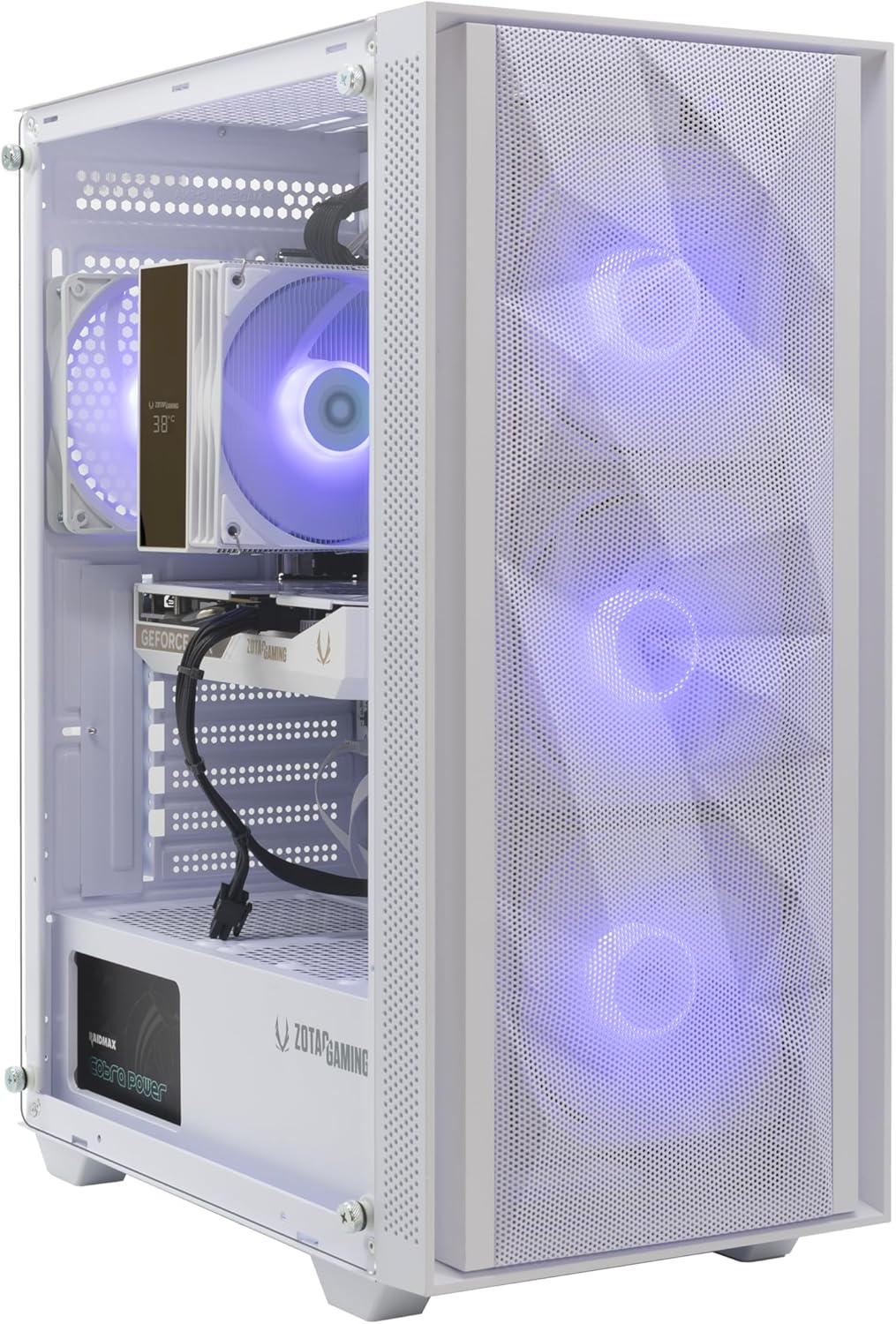
Budget Tier: Mid-upper tier (roughly $1,200–$1,350) | Audited Specs: AMD Ryzen 5 9600X (6C/12T Zen 5, up to 5.4 GHz, 32MB L3, AM5) | ZOTAC GAMING GeForce RTX 5060 8GB GDDR7 | 16GB Dual-Channel DDR5-5200 RGB | 1TB NVMe M.2 SSD | 650W 80+ Gold PSU | Mesh Front, 4x 120mm RGB Fans, Temp Display | Wi-Fi 6E, 5GbE LAN | 1-Yr System + 3-Yr ZOTAC GPU Warranty.
Transparency Audit: The ZOTAC MEK White directly solves both headaches covered in this guide. Because ZOTAC manufactures its own graphics cards, there is zero “Brand may vary” GPU lottery—you get an explicit ZOTAC GAMING GeForce RTX 5060 backed by a dedicated 3-year GPU warranty. Better still, ZOTAC declares a 650W 80+ Gold PSU (well matched to the 145W RTX 5060), explicitly confirms Dual-Channel memory rather than a 1x16GB stick, pairs a full-cache Zen 5 Ryzen 5 9600X (32MB L3 on AM5) with a perforated mesh front and four 120mm fans, and avoids stealth Wi-Fi 5 compromises via Wi-Fi 6E + 5GbE LAN. Honest Caveat: Its 8GB VRAM ($299 GPU Launch MSRP class) limits heavy 1440p Ultra/ray-tracing textures, and 16GB DDR5-5200 leaves future upgrade headroom toward 32GB (2x16GB) DDR5-6000 CL30.
Audit Passes: Zero GPU brand lottery; disclosed 650W 80+ Gold PSU; explicit Dual-Channel RAM; full-cache Zen 5 AM5 CPU; mesh intake; Wi-Fi 6E + 5GbE.
Watch Items: Best suited for 1080p High/Ultra due to 8GB VRAM; verify exact ATX 3.1 label if stepping up to higher-wattage GPUs later.
2. MSI Codex R2 (A14NVL5-454US) — Core i5-14400F & RTX 5060 (Documented 80+ Gold Under $1,200)

Budget Tier: Value mid-range (under $1,200; roughly $1,100–$1,200) | Audited Specs: Intel Core i5-14400F (10C/16T: 6P+4E, up to 4.7 GHz, 20MB L3) | NVIDIA GeForce RTX 5060 8GB GDDR7 | 16GB DDR5-6000 | 1TB M.2 NVMe SSD | 80+ Gold PSU (650W class) | ARGB Air Cooler, Wi-Fi 6E, Front & Rear USB-C | Shipped & Sold by Amazon, Windows 11 Home, MSI KB & Mouse.
Transparency Audit: Below $1,200, most competing Amazon towers strip out power supply specs and drop RAM down to DDR5-4800. MSI’s Codex R2 stands out by documenting an 80+ Gold PSU (650W class), faster DDR5-6000 memory, Wi-Fi 6E connectivity, a 1TB M.2 NVMe SSD, and standard MSI ATX internal architecture fulfilled directly as Shipped & Sold by Amazon. Honest Caveat: While MSI specifies 80+ Gold 650W-class power, exact ATX 3.1 revision and AIB RTX 5060 card styling remain dependent on MSI production runs, 8GB VRAM targets 1080p gaming rather than maxed 1440p textures, and LGA 1700 lacks AM5’s multi-generation CPU upgrade runway.
Audit Passes: Disclosed 80+ Gold 650W-class PSU under $1,200; DDR5-6000 speed; Wi-Fi 6E + USB-C; standard ATX layout; Shipped & Sold by Amazon.
Watch Items: Confirm dual-stick vs. single-stick memory population upon arrival; 8GB VRAM suits 1080p esports and mainstream settings.
3. KOTIN Gaming PC Desktop — Ryzen 7 8700F & RTX 5060 Ti (Disclosed 650W Gold, 3x M.2 & Wi-Fi 7)

Budget Tier: Upper budget ceiling (around $1,400–$1,500) | Audited Specs: AMD Ryzen 7 8700F (8C/16T, AM5, 16MB L3) | NVIDIA GeForce RTX 5060 Ti 8GB GDDR7 | 16GB DDR5 (4x DDR5 DIMM slots on board) | 1TB PCIe Gen4 NVMe SSD (3x M.2 slots total) | 650W 80+ Gold PSU, 6-heatpipe Digital Tower Cooler, 5x 120mm ARGB fans | Wi-Fi 7 + Bluetooth, Sold by Kotin / Ships from Amazon.
Transparency Audit: Unlike $1,400–$1,500 rivals that leave power, cooling, and expansion slots completely blank, KOTIN spells out nearly every supporting subsystem: a verified 650W 80+ Gold PSU, a substantial 6-heatpipe digital tower air cooler paired with five 120mm ARGB fans, four DDR5 DIMM slots, three total M.2 storage slots, and Wi-Fi 7 wireless networking. Honest Caveat: Per our R-AMZ-03 and R-GPU-01 audit rules, note that the AM5 Ryzen 7 8700F cuts L3 cache to 16MB and usable PCIe 4.0 lanes to 16 (without integrated graphics), the 8GB RTX 5060 Ti ($379 GPU Launch MSRP class) encounters VRAM ceilings at 1440p Ultra compared against 16GB cards, and exact RAM stick count/CAS latency and AIB GPU partner remain unstated.
Audit Passes: Disclosed 650W 80+ Gold PSU; 6-heatpipe cooler + 5 fans; 3x M.2 slots + 4x DIMM slots on AM5; Wi-Fi 7; Fulfilled by Amazon.
Watch Items: Verify dual-stick RAM population in interior inspection; 8GB VRAM and 16MB-L3 8700F leave upgrade paths open on AM5.
4. STORMCRAFT Phantom — Ryzen 7 9800X3D & RTX 5080 (Flagship B850 & 850W 80+ Gold Transparency)

Budget Tier: Flagship tier (over $3,500) | Audited Specs: AMD Ryzen 7 9800X3D (8C/16T, up to 5.2 GHz, 96MB L3 3D V-Cache) | NVIDIA GeForce RTX 5080 16GB GDDR7 | 32GB DDR5-6000 RGB | 2TB NVMe Gen4 SSD | AMD B850 Chipset | 360mm AIO Liquid Cooler + 7x ARGB Fans | 850W 80+ Gold PSU | 2-Yr Parts / 3-Yr Labor Warranty.
Transparency Audit: At flagship pricing, hiding the motherboard chipset or PSU rating is inexcusable—and STORMCRAFT avoids both traps cleanly. The listing explicitly discloses an AMD B850 AM5 platform, matched 32GB DDR5-6000 memory tuned for AM5’s 1:1 UCLK ratio, a generous 2TB Gen4 NVMe SSD, a full 360mm AIO liquid cooler with seven case fans, and an 850W 80+ Gold PSU driving the 16GB RTX 5080 ($999 GPU Launch MSRP) and Ryzen 7 9800X3D ($479 CPU Launch MSRP) with a 2-year parts / 3-year labor warranty. Honest Caveat: Exact AIB RTX 5080 model, Wi-Fi adapter generation, and ATX 3.1 native 12V-2×6 status are omitted from the top bullets—inspect the PSU’s native 12V-2×6 bend clearance (≥35mm) upon arrival, and consider a 1000W ATX 3.1 swap if running sustained heavy 4K power loads.
Audit Passes: Explicit AMD B850 chipset; 850W 80+ Gold PSU; 32GB DDR5-6000; 2TB Gen4 NVMe; 360mm AIO + 7 fans; 2-Yr Parts / 3-Yr Labor coverage.
Watch Items: Confirm Wi-Fi generation and native 12V-2×6 cable routing on delivery; flagship pricing carries a noticeable premium.
Audit Verdict Matrix & Related Guides
Best Anti-“Brand May Vary” & Budget PSU Clarity
- ZOTAC MEK White (~$1,200–$1,350): Locks in an explicit ZOTAC GAMING RTX 5060 with a 3-year GPU warranty, 650W 80+ Gold PSU, Dual-Channel DDR5, full-cache Zen 5 9600X, and Wi-Fi 6E + 5GbE.
- MSI Codex R2 (Under $1,200): Delivers an 80+ Gold 650W-class PSU, DDR5-6000, Wi-Fi 6E, and direct Shipped & Sold by Amazon fulfillment for entry 1080p buyers.
Best Disclosed Expansion & Flagship Power
- KOTIN Desktop (~$1,400–$1,500): Spells out 650W 80+ Gold power, 6-heatpipe tower cooling, 3x M.2 slots, 4x DDR5 DIMMs, and Wi-Fi 7 on an upgradeable AM5 socket.
- STORMCRAFT Phantom ($3,500+): Pairs explicit AMD B850 platform clarity and an 850W 80+ Gold PSU with 9800X3D 3D V-Cache, RTX 5080 16GB, 32GB DDR5-6000, and 2TB Gen4 storage.
Continue strengthening your Amazon pre-checkout audit across our connected guides: start with our 10-axis Amazon PC component audit hub, review our 2026 best prebuilt gaming PC rankings, cross-check standard ATX integrators in MSI Codex Z2 vs. CyberPowerPC Gamer Master, flag stealth compromises via our 10 prebuilt gaming PC red flags audit, and plan safe PSU swaps with our audited ATX 3.1 gaming power supplies guide or our priority Amazon prebuilt upgrade roadmap inside Guides & Optimization.
How We Audited This Guide
- Steps were validated against official BIOS, driver, and platform vendor documentation and ordered from lowest-risk to highest-risk so readers can stop as soon as the issue is resolved.
- Every specification claim was cross-checked against official OEM datasheets, platform vendor documentation, and published industry standards (PCI-SIG, JEDEC, VESA, Intel ATX) rather than marketplace listing copy.
- Recommendations were evaluated against our weighted audit rubric and documented compatibility rules; we do not publish fabricated FPS, thermal, or acoustic numbers.
Frequently Asked Questions
Why do Amazon gaming PC listings omit PSU wattage and 80+ ratings?
Many system integrators omit PSU wattage and 80+ ratings so they can substitute lower-cost bulk supplies across production runs without rewriting product bullets. Unlisted units often lack ATX 3.1 transient protection or native 12V-2×6 connectors, so always verify buyer teardown photos before checkout.
Is a “Brand may vary” GPU on an Amazon prebuilt PC a red flag?
Not automatically, provided the GPU model and exact VRAM capacity are clearly locked. While the core RTX 50 or RX 9000 silicon stays identical, AIB cooler size, fan noise, and card length swing between dual-fan and triple-fan models across shipping batches.
How can I check the real PSU inside an Amazon prebuilt before buying?
Filter customer reviews to “This format only” for your selected configuration, then browse buyer-uploaded interior photos and search the page Q&A for wattage, 80+ Gold, and ATX 3.1 mentions. Also verify a standard rectangular ATX PSU bay so future upgrades remain easy.
Does an “80+ Gold PSU” bullet guarantee ATX 3.1 and 12V-2×6 safety?
No. 80+ Gold measures AC-to-DC conversion efficiency at fixed loads, not transient excursion compliance or connector safety. An older ATX 2.x Gold PSU still uses adapter dongles rather than a native 12V-2×6 cable with recessed sense pins and lacks 200%–300% transient headroom.
What other specs are commonly omitted alongside the PSU on Amazon?
Sellers frequently omit motherboard chipsets, DDR5 stick counts (single-channel 1x16GB vs. dual-channel 2x8GB/2x16GB), CAS latency, SSD NAND type (TLC vs. DRAM-less QLC), CPU cooler radiator sizes, and whether $1,500–$3,000 desktops secretly ship legacy Wi-Fi 5 adapters instead of Wi-Fi 6E or Wi-Fi 7.
Official Standards & Technical References
- PCI-SIG PCIe CEM 5.1 & 12V-2×6 Power Connector Specifications: pcisig.com/specifications
- Cybenetics PSU ETA Efficiency & Lambda Acoustic Certification Database: cybenetics.com
- NVIDIA GeForce RTX 50-Series Blackwell Specifications: nvidia.com/en-us/geforce/graphics-cards/50-series/
- AMD Ryzen Desktop Processors & AM5 Platform Documentation: amd.com/en/products/processors/desktops/ryzen.html
- Intel Core Ultra Desktop Processors Series 2 Specifications: intel.com/content/www/us/en/products/details/processors/core-ultra.html
- Wi-Fi Alliance Wi-Fi 7 (802.11be) Technical Overview: wi-fi.org/discover-wi-fi/wi-fi-7


