
Disclosure: As an Amazon Associate, The PC Audit earns from qualifying purchases. If you buy through links on this page, we may earn a small commission at no extra cost to you.
Comparing the MSI Codex Z2 vs CyberPowerPC Gamer Master prebuilt families exposes one of the trickiest retail dilemmas in the $1,200 to $1,400 mid-range AM5 bracket: their flagship Amazon configurations share the exact same headline CPU and GPU silicon—an AMD Ryzen 7 8700F paired with an NVIDIA GeForce RTX 5060 Ti 8GB—yet diverge sharply in chipset documentation, cooling transparency, chassis consistency, and upgrade ceilings.
Within our broader hierarchy of the best prebuilt gaming PCs, both towers earn points for avoiding proprietary OEM lock-in while putting shoppers onto AMD’s upgradeable AM5 socket. To separate identical marketing headlines from real hardware value, this audit scores both rigs against our weighted 100-point desktop rubric: GPU & VRAM Headroom (35%), CPU & Platform Runway (25%), Memory & Storage Balance (20%), and Cooling, PSU & Warranty Support (20%).
In This Audit
- TL;DR Winner Matrix: Quick Verdict
- Side-by-Side Verified Spec Table
- Battleground 1: RTX 5060 Ti 8GB vs. RTX 5070 12GB VRAM Ceiling (35%)
- Battleground 2: Ryzen 7 8700F Silicon Limits, B850 Boards & AM5 Runway (25%)
- Battleground 3: 16GB DDR5 Channel Risks & NVMe SSD Ambiguity (20%)
- Battleground 4: Airflow Cooling, Omitted PSUs & ATX Upgradability (20%)
- Battleground 5: Amazon Nameplate Traps & Post-Unboxing Validation
- Audited Retail Configurations: MSI Codex Z2 vs. CyberPowerPC Gamer Master
- Decisive Verdict: Which AM5 Prebuilt Deserves Your Desk?
- Frequently Asked Questions
TL;DR Winner Matrix: Quick Verdict
When two prebuilt rivals run identical base silicon, hidden platform specs and step-up configurations break the tie. Here is the unambiguous verdict across each hardware category.
| Evaluation Category | Declared Winner | Decisive Technical Reason |
|---|---|---|
| Overall Value Winner | MSI Codex Z2 (A8NVM-671US) | Matches the Ryzen 7 8700F + RTX 5060 Ti 8GB core under $1,350 with tighter cooling documentation and zero peripheral bloat markup. |
| Chipset & Platform Disclosure | CyberPowerPC Gamer Master (GMA2900A3) | Explicitly specifies an AMD B850 chipset motherboard, guaranteeing PCIe 5.0 M.2 support and AM5 CPU/RAM tuning out of the box. |
| Cooling, Airflow & Consistency | MSI Codex Z2 Series | Documents a 4-fan airflow tower, dedicated ARGB tower air cooler, front/rear USB Type-C, and consistent MSI retail ATX parts. |
| 1440p VRAM & RAM Step-Up Path | MSI Codex Z2 (A8NVP-436US) | Scales cleanly under $1,850 to an RTX 5070 12GB GDDR7, 32GB DDR5, and a 2TB NVMe SSD on a standard MSI ATX AM5 board. |
| Catalog Safety & Clarity | MSI Codex Z2 Series | Avoids the severe Gamer Master nameplate confusion where legacy AM4 4GB RX 6500 XT rigs share the same brand label. |
Side-by-Side Verified Spec Table
Below is the verified specification breakdown comparing the direct head-to-head mid-range AM5 twins—the MSI Codex Z2 (A8NVM-671US) and CyberPowerPC Gamer Master (GMA2900A3)—alongside MSI’s upper mid-range Codex Z2 (A8NVP-436US) configuration for shoppers deciding whether to stretch beyond 8GB VRAM and 16GB RAM.
| Specification | MSI Codex Z2 (A8NVM-671US) | CyberPowerPC Gamer Master (GMA2900A3) | MSI Codex Z2 Step-Up (A8NVP-436US) |
|---|---|---|---|
| Budget Tier | Mid-upper tier (under $1,350; roughly $1,200–$1,350) | Mid-upper tier (under $1,400; roughly $1,200–$1,350) | Upper prebuilt tier (under $1,850) |
| Processor (CPU) | AMD Ryzen 7 8700F (8C/16T, up to 5.0 GHz, 65W TDP) | AMD Ryzen 7 8700F (8C/16T, up to 5.0 GHz, 65W TDP) | AMD Ryzen 7 8700F (8C/16T, up to 5.0 GHz, 65W TDP) |
| L3 Cache & PCIe Lanes | 16MB L3 (24MB total) / 16 usable PCIe 4.0 lanes | 16MB L3 (24MB total) / 16 usable PCIe 4.0 lanes | 16MB L3 (24MB total) / 16 usable PCIe 4.0 lanes |
| Socket & Motherboard | AM5 platform (ATX chassis; chipset tier unspecified) | AM5 platform — AMD B850 chipset explicitly specified | AM5 platform — Standard MSI ATX AM5 motherboard |
| Graphics Card (GPU) | NVIDIA GeForce RTX 5060 Ti 8GB GDDR7 ($379 Launch MSRP class) | NVIDIA GeForce RTX 5060 Ti 8GB GDDR7 ($379 Launch MSRP class) | NVIDIA GeForce RTX 5070 12GB GDDR7 ($549 Launch MSRP class) |
| System Memory (RAM) | 16GB DDR5 (speed & stick count omitted) | 16GB DDR5 (speed & stick count omitted) | 32GB DDR5 |
| NVMe SSD Storage | 1TB M.2 NVMe SSD | 1TB PCIe 4.0 NVMe SSD | 2TB NVMe SSD |
| CPU Cooling & Airflow | 4-fan airflow tower + ARGB air cooler | ATX chassis cooling (fan count/cooler size omitted) | 4-fan airflow tower + ARGB air cooler |
| PSU Disclosure | Omitted on headline Amazon listing | Omitted on headline Amazon listing | Omitted on headline Amazon listing |
| Chassis I/O & Extras | USB Type-C, Windows 11 Home | RGB keyboard & mouse, Windows 11 Home | USB Type-C, Windows 11 Home |
| Fulfillment & Status | Shipped & Sold by Amazon | Shipped & Sold by Amazon | Standard Amazon US Retail |
Battleground 1: RTX 5060 Ti 8GB vs. RTX 5070 12GB VRAM Ceiling (35%)
Accounting for 35% of our system evaluation score, graphics silicon and video memory define how long either desktop stays sharp before texture sliders must come down. Both the base MSI Codex Z2 (A8NVM-671US) and the CyberPowerPC Gamer Master (GMA2900A3) deploy the NVIDIA GeForce RTX 5060 Ti 8GB GDDR7 ($379 Launch MSRP, compared against the 16GB retail variant at $429 Launch MSRP). Built on NVIDIA’s Blackwell architecture with a 128-bit bus and 180W Total Board Power, the 8GB RTX 5060 Ti outperforms entry RTX 5060 systems comfortably in 1080p gaming and handles competitive esports titles effortlessly.
However, our GPU audit triggers an immediate VRAM capacity warning whenever an 8GB graphics card appears inside a desktop above $1,100. Across demanding 2025–2026 Unreal Engine 5 releases and ray-traced scenes during 1440p gaming, high-resolution texture pools, ray tracing bounding-volume hierarchies, and frame-generation buffers easily exceed an 8GB frame buffer. Once VRAM spills across PCIe lanes into system DDR5 memory, frame pacing degrades and 1% Lows dip noticeably even when average framerates appear respectable.
- DLSS 4 & Frame Generation Guardrails: Both rigs leverage Blackwell’s Transformer-based DLSS 4 upscaling and Multi-Frame Generation. Keep in mind that frame generation never lowers input latency; you still need a 50 to 60 base FPS baseline via DLSS Quality or Balanced before enabling Multi-Frame Generation, always paired with NVIDIA Reflex.
- Why the Step-Up Codex Z2 (A8NVP-436US) Matters: Jumping to the RTX 5070 12GB GDDR7 ($549 Launch MSRP, 192-bit bus, 250W TDP) inside MSI’s upper-tier Codex Z2 pushes headroom meaningfully past the 8GB wall for 1440p Ultra play, though 12GB still falls short of 16GB rivals like the RX 9070 XT ($599 Launch MSRP), RTX 5070 Ti ($749 Launch MSRP), or flagship RTX 5080 ($999 Launch MSRP) meant for sustained 4K gaming.
- Retail Hardware Discipline: Shoppers should evaluate these configurations strictly against released 2025–2026 retail GPUs—including 12GB OEM boards like the RX 9070 GRE or 16GB RX 9070 / RTX 5070 Ti desktops—rather than pausing purchases over unconfirmed, unreleased Super refreshes.
Between the two base $1,200–$1,350 contenders, GPU performance is a dead heat because both ship 8GB RTX 5060 Ti silicon. MSI pulls ahead in the broader product line by offering a straightforward under-$1,850 path to a 12GB RTX 5070 alongside double the memory and SSD capacity.
Battleground 2: Ryzen 7 8700F Silicon Limits, B850 Boards & AM5 Runway (25%)
Both the MSI Codex Z2 and the CyberPowerPC Gamer Master GMA2900A3 rely on the AMD Ryzen 7 8700F—and understanding that exact processor explains almost everything about how these rigs perform today versus how far you can upgrade them tomorrow. On paper, 8 cores, 16 threads, a 5.0 GHz boost ceiling, and a cool-running 65W power envelope on the AMD Socket AM5 platform look straightforward. Under the hood, however, the Phoenix-derived 8700F introduces three architectural trade-offs documented in our Ryzen 7 8700F vs. Ryzen 7 9800X3D deep-dive audit:
- 16MB L3 Cache Ceiling: The Ryzen 7 8700F packs only 16MB of L3 cache (24MB total L2+L3)—half the 32MB L3 found on mainstream Ryzen 5 9600X or Ryzen 7 9700X chips, and just one-sixth of the 96MB L3 3D V-Cache inside a Ryzen 7 9800X3D ($479 Launch MSRP). In CPU-heavy esports matches, strategy sims, and shader compilation phases, reduced L3 cache forces more trips to DDR5 memory, trimming 1% Lows relative to X3D silicon.
- 16 Usable PCIe 4.0 Lanes: Unlike full desktop Zen 4 or Zen 5 processors offering 24 usable CPU PCIe lanes (including PCIe 5.0), the 8700F supplies 16 usable PCIe 4.0 lanes total. That easily handles a single PCIe 4.0/5.0 x16 graphics card running at x8 electrical or sharing bandwidth cleanly with a primary NVMe SSD, though it leaves zero spare PCIe 5.0 CPU lanes until you drop in a newer Ryzen 9000 processor.
- No Integrated Graphics: Like Intel’s OEM-heavy Core Ultra 7 265F, AMD’s F suffix removes the iGPU. If your discrete GPU ever experiences a black screen or driver fault, you cannot plug a monitor into the rear motherboard port for quick video troubleshooting.
Here is where CyberPowerPC Gamer Master (GMA2900A3) lands its strongest punch: its Amazon product sheet explicitly specifies an AMD B850 chipset motherboard. Per AMD’s AM5 chipset specification, B850 mandates a PCIe 5.0 M.2 NVMe slot, supports full CPU Precision Boost Overdrive (PBO) and DDR5 EXPO memory overclocking, and provides modern VRM readiness for a later drop-in upgrade to a Ryzen 7 7800X3D, Ryzen 7 9800X3D, or Ryzen 7 9850X3D ($499 Launch MSRP). By contrast, MSI’s base A8NVM-671US listing states AM5 without disclosing whether the board inside is B650 or B850, though MSI’s upper A8NVP-436US confirms a standard MSI ATX AM5 motherboard rather than a locked proprietary board. Browse our best Ryzen 7 8700F prebuilt gaming PCs guide to see how B650 and B850 boards shape long-term upgrade economics.
Battleground 3: 16GB DDR5 Channel Risks & NVMe SSD Ambiguity (20%)
Memory and storage balance represent 20% of our audit score, and both $1,200–$1,400 systems exhibit identical prebuilt compromises here. Every base specification sheet lists 16GB DDR5 and a 1TB NVMe SSD—leaving out four crucial engineering details that determine frametime smoothness and drive longevity:
- Single-Channel 1x16GB vs. Dual-Channel 2x8GB Risk: Neither MSI’s base A8NVM-671US nor CyberPowerPC’s GMA2900A3 guarantees two DIMMs in the spec bullet list. When a prebuilt ships with a lone 1x16GB stick instead of dual-channel memory, effective DDR5 bandwidth drops by half—a well-documented cause of 15% to 30% losses in 1% Lows, exacerbated further on the 8700F’s modest 16MB L3 cache.
- JEDEC DDR5-4800 / CL42 vs. DDR5-6000 CL30: Budget AM5 system integrators routinely ship loose DDR5-4800 or DDR5-5200 kits instead of AMD’s sweet-spot 32GB DDR5 (2x16GB) DDR5-6000 CL30 configuration, which maintains a synchronous 1:1 UCLK:MCLK memory controller ratio near 10.0ns First Word Latency. Avoid populating four DDR5 sticks if you upgrade; swap in a clean two-stick 2x16GB EXPO kit in slots A2 and B2 instead.
- DRAM-less QLC vs. DRAM+TLC NVMe SSDs: CyberPowerPC explicitly specifies a 1TB PCIe 4.0 NVMe SSD, whereas MSI lists a 1TB M.2 NVMe SSD without stating Gen 4 or NAND type. Neither vendor names the controller, meaning you should assume an entry DRAM-less HMB drive. While fine for your operating system and initial downloads, heavy game libraries should eventually gain a secondary 2TB PCIe 4.0 DRAM+TLC drive (such as a WD Black SN850X or Samsung 990 Pro)—delivering identical gaming load speeds to costlier Gen 5 drives with cooler thermals and zero FPS penalty.
If upgrading RAM and storage immediately sounds tedious, note that the step-up MSI Codex Z2 (A8NVP-436US) doubles both specifications straight from the factory to 32GB DDR5 and a 2TB NVMe SSD. Alternatively, shoppers strictly capped below $1,500 can check our best prebuilt gaming PCs under $1,500 audit to compare transparent DDR5-6000 alternatives.
Battleground 4: Airflow Cooling, Omitted PSUs & ATX Upgradability (20%)
Power delivery, cooling topology, and physical serviceability separate well-engineered retail ATX towers from noisy cut-corner boxes. Here, the MSI Codex Z2 establishes a clearer spec floor than the CyberPowerPC Gamer Master—though neither base listing clears every disclosure bar.
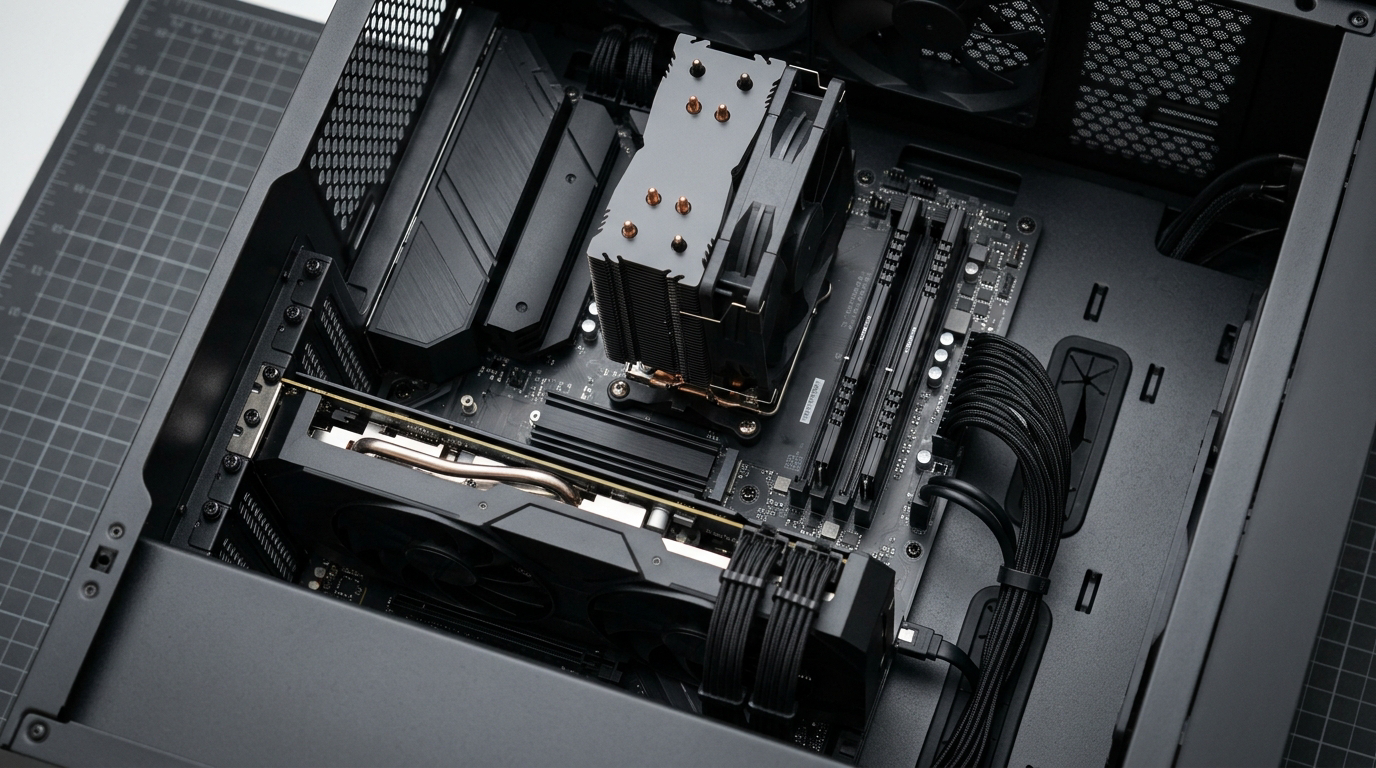
On thermals, MSI explicitly documents a 4-fan airflow tower paired with an ARGB tower air cooler plus chassis USB Type-C connectivity. Because the Ryzen 7 8700F caps out around 65W, a true tower heatsink with four case fans keeps CPU temperatures low and acoustics quiet without relying on fragile 120mm closed-loop liquid coolers. CyberPowerPC’s GMA2900A3 listing omits fan count and cooler geometry, and system integrators frequently rotate chassis tooling across retail production batches.
Even more importantly, both base Amazon pages omit exact power supply (PSU) wattage, 80+ Gold certification, and whether the unit conforms to PCI-SIG CEM 5.1 / ATX 3.1 transient excursion standards as verified by labs like Cybenetics. As detailed in our omitted PSU ratings and “Brand may vary” buyer guide, skipping PSU disclosures is widespread between $1,000 and $1,500. While an unremarkable 600W–650W PSU comfortably powers a 65W CPU plus a 180W RTX 5060 Ti 8GB today, dropping in a 300W+ RTX 5070 Ti or RX 9070 XT alongside a 162W PPT Ryzen 7 9800X3D later demands a verified 750W–850W ATX 3.1 80+ Gold unit with a native 12V-2×6 cable and at least 35mm of side-panel bend clearance.
Why do both towers still beat big-box OEM brands like Dell/Alienware or HP? Because neither uses a proprietary motherboard, custom 10-pin PSU wiring harness, or riveted chassis tray. Both MSI and CyberPowerPC build on standard ATX mounting points, letting you swap the PSU, add an extra NVMe drive, upgrade to 32GB DDR5, install a Wi-Fi 6E or Wi-Fi 7 PCIe/M.2 card (critical if an entry batch ships slower Wi-Fi 5), and drop in an X3D processor cleanly. MSI enjoys an extra edge on component predictability: its retail motherboard and MSI AIB graphics card avoid CyberPowerPC’s looser multi-vendor “Brand may vary” GPU lottery.
Battleground 5: Amazon Nameplate Traps & Post-Unboxing Validation
Before adding either tower to your cart, watch closely for three marketplace pitfalls that catch Amazon desktop shoppers off guard:
- The Gamer Master Legacy AM4 Trap: CyberPowerPC reuses the “Gamer Master” series name across dramatically different generations—including budget sub-$700 listings such as the GMA3100A3 equipped with a legacy AM4 Ryzen 5 5500, an outdated 4GB Radeon RX 6500 XT, 8GB of DDR4, and a tiny 500GB SSD. Always confirm the exact model code GMA2900A3, AM5 DDR5 memory, and RTX 5060 Ti 8GB before checkout.
- Broken Sidebar Filters & Variant Pooling: Amazon’s left-hand “Graphics Memory” filter tops out at “8 GB & above,” hiding the huge leap between 8GB, 12GB, and 16GB cards, while processor dropdowns often list duplicated strings like “AMD Ryzen 7”, “8700 F”, and “8700F” on shared parent pages that pool reviews from years-old hardware. Lock the Condition filter strictly to New and verify “Shipped & Sold by Amazon.”
- First-Hour Post-Unboxing Checklist: Once your Codex Z2 or Gamer Master arrives, open the tempered glass panel to verify PSU wattage/80+ label, confirm two memory sticks sit in slots A2/B2, and check for a GPU support bracket or clean cable routing. Enter BIOS to enable AMD EXPO and Resizable BAR, update chipset and NVIDIA Game Ready drivers, remove bundled antivirus trials, and run quick stability checks using HWiNFO64, Cinebench 2024, 3DMark, and CapFrameX to verify boost clocks, VRM temperatures, and 1% Lows.
Audited Retail Configurations: MSI Codex Z2 vs. CyberPowerPC Gamer Master
Below are the three verified in-stock Amazon US configurations representing the MSI Codex Z2 and CyberPowerPC Gamer Master AM5 matchup—covering both direct $1,200–$1,400 contenders and MSI’s 12GB RTX 5070 step-up tower.
1. MSI Codex Z2 Gaming Desktop (A8NVM-671US) — Best Overall Value Under $1,350

Budget Tier: Mid-upper tier (under $1,350; roughly $1,200–$1,350) | Audited Specs: AMD Ryzen 7 8700F (8C/16T, up to 5.0 GHz, 16MB L3, AM5) | NVIDIA GeForce RTX 5060 Ti 8GB GDDR7 | 16GB DDR5 | 1TB M.2 NVMe SSD | 4-Fan Airflow Tower + ARGB Air Cooler | USB Type-C | Windows 11 Home | Shipped & Sold by Amazon.
Audit Summary: The A8NVM-671US delivers identical Ryzen 7 8700F + RTX 5060 Ti 8GB silicon to CyberPowerPC’s GMA2900A3 while generally landing in a slightly leaner price bracket and explicitly verifying its 4-fan airflow layout, dedicated ARGB tower cooler, and front USB Type-C port. You still inherit standard prebuilt unknowns (omitted PSU wattage and single- vs. dual-channel DDR5 stick count), making an inspection and eventual 32GB DDR5-6000 CL30 swap worthwhile.
Pros: Lower entry ceiling under $1,350 for identical core silicon; documented 4-fan airflow + ARGB air cooler + USB Type-C; standard MSI ATX AM5 chassis ready for later X3D upgrades.
Cons: 8GB RTX 5060 Ti hits VRAM ceilings at 1440p Ultra + RT; Ryzen 7 8700F trims L3 cache to 16MB; headline listing omits PSU rating, chipset tier, and DDR5 stick configuration.
2. CyberPowerPC Gamer Master (GMA2900A3) — Best Documented AMD B850 Board

Budget Tier: Mid-upper tier (under $1,400; roughly $1,200–$1,350) | Audited Specs: AMD Ryzen 7 8700F (8C/16T, up to 5.0 GHz, 16MB L3, AM5) | AMD B850 Chipset Motherboard | NVIDIA GeForce RTX 5060 Ti 8GB GDDR7 | 16GB DDR5 | 1TB PCIe 4.0 NVMe SSD | Windows 11 Home | RGB KB & Mouse | Shipped & Sold by Amazon.
Audit Summary: CyberPowerPC wins on motherboard transparency by explicitly locking in an AMD B850 chipset and PCIe 4.0 NVMe SSD, ensuring PCIe 5.0 M.2 support and AM5 tuning headroom when you eventually replace the 8700F with a Ryzen 7 9800X3D. First-time desktop buyers also get a starter RGB keyboard and mouse in the box, though omitted PSU wattage, unspecified fan counts, and “Brand may vary” GPU sourcing slightly offset that convenience.
Pros: Confirmed AMD B850 AM5 chipset and PCIe 4.0 NVMe SSD; non-proprietary off-the-shelf ATX internals; bundled RGB keyboard and mouse with direct Amazon fulfillment.
Cons: Typically tracks slightly higher toward $1,400 without adding VRAM or 32GB DDR5; omits PSU wattage/80+ rating, cooling specs, and exact GPU AIB vendor; watch out for legacy AM4 Gamer Master listings.
3. MSI Codex Z2 Gaming Desktop (A8NVP-436US) — Step-Up 12GB RTX 5070 & 32GB DDR5 Pick

Budget Tier: Upper prebuilt tier (under $1,850) | Audited Specs: AMD Ryzen 7 8700F (8C/16T, 16MB L3, 16 Usable PCIe 4.0 Lanes, AM5) | NVIDIA GeForce RTX 5070 12GB GDDR7 | 32GB DDR5 | 2TB NVMe SSD | Standard MSI ATX AM5 Motherboard | 4-Fan Airflow + ARGB Air Cooler | USB Type-C | Windows 11 Home.
Audit Summary: If you play modern 1440p AAA titles and want to bypass both the 8GB VRAM limit and 16GB RAM constraint right out of the box, MSI’s A8NVP-436US configuration upgrades the Codex Z2 platform to a 12GB RTX 5070, 32GB DDR5, and a roomy 2TB NVMe SSD. Its standard MSI ATX AM5 motherboard keeps the door open for a future 9800X3D swap, though shoppers paying near $1,850 should verify PSU wattage before heavier upgrades.
Pros: Clears 8GB VRAM and 16GB RAM bottlenecks immediately with RTX 5070 12GB, 32GB DDR5, and 2TB storage; confirmed standard MSI ATX AM5 motherboard and 4-fan airflow cooling.
Cons: Still relies on the 16MB L3 Ryzen 7 8700F rather than a full-cache X3D chip; 12GB VRAM trails 16GB RX 9070 XT / RTX 5070 Ti systems in ultra-heavy 4K textures.
Decisive Verdict: Which AM5 Prebuilt Deserves Your Desk?
Between two near-twin Ryzen 7 8700F and RTX 5060 Ti 8GB towers, choosing the winner depends on whether you prioritize verified chassis airflow and lower entry cost from MSI or explicit AMD B850 motherboard documentation and bundled peripherals from CyberPowerPC.
Choose the MSI Codex Z2 If…
- You want the tighter sub-$1,350 entry value on the A8NVM-671US without paying extra for bundled starter peripherals.
- You value explicit 4-fan airflow, a dedicated ARGB tower air cooler, front/rear USB Type-C, and consistent MSI ATX parts.
- You prefer stepping up to the A8NVP-436US under $1,850 for 12GB RTX 5070 VRAM, 32GB DDR5, and a 2TB NVMe SSD.
Choose the CyberPowerPC Gamer Master If…
- You want explicit AMD B850 chipset confirmation guaranteeing PCIe 5.0 M.2 support for a future Ryzen X3D swap.
- You are buying your first gaming desktop and want an RGB keyboard and mouse included right out of the shipping box.
- You confirm the exact GMA2900A3 SKU, RTX 5060 Ti 8GB, and AM5 DDR5 specs—avoiding legacy AM4 Gamer Master models.
For most 1080p and light-1440p shoppers comparing these two lines head-to-head, the MSI Codex Z2 (A8NVM-671US) earns our slight overall nod thanks to lower budget positioning and documented 4-fan airflow cooling—while the CyberPowerPC Gamer Master (GMA2900A3) stays right behind on confirmed B850 AM5 transparency. Want to compare either rig against RTX 5070, RX 9070 XT, or Core Ultra 7 systems? Return to our best prebuilt gaming PC hub or browse the full Gaming PCs archive.
How We Audited This Guide
- Prebuilt configurations were audited for GPU tier and VRAM, CPU platform runway, memory channel layout, SSD class, PSU brand and rating disclosure, and case airflow before inclusion.
- Every specification claim was cross-checked against official OEM datasheets, platform vendor documentation, and published industry standards (PCI-SIG, JEDEC, VESA, Intel ATX) rather than marketplace listing copy.
- Recommendations were evaluated against our weighted audit rubric and documented compatibility rules; we do not publish fabricated FPS, thermal, or acoustic numbers.
Frequently Asked Questions
Which is better in 2026: the MSI Codex Z2 or CyberPowerPC Gamer Master?
Both deliver virtually identical gaming speed when configured with the Ryzen 7 8700F and RTX 5060 Ti 8GB. The MSI Codex Z2 (A8NVM-671US) wins slightly on value and documented 4-fan airflow cooling, whereas the CyberPowerPC Gamer Master (GMA2900A3) leads on explicit AMD B850 motherboard disclosure and bundled peripherals.
Can you upgrade the Ryzen 7 8700F in an MSI Codex Z2 or CyberPowerPC Gamer Master to a Ryzen 7 9800X3D?
Yes. Both desktops use standard AM5 motherboards without proprietary OEM sockets. After updating your BIOS, you can swap the 16MB L3 Ryzen 7 8700F for a 96MB L3 3D V-Cache chip like the Ryzen 7 7800X3D or 9800X3D—provided your tower air cooler handles 120W–162W PPT thermals.
Is 8GB VRAM on the RTX 5060 Ti enough for 1440p gaming in these prebuilts?
At 1080p Ultra and esports 1440p, 8GB GDDR7 works well with DLSS 4 upscaling. In heavy 1440p Ultra titles with ray tracing and Multi-Frame Generation enabled, 8GB hits texture ceilings quickly—which is why stepping up to the 12GB RTX 5070 Codex Z2 (A8NVP-436US) improves 1440p longevity.
What hidden specs should I verify after buying an MSI Codex Z2 or CyberPowerPC Gamer Master?
Neither base listing discloses PSU wattage, 80+ Gold efficiency, or DDR5 stick layout. Inspect the PSU label for 650W+ ATX 3.1 headroom before future GPU upgrades, verify whether RAM runs dual-channel (2x8GB) or single-channel (1x16GB), and enable AMD EXPO in BIOS.
Why do some CyberPowerPC Gamer Master listings cost under $700?
CyberPowerPC applies the Gamer Master name across multiple hardware eras. Sub-$700 listings like the GMA3100A3 bundle an older AM4 Ryzen 5 5500, 8GB DDR4, and a 4GB RX 6500 XT. Always confirm the AM5 GMA2900A3 configuration with Ryzen 7 8700F and RTX 5060 Ti 8GB.
Official Standards & Technical References
- AMD Socket AM5 Chipset & Processor Documentation: amd.com/en/products/processors/chipsets/am5.html
- NVIDIA GeForce RTX 50-Series Blackwell Specifications: nvidia.com/en-us/geforce/graphics-cards/50-series/
- MSI Gaming Desktops Platform Overview: msi.com/Desktops
- PCI-SIG PCIe CEM 5.1 & ATX 3.1 12V-2×6 Specifications: pcisig.com/specifications
- Cybenetics PSU Efficiency & Acoustic Database: cybenetics.com


