
Disclosure: As an Amazon Associate, The PC Audit earns from qualifying purchases. If you buy through links on this page, we may earn a small commission at no extra cost to you.
Direct Answer: Choosing what wattage PSU for RTX 50 series and RX 9000 GPUs uses five ATX 3.1 tiers: 650W for RTX 5060 and RX 9060 XT, 750W for RTX 5060 Ti, RX 9070, and RTX 5070, 850W for RTX 5070 Ti and RX 9070 XT, 1000W for RTX 5080, and 1200W+ for RTX 5090.
Adding a GPU’s advertised TDP to a processor’s base wattage used to be enough when older ATX 2.x power supplies only faced gradual load climbs. In 2026, NVIDIA Blackwell and AMD RDNA 4 graphics cards transition from desktop idle to full shader and ray-tracing saturation within microseconds, triggering brief current bursts well above steady-state ratings. Meanwhile, modern desktop CPUs regularly boost from 65W–125W base figures up to 162W–250W Package Power Tracking (PPT) or Maximum Turbo Power (MTP) limits during shader compilation and multi-core creator work.
That shift makes correct capacity planning essential for stability, efficiency, and acoustics across every desktop in our Cases, Cooling & Power hub and best gaming power supplies guide. Following our hardware architecture rule ATX 3.1 / PCIe 5.1 PSU --[SUPPLIES_TRANSIENT_SAFE_POWER]--> GPU, this sizing guide pairs verified 2025–2026 silicon power envelopes from our gaming GPU hierarchy with 50%–60% gaming load math, ATX 3.1 transient rules, and real chassis depth limits.
In This Guide
- 2026 PSU Wattage Quick Reference Table (RTX 50, RX 9000 & Arc B-Series)
- How to Calculate Exact Gaming PC PSU Wattage (The 50%–60% Sweet Spot Math)
- Transient Power Excursions, ATX 3.1, and 12V-2×6 Connector Safety
- Physical PSU Depth, Electrical Protections, and Modular Cable Rules
- Myth vs. Engineering Reality: Five PSU Wattage Myths Busted
- Actionable PSU Sizing & Buying Checklist
- Verified ATX 3.1 Power Supplies by Wattage Tier (2026)
- Frequently Asked Questions
2026 PSU Wattage Quick Reference Table (RTX 50, RX 9000 & Arc B-Series)
Every wattage recommendation below accounts for typical CPU gaming draw, full 162W–250W CPU boost headroom, motherboard VRM losses, DDR5 memory, NVMe drives, cooling fans, and the 50%–60% efficiency sweet spot rather than bare minimum boot requirements.
| Build Tier | GPU Models & Rated TBP/TDP | Typical CPU Pairings (Max PPT/MTP) | Recommended PSU Wattage | Target PSU & Connector Spec |
|---|---|---|---|---|
| Entry 1080p | RTX 5060 (145W), RX 9060 XT 8GB/16GB (150W–160W), Arc B570 (150W), Arc B580 (190W) | Ryzen 5 9600X (88W), Ryzen 7 8700F (65W), Core Ultra 5 245K (159W) | 650W | ATX 3.1 / 80 Plus Gold / 1x 8-Pin PCIe |
| Mid-Range 1440p | RTX 5060 Ti 8GB/16GB (180W), RX 9070 (220W), RX 9070 GRE (220W OEM) | Ryzen 7 7800X3D / 9800X3D (162W), Core Ultra 7 265F (182W) | 750W | ATX 3.1 / 80 Plus Gold / Native 12V-2×6 or Dual 8-Pin |
| Performance 1440p | RTX 5070 (250W), RTX 5070 Ti (300W), RX 9070 XT (~304W) | Ryzen 7 9800X3D / 9850X3D (162W), Core Ultra 7 270K Plus (250W) | 750W – 850W (850W ideal for 5070 Ti / 9070 XT) | ATX 3.1 / 80 Plus Gold or Cybenetics Gold+ / Full Modular |
| High-End 4K | RTX 5080 (360W) | Ryzen 7 9850X3D (162W), Ryzen 9 9900X3D (162W), Core Ultra 9 285K (250W) | 850W – 1000W (1000W recommended) | ATX 3.1 / Cybenetics Gold–Platinum / Native 12V-2×6 |
| Flagship / AI Rig | RTX 5090 (575W) | Ryzen 9 9950X3D (230W), Core Ultra 9 285K (250W) | 1000W – 1200W+ (1200W recommended) | ATX 3.1 / Cybenetics Platinum–Titanium / Lambda A+ / A++ |
Notice how the upper midrange and flagship classes divide cleanly across dedicated PSU brackets. Stepping from a 220W Radeon RX 9070 into the 300W–304W bracket of an RTX 5070 Ti or RX 9070 XT makes our best 850W ATX 3.1 power supplies roundup the focal point for 1440p Ultra rigs. Above 350W GPU power—specifically on the 360W RTX 5080 ($999 Launch MSRP) and 575W RTX 5090 ($1,999 Launch MSRP)—upgrading into our best 1000W and 1200W+ power supplies guide keeps conversion losses low and fan speeds quiet under sustained 4K ray tracing.
Rumored Hardware Notice (Audit Rule R-GPU-02): Unreleased refreshes discussed in supply-chain rumors—specifically the rumored RTX 5070 Super (rumored 275W TBP, 18GB GDDR7) and RTX 5080 Super (rumored 24GB GDDR7)—remain RUMORED / UNRELEASED and are excluded from shipping retail wattage specifications until officially confirmed.
How to Calculate Exact Gaming PC PSU Wattage (The 50%–60% Sweet Spot Math)
Instead of relying on generic online calculators that guess unknown peripheral draws, calculate both your worst-case continuous system load and your ideal efficiency target using published component power specs. Two straightforward equations keep any custom build or prebuilt audit mathematically grounded:
Peak Combined Load (W) = GPU TBP + CPU Max Boost Power (PPT or MTP) + System Overhead (60W–100W)
Optimal PSU Capacity (W) = Typical Gaming Load (W) ÷ 0.55
Step 1 — Account for CPU PPT/MTP Boost and Platform Overhead
Many builders underestimate CPU wattage because retail spec sheets highlight base TDP rather than sustained turbo power. Under our cooling and platform rule CPU Cooler --[SUSTAINS_PPT_MTP_BOOST]--> CPU, modern processors scale far higher whenever thermal headroom permits:
- AMD AM5 Gaming Processors: The Ryzen 5 9600X carries a 65W TDP but climbs to 88W PPT; pure gaming X3D flagships like the Ryzen 7 7800X3D, 9800X3D, 9850X3D, and Ryzen 9 9900X3D carry 120W base TDP ratings and up to 162W PPT (typically drawing 65W–110W in games); the 16-core Ryzen 9 9950X3D scales from 170W TDP up to 230W PPT.
- Intel LGA 1851 Hybrid Processors: The Core Ultra 5 245K/245KF reaches 159W MTP from a 125W base TDP, the OEM Core Ultra 7 265F jumps from 65W base to 182W MTP, and unlocked Core Ultra 7 265K, 270K Plus, and Core Ultra 9 285K chips climb from 125W base up to 250W MTP during heavy shader compilation, streaming, or rendering.
- System & Cooling Overhead (60W–100W): A modern B850, X870E, or Z890 motherboard chipset, VRM conversion stages, two sticks of DDR5-6000/6400 RAM, one or two PCIe 4.0/5.0 NVMe SSDs, four to six PWM case fans, a 360mm AIO pump, and USB peripherals collectively pull roughly 60W to 100W under gaming load.
Step 2 — Worked Wattage Examples Across 2026 Gaming Tiers
Applying those verified envelopes to real 2026 CPU and GPU pairings clarifies why recommended PSU capacities land above raw component sum totals:
- 1440p Sweet-Spot Rig (RTX 5070 Ti + Ryzen 7 9800X3D): Combine 300W GPU TBP + ~90W typical gaming CPU draw (162W max PPT) + 75W platform overhead = ~465W typical gaming load (537W full synthetic peak). Dividing 465W by 0.55 equals 845W—making an 850W ATX 3.1 PSU hit the exact 55% efficiency and acoustic target.
- 4K High-Refresh Rig (RTX 5080 + Core Ultra 7 270K Plus): Combine 360W GPU TBP + ~125W gaming CPU draw (250W max MTP) + 85W overhead = ~570W typical gaming load (695W worst-case simultaneous peak). Dividing 570W by 0.55 yields 1,036W—confirming why a 1000W ATX 3.1 unit beats an 850W model for quiet operation and creator-load headroom.
- Flagship 4K / AI Workstation (RTX 5090 + Ryzen 9 9950X3D): Combine 575W GPU TDP + ~130W gaming CPU draw (230W max PPT) + 95W overhead = ~800W typical gaming load (900W full simultaneous load). Dividing 800W by 0.55 reaches 1,454W—demonstrating why 1200W+ serves as the practical floor (with 1200W sitting around 67% gaming load and 1350W–1600W restoring the 50%–58% quiet sweet spot).
Step 3 — Why the 50%–60% Load Target Matters (And Prebuilt Omission Alerts)
Switching-mode PC power supplies achieve peak AC-to-DC conversion efficiency when operating between 50% and 60% of continuous rated capacity. Running near that midpoint reduces waste heat inside the PSU enclosure, keeps electrolytic capacitors cooler over a 10-year service life, and prevents internal cooling fans from ramping past gentle baseline speeds. Conversely, running a 500W gaming load continuously on a budget 650W unit pushes utilization near 77%, raising heat and fan noise.
Watch closely when shopping prebuilt systems under audit rules R-PSU-01 and R-AMZ-05: numerous mid-tier prebuilt listings omit exact PSU wattage, 80 Plus tier, or ATX 3.1 status while pairing strong GPUs with bare-minimum ATX 2.x Bronze units. Never assume an undisclosed power supply meets ATX 3.1 excursion standards or leaves room for a future RTX 5080-class upgrade.
Transient Power Excursions, ATX 3.1, and 12V-2×6 Connector Safety
Continuous wattage tells only half the story when evaluating what wattage PSU for RTX 50 series and RX 9000 graphics cards works safely. How rapidly a unit responds to microsecond spikes—and which physical power header carries that current—matters just as much as total watt capacity.
Surviving 200% to 300% GPU Transient Power Excursions
When a graphics card shifts from a lightweight menu into dense path-traced geometry, its voltage regulators demand instantaneous current bursts lasting tens of microseconds to a few milliseconds before steady-state boost governors settle. According to Intel’s ATX Version 3 Desktop Platform Power Supply Design Guide, compliant power supplies above 450W must tolerate 200% total PSU power excursions for 100 microseconds (180% for 1ms and 160% for 10ms) alongside up to 300% transient excursions across the PCIe GPU power delivery channel without voltage droop or false shutdowns.
That transient compliance explains why an older 850W ATX 2.x group-regulated power supply can trip its over-current protection (OCP) mid-game on a 304W–360W card, whereas a properly built 850W or 1000W ATX 3.1 unit absorbs those spikes effortlessly.
Native 12V-2×6 (H++), 8-Pin PCIe Topology, and the 35mm Bend Clearance Rule
NVIDIA’s RTX 5070, RTX 5070 Ti, RTX 5080, and RTX 5090 deliver primary board power over the revised 16-pin 12V-2x6 interface (while entry models such as select RTX 5060 Ti AIB cards, the RX 9060 XT, Intel Arc B580, and most Radeon RX 9070 / RX 9070 XT designs use single, dual, or triple 8-pin PCIe plugs). As documented in our deep dive on ATX 3.1 and 12V-2×6 vs. 12VHPWR, PCI-SIG’s CEM 5.1 update prevents connector melting via one hardware interlock: 12V-2x6 Connector --[IMPROVES_SAFETY_VIA]--> Recessed Sense Pins.
Inside H++-stamped sockets, the 12 main power conductors sit 0.25mm longer for lower contact resistance, while the four top sense pins sit 1.5mm shorter. If a plug pulls loose slightly, those recessed sense pins open first and force the GPU into safe low-power cutoff before localized resistance can heat the shroud. Always prefer a PSU with a native dual-ended 12V-2×6 cable rather than cramming bulky 3x or 4x 8-pin splitter dongles against a glass side panel. Under case clearance rule R-CASE-02, verify at least 35mm to 40mm of straight, unbent clearance between the GPU power socket and your side panel before curving the cable.
Hold-Up Time (12ms vs. 17ms) and 80 Plus vs. Cybenetics ETA / Lambda
Hold-up time measures how long bulk capacitors keep DC rails within ATX voltage tolerances during an AC mains dropout. As Seasonic’s ATX 3.0 vs. ATX 3.1 technical comparison details, ATX 3.1 adjusted the mandatory 100%-load floor from 17ms to 12ms while recommending 17ms at 80% load. Because gaming PCs spend gameplay around 50%–60% capacity, builders keep full brownout protection while gaining improved 2% light-load desktop efficiency.
When comparing efficiency badges, pair traditional 80 Plus Gold ratings (checked only at 20%, 50%, and 100% loads with zero acoustic data) with independent Cybenetics ATX v3.x certification:
- Cybenetics ETA: Audits conversion efficiency across thousands of real load points, power factor, and standby efficiency from Silver up to Titanium and Diamond.
- Cybenetics Lambda: Measures true acoustic output in dBA across the load curve, grading units from Standard up to whisper-quiet Lambda A (20–25 dBA), A+ (15–20 dBA), and A++ (under 15 dBA).
Physical PSU Depth, Electrical Protections, and Modular Cable Rules
Wattage numbers mean nothing if a long enthusiast unit collides with bottom radiator tubes or lacks reliable fault circuitry.
Chassis PSU Depth Clearance (140mm vs. 160mm vs. 200mm & SFX)
Higher continuous capacities often require larger transformers, bulk capacitors, and secondary heatsinks—growing chassis depth alongside wattage and making physical PSU clearance essential:
- Compact ATX (140mm–150mm Depth): Ideal for tight mid-towers and dual-chamber cases with rear cable traps; common on 750W–850W platforms and compact 1000W models such as the Super Flower Leadex VII XG 1000W (150mm).
- Standard Performance ATX (160mm Depth): Common across quiet 850W–1200W designs using 135mm–140mm fans, including the be quiet! Pure Power 13 M 850W (160mm); verify drive-cage removal space in shorter mid-tower cases.
- Extended Enthusiast ATX (180mm–200mm Depth): Flagship 1200W+ Platinum units like the CORSAIR HX1200i (2025) reach 200mm in length—requiring roomy mid-tower or full-tower shrouds with extra clearance for modular plugs.
- SFF / Mini-ITX Builds (100mm SFX): Compact Small Form Factor builds rely on 100mm SFX units (such as 850W or 1000W ATX 3.1 SFX models) engineered to fit tight Mini-ITX brackets without sacrificing native 12V-2×6 power.
Mandatory Electrical Protections, Capacitors, and Cable Pinouts
Before finalizing any wattage bracket, confirm three internal quality anchors documented under our vertical PSU rubric:
- Six Core Protection Circuits: Demand full OCP OVP OPP / UVP / SCP / OTP safeguards—covering Over-Current, Over-Voltage, Under-Voltage, Over-Power, Short-Circuit, and Over-Temperature protection.
- Japanese 105C Capacitors & 7–10+ Year Warranties: High-temperature Japanese 105C capacitors across primary and secondary rails paired with a 10-year manufacturer warranty signal robust ripple suppression and long-term thermal durability.
- Zero Cross-Unit Modular Cable Reuse: Following our critical safety rule
Mixing Modular PSU Cables Across Brands/Models --[CAUSES_CATASTROPHIC_DAMAGE]--> Short Circuits & Component Failure, PSU-side modular pinouts are not standardized. Even between two wattages or revisions from the same brand, reusing old modular cables can feed +12V into ground or +5V lines and destroy GPUs and NVMe drives immediately.
Per-GPU Power Connector Load & 12V Current Audit
Total wattage is only half of PSU sizing. The other half is how much current each graphics card pulls through its power plugs, and how close that draw sits to the connector’s rated limit. PCI-SIG rates the PCIe x16 slot at 75W, each 8-pin PCIe cable at 150W, and a 12V-2×6 cable at up to 600W. The table below divides each released 2025–2026 GPU’s rated board power by those limits to show real connector utilization.
| GPU | Rated Board Power | 12V Current at Rated Power | Typical Power Input | Rated Delivery (Slot + Cables) | Connector Utilization | Suggested ATX 3.1 PSU |
|---|---|---|---|---|---|---|
| RTX 5060 8GB | 145W | ~12.1A | 1x 8-pin | 225W | ~64% | 650W Gold |
| RX 9060 XT 16GB | 160W | ~13.3A | 1x 8-pin | 225W | ~71% | 650W Gold |
| RTX 5060 Ti 16GB | 180W | ~15.0A | 1x 8-pin (most AIB cards) | 225W | ~80% | 750W Gold |
| Arc B580 12GB | 190W | ~15.8A | 1x 8-pin | 225W | ~84% | 650W Gold |
| RX 9070 16GB | 220W | ~18.3A | 2x 8-pin | 375W | ~59% | 750W Gold |
| RTX 5070 12GB | 250W | ~20.8A | 12V-2×6 | 675W | ~37% | 750W Gold |
| RTX 5070 Ti 16GB | 300W | ~25.0A | 12V-2×6 | 675W | ~44% | 850W Gold |
| RX 9070 XT 16GB | 304W | ~25.3A | 2x 8-pin (3x 8-pin or 12V-2×6 on some AIB models) | 375W | ~81% | 850W Gold |
| RTX 5080 16GB | 360W | ~30.0A | 12V-2×6 | 675W | ~53% | 1000W Gold–Platinum |
| RTX 5090 32GB | 575W | ~47.9A | 12V-2×6 | 675W | ~85% | 1200W+ Platinum |
Two patterns stand out. First, the RTX 5070 and RTX 5070 Ti use well under half of the 675W their 12V-2×6 path can deliver, which leaves generous margin for brief transient spikes. Second, three cards run above 80% of their connector rating at stock power: the single 8-pin Arc B580 and RTX 5060 Ti, the dual 8-pin RX 9070 XT, and the 575W RTX 5090. Factory-overclocked versions push those figures higher, which is why many premium RX 9070 XT boards add a third 8-pin plug.
High connector utilization is within specification, but it leaves less tolerance for poor contact. On those cards, always use separate PSU cables for each 8-pin input rather than one daisy-chained pigtail, never reuse modular cables from another unit (see our modular PSU cable safety guide), and keep the required straight run before any bend, as detailed in our GPU clearance and 12V-2×6 bend guide. For 145W–250W cards, our best 750W ATX 3.1 power supplies roundup covers native cabling for every row above up to the RTX 5070.
Myth vs. Engineering Reality: Five PSU Wattage Myths Busted
- Myth 1: “Adding GPU TDP and CPU base TDP equals the PSU wattage you should buy.”
Engineering Reality: Base CPU TDP ignores 162W–250W PPT/MTP boost draws, while GPU TBP hides 200%–300% microsecond excursions. Sizing directly to raw TDP leaves zero headroom and puts your PSU outside its quiet 50%–60% efficiency band. - Myth 2: “Buying a 1000W or 1200W PSU pulls 1000W from your wall outlet all day.”
Engineering Reality: A power supply delivers only what your components demand, multiplied by conversion efficiency. At 80W desktop idle, an ATX 3.1 1000W Platinum unit engineered for ≥60%–70% light-load efficiency pulls roughly the same wall wattage as a smaller 650W unit. - Myth 3: “An older 850W ATX 2.x Bronze PSU handles an RTX 5080 just fine because 850 equals 850.”
Engineering Reality: Older group-regulated ATX 2.x Bronze designs lack ATX 3.1 excursion tolerance and native12V-2x6cables, risking nuisance shutdowns under 4K transient spikes and relying on bulky multi-8-pin adapters. - Myth 4: “An 80 Plus Gold sticker guarantees quiet fan noise and top-tier capacitors.”
Engineering Reality: 80 Plus checks efficiency at only three load points and says nothing about fan acoustics, ripple, or capacitor lifespan. Check Cybenetics ETA, Cybenetics Lambda noise grades, 105°C capacitor specs, and warranty length. - Myth 5: “If an Amazon prebuilt lists an ‘850W PSU,’ you don’t need to inspect further.”
Engineering Reality: Under marketplace audit ruleR-AMZ-05, prebuilt product pages frequently omit efficiency tiers, ATX 3.1 compliance, and modularity—or use proprietary connectors (R-PRE-01). Confirm exact model specs before trusting high-draw upgrades.
Actionable PSU Sizing & Buying Checklist
Walk through these six concrete engineering checks before ordering a power supply or configuring a prebuilt upgrade:
- Lock Your GPU Tier & Power Connector First: Verify rated TBP/TDP—whether a 145W–190W entry GPU, a 250W–304W 1440p card, a 360W RTX 5080, or a 575W RTX 5090—and count native
12V-2x6vs. 8-pin PCIe plugs required by your exact AIB card. - Check CPU Max Boost Wattage (PPT / MTP): Size your power budget around 162W–230W AM5 PPT or 159W–250W LGA 1851 MTP limits rather than 65W–125W base TDP figures.
- Divide Gaming Load by 0.55 for the Sweet Spot: Aim for typical gaming power draw to sit near 50%–60% of PSU capacity (750W for RTX 5060 Ti/RX 9070/RTX 5070, 850W for RTX 5070 Ti/RX 9070 XT, 1000W for RTX 5080, and 1200W+ for RTX 5090).
- Mandate ATX 3.1, PCIe 5.1 & Native 12V-2×6: Confirm
H++recessed-sense-pin geometry and native 16-pin cable inclusion on any 750W+ build powering RTX 50-series GPUs. - Measure Both PSU Depth & Side-Panel GPU Clearance: Check chassis PSU bay length (140mm–160mm vs. 200mm flagships) and verify ≥35mm–40mm straight bend clearance outside the GPU’s
12V-2x6port. - Verify Cybenetics Ratings, Protections & Warranty: Prioritize 80 Plus Gold / Cybenetics ETA Gold–Platinum efficiency, full OCP/OVP/UVP/OPP/SCP/OTP protections, and a 10-year warranty—and discard old modular cables completely when swapping units.
Verified ATX 3.1 Power Supplies by Wattage Tier (2026)
Once your build math locks in a target capacity, explore our complete category rankings in our best gaming power supplies pillar hub, compare mid-high models inside our audited 850W ATX 3.1 roundup, or step up for flagship cards in our 1000W & 1200W+ PSU buyer guide. Below are four verified ATX 3.1 / PCIe 5.1 models on Amazon US matching each core 2026 wattage bracket.
1. Seasonic CORE GX-750 750W — Best 750W Pick for RTX 5060 Ti, RX 9070 & RTX 5070

Budget Tier: Midrange 750W tier | Audited Specs: 750W Continuous Output | ATX 3.1 & PCIe 5.1 Ready | Native 12V-2×6 Connector | 80 PLUS Gold & Cybenetics Platinum Efficiency | Full Modular Cabling.
Why It Fits This Wattage Tier: With 180W–250W graphics cards like the RTX 5060 Ti 16GB ($429 Launch MSRP), RX 9070 ($549 Launch MSRP), and RTX 5070 ($549 Launch MSRP) paired alongside a 65W–120W AM5 or LGA 1851 processor, typical gaming draw lands around 360W–420W—right inside the CORE GX-750’s peak efficiency zone. Earning Cybenetics Platinum efficiency alongside native 12V-2×6 support eliminates splitter dongles cleanly.
2. be quiet! Pure Power 13 M 850W — Best 850W Pick for RTX 5070 Ti & RX 9070 XT

Budget Tier: Budget-friendly 850W tier | Audited Specs: 850W Continuous Output | ATX 3.1 & PCIe 5.1 | Native 12V-2×6 Connector | 80 PLUS Gold & Cybenetics Platinum Efficiency | Semi-Passive Zero-RPM Cooling | 160mm Chassis Depth.
Why It Fits This Wattage Tier: Stepping up to 300W–304W 1440p Ultra GPUs such as the RTX 5070 Ti ($749 Launch MSRP) and Radeon RX 9070 XT ($599 Launch MSRP) places gaming consumption squarely inside 850W’s 50%–60% sweet spot (~465W typical draw). Combining Cybenetics Platinum efficiency with semi-passive Zero-RPM cooling keeps acoustics calm during desktop work and light gaming; confirm 160mm PSU bay clearance inside compact cases.
3. Super Flower Leadex VII XG 1000W — Best 1000W Pick for RTX 5080 4K Builds
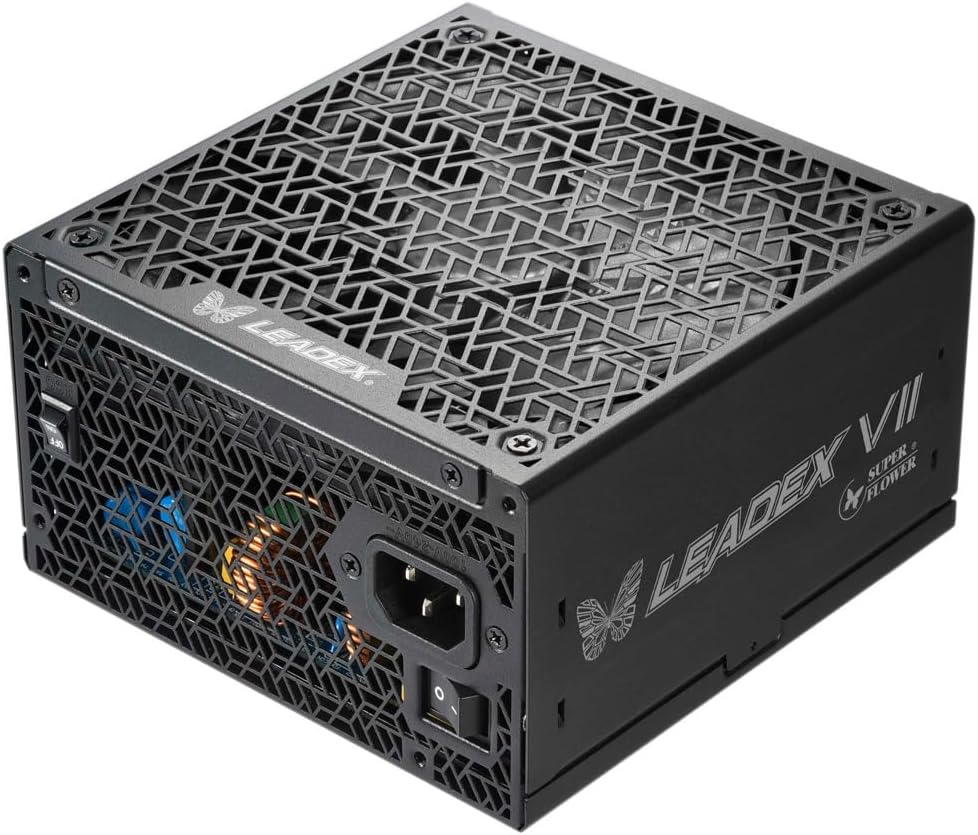
Budget Tier: Midrange 1000W tier | Audited Specs: 1000W Continuous Output | ATX 3.1 & PCIe 5.1 | 16-Pin PCIe Gen 5 (12V-2×6) Connector | 80 PLUS Gold & Cybenetics Platinum Efficiency | FDB Fan | 150mm Chassis Depth.
Why It Fits This Wattage Tier: Pairing a 360W GeForce RTX 5080 ($999 Launch MSRP) with a 230W–250W creator processor pushes sustained gaming load near 570W and synthetic bursts close to 700W. The Leadex VII XG 1000W keeps those loads inside the 50%–60% peak efficiency bracket with Cybenetics Platinum efficiency while trimming chassis length to 150mm for broader mid-tower compatibility.
4. CORSAIR HX1200i (2025) 1200W — Best 1200W Pick for RTX 5090 Flagship Rigs

Budget Tier: Enthusiast 1200W tier | Audited Specs: 1200W Continuous Output | ATX 3.1 & PCIe 5.1 Ready | Native 12V-2×6 Connector | Cybenetics Platinum Efficiency | 140mm FDB (Zero RPM Mode) | 200mm Chassis Depth.
Why It Fits This Wattage Tier: A 575W GeForce RTX 5090 ($1,999 Launch MSRP) running alongside a Ryzen 9 9950X3D or Core Ultra 9 285K drives real gaming load around 800W and full-tilt workstation loads higher still—demanding 1200W+ ATX 3.1 stability. This 2025 HX1200i revision brings Cybenetics Platinum efficiency, a 140mm FDB Zero RPM fan, and native 12V-2×6 power; verify your case accommodates its full 200mm length before ordering.
PSU Configurations Disqualified Under Audit Rule R-PSU-01
- Legacy ATX 2.x Group-Regulated Bronze Units on RTX 5070+ Rigs: Lack 200%–300% transient excursion tolerance and native
12V-2x6cabling, risking rail voltage droop and mid-game OCP shutdowns. - Multi-8-Pin Adapter Harnesses Over Native 12V-2×6 Above 750W: Bulky dongle adapters multiply resistive contact junctions and push awkwardly against tempered glass side panels inside <35mm clearance spaces.
- Omitted-Spec or Sub-5-Year Warranty Prebuilt Power Supplies: Units concealing ATX revision, efficiency rating, capacitor rating, or full OCP/OVP/UVP/OPP/SCP/OTP protections fail baseline long-term reliability audits.
Official Standards & Engineering References
- NVIDIA GeForce RTX 50 Series Architecture & System Power Specifications
- AMD Radeon RX 9000 Series RDNA 4 Power & Platform Specifications
- Intel Engineering Design Center: ATX Version 3 Multi-Rail Desktop Power Supply Design Guide
- Cybenetics Labs: ATX v3.x Excursion, ETA Efficiency & Lambda Noise Standard
- Seasonic Knowledge Base: Engineering Differences Between ATX 3.0 and ATX 3.1
How We Audited This Guide
- Power supplies, coolers, and cases were audited for ATX 3.1 / PCIe 5.1 compliance, 12V-2x6 support, efficiency certification, radiator and GPU clearance, and fan configuration.
- Every specification claim was cross-checked against official OEM datasheets, platform vendor documentation, and published industry standards (PCI-SIG, JEDEC, VESA, Intel ATX) rather than marketplace listing copy.
- Recommendations were evaluated against our weighted audit rubric and documented compatibility rules; we do not publish fabricated FPS, thermal, or acoustic numbers.
Frequently Asked Questions
What wattage PSU do I need for the RTX 50 series?
Match your RTX 50 GPU to five ATX 3.1 brackets: 650W for the 145W RTX 5060, 750W for the RTX 5060 Ti and RTX 5070, 850W for the 300W RTX 5070 Ti, 1000W for the 360W RTX 5080, and 1200W+ for the 575W RTX 5090.
Is an 850W PSU enough for an RTX 5080 or RX 9070 XT?
An ATX 3.1 850W Gold unit comfortably covers the 304W Radeon RX 9070 XT at its 50%–60% efficiency sweet spot. For the 360W RTX 5080 paired with a 250W CPU, 850W works at minimum, yet 1000W is recommended for quieter acoustics and full creator-load headroom.
Do I need a 1200W PSU for an RTX 5090?
While select 1000W ATX 3.1 units can boot an RTX 5090, pairing a 575W GPU with a 230W–250W flagship CPU pushes gaming power toward 800W. Choosing 1200W+ keeps loads near peak efficiency, reduces fan noise, and leaves margin for 3x GPU transient spikes.
Does a higher wattage PSU use more electricity from the wall?
No. A power supply draws only what your components demand plus conversion loss. During gaming, a Cybenetics Platinum 1000W PSU running at 50% load often pulls slightly less wall electricity than a smaller unit pushed near 80% capacity while generating less waste heat.
Do I really need ATX 3.1 instead of an older ATX 2.x or ATX 3.0 PSU?
Yes for new builds. ATX 3.1 units withstand 200%–300% transient power excursions without false shutdowns and add native 12V-2×6 H++ sockets with 1.5mm recessed sense pins, preventing partial-seating cable overheating compared with legacy ATX 2.x units and first-generation 12VHPWR headers.


