
Disclosure: As an Amazon Associate, I earn from qualifying purchases. If you buy through links on this page, we may earn a small commission at no extra cost to you.
Choosing the best air cpu cooler gaming rigs can depend on in 2026 comes down to one sharp engineering reality: seven-heatpipe budget towers under $50 now rival flagship units in the $150-$175 tier on modern gaming processors. For years, serious enthusiasts paid flagship money to tame hot multi-core chips, yet today’s Thermalright Phantom Spirit lineup and ID-COOLING dual-towers deliver massive copper heatpipe density at a fraction of legacy pricing.
Even so, the flagship Noctua NH-D15 G2 and be quiet! Dark Rock Pro 6 still earn their keep in noise-normalized acoustics, base convexity tuning, and multi-year warranty support. To separate genuine thermal engineering from spec-sheet padding, we audited 7 verified air coolers across thermal dissipation, fan pressure, DDR5 RAM clearance, and socket longevity—complementing our Best CPU Coolers for Gaming (2026) hub guide.
In This Guide
Quick Picks: Best Air CPU Cooler Gaming Picks at a Glance
#1 Best Overall
Thermalright Phantom Spirit 120 EVO
Seven 6mm heatpipes, 810g fin mass, and high-pressure TL-K12 fans deliver elite 162W–250W cooling inside a compact 157mm chassis footprint. (Jump to audit)
#2 Best Value Dual-Tower
Thermalright Phantom Spirit 120 SE
Delivers the full seven-heatpipe dual-tower layout at a shorter 154mm height under $40 for maximum cooling per dollar. (Jump to audit)
#3 Best Flagship Acoustic Tower
Noctua NH-D15 G2
Eight heatpipes, speed-offset 140mm NF-A14x25r G2 fans, and a 6-year warranty deliver unmatched acoustic smoothness in wide 168mm+ cases. (Jump to audit)
Side-by-Side Comparison: 7 Air CPU Cooler Gaming Picks
| Product & Award | Best For | Architecture & Height | Fans & Socket Support | Amazon Link |
|---|---|---|---|---|
| Thermalright Phantom Spirit 120 EVO Best Overall | High-value AM5 X3D & LGA 1851 builds ($40-$50 tier) | Dual-tower, 7 heatpipes, 157mm height | Dual 120mm TL-K12 PWM (2150 RPM); AM5/AM4, LGA 1851/1700 | View on Amazon |
| Thermalright Phantom Spirit 120 SE Best Value Dual-Tower | Maximum thermal capacity under $40 | Dual-tower, 7 heatpipes, 154mm height | Dual 120mm TL-C12B V2 PWM (1500 RPM); AM5/AM4, LGA 1851/1700 | View on Amazon |
| Noctua NH-D15 G2 Best Flagship Acoustic Tower | Whisper-quiet flagship builds ($150-$175 tier) | Dual-tower, 8 heatpipes, 168mm height | Dual 140mm NF-A14x25r G2 PWM (1500 RPM); AM5/AM4, LGA 1851/1700 | View on Amazon |
| ARCTIC Freezer 36 (Black) Best Under $30 Single-Tower | Tall RGB RAM & entry rigs under $30 | Single-tower push-pull, 4 heatpipes, 159mm height | Dual 120mm P12 PWM PST (1800 RPM); AM5/AM4, LGA 1851/1700 | View on Amazon |
| ID-COOLING FROZN A620 PRO SE Best Stealth Budget Dual-Tower | All-black builds under $35 (260W TDP rated) | Dual-tower, 6 heatpipes, 157mm height | Dual 120mm AS-120-K PWM (2000 RPM); AM5/AM4, LGA 1851/1700 | View on Amazon |
| Thermalright Peerless Assassin 120 SE Best Proven Classic Dual-Tower | Color-matched budget builds under $40 | Dual-tower, 6 heatpipes, 155mm height | Dual 120mm TL-C12C PWM (1550 RPM); AM5/AM4, LGA 1851/1700 | View on Amazon |
| be quiet! Dark Rock Pro 6 Best Semi-Passive Quiet Tower | Zero-RPM idling & stealth chassis ($75-$100 tier) | Dual-tower, 7 heatpipes, 169mm height | 135mm center + 120mm front Silent Wings PWM (up to 2000 RPM); AM5/LGA 1851 | View on Amazon |
Match Your Use Case: Which Air Cooler Fits Your Build?
| Buyer Scenario | Best Match | Why & Expected Outcome |
|---|---|---|
| Pure AM5 9800X3D / 9850X3D Gaming Rig | Thermalright Phantom Spirit 120 EVO | Seven heatpipes and 2.87 mmH2O static pressure sustain 162W PPT boost clocks quietly inside standard 157mm+ mesh mid-towers. |
| Strict Budget Dual-Tower Under $40 (154mm Limit) | Thermalright Phantom Spirit 120 SE | Retains full seven-heatpipe capacity while trimming 3mm of vertical height to fit tighter ATX and micro-ATX cases. |
| Whisper-Quiet 250W Workstation & Gaming | Noctua NH-D15 G2 | Speed-offset 140mm NF-A14x25r G2 fans, 8 heatpipes, and a 6-year warranty keep sustained multi-core heat remarkably calm. |
| Tall RGB DDR5 RAM / Entry Build Under $30 | ARCTIC Freezer 36 (Black) | Slim single-tower layout avoids RAM slot overhang completely and includes an Intel LGA 1851/1700 contact frame plus MX-6 paste. |
| Minimalist Blackout Dual-Tower Under $35 | ID-COOLING FROZN A620 PRO SE | Zero-RGB matte-black dual-tower rated at 260W TDP keeps mid-range Ryzen and Intel processors cool without messy ARGB cabling. |
| Semi-Passive Zero-RPM Desktop Stealth Rig | be quiet! Dark Rock Pro 6 | Physical quiet-mode toggle halts Silent Wings fans below 40% PWM duty for dead-silent desktop productivity inside 170mm+ enclosures. |
Detailed Audits: Best Air CPU Cooler Gaming Picks (1–7)
1. Thermalright Phantom Spirit 120 EVO CPU Cooler — Best Overall

Quick Specs: Dual-tower heatsink (157mm height, 810g mass) | 7 x 6mm AGHP copper heatpipes | Dual 120mm TL-K12 PWM fans (2150 RPM, 69 CFM, 2.87 mmH2O, S-FDB V2) | AMD AM5/AM4 & Intel LGA 1851/1700/1200/115x | 3-year warranty | Price Tier: $40-$50 tier
Audit Score: 9.4 / 10
- Thermal Dissipation Capacity (PPT/MTP) (35%): 9.4 / 10
- Acoustic Profile & Fan Noise (25%): 8.7 / 10
- Compatibility & RAM/Case Clearance (20%): 9.5 / 10
- Reliability, Warranty & Value (20%): 9.9 / 10
Thermalright built the Phantom Spirit 120 EVO to close the gap between value dual-towers and three-figure flagships, and its physical hardware justifies the top rank. Rather than relying on the six-heatpipe frame of older budget models, Thermalright packs seven 6mm AGHP (Anti-Gravity Heat Pipe) copper tubes into an 810g dual-fin stack backed by a machined C1100 nickel-plated copper coldplate, as documented in the Thermalright Phantom Spirit 120 EVO specification sheet. Upgrading from standard 1500 RPM fans to twin TL-K12 PWM blowers pushes maximum static pressure to 2.87 mmH2O—crucial for forcing cool intake air cleanly through tightly spaced aluminum fins under 162W AM5 PPT or 250W LGA 1851 MTP bursts.
Compared directly with our #2 pick, the Phantom Spirit 120 SE, the EVO adds denser black-anodized top shrouds that conceal bare copper heatpipe tips alongside higher-pressure S-FDB V2 bearing fans for sustained creator workloads. Against our #3 flagship pick, the Noctua NH-D15 G2 in the $150-$175 tier, the EVO sits 11mm shorter at 157mm—meaning it drops cleanly into mainstream mid-towers that reject 168mm coolers—while leaving roughly a hundred dollars free for a better GPU or faster NVMe SSD.
Buyer Verification Alert: At full 2150 RPM, the TL-K12 fans prioritize peak airflow over silence; configure a custom PWM fan curve capped at 60–70% duty inside BIOS and pair with low-profile DDR5 modules under 42mm so the front fan does not push cooler height past 157mm.
Pros
- Seven 6mm AGHP heatpipes and 810g fin stack deliver flagship-tier thermal capacity in the $40-$50 tier
- High-static-pressure 2.87 mmH2O TL-K12 fans maintain airflow through dense fin spacing
- 157mm tower height clears most standard ATX and micro-ATX mesh cases effortlessly
- Anodized top covers with subtle ARGB edge accents elevate windowed build appearance
Cons
- Full 2150 RPM speed sounds brisk without a gentle motherboard PWM fan curve
- Front 120mm fan overhangs primary memory slots, requiring low-profile DIMMs for optimal clearance
Verdict: Buy it if you want flagship-caliber dual-tower cooling for AM5 X3D or LGA 1851 gaming CPUs inside the $40-$50 tier. Skip it if your chassis caps CPU cooler clearance at 155mm or you want a zero-RGB stealth cover with 6-year fan coverage. Upgrade Note: Pairing the coldplate with a PTM7950 phase-change pad eliminates repasting maintenance across multi-year socket upgrades.
2. Thermalright Phantom Spirit 120 SE — Best Value Dual-Tower

Quick Specs: Dual-tower heatsink (154mm height, 765g mass) | 7 x 6mm AGHP copper heatpipes | Dual 120mm TL-C12B V2 PWM fans (1500 RPM, 66.17 CFM, 1.53 mmH2O, S-FDB) | AMD AM5/AM4 & Intel LGA 1851/1700/1200/115x | 3-year warranty | Price Tier: Under $40
Audit Score: 9.3 / 10
- Thermal Dissipation Capacity (PPT/MTP) (35%): 9.1 / 10
- Acoustic Profile & Fan Noise (25%): 9.0 / 10
- Compatibility & RAM/Case Clearance (20%): 9.6 / 10
- Reliability, Warranty & Value (20%): 9.8 / 10
Stripping away decorative anodized top plates lets the Thermalright Phantom Spirit 120 SE sit under $40 while preserving the exact seven-heatpipe thermal core that makes its EVO sibling dominant. Standing just 154mm tall with a 765g fin stack, this Special Edition tower fits compact micro-ATX and narrow mid-tower enclosures where even a 158mm heatsink scrapes tempered side glass, as verified on the Thermalright Phantom Spirit 120 SE datasheet. Its twin TL-C12B V2 fans spin up to 1500 RPM on S-FDB bearings, keeping acoustic output naturally subdued on stock motherboard fan tables without mandatory BIOS tuning.
Putting the Phantom Spirit 120 SE beside our #6 classic pick, the Peerless Assassin 120 SE, highlights why the Phantom Spirit superseded it: you gain a seventh 6mm copper heatpipe and 35g of extra fin mass in a package that actually measures 1mm shorter (154mm vs. 155mm). Compared with our #5 budget alternative, the ID-COOLING FROZN A620 PRO SE, Thermalright provides one additional heatpipe and calmer S-FDB bearings while trading away ID-COOLING’s stealth black top shroud.
Buyer Verification Alert: Thermalright lists non-LED black (`TL-C12B V2`) and ARGB (`TL-C12B-S V2`) versions across closely titled Amazon pages; verify the selected product option before checkout so it matches your motherboard’s 5V 3-pin ARGB header count.
Pros
- Full 7-heatpipe copper architecture priced under $40 delivers unbeatable value per watt
- Ultra-compatible 154mm height clears compact mid-towers and budget cases smoothly
- 1500 RPM S-FDB fans stay remarkably pleasant even under default motherboard curves
Cons
- Exposed soldered copper heatpipe tips look industrial inside glass showcase rigs
- 1.53 mmH2O fan pressure yields slightly higher temperatures than the EVO above 200W
Verdict: Buy it if you want maximum cooling per dollar under $40 with a shorter 154mm tower profile. Skip it if you prioritize clean top-plate aesthetics over exposed heatpipe tips or want extra static pressure for 230W+ creator workloads. Upgrade Note: Standard ~42mm front-fan RAM clearance accommodates low-profile DDR5-6000 CL30 kits cleanly without shifting the front blower.
3. Noctua NH-D15 G2 Dual Tower CPU Cooler — Best Flagship Acoustic Tower
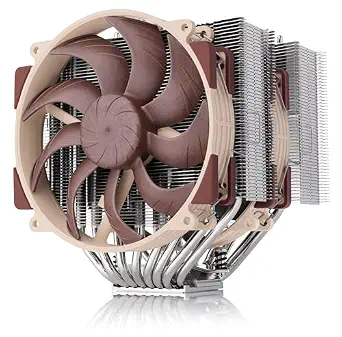
Quick Specs: Dual-tower heatsink (168mm height, 1525g total weight) | 8 copper heatpipes (NSPR 228) | Dual 140mm NF-A14x25r G2 PWM speed-offset fans (1500 RPM, 91.58 CFM, 24.8 dBA) | AMD AM5/AM4 & Intel LGA 1851/1700 | 6-year warranty | Price Tier: $150-$175 tier
Audit Score: 9.1 / 10
- Thermal Dissipation Capacity (PPT/MTP) (35%): 9.8 / 10
- Acoustic Profile & Fan Noise (25%): 9.9 / 10
- Compatibility & RAM/Case Clearance (20%): 8.0 / 10
- Reliability, Warranty & Value (20%): 8.2 / 10
Engineering perfection does not come cheap, and the Noctua NH-D15 G2 proves both halves of that rule. Upgrading the legendary original D15 from six to eight heatpipes and pairing the asymmetric 1,525g fin array with twin round-frame NF-A14x25r G2 fans earns Noctua’s highest 228 NSPR rating on the Noctua NH-D15 G2 official specifications. What sets this flagship apart in open-desk listening is its deliberate ~50 RPM speed offset between the front and center 140mm fans—a subtle acoustic trick that prevents periodic beat-frequency humming when both fans spin near identical frequencies under sustained 230W–250W loads.
Measured purely on noise-normalized cooling and mechanical refinement, the NH-D15 G2 beats every other air cooler on this roster, including our #7 semi-passive pick, the be quiet! Dark Rock Pro 6. However, sitting in the $150-$175 tier pushes its value score down sharply relative to our #1 Phantom Spirit 120 EVO: on an 8-core Ryzen 7 9800X3D drawing under 110W in games, the extra hundred-plus dollars buys superior fan tonality and a 6-year warranty rather than higher in-game frame rates.
Buyer Verification Alert: Noctua manufactures three coldplate curvature models for the NH-D15 G2: Standard (balanced all-rounder), LBC (Low-Base Convexity optimized for flatter AM5/AM4 IHS surfaces), and HBC (High-Base Convexity tailored for concave Intel LGA 1700/1851 chips). Verify which variant matches your CPU socket before purchasing.
Pros
- Speed-offset 140mm NF-A14x25r G2 fans eliminate harmonic resonance and beat humming
- Eight heatpipes, offset AM5 mounting, and 1,525g mass tame 250W MTP chips cleanly
- Six-year warranty plus SecuFirm2+ Torx driver, NT-H2 paste, and free future socket kits
Cons
- Costs roughly three times as much as the #1 Phantom Spirit 120 EVO while matching budget 360mm AIO prices
- Tall 168mm baseline height and tight 32mm default front-fan RAM clearance restrict smaller cases
Verdict: Buy it if you build in a wide 170mm+ airflow case and demand class-leading acoustic smoothness, 8-heatpipe headroom, and a 6-year warranty. Skip it if you want practical gaming value under $50 or your mid-tower caps CPU coolers below 168mm. Upgrade Note: Because stock front-fan clearance measures just 32mm, stick strictly to bare or low-profile DDR5 modules unless your chassis allows raising the front fan above 175mm.
4. ARCTIC Freezer 36 (Black) CPU Cooler with Push-Pull Fans — Best Under $30 Single-Tower

Quick Specs: Single-tower push-pull heatsink (159mm height, 59 fins) | 4 x 6mm direct-touch copper heatpipes | Dual 120mm P12 PWM PST fans (200–1800 RPM, FDB, 0 RPM <5% PWM) | AMD AM5/AM4 & Intel LGA 1851/1700 Contact Frame included | 6-year warranty | Price Tier: Under $30
Audit Score: 8.9 / 10
- Thermal Dissipation Capacity (PPT/MTP) (35%): 8.2 / 10
- Acoustic Profile & Fan Noise (25%): 9.1 / 10
- Compatibility & RAM/Case Clearance (20%): 9.4 / 10
- Reliability, Warranty & Value (20%): 9.5 / 10
Not every gaming PC needs a massive two-pound dual-tower blocking its memory slots. Priced under $30, the ARCTIC Freezer 36 (Black) pairs a 59-fin single tower and four staggered 6mm direct-touch heatpipes with twin P12 PWM PST fluid dynamic bearing fans in a push-pull sandwich, backed by a 6-year warranty on the ARCTIC Freezer 36 Black product page. Because the entire heatsink body sits neatly behind your first DIMM slot, builders running tall RGB DDR5 kits never have to slide a front fan upward or sacrifice four-stick aesthetic symmetry. Better still, ARCTIC includes a machined Intel LGA 1851/1700 Contact Frame and MX-6 paste right inside the box—extras that usually cost ten dollars separately.
Matched against the dual-tower #5 ID-COOLING FROZN A620 PRO SE under $35, the ARCTIC Freezer 36 surrenders heavy 220W–250W thermal ceiling because four direct-touch heatpipes hold less mass than six or seven soldered heatpipes. Yet for 65W–120W gaming CPUs such as the Ryzen 5 9600X, Core Ultra 5 245K, or even gaming-only Ryzen 7 9800X3D rigs prioritizing clear RAM visibility and click-in fan mounting, ARCTIC delivers cleaner ergonomics and twice the warranty length of budget dual-towers.
Buyer Verification Alert: On Intel LGA 1851 and LGA 1700 motherboards, ARCTIC’s included Contact Frame replaces the factory motherboard ILM latch mechanism completely; store the original socket bracket in your motherboard box for warranty returns.
Pros
- Zero DIMM slot overhang leaves tall RGB DDR5 heatspreaders completely unobstructed
- Includes Intel LGA 1851/1700 Contact Frame and MX-6 compound under $30
- Daisy-chained P12 FDB fans support 0 RPM idle stop below 5% PWM and carry a 6-year warranty
Cons
- Four heatpipes saturate faster above 180W than 7-heatpipe dual-tower units
- 159mm height still requires standard mid-tower side-panel clearance
Verdict: Buy it if you run tall RGB DDR5 memory on an entry or mid-range gaming CPU under $30 and want zero RAM slot overhang. Skip it if you run sustained 230W-250W multi-core renders on a Ryzen 9 9950X3D or Core Ultra 9 285K. Upgrade Note: No add-on paste or bracket purchases are required—the click-mount fan pins snap straight off for compressed-air fin cleaning.
5. ID-COOLING FROZN A620 PRO SE Dual-Tower CPU Cooler — Best Stealth Budget Dual-Tower

Quick Specs: Dual-tower heatsink (157mm height) | 6 x 6mm copper heatpipes (260W TDP rated) | Dual 120mm AS-120-K PWM fans (300–2000 RPM, 58 CFM, 1.94 mmH2O, Hydraulic Bearing) | AMD AM5/AM4 & Intel LGA 1851/1700/1200/115x | 3-year warranty | Price Tier: Under $35
Audit Score: 8.7 / 10
- Thermal Dissipation Capacity (PPT/MTP) (35%): 8.8 / 10
- Acoustic Profile & Fan Noise (25%): 8.1 / 10
- Compatibility & RAM/Case Clearance (20%): 8.9 / 10
- Reliability, Warranty & Value (20%): 9.2 / 10
Builders chasing a clean matte-black dual-tower under $35 frequently overlook ID-COOLING’s FROZN A620 PRO SE, yet its hardware execution makes it a legitimate Thermalright alternative. Featuring six soldered 6mm copper heatpipes, a machined copper baseplate, and uniform blackout fin coatings rated up to 260W TDP per ID-COOLING’s official FROZN A620 PRO SE specs, it dresses up a solid mesh or dark-tinted glass case without RGB cable clutter. Its twin 120mm AS-120-K fans reach 1.94 mmH2O of static pressure and fit inside standard 157mm chassis envelopes with roughly 40mm of front-fan RAM headroom.
Stacking the FROZN A620 PRO SE against our #2 pick, the Phantom Spirit 120 SE, exposes a classic trade-off: ID-COOLING wins cleanly on cohesive blackout top-plate aesthetics under $35, while Thermalright holds a narrow engineering advantage via its seventh heatpipe and fluid dynamic bearing fans. Against our #6 Peerless Assassin 120 SE, both share six heatpipes, though ID-COOLING’s AS-120-K hydraulic bearings grow noticeably louder once PWM speeds climb past 1500 RPM.
Buyer Verification Alert: Check the Amazon style dropdown carefully so you do not accidentally swap the matte-black `A620 PRO SE` for higher-priced ARGB or digital-display variants listed on shared catalog pages.
Pros
- Uniform blackout dual-tower finish under $35 avoids bare heatpipe clutter
- Six soldered 6mm heatpipes and 260W TDP rating handle mainstream Ryzen and Intel gaming chips
- 157mm total height and 40mm default RAM clearance suit most mid-tower builds
Cons
- Hydraulic-bearing AS-120-K fans get vocal above 1500 RPM at high duty cycles
- Six heatpipes and 58 CFM airflow trail Thermalright’s 7-heatpipe Phantom Spirit models slightly
Verdict: Buy it if you want an all-black dual-tower cooler under $35 rated for up to 260W TDP without RGB lighting. Skip it if you run fans near max RPM where hydraulic bearings turn noticeably louder than Noctua or be quiet! units. Upgrade Note: Lock maximum fan duty near 65% in your motherboard curve to preserve cooling margin without top-end noise.
6. Thermalright Peerless Assassin 120 SE CPU Cooler — Best Proven Classic Dual-Tower

Quick Specs: Dual-tower heatsink (155mm height, 730g mass) | 6 x 6mm AGHP copper heatpipes | Dual 120mm TL-C12C PWM fans (1550 RPM, 66.17 CFM, 1.53 mmH2O, S-FDB) | AMD AM4/AM5 & Intel LGA 1851/1700/1200/115x | 3-year warranty | Price Tier: Under $40
Audit Score: 8.6 / 10
- Thermal Dissipation Capacity (PPT/MTP) (35%): 8.6 / 10
- Acoustic Profile & Fan Noise (25%): 8.7 / 10
- Compatibility & RAM/Case Clearance (20%): 9.1 / 10
- Reliability, Warranty & Value (20%): 8.8 / 10
Thermalright’s Peerless Assassin 120 SE originally shattered the mid-range cooler market by delivering twin-tower cooling under $40, and it remains widely stocked across black, white, and ARGB editions. Built around six 6mm AGHP copper heatpipes, a 730g fin array, and dual 1550 RPM TL-C12C S-FDB fans listed on the Thermalright Peerless Assassin 120 SE official page, its 155mm height slips smoothly into budget gaming cases where taller 160mm+ towers fail to clear side panels. On 65W–162W processors like the Ryzen 5 9600X or Ryzen 7 9800X3D, six heatpipes still carry ample overhead for quiet everyday gaming sessions.
The only reason the Peerless Assassin 120 SE trails at #6 today is internal competition from Thermalright itself: our #2 pick, the Phantom Spirit 120 SE, regularly sits in the exact same under $40 bracket while packing seven heatpipes, 35g extra heatsink mass, and a 1mm shorter 154mm frame. Still, whenever Phantom Spirit inventory spikes or you specifically need a matching white Peerless Assassin colorway, this proven classic delivers dependable cooling without premium markups.
Buyer Verification Alert: Check the Amazon seller specs to confirm current AM5 and LGA 1851/1700 brackets are packed in the box, since aging third-party inventory can omit newer socket plates.
Pros
- Widest retail availability across black, white, and ARGB editions under $40
- Compact 155mm height fits practically all standard ATX and micro-ATX mesh cases
- S-FDB 1550 RPM fans avoid harsh bearing chatter at gaming load speeds
Cons
- Six heatpipes and 730g fin mass trail the 7-heatpipe Phantom Spirit 120 SE at similar pricing
- Front fan still overhangs standard RAM banks, limiting tall RGB memory compatibility
Verdict: Buy it if Phantom Spirit stock dips or you want a proven 155mm 6-heatpipe dual-tower in black, white, or ARGB finishes. Skip it if the 7-heatpipe #2 Phantom Spirit 120 SE is in stock at the exact same price tier. Upgrade Note: Pair with 33mm–42mm low-profile DDR5 modules so the front 120mm fan stays flush with the fin stack.
7. be quiet! Dark Rock Pro 6 Air CPU Cooler — Best Semi-Passive Quiet Tower

Quick Specs: Dual-tower heatsink (169mm height, 1.34 kg weight) | 7 x 6mm heatpipes (300W TDP rated) | Custom Silent Wings PWM fans (135mm center up to 2000 RPM + rail-adjustable 120mm front) | Hardware Performance / Semi-Passive Quiet switch | Liquid-metal-compatible nickel base | 3-year warranty | Price Tier: $75-$100 tier
Audit Score: 8.5 / 10
- Thermal Dissipation Capacity (PPT/MTP) (35%): 9.2 / 10
- Acoustic Profile & Fan Noise (25%): 9.1 / 10
- Compatibility & RAM/Case Clearance (20%): 7.4 / 10
- Reliability, Warranty & Value (20%): 7.8 / 10
Positioned neatly between budget dual-towers and the flagship Noctua in the $75-$100 tier, the be quiet! Dark Rock Pro 6 leans heavily into stealth acoustic engineering. Its ceramic-particle black dual towers link seven 6mm heatpipes to a nickel-plated CNC copper coldplate rated up to 300W TDP—and uniquely compatible with liquid metal compounds—per be quiet!’s official Dark Rock Pro 6 specifications. Two custom fluid dynamic bearing Silent Wings PWM fans (a 135mm center fan spinning up to 2000 RPM paired with a height-adjustable 120mm front fan) tie into an onboard hardware toggle that activates Semi-Passive Quiet Mode, stopping both fans completely whenever motherboard PWM signals dip below 40%.
Against our #3 Noctua NH-D15 G2, the Dark Rock Pro 6 saves substantial cash and offers zero-RPM idling alongside cleaner stealth black looks, yet concedes ground on warranty coverage (3 years vs. Noctua’s 6 years) and overall acoustic poise at higher loads. Meanwhile, its towering 169mm baseline height makes chassis compatibility noticeably stricter than the 157mm #1 Phantom Spirit 120 EVO.
Buyer Verification Alert: At 169mm tall out of the box, the Dark Rock Pro 6 exceeds the 160mm–165mm cooler ceiling of many common mid-tower cases—and sliding its rail-mounted front fan upward for tall DDR5 modules demands over 170mm of interior width.
Pros
- Physical mode switch provides complete zero-RPM semi-passive operation under 40% PWM duty
- Nickel-plated CNC baseplate safely supports liquid metal thermal compounds
- Height-adjustable front rail eases clearance over 42mm–48mm memory heatspreaders
Cons
- Massive 169mm height disqualifies standard narrow mid-tower PC cases
- Three-year warranty trails Noctua and ARCTIC (6 years) while sitting well above $50
Verdict: Buy it if you want stealth blackout ceramic styling, liquid-metal base compatibility, and zero-RPM semi-passive desktop idling. Skip it if your PC case cannot accommodate a massive 169mm cooler or you want either value under $50 or Noctua’s 6-year warranty. Upgrade Note: Flip the chassis top-switch to Quiet Mode for silent browsing while keeping a smooth ramp past 65C for gaming.
Buying Guide: Choosing an Air CPU Cooler Gaming Setup
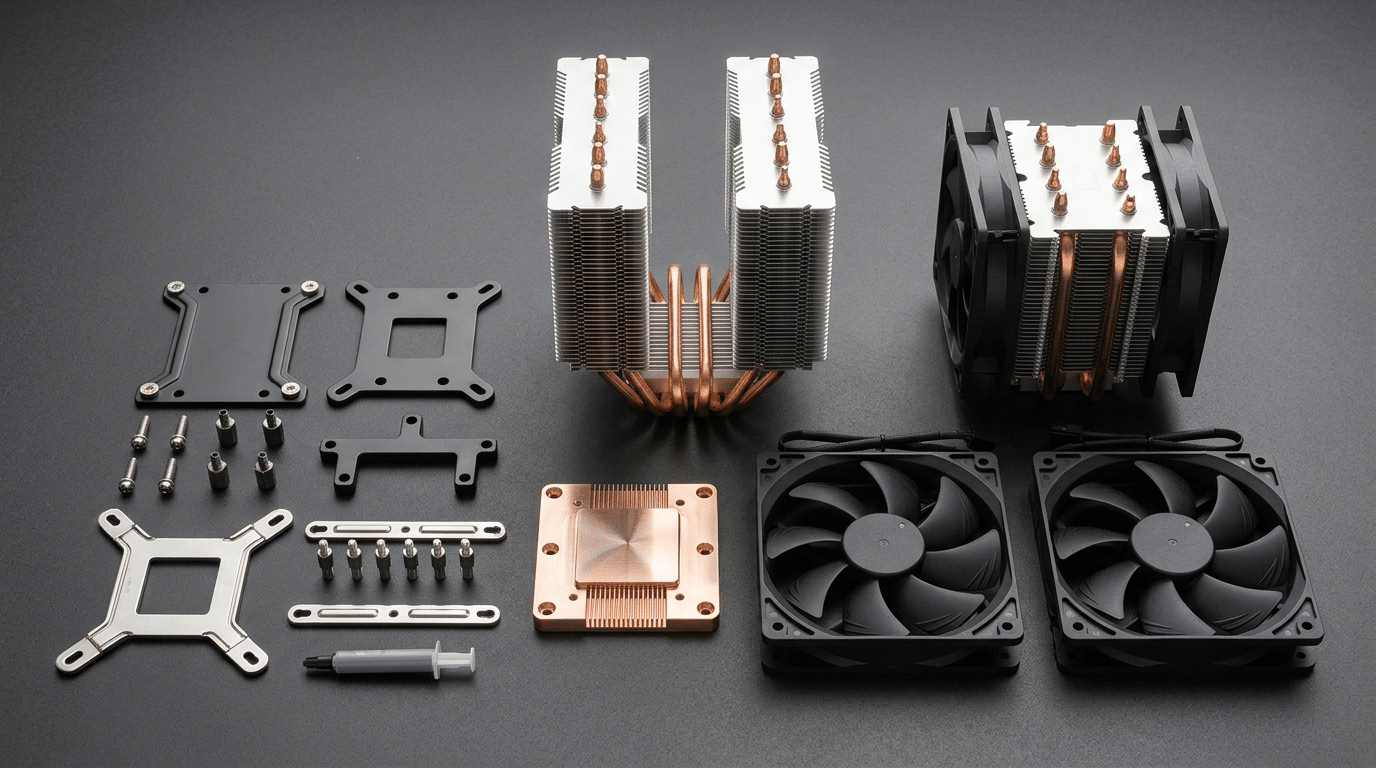
Shopping for the best air cpu cooler gaming build fit purely by brand reputation or flashy RGB fans wastes money fast. In 2026, a dual-tower air cooler under $50 routinely matches or outperforms multi-hundred-dollar coolers from five years ago because thermal physics comes down to four measurable specs: heatpipe count, coldplate flatness, fin surface area, and static pressure airflow.
1. Match Cooling Capacity to PPT and MTP—Never Marketing Base TDP
Never size an air cooler to the nominal base TDP printed on a CPU box. Modern processors scale clock speeds aggressively until they hit power, current, or thermal ceilings. On AMD’s AM5 platform, a 120W TDP processor like the Ryzen 7 9800X3D actually draws up to 162W PPT (Package Power Tracking) under multi-core loads and carries a 95C Tjmax ceiling per AMD’s Ryzen 7 9800X3D specifications, while flagship 16-core Ryzen 9 9950X3D chips push up to 230W PPT. On Intel’s LGA 1851 platform, Arrow Lake chips like the Core Ultra 7 265K, 270K Plus, and Core Ultra 9 285K sustain up to 250W MTP (Maximum Turbo Power).
Crucially, real-world PC gaming pulls far less sustained wattage than all-core rendering—often 75W to 120W during GPU-bound 1440p and 4K sessions, with brief spikes during shader compilation. That is why a 6-heatpipe or 7-heatpipe dual-tower air cooler prevents thermal throttling effortlessly on every mainstream gaming processor, reserving heavy liquid loops strictly for sustained 230W–250W creator workloads.
2. Heatpipe Count, Fin Mass & Static Pressure Fan Physics
Inside any tower cooler, sintered copper heatpipes carry vaporized heat away from the CPU heatspreader up into stamped aluminum fins. Four-heatpipe single-towers like the ARCTIC Freezer 36 excel up to roughly 160W–180W while maintaining slim depth, whereas moving to six or seven 6mm copper heatpipes across twin fin towers roughly doubles total thermal capacity and buffer mass (730g–810g on Thermalright towers vs. 1,525g on Noctua’s 8-heatpipe NH-D15 G2).
Just as important is fan geometry. A dense aluminum fin array creates substantial aerodynamic resistance, so an open-case airflow fan quickly stalls. Look for a dedicated static pressure fan featuring closely spaced, swept blades rated between 1.5 mmH2O and 2.9 mmH2O (such as Thermalright’s TL-K12 or Noctua’s NF-A14x25r G2) paired with a durable fluid dynamic bearing that resists bearing rattle across horizontal and vertical orientations.
3. Chassis Height Limits, Mesh Airflow & DDR5 RAM Clearance
Physical geometry trips up more DIY builders than thermal math. Before clicking buy, verify two millimeter measurements inside your case and motherboard manuals:
- Tower Height vs. Case Clearance: Budget Thermalright dual-towers measure 154mm–157mm tall, fitting nearly all modern mid-towers. Flagships stretch to 168mm (Noctua NH-D15 G2) and 169mm (be quiet! Dark Rock Pro 6), requiring wider 170mm–185mm enclosures—especially if the front fan shifts upward.
- DDR5 RAM Clearance: Dual-tower front fans overhang primary DIMM slots, typically offering 40mm–42mm of clearance on 120mm towers and just 32mm on Noctua’s 140mm NH-D15 G2. Combining tall RGB memory with a wide tower forces you to raise the front fan against your side panel, which is why we recommend checking our Best Low-Profile DDR5 RAM for Dual-Tower Air Coolers (2026) guide before ordering memory.
- Case Mesh Airflow Topology: Dual-tower air coolers rely on clean front-to-back mesh airflow to receive cool room air and exhaust warm air out the rear fan. Solid unvented front glass panels starve dual-tower heatsinks and raise fan RPMs sharply.
4. Tuning PWM Fan Curves & PTM7950 Phase-Change Pads
Out-of-the-box motherboard fan curves react violently to 1-second AM5 background temperature spikes, causing fans to surge noisily on the Windows desktop. Fixing that takes two minutes in BIOS: build a gentle PWM fan curve holding fans at a quiet 30–35% floor up to 60C, ramping linearly to 65–75% by 85C, and set a 2-to-3 second fan spin-up hysteresis delay so transient background tasks never trigger audible swooshing.
Finally, consider swapping standard tube paste for a phase-change thermal pad such as PTM7950 on high-density Ryzen chiplets or long-lived AM5 builds. Unlike traditional silicone greases that can gradually pump out toward edges over 18–24 months of thermal cycling, PTM7950 melts subtly at operating temperature and stays stable for years without repasting.
5. Upgrade Roadmap & Hidden Ownership Costs
Air coolers win total cost of ownership because metal fin stacks never corrode, permeate coolant, or suffer pump failures. Even so, factor hidden compatibility costs before buying: purchasing a $150-$175 tier flagship alongside tall 48mm RGB RAM can force a costly memory swap or wider case upgrade, whereas buying a dual-tower under $40 leaves budget intact for low-profile DDR5-6000 CL30 kits or a PTM7950 sheet. Factor fan warranty longevity too: Noctua and ARCTIC back their fans for 6 years (plus free future socket brackets from Noctua), whereas budget dual-towers carry 3-year coverage—though standard 120mm replacement fans cost very little years down the road.
6. Secondary Intent Resolver: Budget Dual-Tower vs. Flagship Noctua vs. 360mm AIO
Choosing between a sub-$50 dual-tower, a flagship Noctua tower, and a 360mm liquid cooler comes down to your CPU workload and case layout. If you play games on an AM5 X3D or Core Ultra 5/7 chip inside a mesh case, a $40-$50 tier Thermalright dual-tower gives you nearly identical gaming clocks and zero pump risk. Step up to the Noctua NH-D15 G2 only when ultra-smooth fan tonality, 6-year support, and long-term mounting reuse outweigh price sensitivity. Conversely, if you build inside a dual-chamber glass showcase chassis or push sustained 230W–250W all-core rendering on a Ryzen 9 9950X3D or Core Ultra 9 285K, read our 360mm AIO Liquid Cooler vs. Dual-Tower Air Cooler breakdown to decide if top-mounted radiator exhaust suits your rig better.
Methodology: How We Audited, Scored & Filtered These Models
Every cooler in this guide underwent a structured engineering specification and compatibility audit rather than fabricated thermal charts. Following our transparent Editorial Evaluation Methodology, we cross-checked manufacturer datasheets for heatpipe count, coldplate base convexity, fin mass, static pressure (mmH2O), bearing chemistry, millimeter RAM clearance, AM5/LGA 1851 mounting hardware, and warranty terms, then evaluated noise-normalized acoustic trade-offs across real 120W–250W gaming and creator power budgets.
| Evaluation Criterion | Weight | What We Audited |
|---|---|---|
| Thermal Dissipation Capacity (PPT/MTP) | 35% | Heatpipe count and diameter, copper base contact flatness, fin surface mass, and static pressure capacity across 120W–250W CPU power loads without thermal throttling. |
| Acoustic Profile & Fan Noise | 25% | Noise-normalized airflow balance, bearing quality (S-FDB, FDB, hydraulic), speed-offset acoustics, and PWM zero-RPM or low-RPM curve smoothness. |
| Compatibility & RAM/Case Clearance | 20% | Tower height limits (154mm–169mm), front-fan DDR5 RAM clearance (32mm–unlimited), VRM heatsink room, and socket bracket inclusion (AM5 & LGA 1851). |
| Reliability, Warranty & Value | 20% | Heatsink longevity without pump failure risk, 3-to-6-year warranty support, bundled thermal compound/contact frames, and price-tier efficiency. |
Models We Audited & Excluded (And Why)
- 120mm Single-Fan AIO Liquid Coolers: Excluded because a single 120mm radiator offers less surface area than an entry single-tower air cooler while adding pump noise, permeation, and higher cost.
- Stock Low-Profile Box Coolers on 120W+ CPUs: Excluded because compact down-draft aluminum blocks hit thermal throttling quickly during shader compilation and run at irritating fan pitches.
- Generic Unbranded 2-Heatpipe & 3-Heatpipe RGB Towers: Excluded due to thin fin density, short-lived sleeve bearings, and poor socket retention pressure despite flashy lighting.
- Legacy Overpriced Single-Tower Air Coolers Above $60: Excluded because paying more than $60 for a 4-heatpipe single-tower makes poor financial sense when 7-heatpipe dual-towers sit under $50.
Frequently Asked Questions About Air CPU Cooler Gaming
Is a dual-tower air cooler under $40 enough for a Ryzen 7 9800X3D or 9850X3D?
Yes. Both the Ryzen 7 9800X3D and 9850X3D cap default socket power at 162W PPT and pull closer to 75W–110W in real games. A seven-heatpipe dual-tower like the Thermalright Phantom Spirit 120 SE or EVO handles that heat easily without thermal throttling.
When is the Noctua NH-D15 G2 actually worth the upgrade over Thermalright coolers?
When acoustic smoothness matters most. Buy the Noctua NH-D15 G2 when quiet tonality at 120W–250W outweighs raw dollars per degree. Its speed-offset 140mm NF-A14x25r G2 fans eliminate harmonic hum, its three base convexity variants optimize socket contact, and its 6-year warranty covers future mounts.
How much RAM clearance do dual-tower air coolers need on DDR5 motherboards?
Plan for 32mm to 42mm under the front fan. Most 120mm dual-tower air coolers provide 40mm to 42mm by default, while the 140mm Noctua NH-D15 G2 clears just 32mm. Pairing your build with low-profile DDR5-6000 CL30 modules under 35mm avoids raising the front fan toward your side glass.
Should I buy a dual-tower air cooler or a 360mm AIO for a Core Ultra 9 285K?
Choose air for gaming, 360mm AIO for sustained 250W rendering. If you primarily game, a top dual-tower air cooler handles Core Ultra 9 285K loads quietly. If you run continuous 250W MTP rendering or use a dual-chamber glass chassis without front mesh airflow, step up to a 360mm AIO instead.
Do air CPU coolers wear out or need maintenance over time?
Heatsinks last virtually indefinitely. The aluminum fin stack and soldered copper heatpipes do not wear out, leak, or lose fluid. Only the replaceable PWM fans have finite bearing lifespans, and applying a PTM7950 phase-change pad eliminates periodic thermal paste dry-out across multi-year upgrades.
Final Verdict: Which Air CPU Cooler Gaming Setup Should You Buy?
For almost every PC builder, the Thermalright Phantom Spirit 120 EVO claims the best air cpu cooler gaming crown in 2026—blending seven 6mm heatpipes, an 810g fin array, and high-pressure TL-K12 fans inside a case-friendly 157mm frame at the $40-$50 tier. Tighter budgets and narrower 154mm cases should step directly to the Thermalright Phantom Spirit 120 SE under $40, while tall RGB RAM builds under $30 get unbeatable convenience from the single-tower ARCTIC Freezer 36 (Black). Reserve the flagship Noctua NH-D15 G2 for wide 168mm+ enclosures where dead-calm acoustic tonality and a 6-year warranty justify the $150-$175 tier—and revisit our Best CPU Coolers for Gaming (2026) hub whenever deciding between dual-tower air and 360mm liquid rigs.


