
Disclosure: As an Amazon Associate, I earn from qualifying purchases. If you buy through links on this page, we may earn a small commission at no extra cost to you.
Finding the best back connect PC case BTF Project Zero builders can trust requires looking well past panoramic tempered glass. Rear-connector motherboards relocate bulky 24-pin ATX, 8-pin EPS, SATA, and front-panel headers behind the motherboard tray—meaning any enclosure without precision stamped cutouts and generous rear cable depth immediately blocks installation or pinches stiff ATX 3.1 power harnesses.
After auditing manufacturer schematics, cooling capacities, and physical clearance limits across current retail listings, we selected 10 standout enclosures spanning sub-$100 mesh mid-towers, quiet 140mm dual-chamber showcases, compact Micro-ATX frames, and E-ATX flagships. If you are still comparing motherboard ecosystems first, read our Back-Connect Motherboards Explained: ASUS BTF vs. MSI Project Zero Guide, or explore our parent Best Airflow Gaming PC Cases hub for traditional front-header builds.
In This Guide
Quick Picks: Best Back Connect PC Case BTF Project Zero Models
#1 Best Overall
Lian Li O11 Vision Compact Dual-Chamber ATX Case (White)
Swappable top glass or mesh panels, hidden AIO tube grommets, and clean ATX/mATX back-connect support in a desk-friendly footprint. (Jump to audit)
#2 Best Budget Airflow
Corsair 4000D RS ARGB FRAME Modular Mid-Tower PC Case
Verified compatibility for ASUS BTF, MSI Project Zero, and Gigabyte Project Stealth plus three RS120 ARGB fans and dual 360mm radiator support under $100. (Jump to audit)
#3 Best Pre-Installed Cooling Value
MONTECH HS01 PRO High Airflow ATX Mid-Tower PC Case – White
Ships with five ARGB PWM fans, rotatable vertical GPU PCIe slots, and reversible glass orientation under $100. (Jump to audit)
Side-by-Side Comparison: Top 10 Back Connect PC Cases
| Product & Award | Best For | Back-Connect & Fans | Max GPU & Radiator Fit | Link |
|---|---|---|---|---|
| Lian Li O11 Vision Compact Best Overall | Clean dual-chamber showcase with hidden AIO tubes | ATX / mATX BTF & PZ; 0 fans included | 408 mm GPU; 360 mm Top/Side | View on Amazon |
| Corsair FRAME 4000D RS ARGB Best Budget Airflow | Front-to-back mesh airflow under $100 | BTF, Project Zero & Stealth; 3x RS120 ARGB | 430 mm GPU; Dual 360 mm | View on Amazon |
| MONTECH HS01 PRO White Best Pre-Installed Cooling | Turnkey 5-fan chimney cooling under $100 | ATX / mATX Back-Connect; 5x ARGB PWM | 420 mm GPU; 360 mm Top (123 mm max width) | View on Amazon |
| APNX V2 White Best 140mm Quiet Airflow | Low-RPM acoustic tuning & large GPUs | Reverse BTF / PZ / Stealth; 4x 140 mm + 10-port hub | 445 mm GPU; 360 mm Top-Right / Side | View on Amazon |
| ASUS ROG Hyperion GR701 BTF Best Flagship E-ATX | Full ASUS Advanced BTF (GC-HPWR) builds | E-ATX BTF + GC-HPWR; 4x 140 mm + ARGB hub | 460 mm GPU; Dual 420 mm | View on Amazon |
| ASUS ROG Cronox E-ATX (BTF) Best Panoramic LCD Showcase | Integrated 9.2-inch telemetry screen rigs | E-ATX / ATX BTF; 0 fans in base E-ATX edition | 400 mm GPU; Dual 360 mm | View on Amazon |
| Jonsbo D33 Black Best Compact Micro-ATX | Compact mATX MSI Project Zero desks | mATX / ITX BTF & PZ; 0 fans included | 435 mm GPU (no front fans); 360 mm Top | View on Amazon |
| Jonsbo TK-4 Black Best Big-GPU Panoramic | 420 mm radiators & longest custom GPUs | ATX / mATX BTF; 0 fans in standard Black | 460 mm GPU; Dual 420 mm / 360 mm | View on Amazon |
| Jonsbo TK-3 Black Best Curved-Glass Value | 270-degree curved glass on a budget | ATX / mATX BTF & PZ; 0 fans (10 mounts) | 420 mm GPU; Dual 360 mm | View on Amazon |
| Jonsbo X400 Gray Best Open-Frame Styling | Industrial mecha frame with 13 fan mounts | ATX / mATX Back-Connect; 0 fans included | 427 mm GPU; Dual 360 mm (Top & Side) | View on Amazon |
Match Your Use Case: Which Back-Connect Chassis Fits Your Build?
| Buyer Scenario | Best Match | Why & Expected Outcome |
|---|---|---|
| Clean dual-chamber showcase with hidden AIO routing | Lian Li O11 Vision Compact | Conceals both rear motherboard harnesses and top/side AIO tubing through dedicated rear chamber grommets. |
| Maximum mesh airflow under $100 with modular rails | Corsair 4000D RS ARGB FRAME | Straight front-to-back cooling path across three RS120 fans sustains low GPU temperatures on 300W-450W cards. |
| Plug-and-build cooling value without buying extra fans | MONTECH HS01 PRO White | Five pre-installed ARGB PWM fans deliver immediate positive-pressure vertical cooling under $100. |
| Whisper-quiet 140mm airflow for long RTX 5080 / 5090 builds | APNX V2 White | Four 140mm FP3-140 fans, a 10-port PWM hub, and 445 mm GPU clearance minimize fan RPM and cable strain. |
| Complete ASUS BTF 2.0 (GC-HPWR) zero-GPU-cable build | ASUS ROG Hyperion GR701 BTF | Supports cable-free BTF GPU edge power alongside dual 420 mm radiators and a 46 mm rear cable trench. |
| Compact desktop MSI Project Zero Micro-ATX workstation | Jonsbo D33 Black mATX | Slotted strictly for Micro-ATX BTF/Project Zero footprints while preserving full 360 mm top radiator support. |
Detailed Audits: Best Back Connect PC Cases BTF Project Zero
1. Lian Li O11 Vision Compact Dual-Chamber ATX Case (White) — Best Overall

Quick Specs: ATX / Micro-ATX Back-Connect Ready | 360mm Top (Mesh) & Side Radiator Support | 408 mm Max GPU | 167 mm Max Air Cooler | 0 Included Fans (Up to 11x 120mm Mounts) | Price Tier: $115-$130 tier
Audit Score: 9.3 / 10
- Airflow & Thermal Topology (35%): 9.1 / 10
- GPU, Radiator & Cable Clearance (25%): 9.4 / 10
- Acoustics & Dust Filtration (20%): 9.1 / 10
- Build Ergonomics & Value (20%): 9.6 / 10
Trimming bulk without sacrificing dual-chamber convenience earns the Lian Li O11 Vision Compact our overall top spot. According to the official Lian Li O11 Vision Compact specification page, the chassis supports both ATX and Micro-ATX rear-connector motherboards cleanly while letting you swap between a three-sided tempered glass lid and a perforated mesh top panel depending on whether you want a top 360mm radiator exhaust.
Where this frame pulls ahead of both the Jonsbo TK-3 and the APNX V2 is tube routing discipline: integrated pass-through grommets route AIO liquid hoses directly behind the motherboard tray before re-entering at the CPU pump block, doubling down on the cable-free look of an ASUS BTF or MSI Project Zero board. Its 447.5 x 287.5 x 446.4 mm footprint sits meaningfully trimmer on a desk than the 309 mm wide APNX V2, yet still accommodates 220 mm ATX PSUs and 408 mm graphics cards.
Buyer Verification Alert: No cooling fans ship inside the O11 Vision Compact box, so remember to add matching 120mm PWM fans (ideally reverse-blade side and bottom intakes) to your parts list. Top 360mm AIO mounting also requires installing the included mesh top bracket instead of the top glass pane.
Pros
- Stamped cutouts fit both ATX and Micro-ATX back-connect motherboards cleanly
- Included mesh and glass top panels let builders choose aesthetics or top 360mm AIO exhaust
- Rear chamber grommets conceal AIO tubing alongside 24-pin and EPS power leads
- Supports up to 11x 120mm fans and 220 mm ATX 3.1 power supplies
Cons
- Ships with zero stock fans, increasing real out-of-pocket build cost
- 408 mm GPU length ceiling rules out niche 420mm+ water-blocked flagship boards
Verdict: Buy it if you want a compact dual-chamber showcase engineered specifically around cable-free BTF/Project Zero routing and hidden AIO hoses. Skip it if you want pre-installed fans included in the box or 420 mm radiator support. Upgrade Note: Populate three reverse-blade 120mm intake fans on the bottom, three on the side, and two rear exhausts (or one top 360mm AIO in mesh mode) for positive pressure.
2. Corsair 4000D RS ARGB FRAME Modular Mid-Tower PC Case — Best Budget Airflow

Quick Specs: Mini-ITX to E-ATX; ASUS BTF, MSI Project Zero & Gigabyte Project Stealth | Dual 360mm Radiator Fit | 430 mm Max GPU | 170 mm Max Air Cooler | 3x RS120 ARGB PWM Fans | Price Tier: under $100
Audit Score: 9.1 / 10
- Airflow & Thermal Topology (35%): 9.5 / 10
- GPU, Radiator & Cable Clearance (25%): 9.2 / 10
- Acoustics & Dust Filtration (20%): 8.7 / 10
- Build Ergonomics & Value (20%): 9.0 / 10
Not every builder wants an expansive glass aquarium sitting beside their monitor—and for pure front-to-back thermal velocity under $100, Corsair’s modernized FRAME architecture dominates the sub-$100 tier. Listed explicitly on the Corsair FRAME 4000D engineering page, this chassis stamps full reverse-connector cutouts supporting ASUS BTF, MSI Project Zero, and Gigabyte Project Stealth motherboards.
Out of the box, three Corsair RS120 ARGB PWM fans mount onto the sliding InfiniRail bracket, letting you position 120mm or larger 140mm/200mm fans without wrestling fixed screw holes. Compared against the dual-chamber Lian Li O11 Vision Compact, the FRAME 4000D pushes direct cool air across dual-tower CPU air coolers up to 170 mm tall while clearing massive 430 mm graphics cards and simultaneous dual 360mm radiators.
Buyer Verification Alert: Do not confuse ASIN B0DFHNV7TK (the updated FRAME 4000D RS ARGB) with older legacy 4000D Airflow stock—older 4000D revisions lack rear motherboard tray cutouts and cannot accept BTF or Project Zero boards.
Pros
- Verified support across ASUS BTF, MSI Project Zero, and Gigabyte Project Stealth ecosystems
- Three pre-installed RS120 ARGB PWM fans on modular InfiniRail brackets under $100
- Simultaneous dual 360mm radiator compatibility (front, top, or side options)
- Generous 430 mm GPU length and 220 mm ATX PSU depth clearance
Cons
- Omits a rear exhaust fan out of the box
- Traditional mid-tower rear tray space is narrower than wide dual-chamber shells
Verdict: Buy it if you prioritize unchoked mesh airflow, air-cooler headroom, and sub-$100 value without sacrificing full BTF/Project Zero compatibility. Skip it if you want a dual-chamber panoramic glass display. Upgrade Note: Pick up one 120mm or 140mm PWM rear exhaust fan to pair with the three included front intakes.
3. MONTECH HS01 PRO High Airflow ATX Mid-Tower PC Case – White — Best Pre-Installed Cooling Value

Quick Specs: ATX / mATX / Mini-ITX Back-Connect Tray | 360mm Top (Max 123 mm Width) & 240mm Bottom Rad | 420 mm Max GPU | 175 mm Max Air Cooler | 5x Included ARGB PWM Fans | Price Tier: under $100
Audit Score: 8.9 / 10
- Airflow & Thermal Topology (35%): 9.2 / 10
- GPU, Radiator & Cable Clearance (25%): 8.6 / 10
- Acoustics & Dust Filtration (20%): 8.6 / 10
- Build Ergonomics & Value (20%): 9.2 / 10
Delivering five factory-installed ARGB PWM fans under $100 puts the MONTECH HS01 PRO in a value league of its own. According to the MONTECH HS01 PRO product sheet, the chassis arranges three 120mm intake fans along the floor and two 120mm exhaust fans at the rear around a recessed motherboard tray built specifically for ASUS BTF and MSI Project Zero back-connectors.
Two clever mechanical extras separate this chassis from the similarly priced Corsair 4000D RS ARGB FRAME: rotatable PCIe expansion brackets that support vertical GPU mounting without an aftermarket bracket kit, and a fully reversible chassis orientation allowing builders with left-side desk setups to flip the tempered glass panel cleanly. Its 420 mm GPU allowance and towering 175 mm air-cooler ceiling easily clear bulky triple-fan RTX 5080 and RX 9070 XT cards.
Buyer Verification Alert: Montech specifies a strict 123 mm maximum radiator width inside the top 360mm bay due to the concealed top-front PSU chamber, so verify your 360mm AIO width carefully or select a standard 27 mm-thick 120 mm-wide cooler.
Pros
- Five pre-installed ARGB PWM fans create immediate positive-pressure vertical cooling
- Reversible orientation fits both left-side and right-side desk placements
- Rotatable PCIe slot assembly enables vertical GPU mounting out of the box
- Front USB 3.2 Gen 2 Type-C, dual USB 3.0 Type-A, and 420 mm GPU clearance under $100
Cons
- 123 mm top radiator width cap excludes extra-wide custom radiators
- Top-front concealed PSU bay caps power supply depth at 200 mm
Verdict: Buy it if you want maximum out-of-the-box fan value, vertical GPU versatility, and reversible placement under $100. Skip it if your build uses an extra-wide 360mm radiator or a 210mm+ PSU. Upgrade Note: Budget separately for a shielded PCIe 4.0 or 5.0 riser cable if rotating the PCIe bracket vertically.
4. APNX V2 White ATX Case (Reverse BTF Motherboard Support) — Best for 140mm Quiet Airflow

Quick Specs: ATX / mATX / Mini-ITX Reverse BTF Support | 360mm Top-Right / Side Liquid Cooling | 445 mm Max GPU | 183 mm Max Air Cooler | 270 mm Max PSU | 4x 140mm FP3-140 Fans + 10-Port Hub | Price Tier: $100-$150 tier
Audit Score: 8.8 / 10
- Airflow & Thermal Topology (35%): 9.0 / 10
- GPU, Radiator & Cable Clearance (25%): 9.1 / 10
- Acoustics & Dust Filtration (20%): 8.9 / 10
- Build Ergonomics & Value (20%): 8.2 / 10
Larger 140mm fans move comparable airflow at noticeably gentler RPMs than 120mm spinners, making the APNX V2 White the standout pick for noise-conscious builders. Documented in TechPowerUp’s APNX V2 chassis breakdown, it comes stocked with four 140mm FP3-140 fans (three bottom intake, one rear exhaust) wired into an integrated 10-port PWM and ARGB hub.
Inside, the V2 yields an unobstructed 86.5% three-side tempered glass viewing window alongside full cutouts for ASUS BTF, MSI Project Zero, and Gigabyte Project Stealth boards—plus a removable cover panel that masks those cutouts cleanly if you ever drop in a traditional motherboard. Compared against the Lian Li O11 Vision Compact, APNX supplies 37 mm extra GPU length (445 mm total) and a cavernous 270 mm PSU compartment capable of absorbing stiff 1200W-1600W ATX 3.1 harnesses.
Buyer Verification Alert: Check your desk width before ordering: at 309 mm wide, the APNX V2 is wider than standard mid-towers, and mounting a thick radiator in the right-side vertical bracket cuts into the 445 mm GPU length allowance.
Pros
- Four 140mm FP3-140 fans and a 10-port ARGB/PWM hub come pre-installed
- Expansive 445 mm GPU, 183 mm cooler height, and 270 mm PSU depth clearance
- Removable tray panel seals unused BTF cutouts when using standard motherboards
- Supports up to 10 fans across bottom 140mm/160mm, side, top-right, and rear mounts
Cons
- Wide 309 mm chassis footprint claims substantial horizontal desk real estate
- Thick vertical side radiators reduce available clearance for oversized GPUs
Verdict: Buy it if you want quieter 140mm intake airflow, an included 10-port controller hub, and massive GPU/PSU room in the $100-$150 tier. Skip it if desk width is tightly constrained. Upgrade Note: Add a top-right 360mm AIO exhaust to pair cleanly with the three 140mm bottom intakes.
5. ASUS ROG Hyperion GR701 BTF Edition E-ATX Full-Tower Gaming PC Case — Best Flagship E-ATX & Advanced BTF

Quick Specs: E-ATX (12 x 10.9 in) / ATX / mATX | Full ASUS Advanced BTF (GC-HPWR) Support | Dual 420mm Radiators | 460 mm Max GPU | 190 mm Max Air Cooler | 46 mm Cable Trench | 4x 140mm Fans + Hub | Price Tier: $400-$600 tier
Audit Score: 8.7 / 10
- Airflow & Thermal Topology (35%): 9.1 / 10
- GPU, Radiator & Cable Clearance (25%): 9.7 / 10
- Acoustics & Dust Filtration (20%): 8.6 / 10
- Build Ergonomics & Value (20%): 7.4 / 10
Built for enthusiasts assembling full ASUS Advanced BTF systems—where even graphics card power moves off the front GPU edge onto a hidden motherboard GC-HPWR connector—the ASUS ROG Hyperion GR701 BTF Edition holds the highest mechanical headroom in this roundup. Official specs on the ROG Hyperion GR701 BTF Edition product page confirm simultaneous dual 420mm radiator support (front and top), four 140mm stock fans, and a cavernous 460 mm GPU bay complete with a built-in aluminum GPU sag holder.
Cable management behind the E-ATX tray spans an industry-leading 46 mm deep, giving thick ATX 3.1 12V-2×6 and dual 8-pin EPS leads gentle bend radii without bulging the rear panel. Compared with the ASUS ROG Cronox E-ATX, the Hyperion GR701 BTF trades the Cronox’s 9.2-inch front screen for dual 420mm cooling, 60 mm extra GPU clearance, and dual Type-C front ports supporting up to 60W fast charging.
Buyer Verification Alert: Standard non-BTF Hyperion GR701 listings remain active across retailers. Verify the listing explicitly specifies BTF Edition (ASIN B0D38H5LD9) before purchasing, and confirm your desk can support its 21.3 kg empty chassis weight.
Pros
- Native support for full E-ATX ASUS BTF and GC-HPWR hidden GPU power delivery
- Dual 420mm radiator mounts, four 140mm fans, and 460 mm GPU clearance
- 46 mm rear cable trench plus integrated aluminum GPU anti-sag brace
- Heavy front I/O with four USB-A ports and dual USB-C (including 60W charge)
Cons
- Sits in the expensive $400-$600 flagship bracket
- 21.3 kg unpopulated weight makes moving a completed PC a two-person task
Verdict: Buy it if you are building an all-out E-ATX RTX 5090 or ASUS Advanced BTF workstation needing dual 420mm radiators and zero cable compromises. Skip it if you want compact sizing or value under $200. Upgrade Note: Pair with a 1000W-1200W+ ATX 3.1 Platinum PSU equipped with long EPS cables to reach the top-rear header cleanly.
6. ASUS ROG Cronox E-ATX Full-Tower Gaming PC Case (BTF) — Best Panoramic LCD Showcase

Quick Specs: E-ATX (12 x 10.9 in) / ATX / mATX / Mini-ITX BTF Support | Integrated 9.2-inch Rotatable IPS LCD (1920 x 462, 60Hz) | Dual 360mm Radiators | 400 mm Max GPU | 180 mm Max Air Cooler | 40 mm Cable Space | Price Tier: $250-$400 tier
Audit Score: 8.6 / 10
- Airflow & Thermal Topology (35%): 8.6 / 10
- GPU, Radiator & Cable Clearance (25%): 8.8 / 10
- Acoustics & Dust Filtration (20%): 8.4 / 10
- Build Ergonomics & Value (20%): 8.6 / 10
Builders seeking real-time hardware telemetry without clamping loose USB mini-monitors inside their glass box will appreciate the ASUS ROG Cronox E-ATX. Integrated directly onto a hinged chassis mount sits a crisp 9.2-inch rotatable IPS screen (1920 x 462 resolution, 60Hz, 400 nits) designed to display CPU/GPU clock frequencies, coolant temperatures, or custom artwork while hiding every motherboard cable through E-ATX ASUS BTF hidden-connector cutouts.
Backing up the curved glass exterior is genuine cooling scale: up to fourteen 120mm fan mounts, dual 360mm radiator support (top and side), a patented rotatable side fan bracket to aim intake streams directly across VRM heatsinks, and 40 mm of rear cable clearance. Compared with the Jonsbo TK-4, the Cronox limits GPU length to 400 mm rather than 460 mm—still ample for nearly all triple-fan RTX 5070 Ti and RTX 5080 models, though oversized custom 5090 cards require checking exact length.
Buyer Verification Alert: Multiple Cronox variants coexist on Amazon: this E-ATX Black chassis (B0H31W4WL4, $250-$400 tier) and its White Edition let you supply your own PWM fans, whereas the $400-$600 Cronox ARGB SKU bundles four ROG Eurux GR120 ARGB fans.
Pros
- Built-in 9.2-inch hinged IPS LCD (400 nits) eliminates third-party sensor screen clutter
- Full E-ATX BTF tray cutouts with generous 40 mm rear cable channel
- Patented angled side fan bracket plus dual 360mm radiator mounting
- Tool-less GPU slot clamp and 180 mm CPU air-cooler clearance
Cons
- Base $250-$400 E-ATX listing requires purchasing cooling fans separately
- 400 mm GPU ceiling is shorter than the 445 mm-460 mm limits on the APNX V2 and TK-4
Verdict: Buy it if you want a panoramic E-ATX BTF showcase built around an integrated 9.2-inch telemetry screen and customizable fan selection. Skip it if your graphics card exceeds 400 mm or you dislike curved showcase glass. Upgrade Note: Outfit the angled side bracket with three reverse-blade 120mm intake fans paired with a top 360mm AIO exhaust.
7. Jonsbo D33 Black Micro-ATX PC Case (mATX BTF Support) — Best Compact Micro-ATX BTF

Quick Specs: Micro-ATX / Mini-ITX BTF & Project Zero Support | 360mm Top Radiator | 435 mm Max GPU (No Front Fans) | 172 mm Max Air Cooler | 160 mm Max PSU | 0 Included Fans (9 Mounts) | Price Tier: $100-$150 tier
Audit Score: 8.5 / 10
- Airflow & Thermal Topology (35%): 8.4 / 10
- GPU, Radiator & Cable Clearance (25%): 8.6 / 10
- Acoustics & Dust Filtration (20%): 8.5 / 10
- Build Ergonomics & Value (20%): 8.5 / 10
Because MSI’s Project Zero lineup leans heavily into Micro-ATX motherboards (like B650M, B760M, and B850M Project Zero models), stuffing a smaller mATX board inside a huge ATX fishbowl leaves awkward empty bottom space. The Jonsbo D33 Black solves that proportion problem directly at just 368.4 mm tall while stamping dedicated Micro-ATX back-connect cutouts behind the tray.
Despite its trimmed height, Jonsbo preserves serious cooling hardware: a full 360mm top radiator mount, up to nine fan slots, 172 mm CPU air-cooler height clearance, and up to 435 mm GPU clearance when running without front-panel fans. Front I/O adds USB 3.2 Gen 2 Type-C plus dual USB 3.0 Type-A ports, and a slide-out magnetic bottom dust filter simplifies routine cleaning compared with tool-required filters.
Buyer Verification Alert: The Jonsbo D33 caps ATX power supply body length strictly at 160 mm and accepts only Micro-ATX or Mini-ITX motherboards—standard ATX boards and 180mm+ PSUs will not fit.
Pros
- Compact 455 x 238.2 x 368.4 mm chassis tailored for Micro-ATX BTF and Project Zero boards
- Retains full 360mm top radiator support and 172 mm dual-tower air-cooler height
- Magnetic bottom dust filter plus front USB 3.2 Gen 2 Type-C and dual USB 3.0 Type-A
- Up to 435 mm GPU length when leaving front fan positions unpopulated
Cons
- Excludes pre-installed fans from the package
- 160 mm PSU length ceiling demands compact ATX or SFX-L power units
Verdict: Buy it if you are building around an MSI Project Zero or ASUS TUF Micro-ATX back-connect motherboard and want compact desk proportions without dropping down to a 240mm AIO. Skip it if you run full ATX boards or oversized PSUs. Upgrade Note: Choose a compact 140 mm ATX 3.1 Gold PSU and three bottom 120mm intake fans plus one rear exhaust.
8. Jonsbo TK-4 Black ATX PC Case (Back-Connect BTF Support) — Best Big-GPU Panoramic & 420mm Rad

Quick Specs: ATX / Micro-ATX / Mini-ITX Back-Connect BTF | Dual 420mm / 360mm Radiators (Top & Bottom) | 460 mm Max GPU | 175 mm Max Air Cooler | 200 mm Max PSU | 0 Fans in Standard Black SKU | Price Tier: $150-$250 tier
Audit Score: 8.4 / 10
- Airflow & Thermal Topology (35%): 8.3 / 10
- GPU, Radiator & Cable Clearance (25%): 9.3 / 10
- Acoustics & Dust Filtration (20%): 8.3 / 10
- Build Ergonomics & Value (20%): 7.8 / 10
When a panoramic glass build needs 420mm radiator sizing rather than standard 360mm cooling, the Jonsbo TK-4 Black bridges the gap between mid-range fishbowls and $400-$600 E-ATX towers. Inside its 495 x 298.6 x 495 mm frame sit dual 420mm/360mm radiator brackets (top and bottom), up to 11 fan locations, and a massive 460 mm GPU clearance tunnel equal to the ASUS ROG Hyperion GR701 BTF Edition.
Behind the ATX and Micro-ATX back-connect motherboard tray sits room for 200 mm ATX power supplies and integrated mesh intake filtration along the side and bottom panels. Compared with the Jonsbo TK-3 ($100-$150 tier), the TK-4 gains 420mm radiator flexibility and an extra 40 mm of GPU clearance, though Jonsbo drops down to a single front USB 3.0 Type-A port next to the USB 3.2 Gen 2 Type-C header.
Buyer Verification Alert: Standard Black TK-4 listings (ASIN B0G1YMTNFC) normally ship without pre-installed cooling fans—unlike special regional Wood editions—so confirm fan count at checkout and budget for 140mm PWM fans.
Pros
- 460 mm GPU clearance accommodates the longest custom triple-fan RTX 5090 cards
- Rare simultaneous top and bottom 420mm radiator support in a panoramic frame
- Full ATX/mATX back-connect cutouts plus 200 mm PSU clearance
- 175 mm CPU cooler height ceiling supports flagship dual-tower air coolers
Cons
- No pre-installed fans included in the base Black chassis
- Front I/O offers only one USB Type-A port alongside USB 3.2 Gen 2 Type-C
Verdict: Buy it if you want 420mm liquid cooling and 460 mm GPU clearance in a panoramic BTF/Project Zero enclosure for hundreds less than flagship E-ATX towers. Skip it if you prefer included stock fans or dual front USB-A headers. Upgrade Note: Pair with a 420mm top radiator and 140mm reverse-blade bottom intake fans for quiet acoustic scaling.
9. Jonsbo TK-3 Black Curved Glass ATX Mid-Tower PC Case (BTF Support) — Best Curved-Glass Dual-Chamber Value

Quick Specs: ATX / Micro-ATX / Mini-ITX BTF & Project Zero Support | Dual 360mm Radiators (Top & Bottom) | 420 mm Max GPU | 165 mm Max Air Cooler | 10 Fan Mounts (0 Included) | Price Tier: $100-$150 tier
Audit Score: 8.3 / 10
- Airflow & Thermal Topology (35%): 8.2 / 10
- GPU, Radiator & Cable Clearance (25%): 8.7 / 10
- Acoustics & Dust Filtration (20%): 8.0 / 10
- Build Ergonomics & Value (20%): 8.3 / 10
Continuous curved glass usually adds a hefty premium, yet the Jonsbo TK-3 Black wraps an unbroken 270-degree viewing window around a back-plug BTF/Project Zero frame in the $100-$150 tier. Measuring 438 x 288 x 415 mm with 0.7 mm steel construction, it houses up to ten 120mm fans alongside dual 360mm AIO mounts on both the ceiling and floor.
Crucially, the TK-3 supports up to 420 mm of GPU length—12 mm more than the Lian Li O11 Vision Compact—while adding two front USB 3.0 Type-A ports plus USB 3.2 Gen 2 Type-C. The trade-off sits in vertical air-cooler clearance: at 165 mm maximum, oversized 168 mm dual-tower air coolers sit outside tolerance, making 360mm liquid coolers the ideal thermal pairing.
Buyer Verification Alert: The Jonsbo TK-3 ships empty of cooling fans, so calculate the cost of 6 to 7 120mm PWM fans plus your 360mm AIO when comparing its total checkout price against fan-equipped cases like the APNX V2 or MONTECH HS01 PRO.
Pros
- Seamless 270-degree curved tempered glass with zero corner pillar obstruction
- Dual 360mm radiator capability and 10 total 120mm fan positions
- 420 mm GPU length clears triple-fan RTX 5080 and RX 9070 XT cards
- Two USB 3.0 Type-A plus USB 3.2 Gen 2 Type-C on the front I/O panel
Cons
- Ships with zero stock fans included
- 165 mm CPU air-cooler ceiling is tighter than most rivals on this list
Verdict: Buy it if you want curved panoramic glass, BTF/Project Zero cable concealment, and a 360mm AIO showcase in the $100-$150 tier. Skip it if you want a pre-fanned enclosure or plan to mount a tall 168 mm air tower. Upgrade Note: Run three reverse-blade side intake fans, three bottom intakes, one rear exhaust, and a top 360mm AIO exhaust.
10. Jonsbo X400 Gray Back-Connect ATX PC Case — Best Industrial Open-Frame Styling

Quick Specs: ATX / Micro-ATX / Mini-ITX Back-Connect BTF | Dual 360mm AIO (Top & Side) | 427 mm Max GPU | 176 mm Max Air Cooler | 180 mm Max PSU | Up to 13 Fan Slots (0 Included) | Price Tier: $100-$150 tier
Audit Score: 8.2 / 10
- Airflow & Thermal Topology (35%): 8.4 / 10
- GPU, Radiator & Cable Clearance (25%): 8.5 / 10
- Acoustics & Dust Filtration (20%): 7.9 / 10
- Build Ergonomics & Value (20%): 8.0 / 10
Standing apart from glossy black and white fishbowl cubes, the Jonsbo X400 Gray uses an angular, mecha-styled industrial exoskeleton surrounding a spacious dual-chamber interior. Builders gain up to 13 fan positions, simultaneous top and side 360mm radiator support, 427 mm GPU length clearance, and a tall 176 mm CPU air-cooler ceiling—all while keeping ATX and Micro-ATX back-connect wiring hidden cleanly behind the tray.
Compared against the Jonsbo TK-3 at the same $100-$150 tier, the X400 favors heavy cooling density and taller air coolers (176 mm vs. 165 mm), plus an industrial gray finish paired with USB 3.2 Gen 2 Type-C and two USB 3.2 Gen 1 Type-A front ports. The main mechanical constraint sits in the power bay: Jonsbo limits ATX PS2 PSU length to 180 mm, making ultra-long flagship 1200W-1600W power bricks a tight squeeze.
Buyer Verification Alert: Stick to compact 140mm-160mm ATX 3.1 power supplies (and remember zero stock fans are included) because the 180 mm maximum PSU envelope leaves minimal slack for stiff rear 24-pin and 12V-2×6 connectors on longer power supplies.
Pros
- Distinctive gray industrial frame breaks away from standard glass-cube aesthetics
- Dual 360mm AIO support (top and side) alongside 13 total fan mounting points
- 427 mm GPU length and 176 mm air-cooler ceiling clear tall custom hardware
- Includes two USB 3.2 Gen 1 Type-A and one USB 3.2 Gen 2 Type-C front headers
Cons
- 180 mm PSU length limit excludes oversized 200mm+ wattage flagships
- Zero fans in the box means populating all 13 mounts adds noticeable cost
Verdict: Buy it if you want industrial gray dual-chamber styling, dual 360mm radiator routing, and back-connect BTF compatibility in the $100-$150 tier. Skip it if you own a 190mm+ PSU or want a ready-to-cool chassis out of the box. Upgrade Note: Populate 6 to 9 quiet PWM fans (front/side/bottom intakes plus top 360mm AIO exhaust) rather than maxing out all 13 slots.
Buying Guide: How to Choose the Best Back Connect PC Case BTF Project Zero
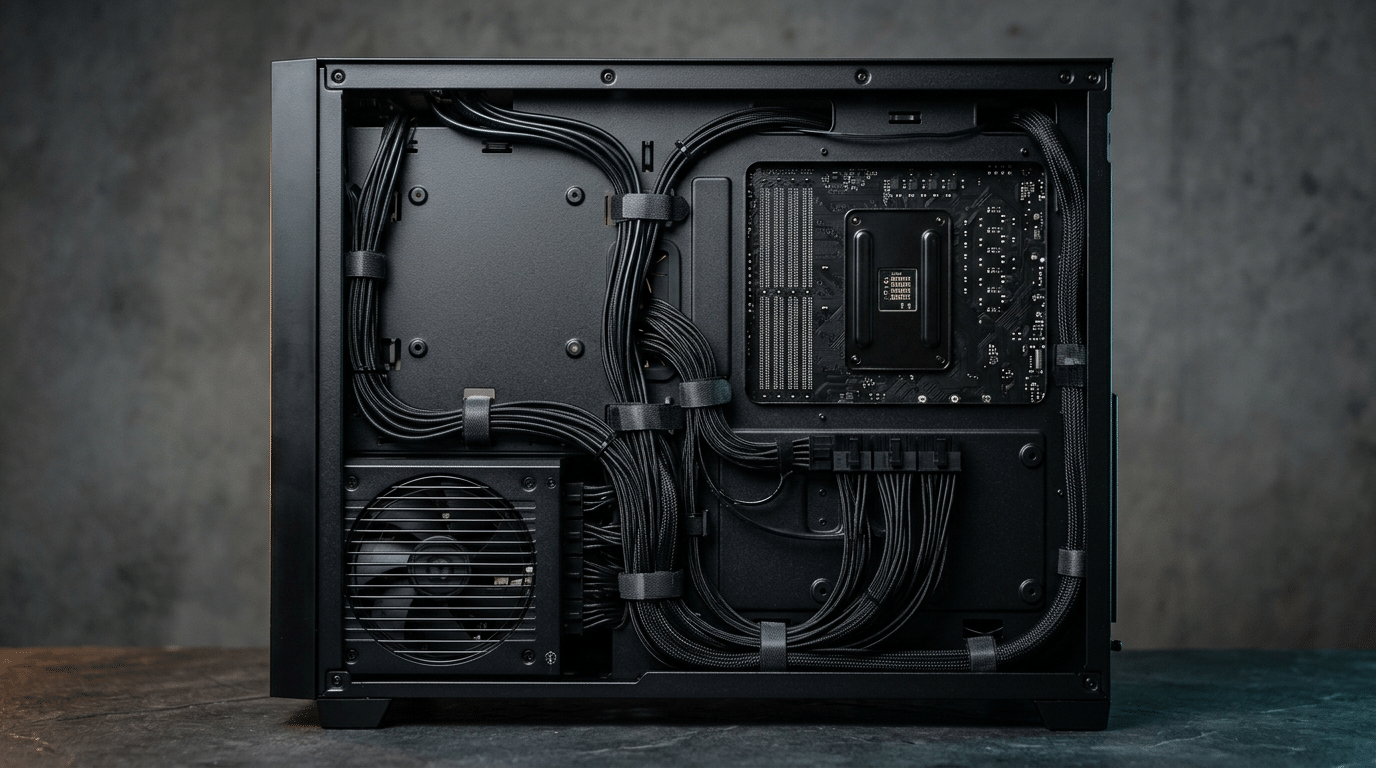
Back-connect PC builds eliminate front-facing cable clutter only when chassis tray cutouts, power supply cable lengths, and airflow paths align cleanly. Evaluating five engineering details before checkout guarantees zero physical surprises during assembly.
1. ASUS BTF vs. MSI Project Zero vs. Gigabyte Project Stealth Cutout Compatibility
Because back-connect motherboards are not governed by a single universal ATX specification, rear header positions vary slightly across motherboard brands and board sizes. Most 2026 ATX mid-towers—including the Corsair 4000D RS ARGB FRAME, Lian Li O11 Vision Compact, and APNX V2—stamp generous multi-standard openings accommodating ASUS BTF, MSI Project Zero, and Gigabyte Project Stealth alike. However, two subtle traps remain:
- ATX vs. Micro-ATX Bottom Header Rows: Micro-ATX MSI Project Zero boards place fan, audio, and front-panel pins higher up the tray than full ATX boards. Always confirm explicit mATX back-connect cutout support (such as the Jonsbo D33 or Lian Li O11 Vision Compact) before dropping an mATX Project Zero board into an ATX-only BTF chassis.
- Standard BTF vs. ASUS Advanced BTF (GC-HPWR): Standard BTF and MSI Project Zero relocate motherboard power and I/O headers to the rear while leaving your graphics card powered by a normal front-accessible 12V-2×6 cable. ASUS Advanced BTF adds a motherboard GC-HPWR high-power slot capable of feeding compatible BTF GPUs without any PCIe cable—just ensure the chassis cutout exposes the extra rear GC-HPWR 12V-2×6 header (like the ROG Hyperion GR701 BTF Edition) and still pair a normal ATX 3.1 PSU. For a deeper board-level breakdown, see our ASUS BTF vs. MSI Project Zero motherboard guide.
2. Airflow Topology: Positive Pressure, Reverse-Blade Fans & Dual-Chamber Cooling
Panoramic glass showcases look cleanest without exposed front fans, yet glass enclosures require disciplined airflow engineering to keep 300W-575W GPUs cool. Aim for slight positive pressure—more filtered intake airflow than exhaust airflow—such as five to six bottom and side intake fans feeding three to four top/rear exhaust fans. Positive pressure pushes excess air out through panel seams rather than drawing unfiltered dust inward through open gaps.
In dual-chamber cases like the O11 Vision Compact, Jonsbo TK-3, or APNX V2, bottom and side mounts pull cool ambient air directly toward the GPU cooler shroud. Installing reverse-blade fans on intake positions keeps the clean fan hub facing inward without sacrificing airflow direction, while magnetic dust filters along the floor and side chambers catch household lint before it coats radiator fins. To compare additional glass-first layouts, check our Best Dual-Chamber Fishbowl PC Cases guide alongside our parent Best Airflow Gaming PC Cases reference.
3. Five Physical Clearances to Verify Before Ordering Parts
- GPU Length & 12V-2×6 Side-Panel Bend Clearance: Modern triple-fan RTX 5080, RTX 5090, and RX 9070 XT cards routinely span 310 mm to 360 mm long. Confirm both horizontal clearance (400 mm to 460 mm across our top 10 picks) and at least 35 mm to 40 mm between the GPU power socket and the tempered glass side panel so a stiff ATX 3.1 12V-2×6 cable never bends sharply right at the plug housing.
- Rear Cable Routing Depth: Back-connect headers push rigid 24-pin ATX and 8-pin EPS plugs directly toward the rear side panel. Prioritize dual-chamber enclosures or full-towers offering 32 mm to 46 mm of space behind the tray so panels close flat without straining motherboard solder joints.
- 360mm / 420mm Radiator Stack Thickness: Standard 360mm AIO coolers measure roughly 27 mm to 38 mm thick plus 25 mm fans (52 mm to 63 mm total). Verify both thickness clearance above tall motherboard VRM heatsinks and width limits—such as the 123 mm max top radiator width on the MONTECH HS01 PRO.
- CPU Air Cooler Height: Dual-tower air coolers commonly sit between 158 mm and 168 mm tall; stay comfortably inside chassis limits (165 mm on Jonsbo TK-3 up to 190 mm on Hyperion GR701 BTF).
- ATX 3.1 Power Supply Body Length: Compact 650W-850W ATX 3.1 Gold units usually measure 140 mm to 150 mm long, fitting every case on this list, whereas flagship 1200W-1600W units stretch to 180 mm-210 mm and exceed the limits of compact frames like the Jonsbo D33 (160 mm) or Jonsbo X400 (180 mm).
4. Upgrade Roadmap & Hidden Ownership Costs
Budget buyers frequently overlook one reality of the $100-$150 dual-chamber segment: flagship showcase chassis like the Lian Li O11 Vision Compact, Jonsbo TK-3, Jonsbo TK-4, Jonsbo D33, and Jonsbo X400 ship with zero included cooling fans. Factor an extra $40-$90 into your budget for matching PWM fans (plus a PWM/ARGB hub if your back-connect motherboard offers fewer than four rear fan headers), or choose fan-stocked contenders like the APNX V2 or MONTECH HS01 PRO.
Two additional upgrades dramatically improve long-term build quality: first, upgrading to an ATX 3.1 Gold+ modular PSU with supple braided cables makes rear-tray routing vastly easier than stiff flat-ribbon cables; second, if vertical GPU mounting appeals to you inside frames like the MONTECH HS01 PRO or FRAME 4000D, verify your budget covers a shielded PCIe 4.0 or 5.0 riser cable (typically sold separately).
5. Dual-Chamber Showcase vs. Airflow Mesh Mid-Tower: Which Architecture Fits You?
Your cooler choice and desk space decide this trade-off cleanly. Choose a dual-chamber panoramic case (Lian Li O11 Vision Compact, APNX V2, Jonsbo TK-3, or TK-4) if you plan to install a 360mm or 420mm liquid cooler, love unobstructed glass views without exposed PSU shrouds, and have roughly 288 mm to 309 mm of horizontal desk width. Choose an airflow mesh mid-tower (Corsair 4000D RS ARGB FRAME or ROG Hyperion GR701 BTF) if you prefer zero-maintenance dual-tower air cooling, want lower peak component temperatures per fan RPM via straight front-to-back airflow, or sit in a narrower desk space.
How We Audited, Scored & Filtered These Models
Every enclosure in this guide was evaluated through structural specification auditing rather than paid placement or synthetic guesses, following our The PC Audit Evaluation Methodology. We cross-referenced official manufacturer chassis manuals, stamped BTF/Project Zero cutout layouts, radiator thickness envelopes, dust filtration coverage, front USB-C 3.2 Gen 2/2×2 I/O specs, and out-of-the-box fan value against our 100% weighted PC case rubric.
| Evaluation Criterion | Weight | What We Audited |
|---|---|---|
| Airflow & Thermal Topology | 35% | Intake mesh area, straight vs. dual-chamber airflow paths, reverse-blade intake geometry, and included PWM/ARGB fans. |
| GPU, Radiator & Cable Clearance | 25% | Maximum GPU length, 12V-2×6 side bend depth, 360mm/420mm radiator fit, ATX/mATX back-connect cutouts, and rear tray depth. |
| Acoustics & Dust Filtration | 20% | Positive-pressure balance, 140mm low-RPM fan support, removable magnetic dust filters, and chassis steel rigidity. |
| Build Ergonomics & Value | 20% | Included fan/ARGB controllers, modular brackets, front USB-C Gen 2/2×2 I/O, and true total-cost value after fan additions. |
Models We Audited & Rejected (And Why)
- Legacy Non-BTF Mid-Towers (e.g., Pre-FRAME Corsair 4000D Airflow): Disqualified because older motherboard trays omit rear 24-pin ATX, EPS, and front-panel cutouts, making ASUS BTF and MSI Project Zero installation physically impossible.
- Solid Unvented Front-Glass Cases Without Side or Floor Mesh: Excluded under our thermal rules because choked intake slits spike GPU fan noise and invite thermal throttling on 300W-575W cards.
- Shallow Mid-Towers Under 25 mm Rear Tray Depth: Rejected because rigid 24-pin ATX plugs and ATX 3.1 harnesses sitting behind a back-connect motherboard prevent narrow side panels from closing without board flex.
- Redundant Colorway & Variant Listings (Cronox ARGB / White & Jonsbo TK-2): Audited and consolidated into single canonical picks (ASUS ROG Cronox E-ATX and Jonsbo TK-3/TK-4) so every slot across our Top 10 represents a genuinely distinct size, feature, or price tier.
Frequently Asked Questions About Back-Connect BTF & Project Zero Cases
Are ASUS BTF and MSI Project Zero cases cross-compatible?
Most modern back-connect PC cases stamp overlapping cutouts that fit both ASUS BTF and MSI Project Zero ATX or Micro-ATX motherboards cleanly. However, enclosures lacking Micro-ATX row cutouts or ASUS GC-HPWR openings can block rear connectors, so always verify both the ATX and mATX BTF compatibility lists before purchasing.
Can you install a standard motherboard inside a back-connect PC case?
Yes, every back-connect BTF or Project Zero PC case on this list accepts standard front-header ATX, Micro-ATX, or Mini-ITX motherboards cleanly. Models like the APNX V2 even ship with a removable tray cover panel to hide unused rear cutouts when mounting traditional motherboards.
Do back-connect cases require a special power supply?
No proprietary power supply is required—standard ATX 3.1 modular PSUs work with every back-connect ATX and Micro-ATX chassis. Verify maximum PSU body length (160 mm on compact frames like the Jonsbo D33 versus 200 mm-270 mm on larger mid- and full-towers) so rear power cables bend smoothly.
What is the difference between standard ASUS BTF and ASUS Advanced BTF (GC-HPWR)?
Standard BTF moves 24-pin ATX, 8-pin EPS, SATA, and fan headers to the motherboard backside while still using a normal GPU power cable. Advanced BTF adds a high-power GC-HPWR motherboard slot delivering power directly to compatible BTF graphics cards without any visible front GPU power cable.
How much rear cable clearance does a back-connect PC case need?
Target at least 32 mm to 46 mm of routing depth behind the motherboard tray, or choose a dual-chamber enclosure with a dedicated side PSU compartment. Narrow trays under 25 mm bend stiff 24-pin and 12V-2×6 cables too sharply and risk bulging the rear steel cover.
Do dual-chamber back-connect cases run hotter than mesh mid-tower cases?
Dual-chamber cases run slightly warmer under maximum sustained workloads than straight front-to-back mesh mid-towers, though bottom-to-top intake paths keep real-world gaming thermals safely in check. Pairing reverse-blade side and bottom intakes with a top 360mm AIO exhaust maintains clean positive-pressure airflow.
Final Verdict: Which Back Connect PC Case BTF Project Zero Fits Best?
Choosing the best back connect PC case BTF Project Zero builders can enjoy long term comes down to matching cooling layout and board size to your budget. For the cleanest all-around dual-chamber showcase, the Lian Li O11 Vision Compact balances swappable top glass/mesh cooling, ATX/mATX back-connect cutouts, and concealed AIO tube routing better than any rival. If you want maximum mesh airflow or turnkey fan value under $100, grab the Corsair 4000D RS ARGB FRAME for straight front-to-back cooling or the MONTECH HS01 PRO for five pre-installed ARGB PWM fans—while compact Micro-ATX Project Zero builders should jump straight to the Jonsbo D33 Black.


