
Disclosure: As an Amazon Associate, I earn from qualifying purchases. If you buy through links on this page, we may earn a small commission at no extra cost to you.
Selecting the best airflow gaming pc case in 2026 is no longer a simple binary choice between dull perforated boxes and suffocating glass towers. With modern graphics cards like the 300W RTX 5070 Ti, 304W Radeon RX 9070 XT, 360W RTX 5080, and 575W RTX 5090 demanding aggressive fresh intake alongside 162W–250W Ryzen X3D and Core Ultra processors, chassis topology directly dictates GPU boost stability and acoustic noise. At The PC Audit, we evaluated dozens of retail enclosures against manufacturer clearance sheets, stock fan static pressure, dust filtration, and cable ergonomics to rank 10 standout mesh airflow and dual-chamber cases.
Whether you want maximum direct-to-GPU cooling under $100, a panoramic dual-chamber case built around a 360mm radiator, or clean hidden-cable cutouts supporting ASUS BTF and MSI Project Zero motherboards, this roundup pinpoints the exact trade-offs of each frame. Want a specialized tier comparison? Browse our dedicated dual-chamber fishbowl PC case roundup, back-connect BTF chassis guide, best budget gaming PC cases under $100, or our positive-pressure fan orientation handbook.
In This Guide
- Quick Picks at a Glance
- Side-by-Side Comparison: Top 10 PC Cases
- Match Your Use Case: Which Chassis Fits Your Build?
- Detailed Audits: Best Airflow Gaming PC Case Picks (1–10)
- Buying Guide: Mesh vs. Dual-Chamber, Clearances & Hidden Costs
- Scoring Rubric & Rejected Models
- Frequently Asked Questions
- Final Verdict
Quick Picks: Best Airflow Gaming PC Case Winners at a Glance
#1 Best Overall Airflow Case
LIAN LI LANCOOL 207
Front-PSU topology unlocks two 120mm bottom GPU fans alongside dual 140mm front intakes for peerless cooling under $100. (Jump to audit)
#2 Best Dual-Chamber Airflow Case
NZXT H9 Flow Dual-Chamber
Angled 140mm front-right intake, dual 420mm radiator mounts, BTF cutouts, and wide 12V-2×6 bend clearance. (Jump to audit)
#3 Best Modular & BTF Mesh Case
Corsair 4000D RS ARGB FRAME
InfiniRail sliding mounts, three RS120 ARGB PWM fans, full dust filters, and back-connect motherboard support under $100. (Jump to audit)
Side-by-Side Comparison: Top 10 Best Airflow Gaming PC Cases
| Product & Award | Best For | Included Fans & BTF | Max GPU & Radiator | Action |
|---|---|---|---|---|
| LIAN LI LANCOOL 207 Best Overall Airflow Case | Direct bottom-to-GPU cooling under $100 | 2x 140mm + 2x 120mm PWM | No BTF | 375mm official | 360mm top | View on Amazon |
| NZXT H9 Flow Dual-Chamber Best Dual-Chamber Airflow | Dual 420mm rads, wide 12V-2×6 & BTF rigs | 3x 140mm + 1x 120mm DC | BTF Ready | 459mm max | 420mm top/side | View on Amazon |
| Corsair 4000D RS ARGB FRAME Best Modular & BTF Mesh | DIY upgraders & back-connect boards under $100 | 3x 120mm ARGB PWM | BTF Ready | 430mm max | 360mm front/top/side | View on Amazon |
| MONTECH AIR 903 MAX Best Budget E-ATX Airflow | Zero extra fan spend & oversized coolers | 4x 140mm PWM + Hub | No BTF | 400mm max | 360mm front/top | View on Amazon |
| Lian Li LANCOOL 216 RGB Best Dual-Mode Air/Water | Quiet 160mm front airflow & modular tray | 2x 160mm + 1x 140mm PWM | No BTF | 392mm max | 360mm front/top | View on Amazon |
| MONTECH King 95 PRO Best Convertible Dual-Chamber | Panoramic glass + included front mesh + 6 fans | 6x ARGB PWM (5 reverse) | No BTF | 420mm max | 360mm top | View on Amazon |
| NZXT H7 Flow (2024) Best 420mm Front Mesh | Slim mid-towers with 420mm front rads | 3x 120mm F120Q DC | No BTF | 410mm max | 420mm front / 360mm top | View on Amazon |
| Fractal Design North Best Living-Room Design Mesh | Real walnut front aesthetics & open airflow | 2x 140mm Aspect PWM | No BTF | 355mm max (300mm w/ rad) | 360mm front | View on Amazon |
| Lian Li O11 Vision Compact Best Compact BTF Dual-Chamber | Clean hidden-tube AIO + BTF builds | 0 included (fanless) | BTF Ready | 408mm max | 360mm mesh top/side | View on Amazon |
| MONTECH XR Dual-Glass Best Budget Panoramic Glass | Panoramic aesthetics under $100 | 3x 120mm ARGB (2 reverse) | No BTF | 420mm max | 360mm top | View on Amazon |
Match Your Use Case: Which Airflow PC Case Fits Your Build?
| Buyer Scenario | Best Match | Why & Expected Outcome |
|---|---|---|
| Pure Thermal Performance & Direct GPU Cooling Under $100 | LIAN LI LANCOOL 207 | Two 140mm front fans and two dedicated 120mm bottom GPU fans deliver unobstructed cool intake beneath RTX 5070 Ti, RX 9070 XT, or RTX 5080 cards. |
| Dual-Chamber Fishbowl + Dual 420mm Radiators & BTF | NZXT H9 Flow Dual-Chamber | Wide 315mm dual-chamber chassis accommodates back-connect motherboards, 420mm coolers, and flagship GPUs without 12V-2×6 cable pinch. |
| Future-Proof Modular Mesh + Back-Connect Motherboards Under $100 | Corsair 4000D RS ARGB FRAME | InfiniRail mounts, 430mm GPU clearance, full dust filtration, and ASUS BTF / MSI Project Zero support adapt smoothly across multiple rebuilds. |
| Large E-ATX Builds & 140mm High-Volume Airflow Under $100 | MONTECH AIR 903 MAX | Four included 140mm PWM fans, 180mm tower cooler clearance, and 240mm PSU bay swallow oversized hardware with zero aftermarket fan purchases. |
| Glass Panoramic Display With Zero Extra Fan Purchases | MONTECH King 95 PRO | Six pre-installed ARGB PWM fans (including five reverse-blade intakes) plus an interchangeable front mesh panel deliver instant dual-chamber airflow. |
| Living-Room or Home-Office Rig With Real Walnut Trim | Fractal Design North | Open walnut timber slats backed by dual 140mm Aspect PWM fans deliver genuine mesh intake performance inside a living-space design. |
Detailed Audits: Best Airflow Gaming PC Case Picks (1–10)
1. LIAN LI LANCOOL 207 Black Compact ATX Case — Best Overall Airflow Case

Quick Specs: Compact ATX Mid-Tower | 4x PWM fans included (2x 140mm front ARGB + 2x 120mm bottom GPU intake) | Max GPU clearance: 375mm official (410mm physical span) | Max cooler height: 180mm | Top radiator: up to 360mm | Max PSU depth: 160mm (front-mounted) | Front USB-C 3.2 Gen 2 | Price Tier: Under $100
Audit Score: 9.6 / 10
- Airflow & Thermal Topology (35%): 9.8 / 10
- GPU, Radiator & Cable Clearance (25%): 9.1 / 10
- Acoustics & Dust Filtration (20%): 9.4 / 10
- Build Ergonomics & Value (20%): 9.8 / 10
Most compact mid-towers trap a solid power supply shroud right below the graphics card, forcing GPU intakes to scavenge warmed recirculated air. The Lian Li LANCOOL 207 official chassis layout flips convention by relocating the ATX PSU vertically to the lower-front chamber with side-facing AC and modular ports. That single structural change frees the entire bottom floor directly beneath your PCIe slot for two pre-installed 120mm PWM fans pushing cool ambient air upward into triple-fan RTX 5070 Ti, RX 9070 XT, or RTX 5080 coolers, assisted by two high-static-pressure 140mm front ARGB intakes and a recessed motherboard tray.
Against our #4 MONTECH AIR 903 MAX and #3 Corsair 4000D RS ARGB FRAME in the same under-$100 tier, the LANCOOL 207 delivers stronger out-of-the-box GPU cooling density inside a shorter 45.5-liter footprint while still fitting a top 360mm radiator or a 180mm dual-tower air cooler. You even get a built-in GPU anti-sag bracket and a 10Gbps front USB-C header. Where Corsair and Montech win back points is accommodation for oversized hardware: the LANCOOL 207 skips BTF cutouts and restricts PSU length to 160mm (so pair it with 140mm–160mm ATX 3.1 power supplies rather than 180mm–200mm flagships).
Buyer Verification Alert: While the internal frame measures roughly 410mm to the front fans, Lian Li’s official specification rates maximum GPU clearance conservatively at 375mm—and the front-rotated power bay enforces a strict 160mm ATX PSU length cap. Also note the optional LAN207-1X front dust filter sells separately.
Pros
- Front-mounted PSU design clears space for two 120mm bottom PWM fans directly beneath the GPU
- Four pre-installed PWM fans (2x 140mm ARGB front + 2x 120mm GPU) provide extraordinary under-$100 thermal value
- Fits a 360mm top radiator or 180mm air tower plus an included adjustable GPU anti-sag arm
- Recessed motherboard tray and side-facing PSU plugs streamline rear cable routing
Cons
- Front PSU bay locks out 180mm–200mm power supplies and leaves no room for E-ATX boards
- Omits a fine secondary front nylon dust filter out of the box and lacks BTF reverse-connector cutouts
Verdict: Buy it if you want the strongest thermal-per-dollar mesh airflow chassis under $100 using a standard ATX motherboard and a 140mm–160mm ATX 3.1 PSU. Skip it if you run an E-ATX workstation board, a >375mm triple-fan flagship GPU, or a 200mm power supply. Adding one rear 120mm exhaust fan finishes a nearly unbeatable positive pressure loop.
2. NZXT H9 Flow Dual-Chamber ATX Case — Best Dual-Chamber Airflow Case

Quick Specs: Dual-Chamber ATX / E-ATX (BTF Ready) | 4x included fans (3x 140mm F140Q angled front-right + 1x 120mm F120Q rear) | Max GPU clearance: up to 459mm (410mm w/ front-right rad) | Max cooler height: 165mm | Radiator support: 420mm top & front-right, 360mm bottom | Max PSU: 200mm | Front USB-C 3.2 Gen 2×2 (20Gbps) | Price Tier: $95-$110 tier
Audit Score: 9.4 / 10
- Airflow & Thermal Topology (35%): 9.4 / 10
- GPU, Radiator & Cable Clearance (25%): 9.8 / 10
- Acoustics & Dust Filtration (20%): 9.0 / 10
- Build Ergonomics & Value (20%): 9.2 / 10
Early panoramic dual-chamber glass cases forced side intake fans to blow perpendicularly into the opposite side panel, creating dead zones near the motherboard VRM and GPU tail. The updated NZXT H9 Flow dual-chamber specification fixes that flaw by canting three pre-installed 140mm F140Q fans on an angled front-right channel aimed diagonally toward the graphics card and CPU socket. Even better, its expanded 315mm-wide frame supports dual 420mm radiators (top and front-right), up to 459mm of GPU clearance, 200mm ATX PSUs in the concealed rear vault, and full rear-connector cutouts for ASUS BTF and MSI Project Zero builds.
Compared directly with #6 MONTECH King 95 PRO and #9 Lian Li O11 Vision Compact, the H9 Flow wins on pure radiator flexibility, 20Gbps front USB-C bandwidth, and wide side-glass room that preserves a safe >=35mm 12V-2×6 bend radius even on massive RTX 5080 and RTX 5090 cards. Montech counters by shipping six ARGB PWM fans and a front mesh panel, while the H9 Flow equips four quieter non-RGB 3-pin DC fans (three F140Q intakes plus one F120Q rear exhaust) inside a chassis priced aggressively around the $95-$110 tier.
Buyer Verification Alert: Confirm ASIN B0DQPPKNSS for the refreshed 420mm-ready, BTF-compatible H9 Flow featuring angled F140Q intakes rather than legacy 2023 360mm stock—and note the stock Case Version fans use 3-pin DC connectors rather than 4-pin PWM RGB cables.
Pros
- Angled 3x 140mm front-right intake drives cool air diagonally across GPU heatsinks instead of fighting right angles
- Massive clearance fits 420mm top/side radiators, 459mm GPUs, and relaxed 12V-2×6 cable curves
- Full ASUS BTF / MSI Project Zero back-connect cutouts plus a 20Gbps USB 3.2 Gen 2×2 Type-C port
- Concealed rear PSU/cable chamber keeps showpiece hardware completely unobstructed
Cons
- Wide 315mm x 481mm footprint demands generous desk depth and width
- Included F140Q/F120Q Case Version fans use 3-pin DC non-RGB control rather than PWM ARGB
Verdict: Buy it if you want a spacious dual-chamber case ready for 420mm liquid cooling, back-connect BTF motherboards, and wide RTX 50-series GPUs at a surprisingly reasonable $95-$110 tier. Skip it if your desk cannot hold a 315mm-wide footprint—choose #9 O11 Vision Compact or #3 Corsair FRAME 4000D instead. Adding bottom intake fans further lowers RTX 5080/5090 core temperatures.
3. Corsair 4000D RS ARGB FRAME Modular Mid-Tower PC Case — Best Modular & Back-Connect Mesh Case

Quick Specs: Modular ATX / E-ATX Mid-Tower (BTF Ready) | 3x 120mm RS120 ARGB PWM fans | InfiniRail mounting rails | Max GPU clearance: 430mm (405mm w/ front fans) | Max cooler height: 170mm | Radiator support: 360mm front, top & side | Max PSU: 220mm | Front, side & bottom dust filters | Price Tier: Under $100
Audit Score: 9.3 / 10
- Airflow & Thermal Topology (35%): 9.2 / 10
- GPU, Radiator & Cable Clearance (25%): 9.5 / 10
- Acoustics & Dust Filtration (20%): 9.2 / 10
- Build Ergonomics & Value (20%): 9.4 / 10
Corsair rebuilt its classic 4000D lineup from the frame up into a future-ready modular platform. As detailed in the Corsair FRAME 4000D RS ARGB official technical sheet, its standout innovation is the InfiniRail steel mounting system: instead of locking builders into fixed 120mm or 140mm screw slots, sliding rails let you mount 120mm, 140mm, or even oversized 200mm fans cleanly at the front or top. Out of the box, three daisy-chained RS120 ARGB PWM fans pull air through a high-porosity Y-pattern steel grille backed by removable front, side, and bottom dust filters, plus full cutouts supporting ASUS BTF, MSI Project Zero, and Gigabyte Project Stealth reverse-connector motherboards.
Stacking the FRAME 4000D against #1 LIAN LI LANCOOL 207 and #4 MONTECH AIR 903 MAX highlights clear ergonomic strengths. While the LANCOOL 207 outperforms it on direct bottom-to-GPU cooling and Montech bundles four 140mm fans with a rear exhaust, Corsair wins decisively on dust protection, modular upgrade longevity, triple 360mm radiator flexibility (front, top, or side), 220mm PSU depth, and BTF compatibility under $100. You also get an integrated GPU anti-sag arm and front USB 3.2 Gen 2 Type-C.
Buyer Verification Alert: Corsair notes that graphics cards wider than 140mm using straight 12V-2×6 power plugs can press close to the tempered glass—use a low-profile 90-degree 12V-2×6 cable for extra-wide flagship GPUs, and note this RS ARGB SKU ships without a rear exhaust fan.
Pros
- InfiniRail sliding mounts support 120mm, 140mm, or 200mm fans without restrictive rail bars
- Native ASUS BTF, MSI Project Zero, and Gigabyte Project Stealth reverse-connector motherboard support under $100
- Complete removable front, side, and PSU bottom dust filtration keeps components spotless
- Triple 360mm radiator placement options (front, top, or side) plus built-in GPU anti-sag arm
Cons
- Omits a pre-installed rear exhaust fan, requiring one extra 120mm fan purchase for balanced airflow
- Standard 239mm chassis width requires a 90-degree 12V-2×6 plug on extra-wide >140mm GPUs
Verdict: Buy it if you want the most modular, dust-filtered, back-connect-ready mesh airflow chassis under $100 for multi-year upgrades. Skip it if you want four fans pre-installed without adding a rear exhaust fan—look at #4 MONTECH AIR 903 MAX instead. Picking up one matching RS120 rear fan completes an ideal positive-pressure loop.
4. MONTECH AIR 903 MAX High-Airflow E-ATX Case — Best Budget High-Airflow E-ATX Case

Quick Specs: E-ATX / ATX / mATX / Mini-ITX | 4x 140mm PWM fans included (3x HP140 ARGB front + 1x HP140 rear) + 6-port PWM/ARGB hub | Max GPU clearance: 400mm | Max cooler height: 180mm | Radiator support: 360mm front & top | Max PSU: 240mm | Front USB-C | Price Tier: Under $100
Audit Score: 9.2 / 10
- Airflow & Thermal Topology (35%): 9.5 / 10
- GPU, Radiator & Cable Clearance (25%): 9.3 / 10
- Acoustics & Dust Filtration (20%): 8.6 / 10
- Build Ergonomics & Value (20%): 9.4 / 10
While many sub-$100 cases skimp on stock cooling—giving you two noisy 3-pin fans and forcing an extra fan purchase—the MONTECH AIR 903 MAX official chassis spec ships completely loaded with four 140mm HP140 PWM fans and a pre-wired 6-port PWM/ARGB controller hub. Three 140mm ARGB intakes pull air effortlessly across an unobstructed high-porosity steel mesh facade, while a fourth 140mm rear exhaust clears rising CPU and GPU heat straight out the back. Inside, cavernous dimensions accommodate true E-ATX motherboards, 400mm flagship graphics cards, towering 180mm air coolers, 360mm top or front radiators, and gigantic 240mm ATX PSUs.
Comparing the AIR 903 MAX with #5 Lian Li LANCOOL 216 RGB reveals why Montech dominates pure value per dollar under $100: you receive a rear 140mm fan plus three front 140mm fans right out of the box alongside longer 400mm GPU room. However, the LANCOOL 216 feels noticeably heavier in panel steel thickness, offers a movable motherboard tray for radiator tuning, and moves air through quieter twin 160mm front propellers. Also remember Montech relies solely on its perforated front steel mesh rather than placing a fine secondary nylon dust filter behind the front grille.
Buyer Verification Alert: Amazon sells both the AIR 903 BASE (three non-RGB fans, no controller hub) and this AIR 903 MAX (ASIN B0CB26ZFKV)—verify MAX is selected so you receive all four 140mm PWM fans and the 6-port hub.
Pros
- Four included 140mm PWM fans plus a pre-wired 6-port ARGB/PWM hub remove extra cooling expenses
- Massive 400mm GPU, 180mm cooler, E-ATX motherboard, and 240mm PSU clearances
- Dual 360mm radiator compatibility (front and top) plus front USB Type-C I/O
- Magnetic top and pull-out PSU bottom dust filters simplify routine maintenance
Cons
- Front metal grille lacks a removable secondary fine nylon mesh sheet for heavy pet-hair rooms
- No BTF reverse-connector cutouts and slightly utilitarian external sheet-metal aesthetics
Verdict: Buy it if you want maximum big-component compatibility and four 140mm PWM fans out of the box below $100. Skip it if you need BTF hidden-cable routing or finer front nylon dust filtration—step over to #3 Corsair 4000D RS ARGB FRAME instead. Keeping the stock 3-in, 1-out fan layout yields effortless positive pressure with zero upgrades required.
5. Lian Li LANCOOL 216 RGB Mid-Tower ATX (Black) — Best Dual-Mode Air & Water Cooling Tower
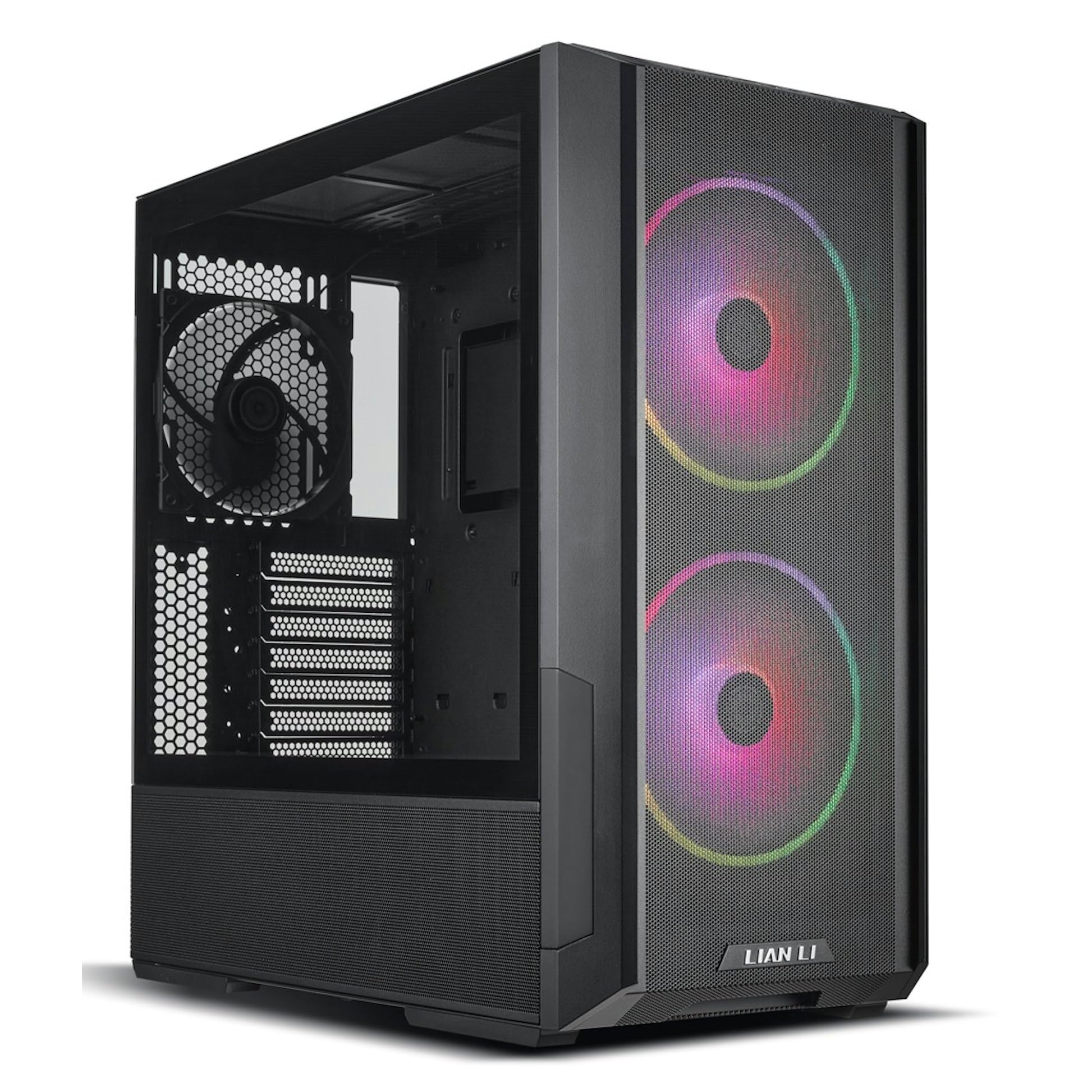
Quick Specs: ATX / E-ATX (<280mm) Modular Tower | 2x 160mm front ARGB PWM + 1x 140mm rear PWM + rear GPU fan bracket | Max GPU clearance: 392mm | Max cooler height: 180.5mm | Radiator support: 360mm front & top | Max PSU: 220mm | Relocatable Front USB-C | Price Tier: Mid-range
Audit Score: 9.1 / 10
- Airflow & Thermal Topology (35%): 9.4 / 10
- GPU, Radiator & Cable Clearance (25%): 9.2 / 10
- Acoustics & Dust Filtration (20%): 8.7 / 10
- Build Ergonomics & Value (20%): 9.1 / 10
Oversized intake fans are an underrated acoustic cheat code: pushing the same cubic feet per minute through two 160mm front blades lets fans spin significantly slower and quieter than three 120mm spinners. The Lian Li LANCOOL 216 official architecture pairs twin 160mm ARGB PWM front fans and a 140mm rear PWM exhaust with an ingenious modular motherboard tray. Builders running tall dual-tower air coolers can drop the tray into Air Cooling mode to maximize PSU-shroud fan space directly beneath the GPU, while liquid-cooling builders raise the motherboard to Water Cooling mode to fit thick top-mounted 360mm radiators cleanly above VRM heatsinks.
Versus its newer sibling, the #1 LIAN LI LANCOOL 207, the LANCOOL 216 steps up to E-ATX compatibility, 392mm GPU length, 220mm PSU support, a relocatable front I/O module (top edge or lower left corner for floor-vs-desk ergonomics), and an external rear PCIe bracket for mounting an optional 120mm GPU exhaust fan. However, the compact LANCOOL 207 edges ahead on price-to-cooling ratio when pairing standard ATX parts with 140mm–160mm PSUs.
Buyer Verification Alert: Check that the listing specifies RGB Black (B0BN3SY5XW) to get the integrated PWM/ARGB hub and front lighting control module; like the LANCOOL 207, the fine secondary front dust filter (LAN216-2X) is an optional add-on rather than included.
Pros
- Dual 160mm front PWM fans deliver deep front-to-back intake volume with lower tonal RPM hum
- Adjustable 2-position motherboard tray optimizes clearance for either dual-tower air or thick 360mm AIOs
- Includes a rear PCIe 120mm exhaust bracket, built-in fan hub, and relocatable USB-C front I/O
- Full 392mm GPU length, 180.5mm air cooler ceiling, and 220mm PSU headroom
Cons
- Optional LAN216-2X magnetic front dust filter costs extra for dusty or pet-hair environments
- Lacks back-connect BTF Project Zero cutouts compared with Corsair FRAME 4000D
Verdict: Buy it if you want a rugged, modular mesh tower built around quiet 160mm intake fans, thick 360mm radiators, and long 220mm PSUs. Skip it if you run a standard 140mm–160mm PSU and want maximum GPU thermal value under $100—pick #1 LANCOOL 207 instead. Adding the LAN216-2X front mesh filter keeps interior heatsinks clean over years of ownership.
6. MONTECH King 95 PRO Curved Dual-Chamber ATX Case — Best Convertible Mesh & Glass Dual-Chamber Case

Quick Specs: Convertible Dual-Chamber ATX / mATX / Mini-ITX | 6x ARGB PWM fans (2x 140mm reverse-blade side + 3x 120mm reverse-blade bottom + 1x 120mm rear) + 10-port hub | Interchangeable front mesh panel included | Max GPU clearance: 420mm | Max cooler height: 175mm | Top rad: 360mm | Front USB-C | Price Tier: $120-$140 tier
Audit Score: 9.1 / 10
- Airflow & Thermal Topology (35%): 9.2 / 10
- GPU, Radiator & Cable Clearance (25%): 8.9 / 10
- Acoustics & Dust Filtration (20%): 9.2 / 10
- Build Ergonomics & Value (20%): 9.3 / 10
Most fishbowl cases hit buyers with a brutal hidden expense: after spending on the enclosure, you still owe another $60 to $120 for reverse-blade intake fans so ugly fan struts do not ruin the view. The MONTECH King 95 PRO dual-chamber blueprint solves that value trap by shipping six ARGB PWM fans pre-wired to a 10-port hub—two 140mm reverse-blade RX side intakes, three 120mm reverse-blade RX bottom intakes, and one 120mm rear AX exhaust. Better yet, Montech includes an interchangeable perforated front mesh panel in the box and mounts the side fan bracket on a forward-swinging hinge, transforming a curved-glass fishbowl into a straight-through mesh wind tunnel whenever summer ambient temps climb.
Compared directly against #2 NZXT H9 Flow and #9 Lian Li O11 Vision Compact, the King 95 PRO wins decisively on turnkey total cost: no aftermarket fan packs required, full top/bottom/side magnetic dust filters included, and tool-free curved glass clarity. Its compromises show only at the top edge: maximum radiator length caps at 360mm (versus dual 420mm on the H9 Flow), side radiator mounts clip GPU length to 275mm if using thick >63mm stacks, and the motherboard tray omits BTF back-connect cutouts.
Buyer Verification Alert: Confirm the listing states King 95 PRO (B0CN95G1YL)—the non-Pro King 95 ships fanless without the six RX/AX ARGB PWM fans or the 10-port ARGB/PWM hub, and avoid mounting thick radiators on the side bracket with long >275mm GPUs.
Pros
- Six ARGB PWM fans—including five clean reverse-blade side and bottom intakes—pre-installed with a 10-port hub
- Included front mesh panel + swinging side bracket converts panoramic glass into high-airflow mesh
- Full magnetic dust filtration across intakes plus 420mm standard GPU clearance and front USB-C
- Curved industrial-grade 4mm tempered glass eliminates harsh corner seams
Cons
- Max top radiator caps at 360mm (no 420mm AIO support) and lacks ASUS BTF / Project Zero cutouts
- Thick side radiators trim GPU length clearance from 420mm down to 275mm
Verdict: Buy it if you want a turnkey dual-chamber showcase loaded with six reverse-blade ARGB fans and convertible front mesh without buying expensive aftermarket fan packs. Skip it if you insist on a 420mm AIO or back-connect BTF motherboard—pick #2 NZXT H9 Flow instead. Pairing the King 95 PRO with a top 360mm AIO exhaust delivers cool, positive-pressure 1440p and 4K performance.
7. NZXT H7 Flow (2024) Mid-Tower Airflow Case — Best Straight-Through Mesh Tower for 420mm Radiators

Quick Specs: Vertical-PSU ATX / E-ATX Mid-Tower | 3x 120mm F120Q front fans | Max GPU clearance: 410mm | Max cooler height: 185mm | Radiator support: 420mm front, 360mm top | Max PSU: 200mm | Front USB-C 3.2 Gen 2×2 (20Gbps) | Price Tier: Under $100
Audit Score: 8.9 / 10
- Airflow & Thermal Topology (35%): 9.0 / 10
- GPU, Radiator & Cable Clearance (25%): 9.3 / 10
- Acoustics & Dust Filtration (20%): 8.4 / 10
- Build Ergonomics & Value (20%): 8.8 / 10
NZXT completely reworked the H7 Flow chassis in its 2024 refresh by rotating the power supply sideways behind a lower vertical chamber—a smart thermal geometry shift shared in spirit with the LANCOOL 207, but scaled into a roomier mid-tower shell. Moving the PSU vertically frees the bottom deck for up to three optional 120mm intake fans feeding cool room air upward into the GPU, while front clearance supports massive 420mm AIO radiators, 410mm triple-fan cards, 185mm dual-tower air coolers, and a 20Gbps USB 3.2 Gen 2×2 front Type-C port.
Compared directly with #1 LIAN LI LANCOOL 207 and #4 MONTECH AIR 903 MAX in the under-$100 class, the H7 Flow (2024) offers cleaner minimalist lines, faster 20Gbps front USB-C, and rare 420mm front radiator clearance in a 244mm-wide mid-tower footprint. However, NZXT cuts stock cooling slightly leaner out of the box: you get three 3-pin DC F120Q front fans with zero pre-installed bottom or rear exhaust fans, no BTF cutouts, and no secondary nylon dust filters behind its fine perforated steel panels.
Buyer Verification Alert: Always verify the Amazon listing explicitly shows “(2024)” (ASIN B0CV4RYKLF) with the full perforated bottom mesh skirt—do not accidentally purchase older 2022 horizontal-shroud H7 Flow inventory lacking triple bottom GPU mounts.
Pros
- Vertical PSU chamber opens three bottom 120mm intake mounts directly beneath long GPUs
- Rare 420mm front radiator capacity plus 360mm top mount and 185mm air-cooler ceiling
- 20Gbps USB 3.2 Gen 2×2 Type-C front I/O and clean minimalist matte finish
- Accommodates up to 410mm GPUs and 200mm ATX power supplies inside a slim footprint
Cons
- Stock F120Q fans use 3-pin DC speed control and ship without a rear exhaust fan
- Lacks BTF back-connect motherboard cutouts and separate fine nylon dust filters
Verdict: Buy it if you want a clean, minimalist under-$100 mid-tower capable of housing a 420mm front radiator and bottom GPU fans in a narrow desk footprint. Skip it if you want four PWM fans included out of the box—#1 LANCOOL 207 and #4 AIR 903 MAX deliver stronger stock cooling. Adding one rear 140mm PWM exhaust fan and two bottom 120mm fans unlocks its full thermal ceiling.
8. Fractal Design North Charcoal Black ATX Case — Best Living-Room & Desk Design Mesh Case

Quick Specs: ATX / mATX / Mini-ITX | 2x 140mm Aspect PWM front fans | Max GPU clearance: 355mm (300mm w/ front 360mm rad) | Max cooler height: 170mm (145mm w/ side fan bracket) | Radiator support: 360mm front, 240mm top | Max PSU: 255mm (155mm w/ 2 HDD trays) | Front USB 3.1 Gen 2 Type-C | Price Tier: $150-$170 tier
Audit Score: 8.8 / 10
- Airflow & Thermal Topology (35%): 8.8 / 10
- GPU, Radiator & Cable Clearance (25%): 8.2 / 10
- Acoustics & Dust Filtration (20%): 9.2 / 10
- Build Ergonomics & Value (20%): 9.0 / 10
Too many high-airflow gaming towers look like industrial plastic armor that clashes inside living rooms or modern home offices. The Fractal Design North official architecture solves industrial fatigue without choking thermals: genuine FSC-certified American walnut vertical slats sit spaced cleanly ahead of a removable nylon dust filter and two 140mm Aspect PWM intake fans, letting air stream straight through beneath a tool-free perforated steel top panel accented with warm brass metal hardware and front USB 3.1 Gen 2 Type-C.
Against utility mesh towers like #4 MONTECH AIR 903 MAX and #3 Corsair 4000D RS ARGB FRAME, you are explicitly paying a design premium in the $150-$170 tier while accepting tighter physical geometry. Top radiator support caps at 240mm rather than 360mm, and installing a 360mm front AIO shrinks maximum GPU clearance from 355mm down to 300mm—tight enough to block many long 3-fan RTX 5080 and RTX 5090 cards. Builders targeting oversized GPUs or top 360mm liquid coolers should either step up to the Fractal North XL or pair the standard North with a dual-tower air cooler.
Buyer Verification Alert: Check the Amazon style selector under ASIN B09V878FXQ to verify whether you are selecting the Tempered Glass Dark panel or the full Steel Mesh side panel (which adds a side fan bracket that drops max tower cooler height from 170mm to 145mm), and measure GPU length against the 355mm limit.
Pros
- Real walnut timber front slats spaced for unobstructed airflow look natural in living spaces
- Includes two quiet 140mm Aspect PWM fans, removable front/PSU dust filters, and USB 3.1 Gen 2 Type-C
- Tool-free leather-tab top panel, brushed brass accents, and crisp build tolerances
- Mesh side-panel variant allows optional side intake fans aimed at GPU/CPU zones
Cons
- 355mm max GPU clearance drops to 300mm with a front 360mm AIO; top mount caps at 240mm
- Premium $150-$170 price tier ships with only two fans, no rear exhaust fan, and no BTF support
Verdict: Buy it if Scandinavian walnut styling matters just as much as clean front-to-back air cooling for a mid-size RTX 5070 Ti or RX 9070 XT air-cooled rig. Skip it if you want a top 360mm AIO or a 360mm+ flagship GPU—pick #5 LANCOOL 216 or #2 H9 Flow instead. Adding one quiet 120mm rear exhaust fan balances its dual 140mm intakes cleanly.
9. Lian Li O11 Vision Compact Dual-Chamber ATX Case (White) — Best Compact Back-Connect Dual-Chamber Case

Quick Specs: Compact Dual-Chamber ATX / mATX (BTF Ready) | Included fans: 0 (Fanless) | Swappable tempered glass OR mesh top panel | Max GPU clearance: 408mm | Max cooler height: 167mm | Radiator support: 360mm top (mesh mode), side & bottom | Max PSU: 220mm | Front USB 3.1 Type-C | Price Tier: $115-$130 tier
Audit Score: 8.7 / 10
- Airflow & Thermal Topology (35%): 8.6 / 10
- GPU, Radiator & Cable Clearance (25%): 9.3 / 10
- Acoustics & Dust Filtration (20%): 8.6 / 10
- Build Ergonomics & Value (20%): 8.4 / 10
Enthusiast fishbowl showcases used to look cluttered by dangling AIO hoses and exposed motherboard power bundles. Built in collaboration with PC enthusiasts, the Lian Li O11 Vision Compact introduces two clever fixes inside a compact dual-chamber case: native cutouts for ATX and Micro-ATX back-connect motherboards (ASUS BTF and MSI Project Zero), plus an angled rubber pass-through opening beside the side radiator tray that conceals AIO liquid hoses in the rear chamber. Unlike the original 3-sided glass Vision that omitted top exhaust mounts, this Compact edition ships with both a panoramic glass top AND a swappable perforated mesh top panel supporting full 360mm radiator exhaust.
Placed alongside #6 MONTECH King 95 PRO and #2 NZXT H9 Flow, the O11 Vision Compact is the cleanest choice for showpiece white BTF builds that rely on unified daisy-chain aftermarket fans. Keep total build math realistic, though: Lian Li ships zero fans inside the box, whereas Montech includes six ARGB PWM fans and NZXT includes four fans alongside 420mm radiator space.
Buyer Verification Alert: The O11 Vision Compact ships completely fanless (0 included fans)—budget roughly $45 to $90 extra for six to eight 120mm PWM fans (ideally reverse-blade side/bottom intakes), and use the included mesh top bracket if running hot 360W–575W GPUs.
Pros
- Includes both panoramic glass top and perforated mesh top panels for 360mm AIO exhaust
- Full ASUS BTF / MSI Project Zero back-connect compatibility plus hidden side-AIO tube pass-through
- Compact dual-chamber footprint still swallows 408mm GPUs and 220mm ATX power supplies
- Removable bottom magnetic dust filter and quick-latch fan brackets streamline cleaning
Cons
- Ships with zero pre-installed fans, raising real-world out-of-pocket build cost
- 167mm air-cooler height ceiling strongly favors 360mm AIO liquid coolers over large towers
Verdict: Buy it if you are building an all-white back-connect BTF showcase around custom daisy-chain reverse-blade fans and a 360mm AIO. Skip it if you want ready-to-run cooling straight out of the box—#6 MONTECH King 95 PRO or #2 NZXT H9 Flow offer far lower total build cost. Installing the included mesh top panel with three bottom and three side reverse-blade intakes creates strong thermal airflow.
10. MONTECH XR Panoramic Dual-Glass ATX Gaming Case — Best Budget Panoramic Glass Airflow Case

Quick Specs: Panoramic Dual-Glass ATX Mid-Tower | 3x 120mm ARGB PWM fans (2x reverse-blade side intake + 1x rear exhaust) | Max GPU clearance: 420mm | Max cooler height: 175mm | Top radiator: up to 360mm | Max PSU: 230mm | Top, bottom & side magnetic dust filters | Front USB-C | Price Tier: Under $100
Audit Score: 8.6 / 10
- Airflow & Thermal Topology (35%): 8.2 / 10
- GPU, Radiator & Cable Clearance (25%): 8.8 / 10
- Acoustics & Dust Filtration (20%): 8.7 / 10
- Build Ergonomics & Value (20%): 8.8 / 10
Shoppers wanting pillarless aquarium aesthetics under $100 typically end up trapped with zero included fans or flimsy sheet metal. The MONTECH XR solves both compromises by packaging two 120mm reverse-blade side intake fans and one 120mm rear ARGB PWM exhaust fan inside a traditional PSU-shroud mid-tower layout fronted by dual tempered glass panels. Despite staying slim enough for modest desks, it swallows 420mm graphics cards, 175mm air coolers, 230mm power supplies, and top 360mm radiators while covering top, side, and bottom vents with removable magnetic dust filters and adding front USB Type-C I/O.
Honesty matters on thermals, however: because the XR pulls intake air through a 90-degree side vent rather than an open mesh front grille, GPU core temperatures naturally run warmer than straight-through mesh towers like our #1 LANCOOL 207 or #4 MONTECH AIR 903 MAX at the exact same under-$100 price tier. Step up to #2 NZXT H9 Flow or #6 King 95 PRO if you pair panoramic glass with high-wattage RTX 5080 or 5090 hardware.
Buyer Verification Alert: Unlike true wide-body dual-chamber cases, the MONTECH XR keeps the PSU beneath a bottom shroud, creating narrower side-panel width clearance—verify 12V-2×6 bend space on wide triple-fan GPUs and pair with efficient 150W–250W cards.
Pros
- Pillarless panoramic dual-glass look with reverse-blade PWM side intakes under $100
- Full top, side, and bottom magnetic dust filtration plus front USB Type-C
- Generous 420mm GPU length, 175mm cooler height, and 360mm top radiator mount
Cons
- 90-degree side intake path trails direct front-mesh towers on sustained GPU cooling
- Narrower single-chamber cable routing trough behind the motherboard tray and no BTF support
Verdict: Buy it if you are building a budget 1080p or 1440p rig (RTX 5060 Ti, RX 9060 XT, or RTX 5070) and crave panoramic showcase glass with included reverse-blade fans under $100. Skip it if raw GPU thermal headroom comes first—choose #4 AIR 903 MAX or #1 LANCOOL 207 instead. Adding two 120mm intake fans atop the perforated PSU shroud strengthens GPU air supply noticeably.
Buying Guide: How to Choose the Best Airflow Gaming PC Case
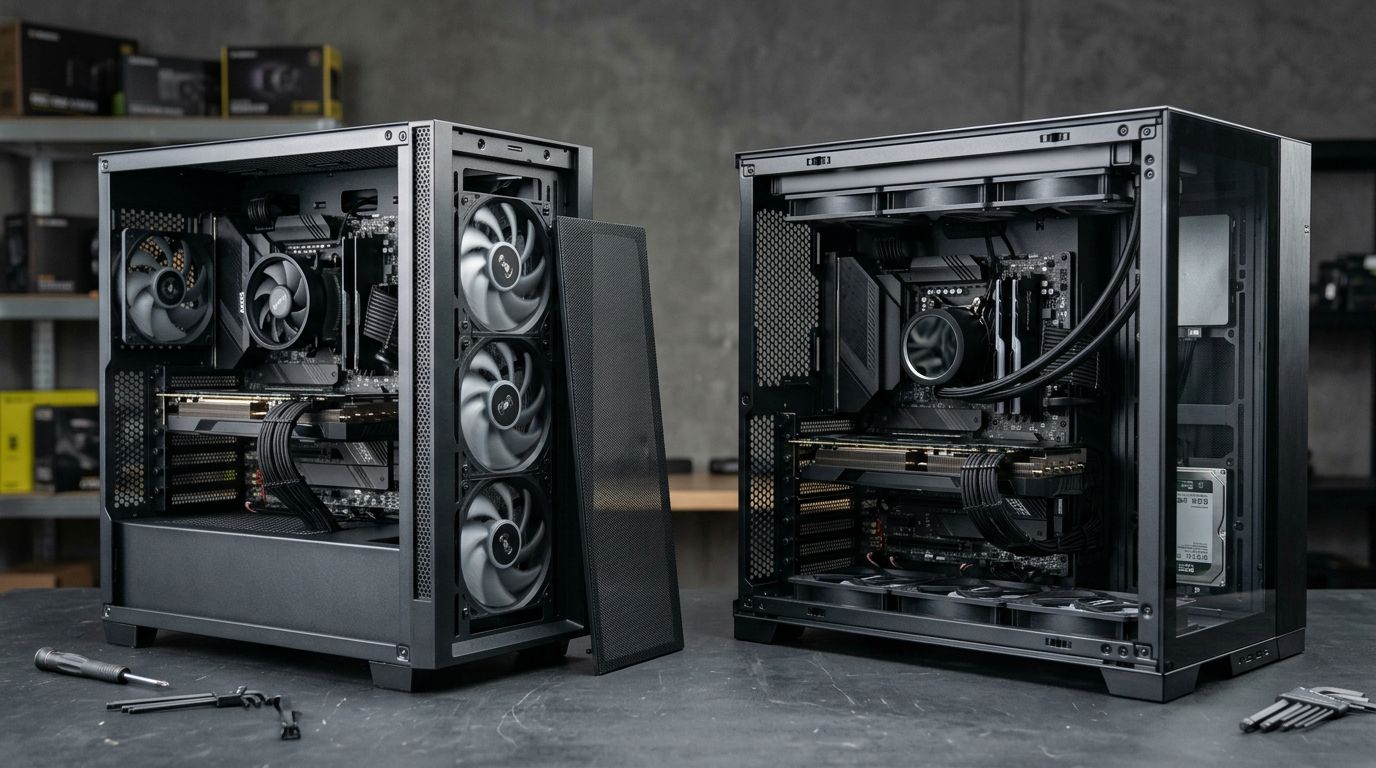
Shopping for the best airflow gaming pc case requires looking far past marketing labels or included RGB strips. Chassis sheet metal thickness, perforation ratio, internal PSU placement, and side-panel width determine whether your 2026 graphics card boosts smoothly in whisper-quiet silence or screams past 80°C while bending fragile power plugs. Apply the six engineering checks below before ordering.
1. Mesh Airflow Mid-Towers vs. Dual-Chamber Cases vs. SFF Mini-ITX
Traditional mesh airflow towers (Lian Li LANCOOL 207, Corsair 4000D FRAME, MONTECH AIR 903 MAX) move intake air along a straight horizontal front-to-back wind tunnel. Because fans face zero 90-degree bends or glass walls, static pressure losses stay low—yielding the best CPU and GPU temperatures per dollar and pairing naturally with dual-tower air coolers like the Thermalright Peerless Assassin or Noctua NH-D15 G2.
By contrast, a dual-chamber case (NZXT H9 Flow, MONTECH King 95 PRO, Lian Li O11 Vision Compact) hides the PSU and cable spaghetti behind the motherboard tray, leaving an unobstructed glass showcase designed around a top or side 360mm radiator. Dual-chamber frames excel on wide 12V-2×6 clearance and visual aesthetics, while convertible designs like the King 95 PRO give you an optional front mesh swap when ambient temperatures rise. Meanwhile, compact SFF Mini-ITX enclosures sacrifice airflow margin and expansion room strictly for tiny sub-15L desk footprints, requiring careful PCIe riser and SFX PSU planning.
2. Fan Orientation, Positive Pressure & Reverse-Blade Fans
Airflow physics beats raw fan counts every time. Always aim for slight positive pressure—more filtered intake airflow entering the case than active exhaust leaving it (for example, three front or side-and-bottom intakes paired with one rear and one or two top exhaust fans). Positive pressure pushes excess air gently outward through unsealed PCIe slot covers and panel gaps, starving dust bunnies of unfiltered entry points. Negative pressure (more exhaust than intake) sucks airborne lint inward through every unprotected seam.
In panoramic glass enclosures, reverse-blade fans preserve both visual style and positive pressure by reversing fin pitch so the clean illuminated face looks inward while still pulling cool air into the system. Equally crucial, match fan design to placement: use high static-pressure blades (closely spaced, thicker fins) on AIO radiators and dense mesh dust screens, and save high-CFM airflow blades for unobstructed rear exhausts. Read our PC case airflow and fan orientation guide for full pressure diagrams and PWM hysteresis curves.
3. Five Mandatory Hardware Clearances (GPU Length, 12V-2×6 Bend Radius & Radiators)
Never order a chassis on GPU length alone. Modern flagship cards from NVIDIA Blackwell and AMD RDNA 4 grow thick and tall as well as long, creating tight bottlenecks around front radiators, VRM armor, and tempered glass side doors. Verify all five measurements against your exact parts list:
| Clearance Spec | Safe 2026 Target | Why It Matters for Modern Builds |
|---|---|---|
| Max GPU Length (GPU clearance) | >= 360mm (400mm+ ideal) | Triple-fan RTX 5080 and RTX 5090 cards routinely reach 330mm–360mm; subtract 30mm–60mm if mounting a front AIO radiator. |
| 12V-2×6 Bend Radius Width | >= 35mm–40mm side clearance | ATX 3.1 / PCIe 5.1 16-pin GPU cables must exit straight before curving; wide >140mm GPUs in narrow cases need a 90-degree plug or wide dual-chamber room. |
| Top 360mm Radiator Height | >= 55mm–65mm offset | Standard 27mm–38mm radiators plus 25mm fans collide with tall motherboard VRM heatsinks and RGB RAM sticks without top offset space. |
| Air Cooler Height | >= 165mm (170mm–185mm ideal) | Dual-tower air coolers stand 158mm–168mm tall (and slightly higher if lifting front fans above tall DDR5 DIMMs). |
| Max PSU Length | 140mm–200mm+ | Compact 140mm–160mm ATX 3.1 PSUs fit front-PSU layouts like LANCOOL 207; 200mm flagships demand spacious rear chambers or drive-cage removal. |
4. Back-Connect BTF Project Zero Cutouts, Front USB-C & Magnetic Dust Filters
Back-connect motherboards—spanning ASUS BTF, MSI BTF Project Zero, and Gigabyte Project Stealth—relocate the 24-pin ATX, 8-pin EPS CPU, fan, and SATA sockets to the back of the PCB, eliminating front-side cable routing clutter. However, back-connect boards will not physically mount inside standard trays without factory-punched perimeter holes. Double-check chassis compatibility before pairing a hidden-connector board: only verified frames like the Corsair 4000D RS ARGB FRAME, updated NZXT H9 Flow, and Lian Li O11 Vision Compact support them natively (see our best back-connect BTF PC cases roundup for full compatibility tables).
Similarly, inspect front I/O and filtration before checkout. Look for a high-speed front USB-C header (10Gbps Gen 2 or 20Gbps Gen 2×2) matched to an internal USB-C Type-E header on your B850, X870, or Z890 motherboard, and prioritize accessible magnetic dust filter panels on intake paths—especially if your PC sits on carpet or near shedding pets.
5. Upgrade Roadmap & Hidden Ownership Costs
Sticker price rarely tells the true out-of-pocket story on PC cases. Several popular mesh and showcase towers arrive with hidden add-on expenses you should calculate upfront: fanless frames like the Lian Li O11 Vision Compact require roughly $45 to $90 in PWM or reverse-blade fan packs before you can safely boot an RTX 5080 build; models like the Corsair FRAME 4000D, NZXT H7 Flow (2024), Fractal North, and LANCOOL 207 omit rear exhaust fans (roughly $12 to $20 extra); Lian Li’s LANCOOL 207 and 216 sell finer magnetic front nylon dust filters separately; and narrow mid-towers housing wide RTX 50-series GPUs benefit from an angled low-profile 12V-2×6 power cable to protect your side-panel 12V-2×6 bend radius.
6. Secondary Intent Resolver: Under-$100 Value Mesh vs. Dual-Chamber Showcase
Still deciding which camp matches your build? Choose a sub-$100 mesh mid-tower (LIAN LI LANCOOL 207, MONTECH AIR 903 MAX, or Corsair 4000D RS ARGB FRAME) whenever GPU thermal headroom, lower total build spending, or air-cooler simplicity leads your list—and explore even more sub-$100 winners in our best budget gaming PC cases under $100 guide. Choose a true dual-chamber enclosure (NZXT H9 Flow or MONTECH King 95 PRO) when you are running a 360mm or 420mm AIO liquid cooler, want effortless rear cable routing behind the tray, and want extra lateral width for thick modern graphics cards—or dive deeper in our dual-chamber fishbowl PC case roundup.
How We Audited, Scored & Rejected Models
Every enclosure in this guide was evaluated strictly through OEM engineering spec sheets, CAD clearance verification, stock fan count and PWM/DC header analysis, BTF tray compatibility audits, and ATX 3.1 / 12V-2×6 physical fit rules—following The PC Audit evaluation methodology. We avoid subjective aesthetic bias by scoring every chassis across four weighted engineering criteria summing to 100%:
| Evaluation Criterion | Weight | What We Audited |
|---|---|---|
| Airflow & Thermal Topology | 35% | Fine mesh intake porosity or dual-chamber angled intake efficiency, direct bottom GPU fan paths, and stock PWM fan value. |
| GPU, Radiator & Cable Clearance | 25% | Maximum GPU clearance, >=35mm 12V-2×6 bend radius width, 360mm/420mm radiator offset, and BTF Project Zero cutouts. |
| Acoustics & Dust Filtration | 20% | Positive pressure balance, 140mm/160mm low-RPM acoustic scaling, reverse-blade fan options, and removable magnetic dust filter coverage. |
| Build Ergonomics & Value | 20% | Rear cable routing space, front USB-C header speed, included PWM/ARGB hubs, anti-sag brackets, and true total cost after missing fans. |
Models We Audited & Rejected (And Why)
- Legacy Sealed-Glass Front Mid-Towers (Older H510 Elite & Choked OEM Shells): Disqualified because flat unvented glass placed millimeters ahead of front fans starves modern 300W–575W graphics cards of intake air, triggering thermal throttling and loud GPU fan whine.
- Proprietary OEM Desktop Shells (Non-Standard Alienware / Dell / HP Enclosures): Excluded because proprietary motherboard standoffs, non-ATX PSU bays, and bespoke wiring block standard 360mm radiator upgrades, ATX 3.1 power supplies, and future case transfers.
- HYTE Y70 Dual-Chamber Flagship ($190-$220 Tier): Excluded from our core airflow value Top 10 because it ships completely fanless at an enthusiast price bracket and enforces mandatory vertical GPU mounting via an included PCIe 4.0 riser rather than offering pre-installed PWM fans and direct mesh airflow.
- Fractal Design Pop XL Air RGB ($110-$130 Tier): Left out of our Top 10 because it omits an active front USB-C cable out of the box (requiring an optional aftermarket USB-C adapter kit) and lacks the BTF cutouts or direct bottom GPU channeling seen on newer under-$100 rivals.
Frequently Asked Questions About Airflow Gaming PC Cases
Are mesh front PC cases cooler than dual-chamber glass cases?
Yes, fine mesh front towers usually deliver slightly lower GPU and CPU temperatures per dollar. Straight front-to-back intake avoids 90-degree airflow bends, though modern dual-chamber cases narrow that gap using angled intake fans, reverse-blade side intakes, and direct bottom fans positioned under the GPU.
How much side-panel clearance do RTX 5080 and RTX 5090 12V-2×6 cables need?
Leave at least 35mm to 40mm of straight, unbent clearance exiting the 16-pin GPU header. Narrow single-chamber mid-towers under 220mm wide often pinch wide GPUs against the glass unless you switch to a low-profile 90-degree native 12V-2×6 cable or choose a wider dual-chamber chassis.
What is the best fan orientation for positive airflow pressure?
Target slightly more filtered intake capacity than exhaust capacity across your chassis. Pairing three front or side-and-bottom intake fans with one rear and one or two top exhaust fans creates gentle positive pressure that pushes dust away from unsealed chassis seams and keeps heatsinks cleaner.
Do back-connect ASUS BTF and MSI Project Zero motherboards fit every ATX case?
No—rear-connector motherboards require custom rectangular cutouts punched into the motherboard tray. Verify explicit back-connect support before ordering; among our audited picks, the Corsair 4000D RS ARGB FRAME, updated NZXT H9 Flow, and Lian Li O11 Vision Compact mount ASUS BTF and MSI Project Zero cleanly.
Should I buy a fanless dual-chamber case or one with pre-installed PWM fans?
Buy a case with pre-installed PWM or reverse-blade fans unless you already own matching fans. Fanless showcase frames save nothing once you spend an extra $45 to $90 on daisy-chain fans, whereas the LANCOOL 207, MONTECH AIR 903 MAX, and King 95 PRO deliver complete airflow straight out of the box.
Can I fit a 360mm AIO liquid cooler inside a compact under-$100 mesh case?
Yes—several compact under-$100 mesh towers accept full 360mm radiators cleanly. The LIAN LI LANCOOL 207, Corsair 4000D RS ARGB FRAME, MONTECH AIR 903 MAX, and NZXT H7 Flow (2024) all mount 360mm AIOs; just check top radiator plus fan thickness against tall RGB RAM sticks.
Final Verdict: Selecting the Best Airflow Gaming PC Case
Choosing the best airflow gaming pc case comes down to matching internal cooling geometry to your exact GPU, cooler, and motherboard style. For pure thermal value under $100, the LIAN LI LANCOOL 207 claims #1 Best Overall thanks to its clever front-mounted PSU layout and two dedicated 120mm bottom GPU fans. If you want panoramic glass, 420mm radiator capacity, back-connect BTF support, and roomy 12V-2×6 cable clearance, step up to #2 NZXT H9 Flow Dual-Chamber.
DIY upgraders prioritizing modular InfiniRail mounts, full magnetic dust filters, and ASUS BTF support under $100 should pick #3 Corsair 4000D RS ARGB FRAME—while E-ATX builders get four 140mm PWM fans out of the box in #4 MONTECH AIR 903 MAX and showpiece builders save substantially on reverse-blade fans with #6 MONTECH King 95 PRO.


