
Disclosure: As an Amazon Associate, I earn from qualifying purchases. If you buy through links on this page, we may earn a small commission at no extra cost to you.
Finding the best Ryzen 7 9850X3D prebuilt gaming PC requires looking past flashy CPU headlines to inspect what system integrators put around AMD’s fastest pure gaming chip. Launched at the end of January 2026 on the AM5 socket, the Ryzen 7 9850X3D boosts up to 5.6 GHz—400 MHz higher than its predecessor—while retaining 104MB of total cache (96MB L3 via Gen 2 3D V-Cache) to lock down smooth 1% Lows at 1440p and 4K. Because native 9850X3D retail towers are still scarce across Amazon US compared to older stock, we audited every verified 9850X3D listing alongside four specialist AM5 Ryzen 7 9800X3D alternatives to cover every GPU, chassis, and warranty tier.
If you are comparing across broader budgets or CPU families, start with our hub for the best prebuilt gaming PCs or review our breakdown of high-end prebuilt gaming towers under $3,000. Below, we rank all eight audited configurations against strict GPU VRAM, dual-channel DDR5, ATX 3.1 power supply, and Amazon catalog-integrity standards.
In This Guide
Quick Picks: Best Ryzen 7 9850X3D Prebuilt Gaming PCs at a Glance
#1 Best Overall 9850X3D Flagship
Skytech Gaming PC Desktop (9850X3D & RTX 5080)
Pairs the 5.6 GHz Ryzen 7 9850X3D with a 16GB GDDR7 RTX 5080, 32GB DDR5, and a 2TB SSD for uncompromised 4K gaming and 360Hz esports. (Jump to audit)
#2 Best 1440p Value & Spec-Verified
Skytech Gaming Azure (9850X3D & RX 9070 XT)
Most transparent native 9850X3D build under $3,000 with confirmed 360mm AIO cooling, zero bloatware, 2TB Gen4 NVMe SSD, and 16GB RX 9070 XT. (Jump to audit)
#3 Best 1440p NVIDIA 9850X3D
Skytech Gaming PC Desktop (9850X3D & RTX 5070 Ti)
Delivers Blackwell DLSS 4 Multi-Frame Generation, NVIDIA Reflex, and 16GB GDDR7 bandwidth driven by the 9850X3D below flagship RTX 5080 pricing. (Jump to audit)
Side-by-Side Comparison: Top 8 Ryzen 7 9850X3D Prebuilt Gaming PCs & AM5 Alternatives
Every prebuilt desktop in the first four slots ships with the genuine AMD Ryzen 7 9850X3D processor. Picks #5 through #8 represent audited AM5 Ryzen 7 9800X3D builds—sharing the exact same 8-core Zen 5 architecture and 96MB L3 3D V-Cache minus the 400 MHz peak boost clock—selected to cover transparent AMD B850 specs, Tier-1 OEM support, Wi-Fi 7 value under $2,500, and Mini-ITX desks where native 9850X3D SKUs are not yet sold.
| Product & Award | CPU & GPU Pairing | Memory & Storage | Audit Score & Tier | Link |
|---|---|---|---|---|
| Skytech Gaming Desktop (RTX 5080) Best Overall 9850X3D Flagship | Ryzen 7 9850X3D (5.6 GHz) RTX 5080 16GB GDDR7 | 32GB DDR5 2TB NVMe SSD | 9.3 / 10 Over $3,000 | View on Amazon |
| Skytech Gaming Azure (RX 9070 XT) Best 1440p Value & Spec-Verified | Ryzen 7 9850X3D (5.6 GHz) RX 9070 XT 16GB GDDR6 | 32GB DDR5-5600 2TB Gen4 NVMe SSD | 9.1 / 10 Around $2,850–$2,950 | View on Amazon |
| Skytech Gaming Desktop (RTX 5070 Ti) Best High-Refresh 1440p NVIDIA | Ryzen 7 9850X3D (5.6 GHz) RTX 5070 Ti 16GB GDDR7 | 32GB DDR5 2TB SSD | 9.0 / 10 Around $2,600–$2,850 | View on Amazon |
| KOTIN Gaming PC (RTX 5080) Best Boutique RTX 5080 Option | Ryzen 7 9850X3D (5.6 GHz) RTX 5080 16GB GDDR7 | 32GB DDR5 2TB SSD | 8.9 / 10 Over $2,900 | View on Amazon |
| STORMCRAFT Phantom (9800X3D Alt.) Best Spec-Transparent B850 Build | Ryzen 7 9800X3D (5.2 GHz) RTX 5080 16GB GDDR7 | 32GB DDR5-6000 2TB Gen4 NVMe SSD | 8.8 / 10 Over $3,500 | View on Amazon |
| HP Omen Max 45L (9800X3D Alt.) Best Tier-1 OEM Cryo Tower | Ryzen 7 9800X3D (5.2 GHz) RTX 5080 16GB GDDR7 | 32GB DDR5 2TB Gen4 SSD | 8.6 / 10 Over $3,000 | View on Amazon |
| Lenovo Legion Tower 5 (9800X3D Alt.) Best Wi-Fi 7 & Value X3D Tower | Ryzen 7 9800X3D (5.2 GHz) RX 9070 XT 16GB GDDR6 | 32GB DDR5 1TB NVMe SSD | 8.5 / 10 Around $2,250–$2,350 | View on Amazon |
| Cooler Master NR2 Pro (9800X3D Alt.) Best Compact Mini-ITX SFF | Ryzen 7 9800X3D (5.2 GHz) RTX 5070 Ti 16GB GDDR7 | 32GB DDR5-6000 2TB M.2 SSD | 8.4 / 10 Over $2,400 | View on Amazon |
Match Your Use Case: Which X3D Prebuilt Fits Your Rig Goals?
| Buyer Scenario | Best Match | Why & Expected Outcome |
|---|---|---|
| 4K 120Hz–240Hz Path Tracing & DLSS 4 Flagship | Skytech Gaming Desktop (9850X3D & RTX 5080) | Combines peak 5.6 GHz Zen 5 X3D frame pacing with 16GB GDDR7 RTX 5080 horsepower and 2TB capacity. |
| Spec-Verified 1440p 240Hz+ Value Under $3,000 | Skytech Gaming Azure (9850X3D & RX 9070 XT) | Confirms a 360mm AIO cooler, 2TB Gen4 NVMe drive, zero bloatware, and 16GB RDNA 4 graphics up front. |
| 1440p Competitive Esports + NVIDIA Reflex | Skytech Gaming Desktop (9850X3D & RTX 5070 Ti) | Matches 5.6 GHz 3D V-Cache with 16GB GDDR7 Blackwell encoding and DisplayPort 2.1b at lower cost than RTX 5080 rigs. |
| Disclosed B850 Chipset, DDR5-6000 & 850W PSU | STORMCRAFT Phantom (9800X3D & RTX 5080) | Eliminates guesswork on motherboard VRM class, memory speed, and 80+ Gold power delivery on the AM5 socket. |
| Wi-Fi 7 Networking & Value X3D Under $2,500 | Lenovo Legion Tower 5 (9800X3D & RX 9070 XT) | Delivers confirmed 850W PSU, Wi-Fi 7, and 2.5GbE LAN with easy secondary M.2 SSD expansion. |
| Compact Desk or Living Room Mini-ITX Build | Cooler Master NR2 Pro Mini-ITX (9800X3D & RTX 5070 Ti) | Packs desktop RTX 5070 Ti graphics and 32GB DDR5-6000 inside a true small-form-factor footprint. |
Detailed Ryzen 7 9850X3D Prebuilt Gaming PC Audits (1–8)
1. Skytech Gaming PC Desktop (Ryzen 7 9850X3D, RTX 5080, 32GB RAM, 2TB SSD) — Best Overall 9850X3D Flagship

Quick Specs: AMD Ryzen 7 9850X3D (8C/16T, up to 5.6 GHz, 104MB Cache) | NVIDIA GeForce RTX 5080 16GB GDDR7 | 32GB DDR5 | 2TB NVMe SSD | Standard ATX Architecture | Price Tier: Flagship tier (over $3,000)
Audit Score: 9.3 / 10
- GPU & VRAM Headroom (35%): 9.6 / 10
- CPU & Platform Runway (25%): 9.6 / 10
- Memory & Storage Balance (20%): 8.8 / 10
- Cooling, PSU & Warranty Support (20%): 8.8 / 10
Pairing AMD’s 5.6 GHz Ryzen 7 9850X3D with NVIDIA’s GeForce RTX 5080 produces the highest pure-gaming ceiling available in an off-the-shelf prebuilt tower right now. With 96MB of L3 3D V-Cache stacked underneath its Zen 5 compute die, the processor eliminates memory-stall micro-stutters in simulation titles and competitive shooters while feeding the RTX 5080’s 10,752 CUDA cores and 16GB of 256-bit GDDR7 memory. DisplayPort 2.1b output also gives 4K 240Hz and 1440p 360Hz OLED owners full uncompressed high-bandwidth display compatibility alongside DLSS 4 Multi-Frame Generation.
Compared directly with our #2 Skytech Azure (RX 9070 XT) configuration, this RTX 5080 edition holds a decisive advantage in heavy ray tracing, path-traced titles, and NVIDIA Broadcast or NVENC streaming workflows. Versus the #5 STORMCRAFT Phantom (9800X3D + RTX 5080), you gain the faster 5.6 GHz 9850X3D bin at the trade-off of less upfront documentation regarding motherboard chipset and exact DDR5 MT/s timings on the main Amazon bullet summary.
Buyer Verification Alert: Skytech’s condensed Amazon listing omits exact DDR5 speed, motherboard chipset (B850 vs. X870), cooler radiator dimensions, and PSU wattage/ATX 3.1 status. Verify the active configuration selector before ordering and confirm a flush 12V-2×6 power connector fit inside the case upon unboxing.
Pros
- Flagship 9850X3D (5.6 GHz) + RTX 5080 (16GB GDDR7) pure-gaming pairing
- Generous 32GB memory and 2TB SSD prevent immediate capacity upgrades
- Standard ATX integrator chassis preserves AM5 socket and GPU upgrade paths
- Full Blackwell DLSS 4 Multi-Frame Generation, Reflex, and DisplayPort 2.1b support
Cons
- Omits PSU wattage, ATX 3.1 rating, motherboard chipset, and exact DDR5 timings in summary
- Commands flagship over-$3,000 pricing compared to RX 9070 XT and RTX 5070 Ti builds
Verdict: Buy it if you want maximum 4K high-refresh and 360Hz esports frame rates with native Ryzen 7 9850X3D silicon and RTX 5080 ray tracing. Skip it if you want every secondary part model listed before checkout—#2 Skytech Azure and #5 STORMCRAFT Phantom provide clearer component transparency. Upgrade note: enable AMD EXPO in BIOS on day one and keep at least 35mm of slack on the 12V-2×6 GPU cable.
2. Skytech Gaming Azure — Ryzen 7 9850X3D & RX 9070 XT — Best 1440p Value & Spec-Verified 9850X3D

Quick Specs: AMD Ryzen 7 9850X3D (4.7 GHz base / 5.6 GHz boost, AM5) | AMD Radeon RX 9070 XT 16GB GDDR6 | 32GB DDR5-5600 | 2TB Gen4 NVMe M.2 SSD | 360mm AIO Cooler | Zero Bloatware | Price Tier: Enthusiast tier (around $2,850–$2,950)
Audit Score: 9.1 / 10
- GPU & VRAM Headroom (35%): 8.9 / 10
- CPU & Platform Runway (25%): 9.6 / 10
- Memory & Storage Balance (20%): 8.6 / 10
- Cooling, PSU & Warranty Support (20%): 9.2 / 10
If transparency matters as much as raw CPU clocks, the Skytech Gaming Azure stands out among native Ryzen 7 9850X3D prebuilts. Unlike vague listings that conceal cooler size and NVMe generation, Skytech explicitly confirms a 360mm AIO liquid cooler capable of dissipating the 9850X3D’s 162W PPT ceiling, a 2TB Gen4 NVMe M.2 SSD, clean Windows 11 Home installation with zero third-party bloatware, and standard ATX hardware inside the Skytech Azure tempered-glass chassis. Paired with AMD’s 64-CU Radeon RX 9070 XT (16GB GDDR6 on a 256-bit bus), this rig hits the sweet spot for 1440p 240Hz+ competitive and ultra-preset rasterization under $3,000.
Compared against our #1 Skytech RTX 5080 build, the Azure saves noticeable budget while providing explicit confirmation of 360mm liquid cooling and Gen4 storage. Relative to our #7 Lenovo Legion Tower 5 (9800X3D + RX 9070 XT), the Azure upgrades both the CPU (+400 MHz boost) and storage capacity (2TB vs. 1TB), making it the stronger plug-and-play pick for players who never want to swap drives or processors.
Buyer Verification Alert: Check the Amazon Set name dropdown carefully before adding to cart. Skytech Azure parent ASIN pages sometimes share historical customer reviews pooled from legacy configurations alongside current 2026 9850X3D | 9070XT builds, and the summary omits Wi-Fi generation and PSU wattage.
Pros
- Verified 360mm AIO liquid cooler and 2TB Gen4 NVMe M.2 SSD specifications
- 16GB RX 9070 XT delivers exceptional 1440p rasterization and FSR 4 value
- Zero preinstalled OEM bloatware on Windows 11 Home
- Off-the-shelf ATX layout keeps AM5 CPU and DDR5 upgrades straightforward
Cons
- Ships with 32GB DDR5-5600 rather than ideal AM5 DDR5-6000 CL30 memory
- Listing does not disclose motherboard chipset, Wi-Fi tier, or exact PSU certification
Verdict: Buy it if you play primarily at 1440p high refresh rates and want a verified 360mm AIO, 2TB Gen4 SSD, and clean Windows install on the 9850X3D platform. Skip it if you demand NVIDIA DLSS 4 Multi-Frame Generation or factory DDR5-6000 CL30 timings. Upgrade note: 96MB of 3D V-Cache minimizes DDR5-5600 losses to roughly 1–3%, so only swap RAM if you chase competitive latency records.
3. Skytech Gaming PC Desktop (Ryzen 7 9850X3D, RTX 5070 Ti, 32GB RAM, 2TB SSD) — Best High-Refresh 1440p NVIDIA 9850X3D

Quick Specs: AMD Ryzen 7 9850X3D (8C/16T, up to 5.6 GHz, AM5) | NVIDIA GeForce RTX 5070 Ti 16GB GDDR7 | 32GB DDR5 | 2TB SSD | Standard ATX Chassis | Price Tier: Enthusiast tier (around $2,600–$2,850)
Audit Score: 9.0 / 10
- GPU & VRAM Headroom (35%): 9.0 / 10
- CPU & Platform Runway (25%): 9.6 / 10
- Memory & Storage Balance (20%): 8.7 / 10
- Cooling, PSU & Warranty Support (20%): 8.6 / 10
Not every 9850X3D buyer needs to stretch above $3,000 for an RTX 5080 when 1440p OLED monitors are the primary target. This Skytech configuration swaps in NVIDIA’s RTX 5070 Ti (8,960 CUDA cores, 16GB GDDR7 on a 256-bit bus, 896 GB/s bandwidth), preserving full 16GB VRAM headroom alongside Blackwell DLSS 4 Multi-Frame Generation, NVIDIA Reflex, and DisplayPort 2.1b. Running at a 300W TDP, the RTX 5070 Ti also leaves wider PSU thermal headroom inside mid-tower enclosures than 360W RTX 5080 cards.
Placed alongside the #2 Skytech Azure (RX 9070 XT), this RTX 5070 Ti build appeals directly to creators, streamers using NVENC AV1 encoding, and ray-tracing fans who prefer GeForce upscaling over Radeon FSR 4. Compared against #8 Cooler Master NR2 Pro (9800X3D + RTX 5070 Ti), you get the faster 9850X3D processor and full-size ATX airflow rather than a cramped Mini-ITX thermal volume.
Buyer Verification Alert: The product title confirms 32GB memory and 2TB storage, yet leaves motherboard chipset, DDR5 speed, PSU wattage/ATX 3.1 status, and cooling radiator dimensions unspecified. Inspect the technical detail drawer on Amazon and confirm dual-channel memory inside Windows Task Manager on arrival.
Pros
- Full 16GB GDDR7 RTX 5070 Ti prevents 1440p and entry-4K VRAM bottlenecks
- Combines NVIDIA Reflex and DLSS 4 with AMD’s 5.6 GHz Ryzen 7 9850X3D
- Includes 32GB RAM and 2TB SSD storage without immediate expansion needs
Cons
- Secondary specs (chipset, DDR5 MT/s, PSU rating, cooler size) omitted in short listing
- Slower native 4K path-tracing headroom than the #1 Skytech RTX 5080 tower
Verdict: Buy it if you play competitive 1440p shooters and ray-traced AAA releases with NVIDIA Reflex and want genuine Ryzen 7 9850X3D speed without RTX 5080 flagship pricing. Skip it if you game natively at 4K 240Hz without upscaling. Upgrade note: ensure Resizable BAR and Hardware-Accelerated GPU Scheduling are active in BIOS and Windows 11 before enabling DLSS 4 Frame Generation.
4. KOTIN Gaming PC Desktop (Ryzen 7 9850X3D, RTX 5080 16GB, 32GB DDR5, 2TB SSD) — Best Boutique RTX 5080 Alternative

Quick Specs: AMD Ryzen 7 9850X3D (8C/16T, AM5) | NVIDIA GeForce RTX 5080 16GB GDDR7 | 32GB DDR5 | 2TB SSD | Tempered-Glass Tower | Price Tier: Flagship tier (over $2,900)
Audit Score: 8.9 / 10
- GPU & VRAM Headroom (35%): 9.6 / 10
- CPU & Platform Runway (25%): 9.4 / 10
- Memory & Storage Balance (20%): 8.7 / 10
- Cooling, PSU & Warranty Support (20%): 7.3 / 10
KOTIN’s flagship configuration is one of only two verified Amazon US systems pairing the Ryzen 7 9850X3D directly with a 16GB RTX 5080, 32GB DDR5, and a 2TB SSD. On headline compute potential alone, it mirrors our #1 Skytech RTX 5080 pick—giving you 5.6 GHz Zen 5 boost speeds, 96MB of L3 cache, and Blackwell 4K rendering muscle for demanding Unreal Engine 5 and competitive titles.
Where it trails #1 Skytech and #5 STORMCRAFT Phantom is ecosystem clarity and documented service longevity. Boutique Amazon assemblers occasionally rotate AIB graphics card vendors, PSU labels, and motherboard boards across production batches, so buyers need to treat the core CPU/GPU/RAM/SSD quartet as confirmed while inspecting internal chassis cabling, GPU support brackets, and PSU efficiency labels upon delivery.
Buyer Verification Alert: KOTIN’s listing omits PSU wattage, 80+ Gold / Cybenetics status, ATX 3.1 cable details, CPU cooler size, and Wi-Fi generation. Confirm seller return windows and verify in HWiNFO64 that dual-channel DDR5 and full 162W PPT boost clocks are active out of the box.
Pros
- True Ryzen 7 9850X3D + RTX 5080 16GB GDDR7 flagship compute specification
- 32GB DDR5 and 2TB SSD baseline meets 2026 AAA game requirements
- Useful alternative inventory source when Skytech RTX 5080 SKUs sell out
Cons
- Sparse secondary component disclosures (chipset, PSU wattage, cooler model, Wi-Fi tier)
- Smaller brand support footprint compared to Skytech, Lenovo, or HP
Verdict: Buy it if Skytech’s RTX 5080 9850X3D stock is unavailable or if KOTIN undercuts competing RTX 5080 listings enough to cover an aftermarket Wi-Fi 7 or PSU audit. Skip it if you prefer disclosed B850 boards and multi-year Tier-1 warranties. Upgrade note: check for a physical GPU anti-sag bracket immediately after removing shipping foam.
5. STORMCRAFT Phantom — Ryzen 7 9800X3D & RTX 5080 — Best Spec-Transparent AM5 Alternative

Quick Specs: AMD Ryzen 7 9800X3D (8C/16T, up to 5.2 GHz, 96MB L3 3D V-Cache) | NVIDIA GeForce RTX 5080 16GB GDDR7 | 32GB DDR5-6000 RGB | 2TB NVMe Gen4 SSD | AMD B850 Chipset | 360mm AIO + 850W 80+ Gold PSU | Price Tier: Flagship tier (over $3,500)
Audit Score: 8.8 / 10
- GPU & VRAM Headroom (35%): 9.4 / 10
- CPU & Platform Runway (25%): 8.2 / 10
- Memory & Storage Balance (20%): 9.3 / 10
- Cooling, PSU & Warranty Support (20%): 8.1 / 10
If opaque component summaries make you hesitant to spend flagship money online, the STORMCRAFT Phantom sets the gold standard for prebuilt disclosure—even though it steps down from the 9850X3D to the Ryzen 7 9800X3D. Every critical bottleneck point is verified upfront: an AMD B850 motherboard (supporting PCIe 5.0 M.2 and unlocked memory/CPU tuning), 32GB of DDR5-6000 memory aligned with AM5’s optimal 1:1 UCLK:MCLK ratio, a 360mm AIO liquid cooler paired with seven ARGB chassis fans, an 850W 80+ Gold power supply, and a 2-year parts / 3-year labor warranty.
Compared to #1 Skytech and #4 KOTIN, STORMCRAFT eliminates memory-speed ambiguity by confirming DDR5-6000 instead of unrated DDR5 or DDR5-5600, while keeping the exact same AM5 upgrade socket. For 4K gaming where the RTX 5080 handles the vast majority of rendering work, the 400 MHz clock gap between the 9800X3D (5.2 GHz) and 9850X3D (5.6 GHz) narrows dramatically—though the Phantom’s over-$3,500 tier asks a steep premium for that parts transparency.
Buyer Verification Alert: Confirm this SKU carries the Ryzen 7 9800X3D rather than the 9850X3D if your primary requirement is 5.6 GHz CPU binning, and verify that the 850W 80+ Gold PSU adheres to ATX 3.1 / PCIe 5.1 cabling standards rather than multi-plug adapters (Cybenetics certification standards).
Pros
- Explicitly discloses AMD B850 motherboard, DDR5-6000 RAM, and 850W 80+ Gold PSU
- 360mm AIO liquid cooler and seven ARGB fans ensure strong thermal airflow
- 2-year parts / 3-year labor warranty with full off-the-shelf AM5 upgradeability
Cons
- Ships with 5.2 GHz Ryzen 7 9800X3D instead of 5.6 GHz Ryzen 7 9850X3D
- Over-$3,500 flagship tier costs substantially more than #2 and #3 9850X3D systems
Verdict: Buy it if spec certainty—specifically confirmed B850 VRM hardware, DDR5-6000 memory, and 80+ Gold power—matters more to you than the 9850X3D’s 400 MHz clock bump. Skip it if you want maximum frames per dollar under $3,000. Upgrade note: because the Phantom uses a standard B850 board, you can drop in future AM5 X3D chips seamlessly later.
6. HP Omen Max 45L Gaming PC (Ryzen 7 9800X3D, RTX 5080, 32GB DDR5, 2TB Gen4 SSD) — Best Tier-1 OEM Cryo Tower

Quick Specs: AMD Ryzen 7 9800X3D (8C/16T, 96MB L3 3D V-Cache) | NVIDIA GeForce RTX 5080 16GB GDDR7 | 32GB DDR5 | 2TB Gen4 SSD | 45L Liquid-Cooled Cryo Chamber Chassis | Price Tier: Flagship tier (over $3,000)
Audit Score: 8.6 / 10
- GPU & VRAM Headroom (35%): 9.4 / 10
- CPU & Platform Runway (25%): 7.8 / 10
- Memory & Storage Balance (20%): 8.6 / 10
- Cooling, PSU & Warranty Support (20%): 8.2 / 10
Corporate and enterprise buyers often prefer a household OEM badge over boutique system integrators—and the HP Omen Max 45L delivers that mainstream warranty security alongside RTX 5080 16GB GDDR7 graphics, 32GB DDR5, and a 2TB Gen4 NVMe SSD. HP’s signature 45L Cryo Chamber design isolates the liquid cooler radiator inside a dedicated top compartment that draws cool external air rather than ingesting pre-warmed GPU exhaust, keeping noise profiles restrained during prolonged 4K sessions.
Compared to our #1 Skytech RTX 5080 and #5 STORMCRAFT Phantom towers, however, major-OEM architecture carries classic upgrade trade-offs. You step down from the 9850X3D to the 9800X3D, and OEM motherboards typically lock granular memory sub-timings, curve optimizer tools, and future CPU AGESA microcode adoption behind HP’s proprietary BIOS schedule.
Buyer Verification Alert: Major OEM builds frequently ship with trial security suites, vendor telemetry utilities, and custom motherboard power profiles. Audit HP OMEN Gaming Hub settings and uninstall bloatware after first boot to keep background latency crisp.
Pros
- Isolated Cryo Chamber liquid cooling prevents radiator intake heat soak
- Full RTX 5080 16GB GDDR7 + 32GB DDR5 + 2TB Gen4 SSD pairing
- Backed by HP’s nationwide Tier-1 OEM customer support and warranty infrastructure
Cons
- Uses the 5.2 GHz Ryzen 7 9800X3D rather than the 5.6 GHz Ryzen 7 9850X3D
- OEM BIOS restrictions limit advanced PBO tuning and future retail motherboard swaps
Verdict: Buy it if major-brand service infrastructure and HP’s isolated Cryo Chamber cooling top your checklist for an RTX 5080 rig. Skip it if you want native 9850X3D frequencies or full open-market ATX upgrade freedom—#1 Skytech and #5 STORMCRAFT serve DIY upgraders far better. Upgrade note: secondary M.2 storage adds easily, while future CPU swaps rely on HP BIOS releases.
7. Lenovo Legion Tower 5 (2026 — Ryzen 7 9800X3D & RX 9070 XT 16GB) — Best Wi-Fi 7 & Value X3D Alternative

Quick Specs: AMD Ryzen 7 9800X3D (8C/16T, 96MB L3 3D V-Cache) | AMD Radeon RX 9070 XT 16GB GDDR6 | 32GB DDR5 | 1TB NVMe SSD | 850W PSU | Wi-Fi 7 (802.11be) + 2.5GbE LAN | Price Tier: Enthusiast tier (around $2,250–$2,350)
Audit Score: 8.5 / 10
- GPU & VRAM Headroom (35%): 8.8 / 10
- CPU & Platform Runway (25%): 8.0 / 10
- Memory & Storage Balance (20%): 8.1 / 10
- Cooling, PSU & Warranty Support (20%): 8.9 / 10
Many enthusiast prebuilts around $2,000–$3,000 quietly cut corners on wireless cards, shipping outdated Wi-Fi 5 radios inside expensive towers. Lenovo’s 2026 Legion Tower 5 avoids that trap completely by confirming native Wi-Fi 7 (802.11be), 2.5GbE Ethernet, an 850W power supply, 32GB DDR5, and AMD’s 16GB Radeon RX 9070 XT around $2,250–$2,350. Paired with the Ryzen 7 9800X3D, it delivers extraordinary value per frame for high-refresh 1440p gaming monitors.
Directly compared against our #2 Skytech Azure (9850X3D + RX 9070 XT), the Legion Tower 5 typically costs around $500 to $650 less while guaranteeing Wi-Fi 7 and an 850W PSU. You give up the 9850X3D’s extra 400 MHz peak boost clock and drop from 2TB down to a 1TB NVMe SSD—a minor compromise that leaves plenty of budget left over to install a secondary 2TB PCIe 4.0 DRAM+TLC drive.
Buyer Verification Alert: A 1TB NVMe SSD fills rapidly once Windows 11 and three or four modern 150GB+ AAA titles are installed. Check Lenovo’s motherboard specifications for the free M.2 2280 expansion slot and update Wi-Fi 7 drivers for 6GHz MLO routers.
Pros
- Exceptional enthusiast value around $2,250–$2,350 with 16GB RX 9070 XT and 32GB DDR5
- Confirmed 850W PSU, Wi-Fi 7 (802.11be), and 2.5GbE Ethernet connectivity
- Clean Eclipse Black airflow tower with mainstream Lenovo warranty coverage
Cons
- 1TB NVMe SSD trails the 2TB baseline offered by picks #1 through #6
- Ships with the 9800X3D (5.2 GHz) instead of the 9850X3D (5.6 GHz)
Verdict: Buy it if you want the strongest price-to-performance 3D V-Cache + 16GB GPU build under $2,500 with verified Wi-Fi 7 and 850W power headroom. Skip it if you must have native 9850X3D binning or 2TB out of the box—check our broader Ryzen 7 9800X3D prebuilt gaming PC guide for additional value towers. Upgrade note: budget for a 2TB PCIe 4.0 NVMe TLC SSD in the open M.2 slot.
8. Cooler Master NR2 Pro Mini-ITX Gaming PC (Ryzen 7 9800X3D, RTX 5070 Ti, 32GB DDR5, 2TB SSD) — Best Compact Mini-ITX SFF

Quick Specs: Mini-ITX SFF Form Factor | AMD Ryzen 7 9800X3D (AM5) | NVIDIA GeForce RTX 5070 Ti 16GB GDDR7 | 32GB DDR5-6000 | 2TB M.2 SSD | Price Tier: Enthusiast tier (over $2,400)
Audit Score: 8.4 / 10
- GPU & VRAM Headroom (35%): 8.9 / 10
- CPU & Platform Runway (25%): 8.0 / 10
- Memory & Storage Balance (20%): 9.0 / 10
- Cooling, PSU & Warranty Support (20%): 7.4 / 10
Small-form-factor builders face scarce options when shopping for native 9850X3D prebuilts, making the Cooler Master NR2 Pro Mini-ITX our top compact pick. Rather than relying on heat-throttled mobile GPUs, Cooler Master fits a full-length 16GB GDDR7 RTX 5070 Ti inside a genuine Mini-ITX enclosure paired with verified 32GB DDR5-6000 memory and a 2TB M.2 NVMe SSD. Built around standardized NR200-class Mini-ITX components rather than proprietary bricks, it remains serviceable years down the road.
Stacking it next to #3 Skytech (9850X3D + RTX 5070 Ti), you trade the extra 400 MHz CPU clock and roomy ATX airflow for less than half the desk footprint and explicit confirmation of DDR5-6000 memory speeds. Because small-form-factor enclosures pack 300W GPUs and 162W PPT processors inches apart, acoustic fan curves run noticeably warmer than full mid-towers under marathon gaming sessions.
Buyer Verification Alert: Mini-ITX layouts limit motherboard expansion to two DDR5 DIMM slots and leave tight lateral space beside the GPU edge. Confirm the PCI-SIG 12V-2×6 power connector sits fully latched without sharp cable bending against the side panel.
Pros
- True Mini-ITX desktop footprint packing a full 16GB RTX 5070 Ti GPU
- Confirmed 32GB DDR5-6000 memory and spacious 2TB M.2 NVMe SSD
- Off-the-shelf SFF parts layout allows future SFX PSU or AM5 processor upgrades
Cons
- Smaller chassis volume produces higher fan acoustics under sustained 1440p/4K load
- Ships with 9800X3D instead of 9850X3D, and Mini-ITX limits RAM to two DIMM slots
Verdict: Buy it if desk space or living-room placement demands a Mini-ITX chassis with zero sacrifice on 16GB GDDR7 graphics or DDR5-6000 speed. Skip it if whisper-quiet acoustics or multi-slot PCIe expansion rank higher than footprint—choose #3 Skytech or #2 Skytech Azure instead. Upgrade note: apply a gentle -15 AMD Curve Optimizer offset in BIOS to trim SFF temperatures cleanly.
Buying Guide: How to Choose the Best Ryzen 7 9850X3D Prebuilt Gaming PC
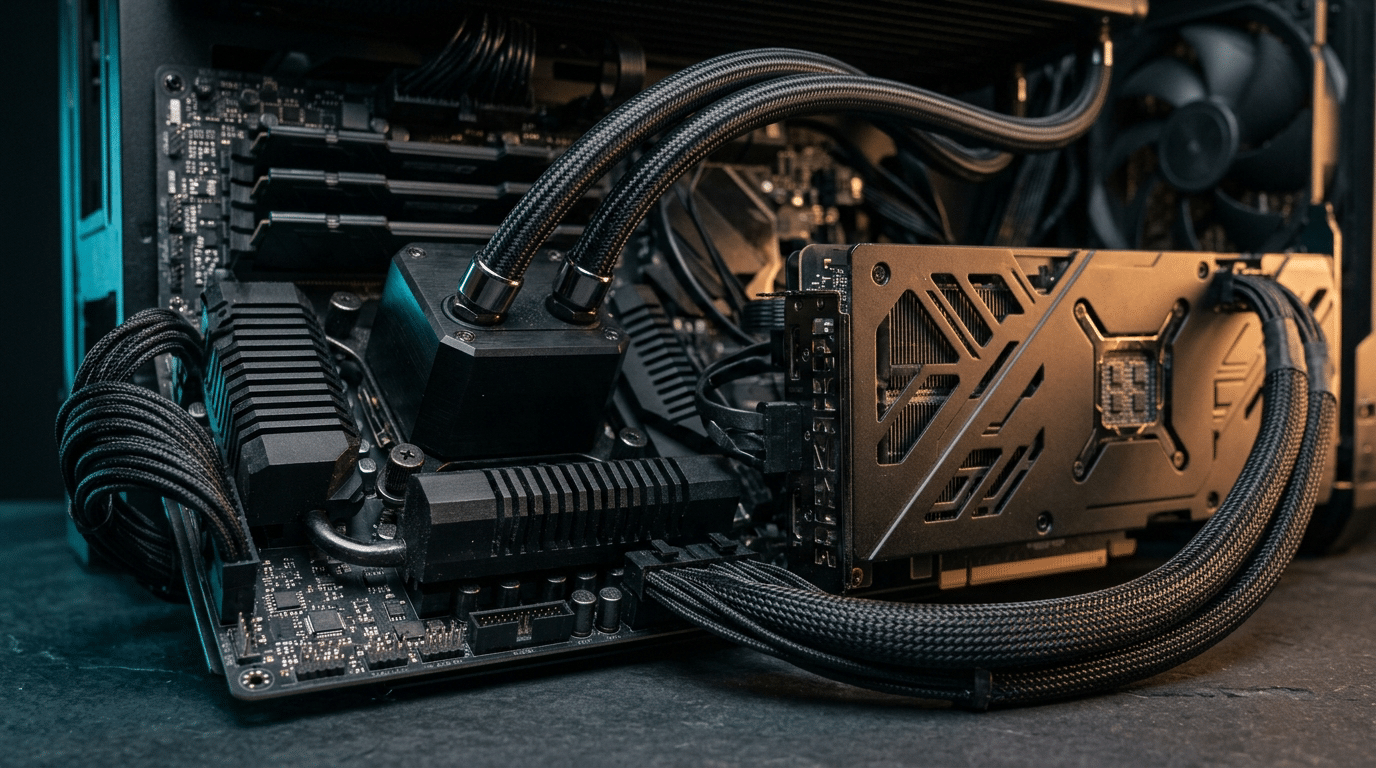
Shopping for the best Ryzen 7 9850X3D prebuilt gaming PC goes well beyond confirming the CPU line item. Because system integrators often allocate margin away from motherboards, memory kits, power supplies, and wireless adapters, verifying five structural criteria separates balanced flagship rigs from bottlenecked showcases.
1. 9850X3D vs. 9800X3D: Understanding Gen 2 3D V-Cache Architecture
Both the Ryzen 7 9850X3D (Launch MSRP around $499) and Ryzen 7 9800X3D (Launch MSRP around $479) share AMD’s inverted Gen 2 3D V-Cache layout on the AM5 socket. Unlike older Ryzen 7000X3D parts that stacked extra SRAM on top of the compute cores, Zen 5 X3D places the 64MB 3D V-Cache die underneath the 8-core compute CCD (for 96MB L3 and 104MB total cache), keeping the Zen 5 cores in direct contact with the heat spreader. That thermal improvement unlocks full Precision Boost Overdrive (PBO) support and lets the 9850X3D sustain up to 5.6 GHz—400 MHz beyond the 9800X3D’s 5.2 GHz ceiling—at the same 120W base TDP and ~162W PPT limit. In CPU-bound 1080p and 1440p esports titles, that clock edge widens peak frame rates and keeps 1% Lows tight, whereas 4K gaming tilts heavily toward GPU throughput; check our Ryzen 7 9800X3D vs. 9850X3D deep comparison for exact bottleneck scenarios.
2. GPU & VRAM Headroom: Why 16GB Is Non-Negotiable
Never pair an enthusiast 9850X3D processor with an 8GB graphics card. Every top pick in our audit pairs the X3D chip with at least 16GB of high-bandwidth VRAM: the RTX 5080 (16GB GDDR7, 360W TDP, Launch MSRP around $999), the RTX 5070 Ti (16GB GDDR7, 300W TDP, Launch MSRP around $749), or the Radeon RX 9070 XT (16GB GDDR6, 304W TBP, Launch MSRP around $599). When running modern Unreal Engine 5 titles at 1440p Ultra or 4K with ray tracing and frame generation active, 8GB buffers spill into system memory and tank 1% Lows. Also keep in mind that DLSS 4 Multi-Frame Generation and FSR frame generation rely on a healthy 50 to 60 native base FPS baseline paired with NVIDIA Reflex or AMD Anti-Lag 2 to preserve crisp mouse responsiveness.
3. Memory Ratio (DDR5-6000 vs. DDR5-5600) & NVMe Storage
On AM5, two 16GB sticks (32GB DDR5-6000 CL30) yield the sweet-spot 1:1 UCLK:MCLK memory controller ratio at roughly 10ns latency—whereas populating four DIMMs or pushing past 6400 MT/s drops the controller into a higher-latency 2:1 divider. While prebuilts like the Skytech Azure ship DDR5-5600, AMD’s massive 96MB L3 V-Cache insulates games far better than non-X3D CPUs, keeping real frame-rate differences around 1% to 3%. By contrast, single-channel 1x16GB configurations cut 1% Lows by 15% to 30% and immediately disqualify any flagship tower. For storage, prioritize a 2TB PCIe 4.0 DRAM+TLC NVMe SSD over paying extra for a smaller 1TB PCIe 5.0 drive, because PCIe 4.0 delivers virtually identical game loading times with zero FPS difference and cooler sustained operation.
4. Cooling Topology, ATX 3.1 Power Safety & Amazon Listing Traps
Although the Ryzen 7 9850X3D sips less wattage in games than 250W hybrid Intel chips, sustaining 5.6 GHz under shader compilation and 162W PPT bursts still warrants a 240mm to 360mm AIO liquid cooler or flagship dual-tower air cooler inside a ventilated mesh or dual-chamber case. Avoid solid unvented glass front panels and thin 120mm AIOs. For power delivery, look for an 850W to 1000W ATX 3.1 80+ Gold (or Cybenetics Gold+) PSU built to absorb 200% to 300% GPU transient power excursions, featuring a native 12V-2×6 cable with recessed sense pins and at least 35mm of side-panel bend clearance.
Finally, defend against Amazon catalog traps before checking out. Amazon’s sidebar Graphics Memory filter still tops out at “8 GB & above,” mixing 8GB cards alongside 16GB flagships, and multiple listings bundle legacy Ryzen 2600 or GTX 1660 Ti eras into the same parent ASIN review counter via Set name dropdowns. Always verify the exact selected CPU, GPU, New condition tag, and Wi-Fi tier—because several enthusiast systems around $1,500–$3,000 quietly drop wireless cards down to legacy Wi-Fi 5 instead of Wi-Fi 6E or Wi-Fi 7.
Upgrade Roadmap & Hidden Ownership Costs
Even on a high-end prebuilt, budget roughly one evening and minor potential upgrades for post-delivery optimization. First, flash your motherboard’s latest stable AGESA BIOS so the AM5 memory controller and 9850X3D boost tables run with current microcode, verify AMD EXPO and Resizable BAR are enabled, and optionally apply a mild -15 to -20 Curve Optimizer offset to trim temperatures by 5°C to 10°C while boosting clocks. Second, verify your monitor cable connects directly to the GPU (not the motherboard), enable your display’s 240Hz or 360Hz refresh rate in Windows, set G-Sync/FreeSync with driver V-Sync ON plus a frame cap 3 FPS below max refresh, and delete preinstalled trialware. If you choose a 1TB model like #7 Lenovo Legion Tower 5 or a tower shipping Wi-Fi 5 or DDR5-5600, keep $100 to $180 set aside down the road for a 2TB PCIe 4.0 DRAM+TLC secondary NVMe drive or a 32GB DDR5-6000 CL30 kit.
Prebuilt 9850X3D vs. Custom DIY vs. 9800X3D Alternatives
Buying a Ryzen 7 9850X3D prebuilt makes the strongest sense when a promotion keeps system pricing within 5% to 12% of standalone parts cost (factoring in Windows 11 licensing, assembly, and single-point warranty coverage) or when you want plug-and-play convenience without sourcing scarce GPU inventory yourself. Conversely, if a listing hides its PSU and motherboard at a 25%+ markup over retail parts, custom DIY remains superior for full component control (such as guaranteeing an off-the-shelf B850 board, Cybenetics-rated ATX 3.1 PSU, and DDR5-6000 CL30 RAM). Likewise, if native 9850X3D builds are priced more than $250 above an identically equipped Ryzen 7 9800X3D prebuilt gaming PC, buying the 9800X3D alternative on AM5 preserves 95%+ of real-world gaming speed while leaving room for future drop-in CPU upgrades.
How We Audited, Scored & Filtered These Models
Every configuration in this roundup underwent a structured specification, platform compatibility, and marketplace-disclosure audit rather than synthetic fabrication. We cross-referenced processor clock, cache, and PPT power envelopes against official AMD Ryzen datasheets, verified GPU memory bus widths and DisplayPort 2.1 capabilities via NVIDIA and AMD Radeon architecture specifications, and evaluated power-delivery and cooling disclosures against PCI-SIG ATX 3.1 / 12V-2×6 and Cybenetics efficiency standards. You can read our complete scoring guidelines on our Editorial Evaluation Methodology page. Once your prebuilt arrives, we recommend validating thermal headroom and frametime consistency directly using HWiNFO64, PresentMon, or CapFrameX.
| Evaluation Criterion | Weight | What We Audited |
|---|---|---|
| GPU & VRAM Headroom | 35% | 16GB VRAM baseline, rasterization and ray-tracing tier, DLSS 4 / FSR 4 feature parity, and 1440p/4K ceiling. |
| CPU & Platform Runway | 25% | Native Ryzen 7 9850X3D 5.6 GHz bin vs. 9800X3D 5.2 GHz bin, 96MB L3 3D V-Cache, AM5 upgrade longevity, and chipset access. |
| Memory & Storage Balance | 20% | Dual-channel 32GB DDR5-6000 vs. DDR5-5600/omitted speeds, 16GB exclusions, and 2TB vs. 1TB NVMe SSD capacity. |
| Cooling, PSU & Warranty Support | 20% | 360mm AIO / airflow design, 850W+ ATX 3.1 / 80+ Gold disclosure, Wi-Fi 7 vs. legacy I/O, and warranty terms. |
Models We Audited & Rejected (And Why)
- Macaron Gaming PC Desktop (Ryzen 7 9800X3D + RTX 5060 8GB + 16GB DDR5): Rejected due to a lopsided CPU-to-GPU mismatch—pairing an enthusiast X3D processor with an 8GB RTX 5060 and only 16GB RAM triggers immediate 1440p VRAM and memory bottlenecks.
- Astral Plus Prebuilt Gaming PC (Ryzen 7 9800X3D + RX 9060 XT 16GB + 16GB DDR5): Excluded because shipping 16GB DDR5 and a 1TB SSD beneath an enthusiast X3D processor wastes budget that belongs in higher-tier GPU silicon and 32GB dual-channel memory.
- LAN Gamer 8.1L Mini-ITX SFF (Ryzen 7 9800X3D + RTX 5080 + 24GB DDR5): Disqualified for bundling a non-binary 24GB memory configuration alongside a 360W RTX 5080 inside a tightly constrained 8.1-liter thermal chamber.
- Discount Ryzen 7 8700F & Wi-Fi 5 AM5 Traps: Excluded because OEM-heavy Ryzen 7 8700F desktops cut L3 cache down to 16MB (one-sixth of X3D’s 96MB L3) and limit usable PCIe 4.0 lanes to 16 while frequently pairing with slow DDR5-4800 or Wi-Fi 5 radios.
Frequently Asked Questions About Ryzen 7 9850X3D Prebuilt Gaming PCs
Is a Ryzen 7 9850X3D prebuilt gaming PC noticeably faster than a 9800X3D prebuilt?
Yes, in CPU-bound esports at 1080p and 1440p, though 4K differences are minimal. Because the Ryzen 7 9850X3D boosts to 5.6 GHz (+400 MHz over the 9800X3D’s 5.2 GHz), CPU-limited titles see roughly 3% to 7% higher peak frames and tighter 1% Lows, while GPU-bound 4K Ultra scenes perform nearly identically.
Which GPU should I pair with a Ryzen 7 9850X3D prebuilt gaming PC?
Stick exclusively to 16GB+ graphics cards such as the RTX 5080, RTX 5070 Ti, or RX 9070 XT. Pairing an enthusiast 9850X3D processor with an 8GB GPU undermines its 3D V-Cache advantage by introducing texture swapping and VRAM stutters in modern 1440p and 4K games.
Does DDR5-5600 hurt Ryzen 7 9850X3D gaming performance compared to DDR5-6000 CL30?
Only marginally—typically 1% to 3% across real games. AMD’s 96MB of L3 3D V-Cache absorbs most memory requests before they ever reach system RAM. While 32GB (2x16GB) DDR5-6000 CL30 remains the optimal 1:1 AM5 target, dual-channel DDR5-5600 still runs fast; only single-stick 1x16GB kits cause severe drops.
What power supply and cooling specs should a 9850X3D prebuilt include?
Demand a 240mm–360mm AIO (or dual-tower air cooler) and an 850W+ ATX 3.1 80+ Gold PSU. Even with Zen 5’s cooler inverted cache stack, sustaining 5.6 GHz boosts up to 162W PPT requires capable cooling, while RTX 5080 configurations need native 12V-2×6 power cables with 35mm+ side-panel clearance.
Why do some Amazon Ryzen 7 9850X3D listings share thousands of reviews from older PCs?
Integrators frequently attach new 2026 configurations onto legacy parent ASINs via Set name selectors. That merges historical review totals from much older Ryzen 2600 or GTX 1660 Ti systems onto one product page, so always verify your exact selected CPU, GPU, and RAM configuration before clicking checkout.
Final Verdict: Which Ryzen 7 9850X3D Prebuilt Gaming PC Should You Buy?
Choosing the best Ryzen 7 9850X3D prebuilt gaming PC comes down to matching 16GB+ graphics headroom with verified cooling and clean ATX upgradability. For peak 4K high-refresh frame rates and ray tracing without compromises, the Skytech Gaming PC Desktop (Ryzen 7 9850X3D & RTX 5080) takes #1 Overall by pairing AMD’s 5.6 GHz flagship CPU with 16GB GDDR7, 32GB DDR5, and a 2TB NVMe SSD. Buyers targeting 1440p 240Hz+ monitors under $3,000 get the clearest spec sheet from the Skytech Gaming Azure (9850X3D & RX 9070 XT) with its confirmed 360mm AIO cooler and bloatware-free setup, while GeForce loyalists can step cleanly into the Skytech 9850X3D & RTX 5070 Ti.
If native 9850X3D stock sells out or you want specific disclosures like an AMD B850 motherboard, DDR5-6000 RAM, Wi-Fi 7 under $2,500, or a Mini-ITX footprint, our audited Ryzen 7 9800X3D alternatives—led by the STORMCRAFT Phantom and Lenovo Legion Tower 5—preserve full AM5 3D V-Cache responsiveness without locking you out of future upgrades.


