
On This Page
Affiliate Disclosure: The PC Audit is a participant in the Amazon Services LLC Associates Program. As an Amazon Associate, we earn from qualifying purchases made through verified Amazon US links on this page at no additional cost to you.
Deciding between the Ryzen 7 9800X3D vs Intel Core Ultra 7 270K Plus exposes the sharpest divide in modern desktop silicon: pure gaming framerate dominance versus aggressive multi-core workstation value. Released in March 2026, Intel’s 24-core Core Ultra 7 270K Plus carries a $299 Launch MSRP that undercuts AMD’s $479 Launch MSRP flagship gaming chip by roughly $180. Yet architecture dictates far more than sticker value alone. Before locking your build around Socket AM5 or LGA 1851, see how both processors stack up against the broader Best Gaming CPUs (2026) landscape across 1% Lows, creator acceleration, cooling overhead, and multi-year upgrade longevity.
TL;DR Winner Matrix: Quick Verdict by Category
Every CPU matchup favors different workloads, so we declare a decisive winner in each category based on verified architectural specifications, cache topology, platform rules, and power behavior.
| Evaluation Category | Clear Winner | Decisive Technical Reason |
|---|---|---|
| Overall Winner (Pure Gaming) | AMD Ryzen 7 9800X3D | 96 MB of L3 cache powered by 2nd Gen 3D V-Cache feeds Zen 5 cores far faster than tile-based interconnects, winning high-refresh gaming outright. |
| Raw Gaming Speed & 1% Lows | AMD Ryzen 7 9800X3D | Under-CCD cache stacking lifts boost clocks to 5.2 GHz with full Precision Boost Overdrive support, cutting frametime stutters in CPU-bound scenes. |
| Creator Throughput, AI & Media | Intel Core Ultra 7 270K Plus | 24 physical cores (8P + 16E), 76 MB combined cache, integrated Intel Quick Sync, and an SoC AI Boost NPU dominate parallel rendering and video exports. |
| Platform Longevity & Upgradability | AMD Ryzen 7 9800X3D (AM5) | The AM5 socket supports multiple CPU generations with affordable B850 boards and optimal 1:1 DDR5-6000 CL30 memory, avoiding LGA 1851’s shorter runway. |
| Multi-Core Value for Money | Intel Core Ultra 7 270K Plus | Delivering 24-core Arrow Lake silicon at a $299 Launch MSRP (~$290–$300 tier) gives hybrid builders flagship-grade thread density for mid-range money. |
Side-by-Side Verified Specification Comparison
All hardware figures below are audited directly against official AMD Ryzen Desktop Processor specifications and Intel Core Ultra Series 2 documentation. Pay close attention to L3 cache allocation and maximum turbo power limits (PPT versus MTP), as those two rows govern real-world gaming consistency and cooling budgets.
| Specification | AMD Ryzen 7 9800X3D | Intel Core Ultra 7 270K Plus |
|---|---|---|
| Launch MSRP & Tier | Launch MSRP: $479 (Enthusiast Tier) | Launch MSRP: $299 (~$290–$300 Value Tier) |
| Release Window | Zen 5 X3D Retail Flagship | March 26, 2026 (Arrow Lake Plus Refresh) |
| Architecture & Node | Zen 5 (Granite Ridge) + 2nd Gen 3D V-Cache | Arrow Lake Tile-Based Chiplet (TSMC N3B) |
| Platform Socket | AM5 Socket (B850, X870, X870E, B650) | LGA 1851 Socket (Z890, B860) |
| Cores / Threads | 8 Cores / 16 Threads (SMT Enabled) | 24 Cores (8P + 16E) / 24 Threads (No Hyper-Threading) |
| Base / Boost Clocks | 4.7 GHz Base / 5.2 GHz Max Boost | P-Cores: 3.7 / 5.5 GHz | E-Cores: 3.2 / 4.7 GHz |
| Cache Breakdown | 104 MB Total (8 MB L2 + 96 MB L3) | 76 MB Total (40 MB L2 + 36 MB Intel Smart Cache L3) |
| Base TDP / Peak Power | 120W Base TDP / 162W Max PPT | 125W Base TDP / 250W Max Turbo Power (MTP) |
| DDR5 Sweet Spot | 32GB (2x16GB) DDR5-6000 CL30 (1:1 UCLK:MCLK) | 32GB (2x16GB) DDR5-6400 CL32 up to DDR5-7200+ CUDIMM |
| CPU PCIe Connectivity | PCIe 5.0 (28 Total / 24 Usable: x16 GPU + 2×4 NVMe) | PCIe 5.0 & PCIe 4.0 Lanes (x16 GPU + Direct NVMe) |
| Integrated Media & NPU | 2-CU Radeon iGPU (Display Fallback) | Integrated Xe iGPU (Intel Quick Sync) + AI Boost NPU |
| Tuning & Overclocking | Fully Unlocked (Precision Boost Overdrive & Multiplier) | Unlocked Multiplier (Requires Z890; Locked on B860) |
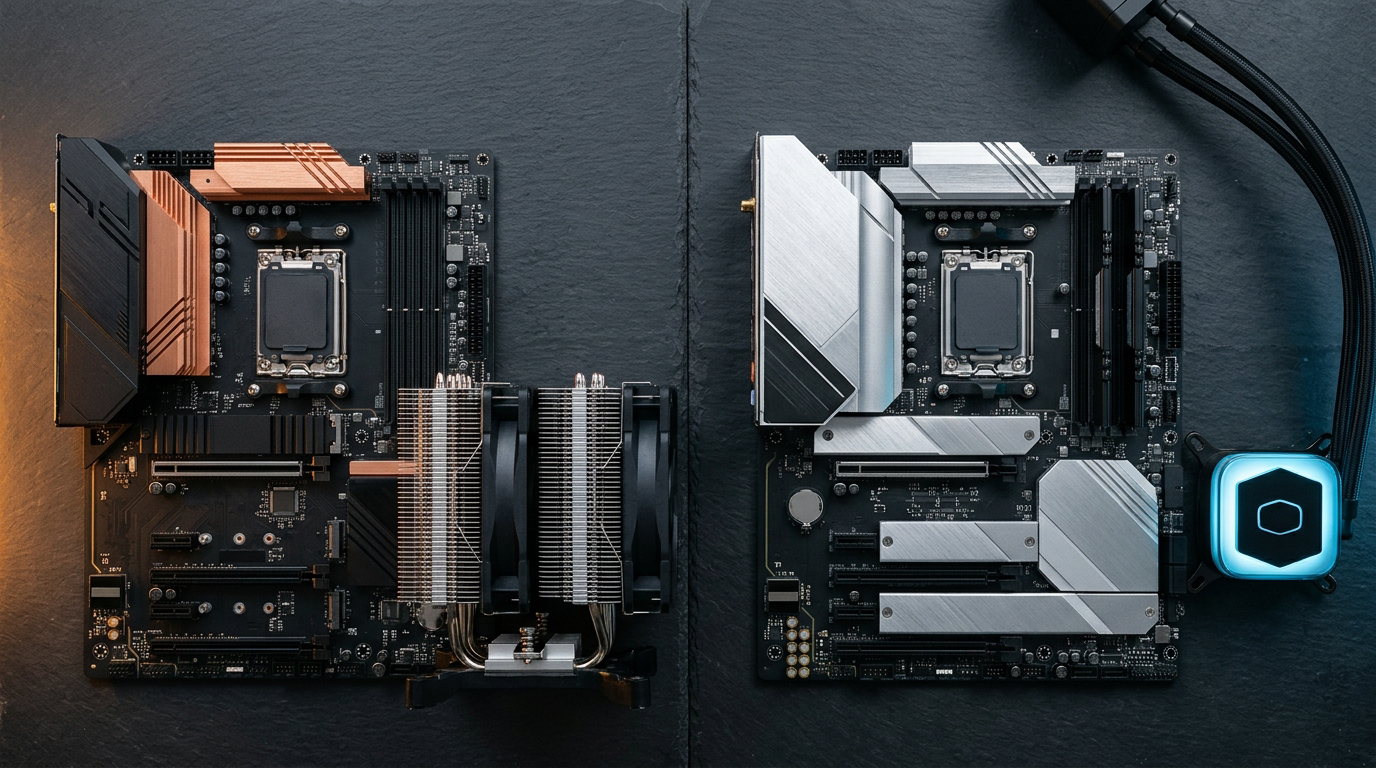
Battleground 1: Gaming Frame Rates, 3D V-Cache & 1% Lows
Before your graphics card shades a single polygon, your processor must calculate game logic, physics states, AI NPC pathfinding, spatial audio queues, and draw calls. When a processor cannot feed draw calls quickly enough, GPU utilization dips below 95%, leaving expensive graphics horsepower sitting idle. That CPU bottleneck appears first in 1% Lows—the painful micro-stutters during heavy team fights, crowded MMO hubs, or sudden map transitions—rather than just peak average framerates.
Here, the AMD Ryzen 7 9800X3D holds a commanding structural advantage thanks to 2nd Gen 3D V-Cache on the Zen 5 architecture. On earlier Ryzen 7000X3D chips like the Ryzen 7 7800X3D, AMD stacked the 64 MB cache SRAM directly on top of the compute cores, creating a thermal blanket that limited voltage and frequency ceilings. With the 9800X3D, AMD flipped the stack: the 64 MB 3D V-Cache sits underneath the Zen 5 CCD, placing the active compute silicon directly against the integrated heat spreader. Combined with 32 MB of base L3 cache and 8 MB of L2 cache for 104 MB total cache, the chip boosts to 5.2 GHz out of the box and unlocks full Precision Boost Overdrive (PBO) and manual multiplier tuning.
Keeping massive game state datasets inside 96 MB of fast on-package L3 cache drastically cuts trips across memory channels, amplifying effective IPC in competitive shooters and simulation engines. Gamers driving 240Hz to 540Hz 1080p or 1440p OLED displays see markedly higher minimum framerates on the 9800X3D. By contrast, Intel’s Core Ultra 7 270K Plus carries 36 MB of Smart Cache L3 paired with 40 MB of L2 cache across its Arrow Lake tile architecture. Separating the compute tile, SoC tile, and I/O tile onto a base interposer introduces cross-tile memory latency penalties that keep Arrow Lake behind AMD X3D processors in pure gaming—even with P-cores boosting to 5.5 GHz.
Resolution scaling still governs how noticeable that lead feels. At 1080p competitive settings or 1440p high-refresh esports, the 9800X3D stretches away clearly. At 4K Ultra with heavy ray tracing or path tracing on cards like the RTX 5080, GPU utilization hits 99%–100% and shifts the bottleneck onto the graphics card, shrinking average framerate differences while leaving the 9800X3D ahead in worst-case 1% Lows. Also watch out for prebuilt traps when shopping AM5: many budget retail towers swap X3D silicon for the OEM-heavy Ryzen 7 8700F, which strips L3 cache down to 16 MB and restricts graphics/storage bandwidth to 16 usable PCIe 4.0 lanes—a massive step down from the 9800X3D’s 96 MB L3 and 24 usable PCIe 5.0 lanes.
Battleground 2: Multi-Core Productivity, Quick Sync & AI Workloads
Flip the script from pure gaming to heavy content creation, and the Intel Core Ultra 7 270K Plus turns its $299 Launch MSRP into a knockout punch. Intel took the complete 24-core die configuration previously reserved for the flagship Core Ultra 9 285K ($589 Launch MSRP)—pairing 8 Performance P-cores with 16 Efficiency E-cores and 76 MB of combined L2+L3 cache—and brought it down to the ~$290–$300 budget tier. Even with Hyper-Threading removed so 24 physical cores equal 24 execution threads, Arrow Lake’s wide out-of-order P-cores and redesigned Skymont E-cores tear through Blender renders, Unreal Engine shader compilation, massive C++ builds, and batch photo exports far faster than an 8-core, 16-thread processor ever can.
Video editors and multi-platform streamers get an extra hardware weapon on Intel’s chiplet package: the integrated Xe media engine featuring Intel Quick Sync, alongside an integrated AI Boost NPU inside the SoC tile. Quick Sync accelerates H.264, HEVC 10-bit 4:2:2, and AV1 timeline scrubbing in Adobe Premiere Pro and DaVinci Resolve independently of your discrete GPU, leaving graphics VRAM free for color grading and heavy effects. Meanwhile, the Ryzen 7 9800X3D includes only a minimal 2-CU Radeon integrated GPU intended strictly for basic display output and hardware troubleshooting.
One critical buyer rule separates smart Intel creator builds from costly mistakes: verify the suffix letter before clicking checkout. While the Core Ultra 7 270K Plus retains its iGPU and Quick Sync hardware, Intel’s F and KF variants (such as the OEM-focused Core Ultra 7 265F or 265KF) disable integrated graphics completely—stripping away Quick Sync acceleration and backup display output. If your workflow depends on video editing, OBS background encoding, and virtual machine multitasking alongside evening gaming sessions, the 270K Plus delivers workstation throughput that forces AMD buyers to step all the way up to a Ryzen 9 9900X3D ($599 Launch MSRP) or Ryzen 9 9950X3D ($699 Launch MSRP).
Battleground 3: Platform Longevity, Chipset Rules & DDR5 Sweet Spots
Processors never operate in isolation; your motherboard socket dictates both day-one I/O features and whether you can drop in a faster CPU three years from now without tearing down your whole rig. Here, the battle between the AM5 socket and LGA 1851 heavily favors AMD. Socket AM5 already spans Ryzen 7000, Ryzen 9000, and future AM5 releases, letting budget-conscious builders enter on an affordable motherboard today and drop in a flagship X3D chip later. By contrast, LGA 1851 reaches the twilight of its socket lifecycle after the Core Ultra 200S Plus refresh, meaning a 270K Plus build offers virtually no meaningful future CPU upgrade path without swapping the motherboard. Dive deeper into socket lifespans in our AMD AM5 vs. Intel LGA 1851 (2026) platform audit.
Chipset rules also create hidden compatibility traps for each platform:
- AM5 Chipset Sweet Spot (AMD B850 vs. X870/X870E): For 95% of Ryzen 7 9800X3D builds, an AMD B850 motherboard ($200–$250 tier) hits the exact balance of mandatory PCIe 5.0 M.2 support, unlocked CPU and PBO tuning, strong 12+2 or 14+2 VRM stages (60A+ DrMOS), and unshared PCIe 5.0 x16 GPU lanes compliant with PCI-SIG PCIe 5.0 standards. Only step up to X870 or X870E if you specifically require dual rear USB4 40Gbps ports—and verify board lane-sharing diagrams from partners like GIGABYTE motherboard specifications so extra M.2 SSDs never slice your primary GPU slot from x16 down to x8. Compare every board tier in our AMD B850 vs. X870 vs. X870E guide.
- LGA 1851 Overclocking Trap (Intel Z890 vs. B860): Pairing an unlocked K-series chip like the Core Ultra 7 270K Plus with a mid-range Intel B860 motherboard ($180–$220 tier) disables CPU multiplier overclocking completely—even though memory overclocking stays active. Builders who want full multiplier control and top VRM headroom must budget for an Intel Z890 motherboard ($240–$280 tier), narrowing Intel’s initial price advantage.
- Memory Controller & DDR5 Tuning Rules: On AM5, target 32GB (2x16GB) DDR5-6000 CL30 with an AMD EXPO profile. That speed locks the Infinity Fabric and memory controller in a
1:1UCLK:MCLK ratio around ~10.0ns latency, whereas pushing above 6400 MT/s drops the controller into a 2:1 divider that can hurt gaming responsiveness. Intel’s Arrow Lake memory controller scales higher, thriving on 32GB (2x16GB) DDR5-6400 CL32 up to DDR5-7200+ MT/s CUDIMM kits with XMP 3.0. On both platforms, strictly run two matching DIMMs—avoid single-stick 1x16GB configurations, loose CL42–CL46 OEM kits, or four-DIMM setups that force clock down-bins and punish 1% Lows.
Battleground 4: Power Efficiency, PPT vs. 250W MTP & Cooling Needs
Looking solely at retail box labels misleads thousands of builders every year. The Ryzen 7 9800X3D advertises a 120W TDP, while the Core Ultra 7 270K Plus lists a 125W TDP—making them appear nearly identical on paper. In real silicon behavior, those numbers represent baseline thermal design power rather than actual peak draw under boost loads.
Under full multi-threaded load, the Ryzen 7 9800X3D caps at 162W Max PPT (Package Power Tracking), and during actual gaming sessions it draws substantially less power while maintaining full boost clocks. Because AMD moved 2nd Gen 3D V-Cache beneath the compute cores, heat transfers cleanly into a modest dual-tower air cooler without fan whine or thermal throttling. Even compact mid-tower mesh chassis stay whisper-quiet during marathon gaming nights.
The Intel Core Ultra 7 270K Plus tells a very different thermal story when pushed hard. Although Arrow Lake’s TSMC N3B node and removal of Hyper-Threading improve gaming efficiency over older 14th Gen Raptor Lake chips, Intel still sets its Max Turbo Power (MTP / PL2) at 250W—just like the Core Ultra 9 285K. When Blender, Premiere exports, or heavy Unreal shader compilation push all 24 cores toward 250W MTP, sizing a cooler for its 125W base label leads straight to thermal throttling against its 105°C Tjmax ceiling. Never pair a 250W MTP processor with a single-fan 120mm AIO or a solid unvented front-glass case; plan on a high-capacity dual-tower air cooler or a 360mm AIO liquid cooler inside a high-airflow mesh or dual-chamber chassis, alongside an ATX 3.1 80+ Gold power supply sized properly for your discrete GPU. Check ASUS Z890 thermal and VRM guidance before finalizing radiator clearance in your chassis.
Battleground 5: Full-Platform TCO & Amazon US Retail Availability
Comparing a $479 Launch MSRP processor against a $299 Launch MSRP processor looks like a clean ~$180 win for Intel—until you add up Total Cost of Ownership (TCO) across motherboard, cooler, memory, and storage. An enthusiast AM5 gaming build pairs the Ryzen 7 9800X3D with a value-packed AMD B850 board ($200–$250 tier), a budget dual-tower air cooler, and affordable DDR5-6000 CL30 RAM. An unlocked LGA 1851 creator-gaming build pairing the 270K Plus with an Intel Z890 board ($240–$280 tier), a 360mm AIO liquid cooler, and faster DDR5-6400/7200 CUDIMM memory claws back a noticeable slice of that headline savings—though Intel still remains cheaper overall if you need 24-core muscle today. Neither build gains gaming FPS from overspending on hot PCIe 5.0 SSDs; put any saved cash toward a 2TB PCIe 4.0 DRAM+TLC NVMe SSD and a stronger GPU tier instead.
Amazon US inventory timing matters just as much in late 2026. Because the Core Ultra 7 270K Plus launched as an Arrow Lake Refresh SKU, verified Amazon stock and pricing fluctuate frequently against its sibling Arrow Lake parts. Always verify three details on Amazon product pages before buying: confirm the Condition filter is locked to New (not Renewed), double-check the exact CPU model and suffix letter inside variant selectors, and ensure your motherboard socket matches (AM5 versus LGA 1851). Below, we showcase four verified, in-stock Amazon US processors representing both sides of this decision: AMD’s Ryzen 7 9800X3D and value-tier Ryzen 7 7800X3D on AM5, alongside Intel’s directly stocked 24-core Core Ultra 9 285K (which shares the identical 24C/24T and 76 MB cache silicon layout as the 270K Plus) and 20-core Core Ultra 7 265K on LGA 1851.
Verified Amazon US Processor Contenders (2026 Catalog)

1. AMD Ryzen 7 9800X3D — Best Overall Pure Gaming CPU
Budget Tier: $479 Launch MSRP (Enthusiast Tier) | Socket: AM5
Verified Specs: Zen 5 (Granite Ridge) + 2nd Gen 3D V-Cache | 8 Cores / 16 Threads (4.7 GHz Base / 5.2 GHz Boost) | 104 MB Total Cache (8 MB L2 + 96 MB L3) | PCIe 5.0 (28 Total / 24 Usable Lanes: x16 GPU + 2×4 NVMe) | 120W TDP / 162W Max PPT | 2-CU Radeon iGPU.
Best For: Competitive 1080p/1440p high-refresh monitors, unmatched 1% Lows stability, quiet air cooling on an AMD B850 motherboard, and long-term AM5 upgrade longevity.

2. Intel Core Ultra 9 285K (Series 2) — Verified 24-Core / 76 MB Arrow Lake Retail Sibling
Budget Tier: $350-$400 tier (Originally $589 Launch MSRP) | Socket: LGA 1851
Verified Specs: Arrow Lake Series 2 | 24 Cores (8P + 16E) / 24 Threads | Up to 5.7 GHz Boost | 76 MB Combined Cache (36 MB Intel Smart Cache L3 + 40 MB L2) | 125W Base TDP / 250W MTP | Integrated Xe iGPU (Quick Sync) + AI Boost NPU.
Best For: While Core Ultra 7 270K Plus retail stock fluctuates, the Core Ultra 9 285K offers the exact same 24-core / 76 MB silicon configuration in verified Amazon stock with an extra 200 MHz peak boost for heavy 4K editing, 3D rendering, and multitasking.

3. Intel Core Ultra 7 265K — Verified Core Ultra 7 LGA 1851 Value Alternative
Budget Tier: $300-$350 tier (Originally $394 Launch MSRP) | Socket: LGA 1851
Verified Specs: Arrow Lake Series 2 | 20 Cores (8P + 12E) / 20 Threads | Up to 5.5 GHz Boost | 66 MB Combined Cache (30 MB Smart Cache L3 + 36 MB L2) | 125W Base TDP / 250W MTP | Integrated iGPU (Quick Sync) + NPU.
Best For: Hybrid creators targeting the $300–$350 tier when the 270K Plus is unavailable at MSRP, keeping full Intel Quick Sync acceleration and unlocked Z890 tuning support.
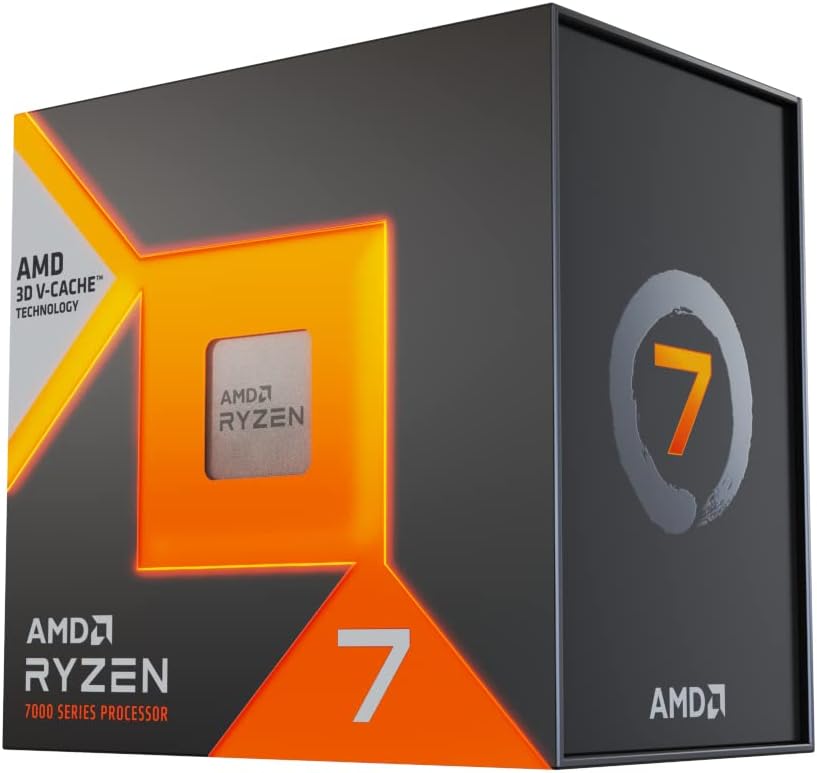
4. AMD Ryzen 7 7800X3D — Value AM5 3D V-Cache Alternative
Budget Tier: Upper-Mid Retail Tier | Socket: AM5
Verified Specs: Zen 4 (Raphael) + 1st Gen 3D V-Cache | 8 Cores / 16 Threads (4.2 GHz Base / 5.0 GHz Boost) | 104 MB Total Cache (8 MB L2 + 96 MB L3) | PCIe 5.0 (28 Total / 24 Usable Lanes) | 120W TDP / 162W Max PPT | 2-CU Radeon iGPU.
Best For: Pure gamers who want 96 MB of 3D V-Cache gaming performance and full Socket AM5 upgrade longevity closer to Intel’s ~$300 price bracket than the flagship 9800X3D.
Decisive Verdict: Which CPU Should You Buy?
The matchup between the Ryzen 7 9800X3D and Intel Core Ultra 7 270K Plus splits cleanly along how you actually use your PC every day. Do not buy 24 cores if you only play games and browse Discord, and do not overpay for 3D V-Cache if batch rendering and 4K Quick Sync exports pay your bills.
Choose AMD Ryzen 7 9800X3D If…
- Your top priority is maximum frame rates and rock-solid 1% Lows at 1080p or 1440p.
- You game on a 240Hz–540Hz OLED or esports display where CPU cache prevents stutter.
- You want quiet, cool operation under a 162W PPT envelope using an affordable dual-tower air cooler.
- You value Socket AM5 upgrade longevity paired with a $200–$250 tier B850 board and DDR5-6000 CL30.
Choose Intel Core Ultra 7 270K Plus (or 24-Core Sibling) If…
- You want flagship-class 24-core (8P + 16E) multi-threaded power near the $299 Launch MSRP (~$290–$300 tier).
- You edit 4K/8K timelines and rely on Intel Quick Sync plus the integrated AI Boost NPU.
- You game mainly at 1440p Ultra or 4K where high-end GPUs saturate near 100% load anyway.
- You already run a 360mm AIO and Z890 board with DDR5-6400+ or CUDIMM memory (or opt for the verified in-stock Core Ultra 9 285K).
How We Audited This Guide
- Processors, motherboards, memory, and storage were compared by socket longevity, chipset lane allocation, VRM design, DDR5 EXPO/XMP support, and PCIe generation.
- Every specification claim was cross-checked against official OEM datasheets, platform vendor documentation, and published industry standards (PCI-SIG, JEDEC, VESA, Intel ATX) rather than marketplace listing copy.
- Recommendations were evaluated against our weighted audit rubric and documented compatibility rules; we do not publish fabricated FPS, thermal, or acoustic numbers.
Frequently Asked Questions
Is the Ryzen 7 9800X3D faster than the Intel Core Ultra 7 270K Plus for gaming?
Yes, the AMD Ryzen 7 9800X3D leads in pure gaming frame rates and 1% Lows at 1080p and 1440p. Its 96 MB L3 cache with 2nd Gen 3D V-Cache feeds Zen 5 cores far faster than Arrow Lake’s tile interconnect and 36 MB Smart Cache.
Why is the Intel Core Ultra 7 270K Plus priced around $299 with 24 cores?
Intel launched the Core Ultra 7 270K Plus on March 26, 2026 at a $299 Launch MSRP to recapture mid-range workstation buyers. It brings full 24-core (8P + 16E) Arrow Lake silicon and 76 MB combined cache down from the flagship $589 Launch MSRP tier.
Which motherboard chipset and RAM speed should I pair with each CPU?
Pair the Ryzen 7 9800X3D with an AMD B850 motherboard and 32GB (2x16GB) DDR5-6000 CL30 memory for optimal 1:1 ratio latency. Pair the Core Ultra 7 270K Plus with an Intel Z890 board for overclocking and DDR5-6400 CL32 or DDR5-7200 CUDIMM memory kits.
Do I need liquid cooling for the Ryzen 7 9800X3D or Core Ultra 7 270K Plus?
The Ryzen 7 9800X3D caps at 162W Max PPT and stays cool with a capable dual-tower air cooler. By contrast, the Core Ultra 7 270K Plus reaches 250W Max Turbo Power (MTP), so creators pushing sustained multi-core rendering should install a 360mm AIO liquid cooler.
Does the Ryzen 7 9800X3D still win at 4K Ultra gaming?
At 4K Ultra with Ray Tracing or Path Tracing, modern graphics cards run near 100% utilization, shrinking average framerate gaps between these processors. However, the Ryzen 7 9800X3D still preserves smoother 1% Lows during heavy traversal scenes, AI simulation spikes, and aggressive DLSS or FSR upscaling.
Related Guides & Platform Deep Dives
- Parent Hub: Best Gaming CPUs (2026): Audited Ryzen 9000X3D vs. Intel Core Ultra 200S — Complete tier rankings across pure gaming, hybrid creation, and budget AM5 chips.
- Socket Showdown: AMD AM5 vs. Intel LGA 1851 (2026): Upgrade Longevity, Platform Cost & Value — Detailed platform lifecycle and DDR5 tuning comparison.
- AM5 Chipset Guide: AMD B850 vs. X870 vs. X870E: Which AM5 Chipset Should Gamers Buy? — Avoid PCIe lane-sharing traps and unnecessary USB4 markups on your Ryzen 7 9800X3D build.


