
Affiliate Disclosure: As an Amazon Associate, The PC Audit earns from qualifying purchases. Every controller specification, NAND flash layer count, IOPS ceiling, endurance figure, and thermal requirement in this comparison is audited directly against official PCI-SIG, Microsoft, Samsung Semiconductor, and Western Digital / SanDisk datasheets without paid placements.
Comparing the samsung 9100 pro vs wd black sn850x forces PC builders to weigh raw interface velocity against real-world gaming value. On paper, Samsung’s flagship Gen 5 drive pushes sequential reads to an astonishing 14,700 MB/s—more than doubling the 7,300 MB/s ceiling of Western Digital’s beloved Gen 4 workhorse—yet switching between them inside modern Windows 11 games produces an exact 0 FPS difference and virtually indistinguishable load screens.
Anchoring our broader best gaming NVMe SSDs hub inside the Processors & Platforms vertical, this head-to-head audit evaluates both 2TB flagships against our 100-point storage rubric: Sustained Random I/O & Load Realities (30%), NAND Flash Type & DRAM Cache (30%), Thermal Control & Heatsink Design (20%), and Endurance (TBW) & Cost per TB (20%).
In This Comparison
- TL;DR Winner Matrix: Quick Verdict
- Side-by-Side Verified Spec Table (2TB Retail Models)
- Battleground 1: Sequential Bandwidth vs. Random 4K IOPS, Real Load Times & DirectStorage (30%)
- Battleground 2: 5nm vs. 8nm Controllers, 3D TLC NAND, Dedicated DRAM Cache & pSLC Behavior (30%)
- Battleground 3: Thermals, Heatsink Fitment & Motherboard PCIe Lane-Sharing Traps (20%)
- Battleground 4: TBW Endurance, Software Suites & Hardware Encryption (20%)
- Battleground 5: Street Pricing Tiers, Cost per TB & System Budget Allocation
- Decisive Verdict: Samsung 9100 PRO vs. WD_BLACK SN850X
- Audited Retail Picks & Platform Pairings on Amazon US
- Frequently Asked Questions
TL;DR Winner Matrix: Quick Verdict
Both drives deliver flagship 3D TLC endurance and dedicated DRAM mapping tables, eliminating the stutter and write-collapse hazards of budget DRAM-less QLC sticks. However, once you separate pure gaming reality from heavy workstation file throughput, distinct category winners emerge immediately.
| Evaluation Category | Declared Winner | Decisive Audit Rationale |
|---|---|---|
| Overall Gaming Sweet Spot & Value | WD_BLACK SN850X (2TB) | Maintains dedicated 2GB DRAM, 112-layer TLC NAND, cool operating thermals, and $130–$170 street pricing—saving $100+ over Gen 5 with zero framerate loss. |
| Peak Sequential Speed & Creator I/O | Samsung 9100 PRO (2TB) | Doubles peak bus speed up to 14,700 MB/s read / 13,400 MB/s write and surges to 2,600K random write IOPS for 8K timelines and massive AI model checkpoints. |
| Game Frame Rates & Real Load Times | Functional Tie (0 FPS Delta) | Storage generation adds 0 FPS; actual Windows game launches separate both drives by roughly 0 to 2 seconds because CPU/GPU asset decompression caps throughput first. |
| Thermals & Heatsink Simplicity | WD_BLACK SN850X (2TB) | Runs comfortably beneath thin factory motherboard M.2 armor without dense Gen 5 heat concentration or cooling-airflow anxiety. |
| Utility Ecosystem & Security | Samsung 9100 PRO (2TB) | Pairs Samsung Magician firmware/cloning utilities with hardware AES-256 and TCG/Opal 2.0 encryption, whereas the SN850X omits Opal hardware encryption. |
Side-by-Side Verified Spec Table (2TB Retail Models)
Every specification below compares the mainstream 2TB bare M.2 2280 models directly—matching the exact retail SKUs verified on Samsung Semiconductor’s 9100 PRO product specification and the official WD_BLACK SN850X datasheet.
| Verified Hardware Specification | Samsung 9100 PRO 2TB (MZ-VAP2T0B/AM) | WD_BLACK SN850X 2TB (WDS200T2X0E) |
|---|---|---|
| Bus Interface & Protocol | PCIe 5.0 x4 / NVMe 2.0 (32.0 GT/s per lane) | PCIe 4.0 x4 / NVMe 1.4 (16.0 GT/s per lane) |
| Form Factor & PCB Layout | M.2 2280 (Single-sided up to 4TB; 8TB double-sided) | M.2 2280 (Single-sided at 1TB/2TB; 4TB/8TB double-sided) |
| Controller Silicon | Samsung 5nm “Presto” (In-house) | Western Digital / SanDisk 8nm 8-Channel (20-82-20035-B2) |
| NAND Flash Architecture | Samsung V8 236-Layer 3D TLC V-NAND | Kioxia/WD 112-Layer BiCS5 3D TLC NAND |
| Dedicated DRAM Cache (2TB) | 2GB LPDDR4X | 2GB DDR4 |
| Max Sequential Read | Up to 14,700 MB/s | Up to 7,300 MB/s |
| Max Sequential Write | Up to 13,400 MB/s | Up to 6,600 MB/s |
| Peak Random 4K IOPS (Read / Write) | 1,850,000 / 2,600,000 IOPS | 1,200,000 / 1,100,000 IOPS |
| Active Operating Power (2TB) | ~8.1W Read / ~7.9W Write (49% perf/watt gain vs. 990 PRO) | ~8.0W Max Operating Power |
| Endurance & Warranty | 1,200 TBW / 5-Year Limited Warranty | 1,200 TBW / 5-Year Limited Warranty |
| Available Capacity Tiers | 1TB, 2TB, 4TB, 8TB | 1TB, 2TB, 4TB, 8TB |
| Software & Security Features | Samsung Magician; AES 256-bit & TCG/Opal 2.0 encryption | WD_BLACK Dashboard (Game Mode 2.0); no Opal hardware encryption |
| Heatsink Options | Bare M.2 or Optional Integrated Heatsink | Bare M.2 or Optional RGB Heatsink |
| 2TB Launch MSRP & 2026 Tier | ~$300 Launch MSRP ($250–$300 Enthusiast Tier) | ~$290 Launch MSRP ($130–$170 Street Value Tier) |
Battleground 1: Sequential Bandwidth vs. Random 4K IOPS, Real Load Times & DirectStorage (30%)
Looking strictly at headline marketing specifications makes the samsung 9100 pro vs wd black sn850x matchup appear lopsided. Compliant with PCI-SIG PCI Express 5.0 specifications, the Samsung 9100 PRO doubles per-lane signaling from 16.0 GT/s to 32.0 GT/s across four lanes (PCIe 5.0 x4), pushing peak sequential reads from 7,300 MB/s on the PCIe 4.0 x4 SN850X up to 14,700 MB/s and sequential writes from 6,600 MB/s up to 13,400 MB/s.
Yet real gaming workloads rarely operate like synthetic sequential copy benchmarks. If you install identical Steam or Epic game folders onto both drives inside a Ryzen 7 9800X3D + RTX 5080 rig, three pipeline constraints compress the real-world gap down to near zero:
- Zero Rendering Impact (0 FPS Delta): Once textures, meshes, and geometry stream into system DDR5 memory and graphics card VRAM, frame rendering happens entirely inside the GPU and CPU cache hierarchy. Neither PCIe 4.0 nor PCIe 5.0 NVMe speed raises average FPS or 1% Lows.
- Shallow Queue-Depth Random 4K IOPS Dominate Launches: Game engines do not stream one continuous 50GB binary file at Queue Depth 32 or Queue Depth 256. Instead, launching Windows and loading open-world zones fires thousands of scattered small-block requests at Queue Depth 1 to 4. While the Samsung 9100 PRO climbs to 1,850K read and 2,600K write peak random 4K IOPS at heavy server-style queues (versus 1,200K / 1,100K on the SN850X), low-queue-depth QD1 random read latency remains tightly bounded by NAND flash page access timing on both drives.
- Decompression & DirectStorage Ceilings: As documented across the Microsoft DirectX Developer Blog, modern studios compress game packages heavily to save download size. Even with DirectStorage routing compressed textures directly from NVMe storage to the GPU for GDeflate or Zstandard hardware decompression, total pipeline consumption saturates smoothly on a fast 7,300 MB/s Gen 4 bus. In practice, loading a 15-to-25-second title separates Gen 5 and Gen 4 by only 0 to 2 seconds—a gap detailed further in our PCIe 5.0 vs. PCIe 4.0 SSD gaming guide.
Where does the Samsung 9100 PRO actually flex its double-bandwidth advantage? Heavy non-gaming throughput: scrubbing multi-stream 8K ProRes or RAW footage, copying 150GB raw project captures across Gen 5 scratch disks, loading multi-gigabyte local AI LLM weights into high-VRAM GPUs, and sustained sequential ingest where 13,400 MB/s write capability halves transfer wait times.
Battleground 2: 5nm vs. 8nm Controllers, 3D TLC NAND, Dedicated DRAM Cache & pSLC Behavior (30%)
Beneath the bus interface, both Samsung and Western Digital engineered true flagship storage topologies—separating both drives decisively from budget NVMe bargains that cut corners inside the PCB.
Controller Silicon & Flash Layering
Samsung builds the 9100 PRO around its vertically integrated 5nm “Presto” controller paired with V8 236-layer 3D TLC V-NAND. Shifting down to a 5nm fabrication node solves the notorious heat and idle power penalty that plagued early 12nm Phison E26 PCIe 5.0 drives (like first-wave Gen 5 flagships that pulled ~11.5W). On the Gen 4 side, the WD_BLACK SN850X pairs Western Digital’s proven 8nm 8-channel controller with 112-layer BiCS5 3D TLC NAND—a mature pairing tuned specifically for sustained low-latency mixed gaming and OS reads.
Dedicated DRAM Cache vs. DRAM-less HMB & Avoiding QLC Write Cliffs
Both 2TB contenders include a full 2GB dedicated DRAM cache right beside the controller (LPDDR4X on the 9100 PRO and DDR4 on the SN850X) to store the Flash Translation Layer (FTL) logical-to-physical block map. That dedicated DRAM matters far more for daily Windows snappiness and heavy game patching than PCIe 5.0 bus marketing. Budget DRAM-less drives rely on HMB (Host Memory Buffer), borrowing a tiny 32MB–64MB slice of system DDR5 over PCIe lanes and suffering higher latency variance when Windows updates, Discord, OBS capture, and a 100GB Steam download collide.
Equally critical, both models exclusively use high-endurance TLC NAND (3 bits per cell) across every capacity from 1TB through 8TB. Cheaper QLC NAND drives pack 4 bits per cell and disguise slow native flash writes behind an aggressive dynamic pSLC cache. Once a massive AAA installation or drive copy exhausts that pSLC buffer—especially once a drive exceeds 70% capacity—a DRAM-less QLC drive suffers a dramatic write cliff, plunging down to 100–200 MB/s. Neither the Samsung 9100 PRO nor the WD_BLACK SN850X suffers from QLC fold-back slowdowns; both maintain brisk post-cache TLC write speeds well above SATA limitations.
PCB Layout & 2TB Capacity Discipline
Notice one clever physical engineering win on the Samsung 9100 PRO: Samsung keeps the M.2 2280 PCB strictly single-sided at 1TB, 2TB, and even 4TB (only stepping to a double-sided layout on the massive 8TB SKU). By contrast, the WD_BLACK SN850X is single-sided at 1TB and 2TB, while its 4TB and 8TB SKUs place flash packages on both sides of the PCB. For standard desktop motherboards, single-sided 2TB drives make single-pad top-side heatsink contact effortless. And regardless of brand, stick to 2TB as the 2026 sweet spot: modern AAA games routinely occupy 100GB–180GB each, and a 2TB drive stores 10 to 15 titles cleanly while maintaining the essential 20% free-space cushion needed for healthy wear-leveling and garbage collection.
Battleground 3: Thermals, Heatsink Fitment & Motherboard PCIe Lane-Sharing Traps (20%)
Thermal behavior and motherboard wiring represent the sharpest practical divider between Gen 5 and Gen 4 ownership. Even though Samsung’s 5nm Presto controller achieves up to a 49% improvement in performance-per-watt compared to Samsung’s older PCIe 4.0 990 PRO—drawing roughly 8.1W during active 2TB sequential reads and 7.9W on writes, remarkably close to the SN850X’s ~8.0W peak rating—Gen 5’s compressed transfer density still pushes controller junction temperatures rapidly upward during multi-minute sustained writes.
- Why Bare Gen 5 Drives Still Demand Armor: If you drop a bare Samsung 9100 PRO into a budget motherboard slot lacking any aluminum spreader and blast sustained 13 GB/s writes, it will eventually hit firmware thermal throttling thresholds to protect NAND retention. Conversely, the WD_BLACK SN850X runs smoothly and coolly beneath thin, everyday motherboard M.2 plates during multi-hour gaming sessions and large downloads.
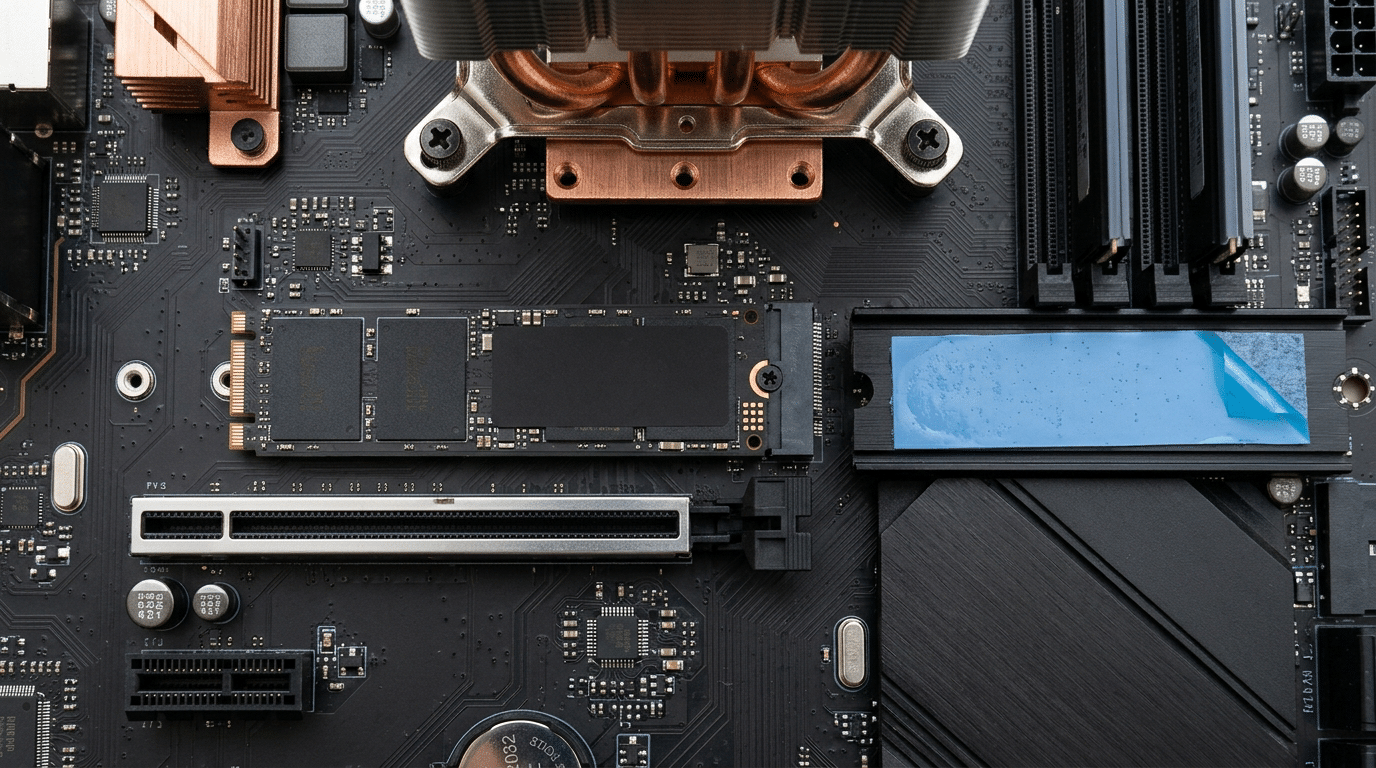
- Avoid the Double-Heatsink Fitment Trap: Both drives sell in bare M.2 2280 editions and factory heatsink editions. Nearly all modern AMD B850, X870, and Intel B860/Z890 motherboards already ship thick aluminum M.2 armor with pre-installed thermal pads on the primary CPU-wired M.2 slot. If your motherboard already includes M.2 armor, buy the bare drive without a pre-installed heatsink, peel the protective plastic off the board’s thermal pad, and lock the motherboard armor flush against the drive. Buying a bulky pre-heatsink SSD when your board has integrated armor either forces you to strip off the board’s matching cover or risks mechanical collision with overhanging dual-tower CPU air coolers and thick RTX 50-series backplates—check exact vertical tolerances in our M.2 SSD heatsink compatibility guide.
- Verify Motherboard PCIe 5.0 M.2 Lane Sharing: Buying a Samsung 9100 PRO accomplishes nothing if you plug it into a chipset-wired PCIe 4.0 x4 slot (which immediately caps the drive at ~7,000 MB/s—SN850X speeds). Worse, several AMD X870 and X870E motherboards wire secondary CPU PCIe 5.0 M.2 slots by splitting lanes away from your primary graphics card slot, dropping your GPU from PCIe 5.0 x16 down to x8. Always read your board’s block diagram—detailed in our PCIe lane sharing guide—or use a clean unshared-lane AMD B850 board such as the GIGABYTE B850 AORUS Elite WIFI7, which keeps your primary CPU PCIe 5.0 M.2 slot active without cutting GPU bandwidth.
Battleground 4: TBW Endurance, Software Suites & Hardware Encryption (20%)
When it comes to long-term write durability, both brands match each other blow for blow. On the 2TB capacities compared here, both the Samsung 9100 PRO and WD_BLACK SN850X carry an identical 1,200 TBW endurance rating backed by a 5-year limited warranty (scaling proportionally to 600 TBW on 1TB models, 2,400 TBW on 4TB models, and 4,800 TBW on 8TB models). Even if a heavy gamer downloads and deletes 100GB of games every single week for five consecutive years, total host writes barely cross ~26 TB—less than 3% of either drive’s 1,200 TBW rating.
Software utilities and security features, however, favor Samsung slightly:
- Samsung Magician vs. WD_BLACK Dashboard: Samsung Magician remains the cleaner all-in-one storage suite for cloning an existing OS drive, validating SMART health, triggering one-click firmware patches, and running secure erase. WD_BLACK Dashboard includes Game Mode 2.0—which adds predictive asset preloading, overhead balancing, and Adaptive Thermal Management when launched alongside games—plus RGB lighting control on heatsink models, though real-world gaming differences with Game Mode 2.0 remain subtle.
- Hardware Encryption Support: If your PC doubles as a workstation handling client media or encrypted BitLocker/Enterprise volumes, note that the Samsung 9100 PRO supports full AES 256-bit hardware encryption and TCG/Opal V2.0, whereas the WD_BLACK SN850X does not support TCG Opal hardware encryption.
Battleground 5: Street Pricing Tiers, Cost per TB & System Budget Allocation
While their historical release MSRPs look deceptively close on paper—roughly $300 Launch MSRP for the 2TB Samsung 9100 PRO bare model versus roughly $290 Launch MSRP when the 2TB WD_BLACK SN850X debuted in 2022—live 2026 street pricing creates a massive gulf in cost per terabyte.
Because PCIe 4.0 production has matured over years of volume manufacturing, the 2TB WD_BLACK SN850X routinely trades inside the $130–$170 street budget tier, whereas the newer PCIe 5.0 Samsung 9100 PRO holds firm in the $250–$300 enthusiast tier. That roughly $100 to $140 gap per 2TB drive triggers our strict system budget allocation rule:
- Rule 1 — Never Buy 1TB Gen 5 Over 2TB Gen 4: Paying enthusiast money for a 1TB Samsung 9100 PRO instead of a 2TB WD_BLACK SN850X cuts your usable game library in half while delivering 0 FPS and identical real game load times.
- Rule 2 — Reinvest Savings Where FPS Actually Scales: On a $1,500 to $2,000 gaming build, keeping $100–$140 out of your SSD budget and funneling it toward a stronger graphics card (stepping from a 12GB RTX 5070 to a 16GB RX 9070 XT or RTX 5070 Ti), upgrading 16GB to 32GB DDR5-6000 CL30 RAM, or stepping from a non-X3D CPU up to an AM5 3D V-Cache chip transforms real frame rates and 1% Lows dramatically.
Decisive Verdict: Samsung 9100 PRO vs. WD_BLACK SN850X
For 90% of PC gamers, the WD_BLACK SN850X 2TB wins effortlessly on value, thermal simplicity, and real-world gaming parity—while the Samsung 9100 PRO 2TB earns its premium specifically on hybrid gaming-and-workstation rigs that move massive sequential assets every day.
Choose Samsung 9100 PRO 2TB (~$300 Launch MSRP) If…
- You regularly transfer 100GB+ 4K/8K ProRes video projects, Unreal Engine builds, or large local AI model weights between high-speed drives.
- Your AM5 B850/X870 or LGA 1851 motherboard has a dedicated CPU-wired PCIe 5.0 x4 M.2 slot with solid aluminum armor and zero GPU x8 lane splitting.
- You value single-sided PCB layouts up to 4TB, 5nm controller efficiency, Samsung Magician utilities, and hardware TCG/Opal 2.0 encryption.
- Your GPU and CPU tiers are already maxed out and you want cutting-edge Gen 5 headroom with no budget compromise.
Choose WD_BLACK SN850X 2TB (~$290 Launch MSRP) If…
- Your desktop is built primarily for gaming, esports, streaming, and everyday productivity where Gen 5 adds 0 FPS and 0–2s load gains.
- You want true flagship 3D TLC + dedicated 2GB DRAM cache reliability in the $130–$170 street tier—nearly half the cost of Gen 5.
- You want to redirect $100+ of savings directly into 4TB of storage capacity, faster DDR5-6000 CL30 RAM, or a higher-tier 16GB GPU.
- You prefer cooler operating temperatures that work cleanly beneath standard motherboard M.2 plates or inside compact airflow cases.
Audited Retail Picks & Platform Pairings on Amazon US
Compare verified Amazon US retail listings for both compared 2TB drives alongside Samsung’s PCIe 4.0 sibling and a clean unshared-lane AM5 B850 motherboard ready for full PCIe 5.0 x4 M.2 speeds.
1. Samsung SSD 9100 PRO 2TB PCIe 5.0×4 M.2 2280 — Best PCIe 5.0 Efficiency Flagship

Budget Tier: Enthusiast ($250–$300 tier; ~$300 Launch MSRP) | Audited Specs: M.2 2280 Single-Sided (MZ-VAP2T0B/AM) | PCIe 5.0 x4 NVMe 2.0 | Samsung 5nm Presto Controller | V8 236-Layer 3D TLC V-NAND | 2GB LPDDR4X DRAM Cache | Up to 14,700 MB/s Read & 13,400 MB/s Write | 1,850K / 2,600K Random 4K IOPS | 1,200 TBW / 5-Year Warranty.
Comparison Audit: Samsung’s 5nm Presto controller transforms PCIe 5.0 power efficiency compared with hot early Gen 5 drives, delivering near-15 GB/s sequential reads and massive 2,600K random write IOPS for heavy 8K creator workflows and AI asset staging. Seat this bare SKU beneath your motherboard’s integrated M.2 armor for clean sustained cooling.
Pros: Leading 14,700 MB/s sequential read throughput; 5nm Presto controller cuts thermal strain versus 12nm Gen 5 rivals; single-sided PCB up to 4TB; AES-256 / TCG Opal 2.0 and Samsung Magician support.
Cons: Enthusiast pricing yields 0 FPS and negligible load-time advantage over Gen 4 in PC gaming; still requires proper motherboard M.2 heatsink contact under sustained writes.
2. WD_BLACK 2TB SN850X NVMe SSD — Best Overall Gaming Sweet Spot

Budget Tier: High-Value Sweet Spot ($130–$170 tier; ~$290 Launch MSRP) | Audited Specs: M.2 2280 Single-Sided (WDS200T2X0E) | PCIe 4.0 x4 NVMe 1.4 | WD 8nm 8-Channel Controller | 112-Layer BiCS5 3D TLC NAND | 2GB DDR4 DRAM Cache | Up to 7,300 MB/s Read & 6,600 MB/s Write | 1,200K / 1,100K Random 4K IOPS | 1,200 TBW / 5-Year Warranty.
Comparison Audit: The WD_BLACK SN850X 2TB delivers every technical trait that actually improves daily Windows and gaming responsiveness—true 3D TLC NAND, dedicated 2GB DRAM cache, 1,200 TBW endurance, and cool ~8W operating thermals—at a fraction of Gen 5 cost. For pure gaming builds, it renders paying extra for PCIe 5.0 unnecessary.
Pros: Unbeatable cost per TB among true DRAM + TLC drives; identical real-world game load speeds and DirectStorage behavior to Gen 5; runs cool beneath stock motherboard armor; WD_BLACK Dashboard Game Mode 2.0.
Cons: Sequential transfers cap at Gen 4 7,300 MB/s; lacks hardware TCG Opal encryption; 4TB/8TB variants switch to double-sided PCBs.
3. Samsung SSD 990 PRO 2TB PCIe 4.0 M.2 2280 — Best Samsung Ecosystem Gen 4 Alternative

Budget Tier: Upper-Mid Gen 4 ($150–$190 tier) | Audited Specs: M.2 2280 (MZ-V9P2T0B/AM) | PCIe 4.0 x4 NVMe 2.0 | In-House 8nm Controller | Samsung V-NAND 3D TLC | 2GB LPDDR4 DRAM Cache | Up to 7,450 MB/s Read & 6,900 MB/s Write | 1,400K / 1,550K Random 4K IOPS | 1,200 TBW / 5-Year Warranty.
Comparison Audit: If you specifically want Samsung Magician utilities, AES-256 / TCG Opal 2.0 encryption, and slightly higher Gen 4 random IOPS than the SN850X without jumping into 9100 PRO Gen 5 pricing, the 990 PRO sits squarely between them when promotions drop near the SN850X tier.
Pros: Leading Gen 4 1,400K/1,550K random IOPS; cool power efficiency; full Samsung Magician and hardware encryption suite.
Cons: Often commands a slight street premium over the WD_BLACK SN850X with zero practical game-loading separation.
4. GIGABYTE B850 AORUS Elite WIFI7 — Recommended Unshared-Lane Gen 5 M.2 Motherboard

Budget Tier: $200–$250 tier (~$230 Launch MSRP) | Audited Specs: ATX Socket AM5 (AMD B850) | 14+2+2 Digital Twin VRM (60A DrMOS) | 1x PCIe 5.0 x16 GPU Slot | 3x M.2 (1x CPU PCIe 5.0 x4 + 2x PCIe 4.0 x4) | Zero GPU x8 Lane Sharing | Wi-Fi 7 + 2.5GbE LAN | Tool-less EZ-Latch Click M.2 Heatsinks.
Comparison Audit: Unlocking the Samsung 9100 PRO’s full 14,700 MB/s bandwidth requires a true CPU-wired PCIe 5.0 x4 M.2 slot with solid thermal mass—without sacrificing GPU lanes. Unlike lane-splitting X870 designs, this B850 board runs a dedicated Gen 5 M.2 slot under tool-less armor alongside a full unshared PCIe 5.0 x16 graphics slot.
Pros: Zero GPU x8 lane-sharing penalty across all three M.2 sockets; sturdy tool-less EZ-Latch Click M.2 armor cools Gen 5 drives cleanly; strong 14+2+2 VRM and Wi-Fi 7.
Cons: Omits rear 40Gbps USB4 ports (supplies 20Gbps front USB-C header and 10Gbps rear USB-C instead).
How We Audited This Guide
- Processors, motherboards, memory, and storage were compared by socket longevity, chipset lane allocation, VRM design, DDR5 EXPO/XMP support, and PCIe generation.
- Every specification claim was cross-checked against official OEM datasheets, platform vendor documentation, and published industry standards (PCI-SIG, JEDEC, VESA, Intel ATX) rather than marketplace listing copy.
- Recommendations were evaluated against our weighted audit rubric and documented compatibility rules; we do not publish fabricated FPS, thermal, or acoustic numbers.
Frequently Asked Questions
Does the Samsung 9100 PRO give higher gaming FPS than the WD_BLACK SN850X?
No. Both NVMe SSDs deliver 0 FPS difference in gaming. Frame rates depend on GPU compute, VRAM capacity, and CPU cache once game assets reside in memory, while real-world level load times between 14,700 MB/s Gen 5 and 7,300 MB/s Gen 4 typically differ by just 0 to 2 seconds.
Will the Samsung 9100 PRO work in a PCIe 4.0 motherboard M.2 slot?
Yes. PCIe 5.0 x4 NVMe drives are backward compatible with PCIe 4.0 x4 and PCIe 3.0 x4 M.2 2280 slots. However, installing the 9100 PRO into a Gen 4 slot caps sequential throughput around 7,000–7,450 MB/s, removing its speed advantage over the far cheaper WD_BLACK SN850X.
Should I buy the bare drive or heatsink version of the 9100 PRO or SN850X?
Buy the bare drive if your motherboard includes built-in aluminum M.2 heatsinks with thermal pads, and remember to peel the protective pad film before tightening the armor. Choose the factory heatsink edition only for uncooled secondary M.2 slots or PlayStation 5 expansion bays after verifying cooler clearance.
How do endurance and DRAM cache compare between the 9100 PRO and SN850X?
At the 2TB capacity point, both drives match cleanly: each integrates a dedicated 2GB DRAM cache (LPDDR4X on the 9100 PRO vs. DDR4 on the SN850X), 3D TLC NAND flash rather than QLC, a 1,200 TBW endurance rating, and a 5-year limited manufacturer warranty.
Which SSD gives better overall value for a 2026 custom gaming PC?
The WD_BLACK SN850X 2TB delivers superior value for virtually all pure gaming rigs. Sitting in the $130–$170 street tier with DRAM, TLC NAND, and cool thermals, it saves $100+ over the Samsung 9100 PRO that is far better invested into a higher GPU or CPU tier.
Official Standards & Technical References
- Samsung Semiconductor 9100 PRO Technical Specifications: semiconductor.samsung.com/consumer-storage/internal-ssd/9100-pro/
- SanDisk / WD_BLACK SN850X NVMe SSD Datasheet: shop.sandisk.com/products/ssd/internal-ssd/wd-black-sn850x-nvme-ssd
- PCI-SIG PCI Express 4.0 & 5.0 Bus Specifications: pcisig.com/specifications/pciexpress
- Microsoft DirectStorage Developer Documentation: devblogs.microsoft.com/directx/
- GIGABYTE B850 AORUS Elite WIFI7 Block Specifications: gigabyte.com/Motherboard/B850-AORUS-ELITE-WIFI7
Continue planning your storage and motherboard foundation across our best gaming NVMe SSDs hub, deep-dive PCIe 5.0 vs. PCIe 4.0 SSD gaming analysis, M.2 SSD heatsink fitment guide, motherboard PCIe lane-sharing explainer, and the full Processors & Platforms archive.


