
Disclosure: As an Amazon Associate, The PC Audit earns from qualifying purchases. If you buy through links on this page, we may earn a small commission at no extra cost to you.
Settling the rx 9060 xt 16gb vs rtx 5060 ti 16gb matchup confronts mainstream PC builders with an $80 Launch MSRP gap between two 16GB graphics cards targeting the exact same 1080p Ultra and entry 1440p market. AMD launches the RDNA 4 Radeon RX 9060 XT 16GB at $349 Launch MSRP with full PCIe 5.0 x16 lane routing, 160W board power, and 32MB of Infinity Cache. NVIDIA prices the Blackwell GeForce RTX 5060 Ti 16GB higher at $429 Launch MSRP, answering with faster 28 Gbps GDDR7 memory, stronger 4th-Generation ray tracing silicon, 9th-Gen NVENC encoding, and DLSS 4 Multi-Frame Generation.
Within our broader hierarchy of the best graphics cards for gaming and our best 1440p graphics cards roundup, both 16GB cards anchor Tier B—delivering far cleaner multi-year longevity than their compromised 8GB siblings covered in our RTX 5060 Ti 8GB vs. 16GB audit. Rather than extrapolating from marketing slides or unreleased refresh rumors, this comparison evaluates both GPUs strictly against our 100-point GPU rubric: Rasterization & Ray Tracing Tier (35%), VRAM Capacity & Memory Bus (25%), Upscaling, Frame Gen & Media Engine (20%), and Thermals, Acoustics & Power Spec (20%).
In This Comparison
- TL;DR Winner Matrix: Quick Verdict
- Side-by-Side Verified Spec Table
- Battleground 1: $80 Price Gap, Rasterization & Ray Tracing Tier (35%)
- Battleground 2: 128-Bit GDDR6 + Infinity Cache vs. 28 Gbps GDDR7 (25%)
- Battleground 3: PCIe 5.0 x16 vs. PCIe 5.0 x8 — The Hidden Platform Trap
- Battleground 4: DLSS 4 Multi-Frame Gen vs. AMD FSR 4 & Media Engines (20%)
- Battleground 5: 160W vs. 180W Power, SFF Clearance & DisplayPort 2.1 (20%)
- Market Context: Budget Alternatives, $549 Step-Ups & Platform Pairing
- Decisive Verdict: Which 16GB Mid-Range GPU Should You Buy?
- Audited Retail Models on Amazon US
- Frequently Asked Questions
TL;DR Winner Matrix: Quick Verdict
Both GPUs solve the single biggest failure point in sub-$450 graphics cards by shipping 16GB of video memory. Choosing between them depends on whether you prioritize pure rasterization value per dollar at $349 Launch MSRP or heavy ray tracing, DLSS 4 neural rendering, and 9th-Gen NVENC creator features at $429 Launch MSRP. Here is the clear winner across every audit category.
| Evaluation Category | Declared Winner | Decisive Technical Reason |
|---|---|---|
| Overall Value Winner | AMD Radeon RX 9060 XT 16GB | Undercuts the RTX 5060 Ti 16GB by $80 at Launch MSRP ($349 vs. $429) while matching its 16GB buffer, running 20W cooler, and retaining full PCIe 5.0 x16 lanes. |
| Raw Raster Value per Dollar | AMD Radeon RX 9060 XT 16GB | Pairs 32 RDNA 4 Compute Units, 64 ROPs, and up to 3,130 MHz reference boost clocks (3,320 MHz OC) with 32MB Infinity Cache at $349 Launch MSRP. |
| Ray Tracing, AI & Memory Bandwidth | NVIDIA GeForce RTX 5060 Ti 16GB | Pairs 4th-Gen RT Cores (72 TFLOPS), 5th-Gen Tensor Cores (759 AI TOPS), and 448 GB/s 28 Gbps GDDR7 (+40% raw bandwidth over GDDR6) with Transformer DLSS 4 Multi-Frame Generation. |
| Legacy Platform & Power Simplicity | AMD Radeon RX 9060 XT 16GB | Full PCIe 5.0 x16 routing avoids half-width x8 slowdowns on older PCIe 3.0 boards, paired with a lower 160W TBP and 450W minimum PSU spec. |
| Creator Video & Compact SFF Fit | NVIDIA GeForce RTX 5060 Ti 16GB | 9th-Gen NVENC introduces 10-bit 4:2:2 hardware acceleration plus dual-fan 229mm cards like the ASUS Dual OC drop into tight Mini-ITX builds. |
Side-by-Side Verified Spec Table
Raw shader counts never translate directly between competing GPU architectures: 2,048 AMD RDNA 4 Stream Processors execute waves differently from 4,608 NVIDIA Blackwell CUDA Cores. Evaluate verified silicon capabilities side by side—specifically memory bandwidth, cache size, PCIe lane count, board power, display I/O, and official Launch MSRP.
| Specification | AMD Radeon RX 9060 XT (16GB) | NVIDIA GeForce RTX 5060 Ti (16GB) |
|---|---|---|
| Architecture & Node | AMD RDNA 4 (Navi 44, TSMC 4nm) | NVIDIA Blackwell (GB206) |
| Release Date | June 5, 2025 | April 16, 2025 |
| Launch MSRP | $349 | $429 |
| Compute Silicon | 32 Compute Units (2,048 SP) / 32 3rd-Gen Ray Accelerators / 64 2nd-Gen AI Accelerators / 64 ROPs | 4,608 CUDA Cores / 4th-Gen RT Cores (72 TFLOPS) / 5th-Gen Tensor Cores (759 AI TOPS) / 48 ROPs |
| Reference Clock Speeds | 2,530 MHz Game / Up to 3,130 MHz Boost | 2,407 MHz Base / 2,572 MHz Boost |
| VRAM Capacity & Type | 16GB GDDR6 (up to 20 Gbps) | 16GB GDDR7 (28 Gbps) |
| Memory Bus & Bandwidth | 128-bit / up to 320 GB/s + 32MB 3rd-Gen Infinity Cache | 128-bit / 448 GB/s |
| Host PCIe Interface | PCIe 5.0 x16 (Full 16 lanes) | PCIe 5.0 x8 (8 electrical lanes) |
| Total Board Power (TBP / TDP) | 160W | 180W |
| Power Header Standard | 1x 8-pin PCIe | 1x 8-pin PCIe or 16-pin 12V-2×6 (model dependent; 1x 8-pin on ASUS Dual OC) |
| Minimum / Recommended PSU | 450W minimum (550W–650W ATX 3.1 / 80+ Gold advised) | 600W reference min (550W–650W ATX 3.1 / 80+ Gold advised) |
| Upscaling & Latency Pipeline | AMD FSR 4 (ML) + Frame Gen + Anti-Lag 2 | DLSS 4 + Multi-Frame Generation + Reflex / Reflex 2 |
| Display I/O Standards | DisplayPort 2.1a + HDMI 2.1b | DisplayPort 2.1b UHBR20 (80 Gbps) + HDMI 2.1b |
| Media / Encode Engine | AMD VCN (Hardware H.264, HEVC, AV1) | 9th-Gen NVENC (AV1 + 10-bit 4:2:2) |
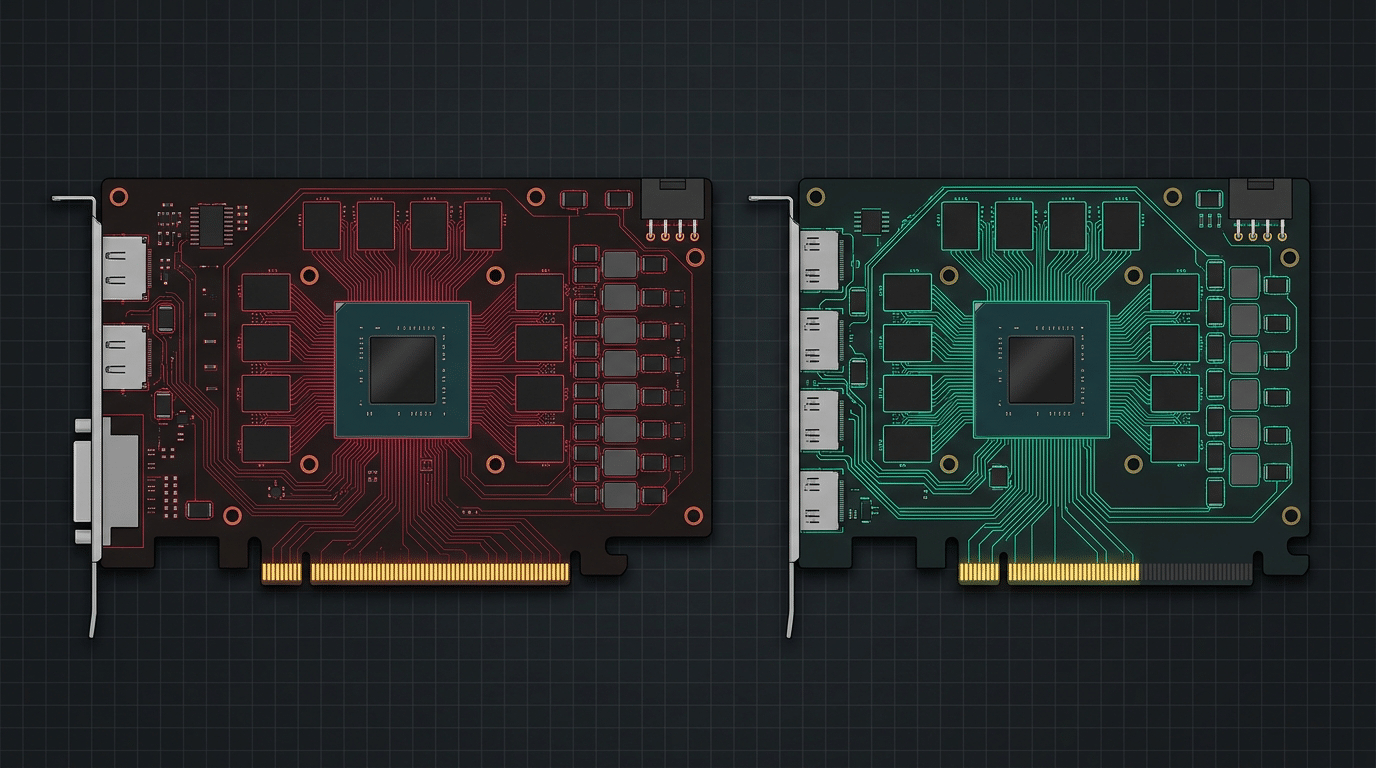
Battleground 1: $80 Price Gap, Rasterization & Ray Tracing Tier (35%)
Before dissecting silicon blocks, look at the $80 Launch MSRP spread separating $349 from $429. In a $900 to $1,250 desktop gaming build—where the graphics card typically represents 35% to 45% of total component cost—an extra $80 shifts a system from a 1TB NVMe drive to a 2TB PCIe 4.0 DRAM+TLC drive, upgrades a stock CPU cooler to a dual-tower unit, or covers the jump from an entry CPU up to a Ryzen 5 9600X on an AMD B850 motherboard. That means the GeForce RTX 5060 Ti 16GB does not merely need to match the Radeon RX 9060 XT 16GB; it must justify paying nearly 23% more at Launch MSRP.
In native DirectX 12 and Vulkan rasterization, AMD built Radeon RX 9000-series RDNA 4 silicon specifically to maximize raster throughput per dollar. The Navi 44 die inside the RX 9060 XT 16GB activates 32 Compute Units (2,048 Stream Processors), 64 Render Output Units (ROPs), and aggressive clock scaling up to 3,130 MHz reference boost—reaching up to 3,320 MHz on partner models such as the XFX Swift OC Triple Fan. Those 64 ROPs (compared against 48 ROPs on the RTX 5060 Ti) give AMD strong pixel fill-rate efficiency across 1080p Ultra competitive shooters, open-world RPGs, and rasterized Unreal Engine 5 titles. For price-sensitive builders comparing sub-$350 contenders like the Intel Arc B580 12GB ($249 Launch MSRP), check our best budget graphics cards under $350 guide to see how far $349 stretches rasterization headroom.
Once lighting pipelines shift toward heavy hardware ray tracing, global illumination, or path tracing, NVIDIA Blackwell GeForce RTX 50-series architecture reclaims the upper hand. With 4,608 CUDA Cores, 4th-Generation RT Cores rated at 72 TFLOPS, and 5th-Generation Tensor Cores delivering 759 AI TOPS, the RTX 5060 Ti 16GB handles dense ray-triangle intersections and denoising workloads with greater throughput headroom than AMD’s 32 3rd-Gen Ray Accelerators. AMD closed substantial ground in lighter hybrid ray-traced games with RDNA 4 compared to earlier Radeon generations, yet Blackwell remains decisively ahead when ray-traced reflections and shadow cascades stack simultaneously.
Battleground 2: 128-Bit GDDR6 + Infinity Cache vs. 28 Gbps GDDR7 (25%)
Both GPUs share two vital traits on paper: 16GB of total VRAM and a narrow 128-bit memory bus. Yet the way each vendor feeds shader cores across that 128-bit interface marks a major engineering divide—and explains why neither 16GB card should ever be confused with its 8GB namesake.
- NVIDIA GeForce RTX 5060 Ti 16GB (128-bit GDDR7): By adopting cutting-edge 28 Gbps GDDR7 memory chips, NVIDIA pushes 448 GB/s of raw off-chip memory bandwidth through a compact 128-bit controller—40% more raw external bandwidth than reference 20 Gbps GDDR6. That extra raw throughput pays dividends at 1440p Ultra, during heavy ray-tracing BVH traversals, and inside local AI inference where large models cannot stay resident inside small on-die L2 caches.
- AMD Radeon RX 9060 XT 16GB (128-bit GDDR6 + 32MB Infinity Cache): AMD relies on mature, cost-effective 20 Gbps GDDR6 delivering up to 320 GB/s reference bandwidth (with factory-tuned cards like XFX Swift OC citing 340 GB/s class memory spec), then embeds 32MB of 3rd-Gen Infinity Cache directly on the silicon die. Keeping hot framebuffers, shadow maps, and depth buffers inside low-latency Infinity Cache relieves external GDDR6 traffic at 1080p and 1440p—enabling AMD to hit the $349 Launch MSRP without paying early GDDR7 component premiums.
Crucially, both cards provide the full 16GB VRAM capacity that our 2026 VRAM sizing guide identifies as the golden standard for 2026–2029 longevity. Why is 16GB non-negotiable in the $350 to $430 bracket? Whenever an 8GB card—like the $379 Launch MSRP RTX 5060 Ti 8GB or $299 Launch MSRP RX 9060 XT 8GB—hits a VRAM bottleneck under Unreal Engine 5 Ultra texture packs or Frame Generation buffers, drivers spill assets across the PCIe bus into much slower system DDR5 RAM. Average FPS occasionally conceals the damage, while 1% Lows crater into jagged camera stutters and smeared low-resolution textures. Under our GPU audit rules, spending over $350 on any 8GB graphics card is a structural dead end; verify why in our RTX 5060 Ti 8GB vs. 16GB breakdown.
Battleground 3: PCIe 5.0 x16 vs. PCIe 5.0 x8 — The Hidden Platform Trap
Most mainstream spec sheets bury the host interface row at the bottom, yet the rx 9060 xt 16gb vs rtx 5060 ti 16gb comparison exposes a major physical compatibility difference for anyone upgrading an older desktop PC.
AMD wires the Radeon RX 9060 XT 16GB with a full PCIe 5.0 x16 electrical interface. NVIDIA wires the GeForce RTX 5060 Ti 16GB (both 8GB and 16GB versions) with a half-width PCIe 5.0 x8 interface. On modern PCIe 5.0 or PCIe 4.0 motherboards—such as an AMD B850, X870, or Intel B860/Z890 platform—8 lanes of PCIe 4.0 or 5.0 carry ample bidirectional bandwidth, especially when 16GB of onboard VRAM keeps texture paging minimal.
However, consider drop-in upgraders running older PCIe 3.0 motherboards (such as B450 AM4 boards, older Intel 10th-Gen systems, or budget office towers) or PCIe-lane-restricted OEM chips like the Ryzen 7 8700F (limited to 16 usable PCIe 4.0 lanes and 16MB L3 cache). On a PCIe 3.0 motherboard, an x8 GPU negotiates only PCIe 3.0 x8—cutting available host bandwidth to half of PCIe 3.0 x16. While 16GB VRAM shields the RTX 5060 Ti 16GB from the worst asset-streaming collapses seen on 8GB x8 cards, the RX 9060 XT 16GB preserves full x16 electrical width across PCIe 3.0, 4.0, and 5.0 platforms alike.
Whichever card you install, always enter BIOS immediately afterward to verify Resizable BAR (and Above 4G Decoding) is enabled so the CPU addresses the entire 16GB memory pool cleanly rather than legacy 256MB windows. Also double-check your motherboard’s manual before populating secondary M.2 NVMe slots so storage lanes never steal electrical lanes from your primary graphics slot.
Battleground 4: DLSS 4 Multi-Frame Gen vs. AMD FSR 4 & Media Engines (20%)
At $349 to $429, neither mid-range GPU pushes native 1440p Ultra ray tracing to 144Hz without smart temporal reconstruction. For a deep pixel-by-pixel breakdown across NVIDIA, AMD, and Intel XeSS 2 on Battlemage, explore our DLSS 4 Multi-Frame Gen vs. AMD FSR 4 vs. XeSS 2 guide.
On the RTX 5060 Ti 16GB, NVIDIA brings Transformer-based DLSS 4 upscaling alongside Blackwell-exclusive DLSS 4 Multi-Frame Generation powered by 759 AI TOPS on 5th-Gen Tensor Cores. Shifting from legacy convolutional networks to Transformer models substantially reduces shimmer on thin geometry—chain-link fences, power cables, distant foliage, and volumetric particles—while preserving crisp motion stability. Multi-Frame Generation can multiply frame pacing toward 180Hz–240Hz display ceilings when native throughput is already robust, and native AAA game integration remains widest across GeForce.
AMD answers forcefully on RDNA 4 with AMD FSR 4. Utilizing 64 dedicated 2nd-Gen AI Accelerators on the RX 9060 XT 16GB, FSR 4 leaves FSR 3’s shader-only temporal heuristics behind in favor of true machine-learning upscaling. Fine edge stability, temporal disocclusion cleanup, and sub-pixel clarity jump dramatically closer to DLSS quality, backed by driver-level FSR 4 upgrades in supported FSR 3.1 titles. Still, native title count trails DLSS 4, and AMD’s Frame Generation interpolates single intermediate frames rather than NVIDIA’s multi-frame multiplier.
Both camps require strict expectations around frame interpolation: never treat 120 generated frames per second as equivalent to 120 native FPS. Frame Generation smooths visual motion between rendered frames without speeding up game logic or mouse responsiveness. Always follow our 50–60 base FPS baseline rule—avoid activating Frame Generation or DLSS 4 MFG when native frame rates fall below 45–50 FPS, or controls feel sluggish and UI warping surfaces. Dial upscaling quality first until base FPS clears 55–60+, and always pair Frame Gen with NVIDIA Reflex / Reflex 2 on GeForce or AMD Anti-Lag 2 on Radeon.
For hybrid gamers who edit video, stream on OBS, or run local AI image/LLM pipelines, the RTX 5060 Ti 16GB earns much of its $80 premium outside gaming. NVIDIA’s 9th-Gen NVENC media engine supports hardware AV1 alongside hardware 10-bit 4:2:2 decoding and encoding prized in Adobe Premiere Pro and DaVinci Resolve, while CUDA and 16GB GDDR7 bandwidth offer broad local AI software compatibility. AMD’s upgraded VCN media engine handles crisp AV1, HEVC, and H.264 game streaming cleanly for Twitch and YouTube creators, though CUDA-exclusive productivity workflows still favor GeForce.
Battleground 5: 160W vs. 180W Power, SFF Clearance & DisplayPort 2.1 (20%)
Both mid-range 16GB cards sit well below the thermal and electrical demands of 300W+ 1440p/4K flagships, making them effortless upgrades for modest mid-towers and existing power supplies—provided you verify exact partner board dimensions and power connectors.
- Power Draw & Connectors (160W vs. 180W): AMD rates the RX 9060 XT 16GB at 160W TBP with a 450W minimum PSU requirement and a single traditional 1x 8-pin PCIe power connector across retail cards like the XFX Swift OC. NVIDIA rates the RTX 5060 Ti 16GB slightly higher at 180W TBP with a 600W reference system recommendation (550W–650W advised on cards like the ASUS Dual OC). Most 180W partner cards—including the ASUS Dual OC—keep a simple 1x 8-pin PCIe plug, though select factory-OC AIB designs use a 16-pin 12V-2×6 connector defined under PCI-SIG CEM 5.1. If your chosen AIB uses 12V-2×6, leave at least 35mm of side-panel bend clearance, and for any new build choose a 650W ATX 3.1 / PCIe 5.1 80+ Gold PSU so 2x–3x millisecond transient power excursions never trip legacy over-current protection.
- Cooler Sizing & Case Fit: Partner engineering varies sharply. The XFX Swift RX 9060 XT OC stretches 290 x 124 x 49 mm across a dual-slot triple-fan cooler, dissipating 160W effortlessly at low fan RPMs inside standard ATX or micro-ATX mesh cases. By contrast, the ASUS Dual RTX 5060 Ti 16GB OC measures just 229 x 120 x 50 mm (2.5-slot dual Axial-Tech fans), slipping easily into ultra-compact Mini-ITX enclosures where 290mm+ cards collide with front radiators. On both cards, keep Zero-RPM fan stop active for silent desktop browsing and set a global driver frame-rate limiter in menus to prevent high-FPS coil whine.
- Display Connectivity (DisplayPort 2.1): NVIDIA provides DisplayPort 2.1b UHBR20 (up to 80 Gbps over DP80 cabling) plus HDMI 2.1b—supporting uncompressed signaling on next-generation 4K 240Hz or 1440p 360Hz+ OLED panels without relying on Display Stream Compression (DSC). AMD equips the RX 9060 XT with DisplayPort 2.1a and HDMI 2.1b, driving high-refresh 1080p and 1440p OLEDs cleanly while engaging visually lossless DSC at extreme bandwidth modes.
Market Context: Budget Alternatives, $549 Step-Ups & Platform Pairing
Smart buyers also check the tiers immediately below and above $349–$429 before pulling the trigger. If $349 stretches your build too far, skip $299 8GB compromises for long-term AAA texture quality and compare the $249 Launch MSRP Intel Arc B580 (12GB) (Xe2 Battlemage, 192-bit bus, 456 GB/s, 190W TBP, XeSS 2, AV1 hardware encode)—just confirm your motherboard supports Resizable BAR. Conversely, if retail street pricing pushes a partner RTX 5060 Ti 16GB close to $480–$500 while a $549 Launch MSRP Radeon RX 9070 (16GB) (56 CUs, 256-bit bus, 220W) or RTX 5070 (12GB) sits within striking distance, stepping up into Tier A unlocks substantially stronger 1440p Ultra throughput.
Rumor Status Warning (November 2026): Do not stall a mid-range purchase waiting for unannounced NVIDIA refresh rumors such as the rumored RTX 5070 Super (18GB GDDR7, 192-bit) or RTX 5080 Super (24GB GDDR7). Both cards remain strictly unreleased and unconfirmed as of November 2026 (widely linked to late 2026 or Q1 2027 memory allocation windows) and would sit well above the $349–$429 price bracket anyway.
To keep CPU draw calls and memory latency from hurting 1% Lows on either 16GB card, pair custom desktop builds with an AMD Ryzen 5 9600X (or Ryzen 7 7800X3D/9800X3D for high-refresh esports) on an AMD B850 motherboard running 32GB (2x16GB) DDR5-6000 CL30 in dual-channel 1:1 mode, paired with a 1TB–2TB PCIe 4.0 DRAM+TLC NVMe SSD and a 650W ATX 3.1 80+ Gold power supply. If buying a prebuilt desktop with either GPU, reject systems shipping single-stick 1x16GB DDR5-4800 memory, Wi-Fi 5 downgrades, or unlisted PSU ratings.
Decisive Verdict: Which 16GB Mid-Range GPU Should You Buy?
For the vast majority of 1080p Ultra and 1440p gamers, the AMD Radeon RX 9060 XT 16GB wins the value audit decisively at $349 Launch MSRP: it delivers full 16GB longevity, cooler 160W operation, ML-powered FSR 4, and full PCIe 5.0 x16 compatibility for $80 less. Choose the NVIDIA GeForce RTX 5060 Ti 16GB at $429 Launch MSRP only when your workload specifically leverages heavy ray tracing, DLSS 4 Multi-Frame Generation, 9th-Gen NVENC 10-bit 4:2:2 video editing, local CUDA AI models, or ultra-compact 229mm Mini-ITX clearance.
Choose AMD Radeon RX 9060 XT 16GB ($349 Launch MSRP) If…
- You want maximum 16GB rasterization FPS per dollar at $349 Launch MSRP without paying an $80 premium.
- You are upgrading an older PCIe 3.0 system or lane-limited CPU that benefits from full PCIe 5.0 x16 routing.
- You want cooler 160W board power, a 450W minimum PSU spec, and a single 8-pin PCIe plug.
- You want ML-accelerated AMD FSR 4 and silent triple-fan cooling in a standard mid-tower case.
Choose NVIDIA GeForce RTX 5060 Ti 16GB ($429 Launch MSRP) If…
- You prioritize heavy ray tracing, Transformer DLSS 4 upscaling, and Multi-Frame Generation.
- You edit 10-bit 4:2:2 video on 9th-Gen NVENC or run CUDA and local AI workloads needing 16GB GDDR7 (759 AI TOPS).
- You are building inside a tight SFF or Mini-ITX case needing a compact 229mm dual-fan card.
- Your high-refresh OLED monitor uses DisplayPort 2.1b UHBR20 (80 Gbps) signaling.
Audited Retail Models on Amazon US
Cooling geometry, length clearance, and power headers make a real difference among partner cards in the $349–$429 bracket. Below are two verified Amazon US retail models representing each side—explicitly confirming 16GB VRAM capacity so you never get trapped by similarly named 8GB variants.
1. XFX Swift AMD Radeon RX 9060 XT OC Triple Fan 16GB — Best Mid-Range 16GB Value Pick
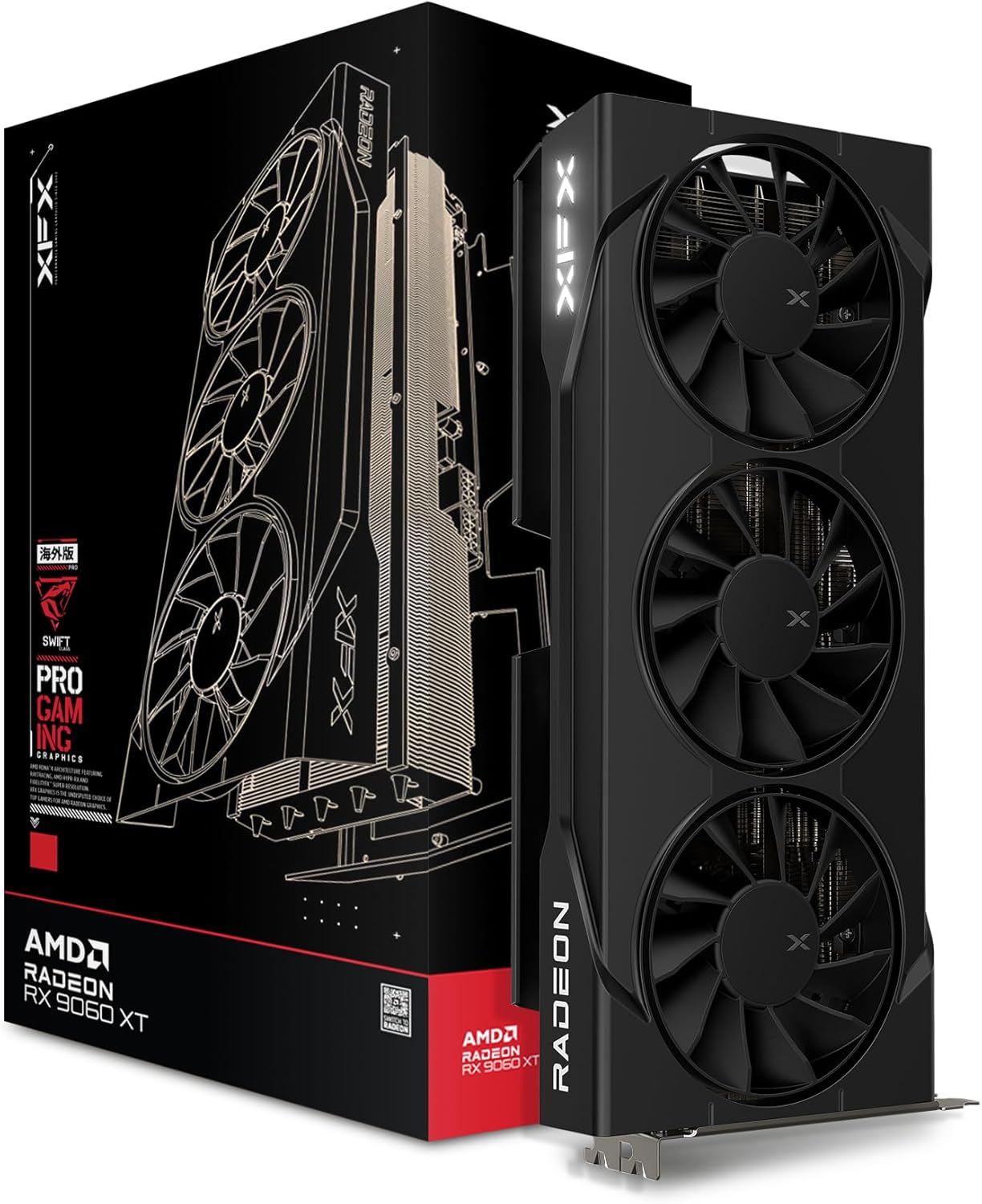
Budget Tier: Value tier (starting at $349 Launch MSRP) | Audited Specs: AMD RDNA 4 | 32 Compute Units (2,048 SP) | Up to 3,320 MHz Boost | 16GB GDDR6 | 128-bit Bus | 20 Gbps (340 GB/s Bandwidth) + 32MB Infinity Cache | 160W Class TBP | 1x PCIe 8-Pin | 450W-650W PSU Recommended | 2x DisplayPort 2.1 + 1x HDMI 2.1 | 290 x 124 x 49 mm Dual-Slot Triple-Fan | PCIe 5.0 x16 Full Interface.
Comparison Audit: Pairing a 160W RDNA 4 silicon die with a long 290mm triple-fan heatsink produces exceptionally quiet thermal headroom at an accessible $349 Launch MSRP tier. Keeping a single standard 8-pin PCIe power header and full PCIe 5.0 x16 electrical lanes makes the XFX Swift OC an effortless drop-in upgrade for value-conscious 1080p Ultra and 1440p gaming towers, just confirm your chassis clears 290mm GPU length.
Pros: $80 lower Launch MSRP than RTX 5060 Ti 16GB with identical 16GB capacity; cool, quiet triple-fan dual-slot design at 160W TBP; full PCIe 5.0 x16 lanes and single 8-pin plug.
Cons: 290mm card length excludes ultra-short Mini-ITX cases; trails Blackwell in heavy ray tracing and lacks 10-bit 4:2:2 NVENC or CUDA acceleration.
2. ASUS Dual GeForce RTX 5060 Ti 16GB GDDR7 OC — Best Compact Ray-Tracing & Creator Pick

Budget Tier: Lower-midrange tier (starting at $429 Launch MSRP) | Audited Specs: NVIDIA Blackwell | 4,608 CUDA Cores | 2,632 MHz OC Boost | 16GB GDDR7 | 128-bit Bus | 28 Gbps Memory Speed (448 GB/s) | 180W TBP | 1x 8-Pin PCIe Connector | 550W-650W PSU Recommended | 3x Native DisplayPort 2.1b + 1x HDMI 2.1b | 229 x 120 x 50 mm 2.5-Slot Compact Dual Axial-Tech Fans | PCIe 5.0 x8.
Comparison Audit: At just 229mm long, the ASUS Dual OC fits virtually any Mini-ITX or micro-ATX build while ditching multi-cable adapters for one clean 8-pin PCIe plug. Its 16GB of 28 Gbps GDDR7 memory avoids the severe 8GB texture bottleneck of cheaper RTX 5060 Ti models while unlocking Transformer DLSS 4, Multi-Frame Generation, 759 AI TOPS, DisplayPort 2.1b UHBR20, and 9th-Gen NVENC 10-bit 4:2:2 video acceleration.
Pros: Fast 448 GB/s 16GB GDDR7 memory pool eliminates 8GB ceilings; compact 229mm length with single 8-pin power plug; top-tier ray tracing, DLSS 4 MFG, and 9th-Gen NVENC.
Cons: $80 higher Launch MSRP than RX 9060 XT 16GB; PCIe 5.0 x8 electrical interface trims host bandwidth on older PCIe 3.0 systems; dual fans work louder than triple-fan coolers under sustained loads.
How We Audited This Guide
- Graphics cards were evaluated by VRAM capacity, memory bus, power connector and PSU requirements, slot width and length clearance, and display output standards.
- Every specification claim was cross-checked against official OEM datasheets, platform vendor documentation, and published industry standards (PCI-SIG, JEDEC, VESA, Intel ATX) rather than marketplace listing copy.
- Recommendations were evaluated against our weighted audit rubric and documented compatibility rules; we do not publish fabricated FPS, thermal, or acoustic numbers.
Frequently Asked Questions
Is the RTX 5060 Ti 16GB worth $80 more than the RX 9060 XT 16GB?
For pure gaming value per dollar, the $349 Launch MSRP RX 9060 XT 16GB wins easily. Pay the extra $80 for the $429 Launch MSRP RTX 5060 Ti 16GB only if heavy ray tracing, DLSS 4 Multi-Frame Generation, CUDA local AI, or 9th-Gen NVENC 10-bit 4:2:2 video editing matter daily.
Does GDDR7 on the RTX 5060 Ti 16GB outperform GDDR6 on the RX 9060 XT 16GB?
28 Gbps GDDR7 gives the RTX 5060 Ti 448 GB/s of raw bandwidth across 128 bits—40% above reference 320 GB/s GDDR6. However, AMD counters with 32MB of on-die 3rd-Gen Infinity Cache to keep repetitive 1080p and 1440p texture lookups off external DRAM, narrowing practical raster differences.
Does the RTX 5060 Ti PCIe 5.0 x8 interface hurt gaming on older motherboards?
On PCIe 5.0 and PCIe 4.0 systems, x8 links handle 16GB cards without noticeable bottlenecks. On legacy PCIe 3.0 boards, half-width x8 routing cuts link bandwidth compared to the RX 9060 XT’s full PCIe 5.0 x16 slot, making Radeon safer for older B450 or legacy upgrades.
What power supply wattage do the RX 9060 XT 16GB and RTX 5060 Ti 16GB require?
AMD specifies a 450W minimum PSU for the 160W RX 9060 XT 16GB, whereas NVIDIA lists 600W for the 180W RTX 5060 Ti (550W–650W on ASUS Dual OC). For fresh builds, use a quality 650W ATX 3.1 80+ Gold PSU to handle transient power spikes safely.
Should I buy an 8GB RTX 5060 Ti or 8GB RX 9060 XT to save money?
No—avoid 8GB cards above $350 if you play modern AAA games at 1080p Ultra or 1440p. Turning on Ultra textures, ray tracing, or Frame Generation pushes VRAM past 8GB, tanking 1% Lows. Always prioritize the 16GB RX 9060 XT ($349 Launch MSRP) or 16GB RTX 5060 Ti.
Official Standards & Technical References
- AMD Radeon RX 9000-Series RDNA 4 Architecture & Specs: amd.com/en/products/graphics/desktops/radeon.html
- NVIDIA GeForce RTX 50-Series Blackwell Specifications: nvidia.com/en-us/geforce/graphics-cards/50-series/
- PCI-SIG PCIe CEM 5.1 & 12V-2×6 Power Connector Standard: pcisig.com/specifications
- VESA DisplayPort 2.1 Signaling & UHBR20 Standards: displayport.org
Continue exploring our best graphics cards for gaming hub, compare sub-$350 picks in our best budget graphics cards under $350 guide, or browse all Graphics Cards hardware audits.


