
Disclosure: As an Amazon Associate, I earn from qualifying purchases. If you buy through links on this page, we may earn a small commission at no extra cost to you.
Choosing the best budget graphics card under 350 in 2026 comes down to one critical hardware threshold: avoiding premature memory starvation without falling for inflated third-party marketplace markups. Shoppers in the under-$350 tier now face an unusually wide split between 16GB RDNA 4 silicon, 12GB Battlemage cards, 8GB Blackwell GPUs, and discounted previous-generation RDNA 3 models.
We audited eight verified Amazon US retail graphics cards spanning four distinct architectures—AMD RDNA 4, Intel Xe2 Battlemage, NVIDIA Blackwell, and AMD RDNA 3—against memory bus width, PCIe lane wiring, upscaling feature stacks, TBP wattage, and physical chassis dimensions. Whether you are building a new 1080p Ultra rig or upgrading an existing tower within our broader best graphics cards for gaming hierarchy, this guide separates legitimate value leaders from overpriced 8GB traps.
In This Guide
Quick Picks: Best Budget Graphics Cards Under 350 at a Glance
#1 Best Overall Under $350
XFX Swift AMD Radeon RX 9060 XT OC Triple Fan 16GB
Pairs 16GB GDDR6 and full PCIe 5.0 x16 routing with quiet triple-fan cooling starting at $349 Launch MSRP. (Jump to audit)
#2 Best Budget Under $250
Intel Arc B580 Limited Edition 12GB (WEELIAO)
Delivers 12GB GDDR6 on a wide 192-bit 456 GB/s bus and hardware AV1 encoding around $249 Launch MSRP. (Jump to audit)
#3 Best DLSS 4 & Frame Gen Pick
ASUS TUF Gaming GeForce RTX 5060 8GB GDDR7 OC Edition
Brings Blackwell neural rendering, 28 Gbps GDDR7 memory, and DLSS 4 Multi-Frame Generation at 145W. (Jump to audit)
Side-by-Side Comparison: Best Budget Graphics Card Under 350 Contenders
| Product & Award | Best For | VRAM & Memory Bus | TBP & Card Length | Link |
|---|---|---|---|---|
| XFX Swift Radeon RX 9060 XT OC Triple Fan Best Overall Under $350 | 1080p Ultra & 1440p longevity | 16GB GDDR6 (128-bit + 32MB Cache) | 160W TBP | 290 mm (PCIe 5.0 x16) | View on Amazon |
| Intel Arc B580 Limited Edition (WEELIAO) Best Budget Under $250 | Sub-$250 builds & AV1 streaming | 12GB GDDR6 (192-bit, 456 GB/s) | 190W TBP | 272 mm (Requires ReBAR) | View on Amazon |
| ASUS TUF Gaming GeForce RTX 5060 OC Best DLSS 4 & Frame Gen Pick | Esports, DLSS 4 MFG & NVENC | 8GB GDDR7 (128-bit, 448 GB/s) | 145W TBP | 302 mm (3.1-Slot) | View on Amazon |
| ASRock Radeon RX 9060 XT Challenger OC Best Compact Dual-Fan 16GB | Standard mATX & shorter cases | 16GB GDDR6 (128-bit, 20 Gbps) | 160W TBP | 249 mm (2-Slot) | View on Amazon |
| ASUS Dual Radeon RX 9060 XT 16GB Best Small-Form-Factor 16GB | Mini-ITX & cramped OEM towers | 16GB GDDR6 (128-bit, 20 Gbps) | 160W TBP | 202 mm (2.5-Slot) | View on Amazon |
| XFX Swift Radeon RX 9060 XT OC White Best All-White 16GB Build | White showcase panoramic rigs | 16GB GDDR6 (128-bit + 32MB Cache) | 160W TBP | 290 mm (Triple-Fan) | View on Amazon |
| XFX Speedster SWFT210 Radeon RX 7600 Best Entry Dual-Fan Alternative | Legacy CPUs & sub-$250 esports | 8GB GDDR6 (128-bit, 288 GB/s) | 165W TBP | 241 mm (2-Slot) | View on Amazon |
| ASRock Radeon RX 7600 Challenger Pro OC Best Triple-Fan Entry 1080p | Quiet 1080p esports in ATX cases | 8GB GDDR6 (128-bit, 288 GB/s) | 165W TBP | 303 mm (Triple-Fan) | View on Amazon |
Match Your Use Case: Which Budget GPU Fits Your Rig?
| Buyer Scenario | Best Match | Why & Expected Outcome |
|---|---|---|
| Long-term 1080p Ultra & entry 1440p AAA gaming | XFX Swift RX 9060 XT OC Triple Fan 16GB | Doubles 8GB entry cards to 16GB VRAM, unlocks ML-based AMD FSR 4, and preserves full PCIe 5.0 x16 lane bandwidth. |
| Strict under-$250 GPU upgrade with 12GB VRAM | Intel Arc B580 Limited Edition 12GB | Wide 192-bit memory bus delivers 456 GB/s bandwidth and Intel XeSS 2 headroom on ReBAR-enabled platforms. |
| Competitive 1080p esports & DLSS 4 Multi-Frame Gen | ASUS TUF Gaming GeForce RTX 5060 OC | Combines 28 Gbps GDDR7 speed, NVIDIA Reflex latency reduction, and NVENC streaming at just 145W TBP. |
| Standard compact mid-tower lacking 290mm GPU room | ASRock RX 9060 XT Challenger 16GB OC | Trim 249mm two-slot PCB drops effortlessly into tighter budget enclosures while keeping full 16GB RDNA 4 specs. |
| Mini-ITX / SFF case under 210mm length limit | ASUS Dual RX 9060 XT 16GB | Ultra-short 202mm dual Axial-tech layout brings 16GB VRAM and DisplayPort 2.1a into tiny footprints. |
| All-white panoramic dual-chamber gaming build | XFX Swift RX 9060 XT OC White 16GB | Matches white airflow components cleanly while running factory-overclocked 3,320 MHz boost clocks. |
| Older non-ReBAR PC running DX11/DX12 esports | XFX Speedster SWFT210 RX 7600 8GB | Avoids Intel Arc BIOS ReBAR dependency while offering mature RDNA 3 drivers in a compact 241mm shroud. |
Detailed Reviews: 8 Audited Best Budget Graphics Cards Under 350
1. XFX Swift AMD Radeon RX 9060 XT OC Triple Fan 16GB — Best Overall Under $350
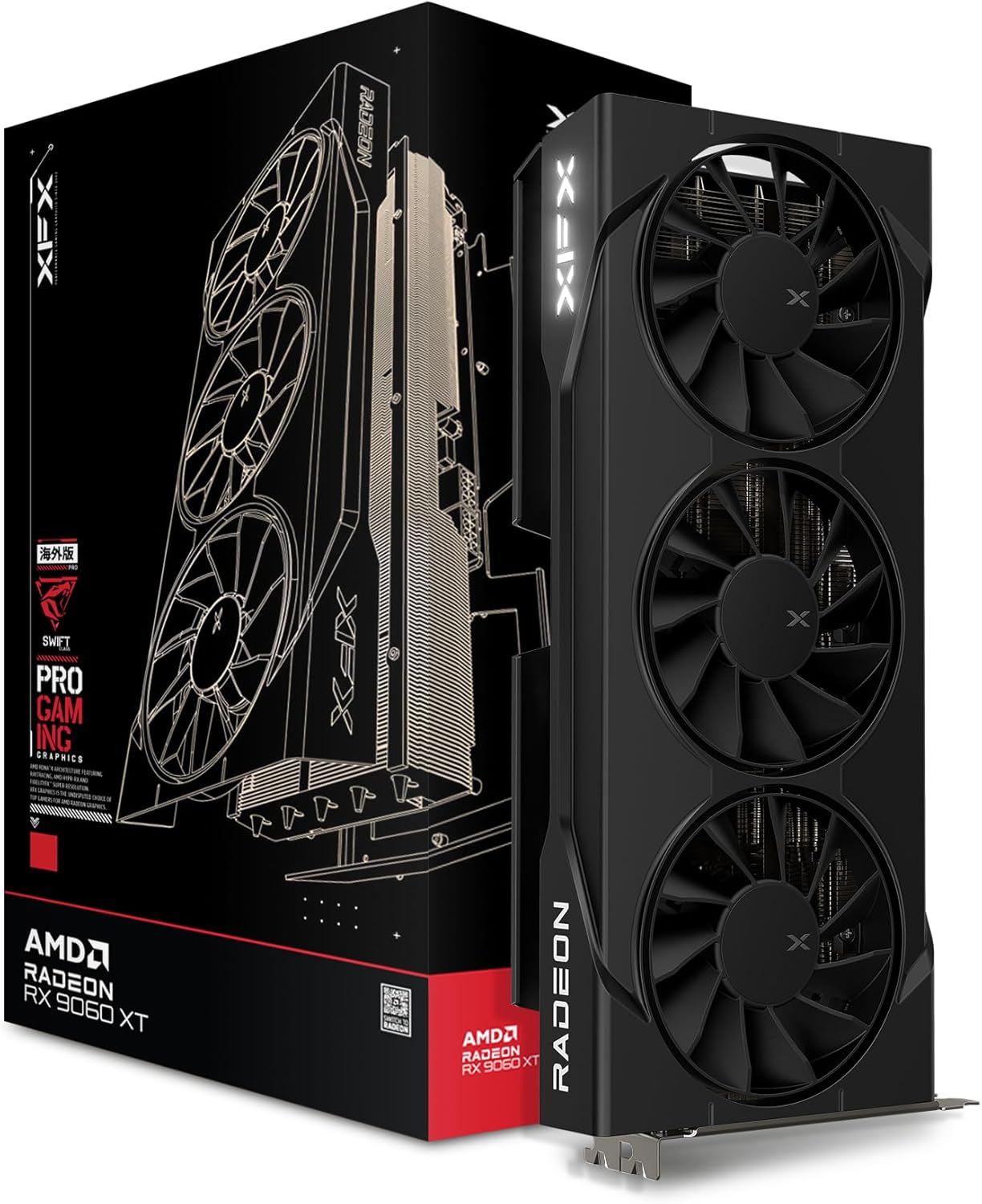
Quick Specs: AMD RDNA 4 (32 CUs / 2,048 SP) | Up to 3,320 MHz Boost | 16GB GDDR6 (128-bit, 20 Gbps, 340 GB/s + 32MB Infinity Cache) | 160W Class TBP (1x 8-Pin) | 2x DisplayPort 2.1a, 1x HDMI 2.1b | 290 x 124 x 49 mm | PCIe 5.0 x16 | Price Tier: Value tier (starting at $349 Launch MSRP)
Audit Score: 9.3 / 10
- Rasterization & Ray Tracing Tier (35%): 9.2 / 10
- VRAM Capacity & Memory Bus (25%): 9.6 / 10
- Upscaling, Frame Gen & Media Engine (20%): 9.0 / 10
- Thermals, Acoustics & Power Spec (20%): 9.4 / 10
Memory capacity separates lasting budget GPUs from two-year stopgaps, and the XFX Swift AMD Radeon RX 9060 XT OC Triple Fan 16GB dominates the sub-$350 value bracket on spec balance alone. Built on AMD’s RDNA 4 architecture, it pairs 32 Compute Units (boosting up to 3,320 MHz on XFX’s factory OC curve) with a full 16GB of 20 Gbps GDDR6 memory and 32MB of Infinity Cache. Crucially, unlike several budget competitors restricted to eight electrical lanes, the RX 9060 XT uses a complete PCIe 5.0 x16 interface—protecting frame pacing and 1% Lows even when dropped into older PCIe 3.0 or PCIe 4.0 upgrade platforms.
Compared directly with our #2 Intel Arc B580 (12GB) and #3 ASUS TUF RTX 5060 (8GB), the XFX Swift trades a higher entry price starting at $349 Launch MSRP for double NVIDIA’s VRAM buffer and far stronger hardware ray-tracing and AI throughput than RDNA 3. Upgraded second-generation AI accelerators unlock machine-learning AMD FSR 4 upscaling alongside Anti-Lag 2 latency synchronization and hardware AV1 encoding. Meanwhile, the 290mm triple-fan heatsink handles a modest 160W Class TBP with effortless acoustic composure, drawing power cleanly from a single 8-pin PCIe cable rather than requiring an ATX 3.1 12V-2×6 adapter.
Buyer Verification Alert: Amazon lists both 8GB and 16GB RX 9060 XT models alongside multiple XFX SKU codes (such as RX-96TS316B7). Verify that your selected listing explicitly reads 16GB and check the Ships from / Sold by seller line so third-party markups do not pull the total far above the $349-$400 value bracket.
Pros
- Full 16GB GDDR6 frame buffer eliminates texture downgrades in 1080p Ultra and 1440p AAA games
- Uncompromised PCIe 5.0 x16 bus prevents older motherboard bandwidth throttling
- Triple-fan cooling shroud manages 160W TBP quietly with Zero-RPM idle fan stop
- Supports ML-powered AMD FSR 4, DisplayPort 2.1a, and single 8-pin power hookup
Cons
- 290mm card length exceeds maximum GPU clearance in ultra-short budget mini-towers
- Amazon AIB street prices often float above $350 when official MSRP stock sells through
Verdict: Buy it if you want a 16GB GPU built to stay relevant through 2029 at 1080p Ultra and 1440p High without worrying about a VRAM bottleneck. Skip it if your budget is capped strictly under $250 or your chassis clears less than 295mm. Pairs smoothly with a standard 550W to 650W 80+ Gold PSU using one existing 8-pin lead.
2. Intel Arc B580 Limited Edition 12GB (WEELIAO) — Best Budget Under $250

Quick Specs: Intel Xe2 Battlemage (BMG-G21, 20 Xe-Cores / 160 XMX Engines) | 2,670 MHz Clock | 12GB GDDR6 (192-bit, 456 GB/s) | 190W TBP (1x 8-Pin) | 3x DisplayPort 2.1, 1x HDMI 2.1 | 272 x 115 x 44 mm | PCIe 4.0 x8 (Requires ReBAR) | Price Tier: Budget tier (starting at $249 Launch MSRP)
Audit Score: 9.0 / 10
- Rasterization & Ray Tracing Tier (35%): 8.8 / 10
- VRAM Capacity & Memory Bus (25%): 9.4 / 10
- Upscaling, Frame Gen & Media Engine (20%): 9.0 / 10
- Thermals, Acoustics & Power Spec (20%): 8.7 / 10
For strict sub-$250 builders, Intel rewrote the entry-level VRAM rules with its Xe2 Battlemage silicon. According to Intel’s official Arc B580 specification sheet, the Limited Edition reference board deploys 20 Xe2-cores, 160 XMX AI matrix engines, and 12GB of GDDR6 memory across a wide 192-bit bus generating 456 GB/s of raw bandwidth—higher raw bandwidth than every 8GB card on this page and roughly $100 below the RX 9060 XT 16GB Launch MSRP.
In direct comparison with our #3 ASUS TUF RTX 5060 (8GB) and #7 XFX RX 7600 (8GB), the Arc B580 holds its lead whenever modern Unreal Engine 5 textures or 1440p render targets push memory demand beyond 8GB. Intel XeSS 2 leverages dedicated XMX hardware for sharp temporal reconstruction alongside Xe Low Latency and dual hardware AV1 encoders for budget streaming rigs. The catch sits squarely on platform rules: the Arc B580 requires Resizable BAR enabled in UEFI BIOS, and its 190W TBP makes it slightly hungrier than the 145W RTX 5060, calling for a dependable 600W to 650W PSU. For a deeper head-to-head breakdown across modern engines, see our Arc B580 vs. RTX 5060 vs. RX 9060 XT comparison.
Buyer Verification Alert: Limited Edition cards on Amazon frequently route through third-party storefront resellers such as WEELIAO. Confirm New sealed retail condition, verify Amazon A-to-z return protection, and confirm your motherboard supports Resizable BAR (AM4 3000/5000 series with updated BIOS, AM5, or Intel 11th Gen+) before ordering.
Pros
- 12GB GDDR6 on a 192-bit 456 GB/s memory bus delivers exceptional sub-$250 VRAM value
- 160 XMX engines accelerate Intel XeSS 2 upscaling and frame generation smoothly
- Clean two-slot 272mm Limited Edition chassis includes three DisplayPort 2.1 outputs
- Hardware AV1 encoding rivals higher-tier creator cards for Twitch and YouTube capture
Cons
- Older platforms lacking Resizable BAR suffer noticeable performance and frametime losses
- 190W TBP runs warmer and demands slightly more PSU headroom than RTX 5060 or RX 9060 XT
Verdict: Buy it if you are assembling a value PC on an AM5, LGA 1700/1851, or modern AM4 motherboard and want 12GB VRAM around $249 Launch MSRP. Skip it if your older OEM motherboard locks out Resizable BAR in BIOS or you spend most hours in niche legacy DirectX 9 games. Plan a quick BIOS update and ReBAR toggle immediately after installation.
3. ASUS TUF Gaming GeForce RTX 5060 8GB GDDR7 OC Edition — Best DLSS 4 & Frame Gen Pick

Quick Specs: NVIDIA Blackwell (3,840 CUDA Cores) | 2,677 MHz OC Boost | 8GB GDDR7 (128-bit, 28 Gbps, 448 GB/s) | 145W Class TBP (1x 8-Pin) | 3x DisplayPort 2.1b, 1x HDMI 2.1b | 302 x 133.5 x 62 mm (3.1-Slot) | PCIe 5.0 x8 | Price Tier: Starting at $299 Launch MSRP (TUF OC fluctuates into $400-$600 tier)
Audit Score: 8.6 / 10
- Rasterization & Ray Tracing Tier (35%): 8.7 / 10
- VRAM Capacity & Memory Bus (25%): 7.7 / 10
- Upscaling, Frame Gen & Media Engine (20%): 9.6 / 10
- Thermals, Acoustics & Power Spec (20%): 8.9 / 10
Software ecosystem leadership keeps NVIDIA’s Blackwell architecture compelling at 1080p even when memory capacity stops at 8GB. According to NVIDIA’s GeForce RTX 5060 specification sheet, the chip combines 3,840 CUDA cores, fifth-generation Tensor cores, and ultra-fast 28 Gbps GDDR7 memory delivering 448 GB/s across a 128-bit interface—all inside a lean 145W envelope powered by a single 8-pin cable rather than a 12V-2×6 plug. On ASUS’s TUF Gaming OC board, an oversized 3.1-slot triple Axial-tech heatsink cools those 145 watts with whisper-quiet acoustic headroom.
Still, contrasting the ASUS TUF RTX 5060 against our #1 XFX Swift RX 9060 XT (16GB) exposes two unmistakable trade-offs. First, 8GB of GDDR7 cannot prevent texture swaps or VRAM bottleneck stutters once 2026 AAA games push Ultra presets plus ray tracing or DLSS 4 Multi-Frame Generation buffers simultaneously. Second, the TUF shroud stretches 302mm long and 62mm thick, occupying more case space than compact 16GB RX 9060 XT dual-fan cards while running on a PCIe 5.0 x8 electrical bus.
Buyer Verification Alert: Base RTX 5060 8GB cards arrive starting at $299 Launch MSRP, yet flagship triple-fan OC models like the ASUS TUF frequently list in the $400-$600 tier on Amazon. Never pay over $350 for an 8GB card; if TUF OC pricing sits above $350, pivot immediately to a 16GB RX 9060 XT.
Pros
- DLSS 4 Multi-Frame Generation, transformer upscaling, and NVIDIA Reflex lead game adoption
- High-speed 28 Gbps GDDR7 memory sustains 448 GB/s bandwidth at just 145W TBP
- Three DisplayPort 2.1b outputs and Blackwell NVENC encoder benefit streamers and creators
- Overbuilt 3.1-slot TUF cooler stays remarkably cool and quiet under sustained 1080p loads
Cons
- 8GB VRAM limits Ultra texture packs and heavy ray tracing in demanding 2026 releases
- Bulky 302 x 133.5 x 62 mm footprint requires mid-tower clearance despite entry GPU tier
Verdict: Buy it if you find an RTX 5060 around $299 Launch MSRP and play 1080p esports or DLSS 4 titles where Reflex and NVENC shine. Skip it if street pricing drifts over $350 or you refuse to compromise on Ultra textures at 1440p. Keep native base frame rates above 50-60 FPS before toggling Multi-Frame Generation.
4. ASRock Radeon RX 9060 XT Challenger 16GB OC Graphics Card — Best Compact Dual-Fan 16GB

Quick Specs: AMD RDNA 4 (32 CUs / 2,048 SP) | Up to 3,290 MHz Boost (2,700 MHz Game) | 16GB GDDR6 (128-bit, 20 Gbps) | 160W Class TBP (1x 8-Pin) | 2x DisplayPort 2.1a, 1x HDMI 2.1b | 249 x 132 x 41 mm (2-Slot, 645 g) | PCIe 5.0 x16 | Price Tier: Value tier (starting at $349 Launch MSRP)
Audit Score: 8.9 / 10
- Rasterization & Ray Tracing Tier (35%): 9.1 / 10
- VRAM Capacity & Memory Bus (25%): 9.5 / 10
- Upscaling, Frame Gen & Media Engine (20%): 9.0 / 10
- Thermals, Acoustics & Power Spec (20%): 8.0 / 10
Not every budget PC chassis can swallow a 290mm triple-fan GPU, which makes the ASRock Radeon RX 9060 XT Challenger 16GB OC the pragmatic alternative for standard micro-ATX and budget mid-towers. Shaving length down to 249mm and width to a clean 41mm dual-slot profile, this 645-gram card leaves motherboard PCIe retention clips intact without sag brackets while retaining full 16GB GDDR6 capacity and PCIe 5.0 x16 wiring from AMD’s RDNA 4 specification.
Measured against our #1 XFX Swift Triple Fan, the ASRock Challenger gives up just 30 MHz on rated boost clock (3,290 MHz versus 3,320 MHz)—less than a one-percent frequency variance that disappears inside normal game variance. Where you will hear the difference is sustained thermal acoustics: two fans work slightly harder than three across a 160W load, though 0dB Silent Cooling still stops both fans completely at idle. Compared against our #5 ASUS Dual 16GB, ASRock’s slimmer 41mm two-slot profile keeps bottom motherboard headers clear in compact micro-ATX layouts.
Buyer Verification Alert: Marketplace sellers periodically list the Challenger 16GB OC well above $349 Launch MSRP inside the $600-$900 tier when inventory dips. Always verify Ships from / Sold by Amazon.com and compare live pricing against the #1 XFX Swift before checking out.
Pros
- Compact 249mm length and true 2-slot 41mm width fit almost any mATX or ATX tower
- Lightweight 645g chassis prevents PCIe slot sag without extra support brackets
- Full 16GB GDDR6 buffer, PCIe 5.0 x16 routing, and FSR 4 ML upscaling support
Cons
- Dual-fan heatsink runs slightly louder under prolonged 160W loads than triple-fan 9060 XT designs
- Provides three display ports total (two DP 2.1a and one HDMI 2.1b) instead of four
Verdict: Buy it if your case maxes out between 250mm and 285mm GPU length and you want zero-compromise 16GB RDNA 4 performance in a two-slot design. Skip it if your mid-tower clears 295mm+ easily and the XFX Swift Triple Fan sells near the same bracket. Confirm your monitor cables fit a three-port (2x DP + 1x HDMI) layout.
5. ASUS Dual Radeon RX 9060 XT 16GB GDDR6 Gaming Graphics Card — Best Small-Form-Factor 16GB

Quick Specs: AMD RDNA 4 (32 CUs / 2,048 SP) | Up to 3,250 MHz OC Boost (3,230 MHz Default) | 16GB GDDR6 (128-bit, 20 Gbps) | 160W Class TBP (1x 8-Pin) | 2x DisplayPort 2.1a, 1x HDMI 2.1b | 202 x 120 x 49 mm (2.5-Slot) | PCIe 5.0 x16 | Price Tier: Value tier (starting at $349 Launch MSRP)
Audit Score: 8.7 / 10
- Rasterization & Ray Tracing Tier (35%): 9.0 / 10
- VRAM Capacity & Memory Bus (25%): 9.5 / 10
- Upscaling, Frame Gen & Media Engine (20%): 9.0 / 10
- Thermals, Acoustics & Power Spec (20%): 7.6 / 10
Small Form Factor (SFF) builders upgrading older OEM office towers or cramped Mini-ITX cubes typically get forced onto compromises like cut-down 8GB cards, yet the ASUS Dual Radeon RX 9060 XT 16GB breaks that rule at just 202mm long. Packing two barrier-ring Axial-tech fans onto an ultra-short PCB, ASUS preserves all 32 RDNA 4 Compute Units, full 16GB GDDR6 memory, and complete PCIe 5.0 x16 lane routing while shaving 88mm off the length of our #1 XFX Swift.
Trade-offs become clearer when compared side by side with our #4 ASRock Challenger 16GB OC. ASUS beats ASRock easily on front-to-back length (202mm versus 249mm), fitting behind front-mounted radiators or drive cages where 250mm boards collide. However, ASUS recovers cooling fin surface area through extra thickness—49mm (2.5 slots) compared with ASRock’s leaner 41mm (2-slot) housing—so strict 2.0-slot sandwich ITX cases still need careful width measurements. Boost clocks run slightly lower at 3,250 MHz OC mode, delivering virtually indistinguishable real-world 1080p and 1440p frame output backed by AMD’s FSR 4 software stack.
Buyer Verification Alert: Ensure the Amazon listing explicitly displays 16GB GDDR6 rather than the 8GB ASUS Dual SKU, and watch out for third-party reseller listings inflating pricing into the $600-$900 tier above $349 Launch MSRP reference pricing.
Pros
- Ultra-compact 202mm length slides easily into Mini-ITX cubes and front-radiator cases
- Dual Axial-tech fans maximize static pressure across a short fin stack
- Zero cutbacks on 16GB GDDR6 VRAM, PCIe 5.0 x16 interface, or single 8-pin power convenience
Cons
- 2.5-slot (49mm) width rules out strict two-slot SFF sandwich enclosures
- Compact heatsink runs slightly louder at peak load than 290mm triple-fan siblings
Verdict: Buy it if your Mini-ITX or compact mATX enclosure requires a sub-210mm GPU and you still refuse to settle for 8GB VRAM. Skip it if your case limits thickness strictly under 45mm or comfortably fits the quieter 290mm XFX Swift. Double-check both 202mm length and 2.5-slot width clearance against your case manual.
6. XFX Swift AMD Radeon RX 9060 XT OC White 16GB GDDR6 — Best All-White 16GB Build

Quick Specs: AMD RDNA 4 (32 CUs / 2,048 SP) | Up to 3,320 MHz Boost (2,780 MHz Game) | 16GB GDDR6 (128-bit, 20 Gbps, 340 GB/s) | 160W Class TBP (1x 8-Pin) | 2x DisplayPort 2.1a, 1x HDMI 2.1b | 290 x 124 x 49 mm | PCIe 5.0 x16 | Price Tier: Value tier (starting at $349 Launch MSRP; white colorway markup varies)
Audit Score: 8.8 / 10
- Rasterization & Ray Tracing Tier (35%): 9.2 / 10
- VRAM Capacity & Memory Bus (25%): 9.5 / 10
- Upscaling, Frame Gen & Media Engine (20%): 9.0 / 10
- Thermals, Acoustics & Power Spec (20%): 8.0 / 10
Panoramic tempered-glass builders pursuing an all-white rig usually eat a painful aesthetic tax—or drop down to slower 8GB GPUs just to match white fans. The XFX Swift AMD Radeon RX 9060 XT OC White 16GB GDDR6 brings the exact mechanical DNA of our #1 pick into a clean white Ghost Thermal triple-fan shroud and matching backplate, running identical 3,320 MHz OC boost clocks, 16GB GDDR6 capacity, and 160W single 8-pin efficiency.
Why does it rank #6 instead of tying at #1? Purely because of Amazon pricing dynamics. White AIB editions regularly experience shorter retail production runs, causing seasonal third-party listings to spike higher than the standard black XFX Swift. Mechanically, you get the exact same RDNA 4 compute engine, DisplayPort 2.1a connectivity, and PCIe 5.0 x16 lane security—just verify you are not paying a triple-digit color tax over standard dark shrouds.
Buyer Verification Alert: Like other white specialty cards, third-party listings for this White Edition sometimes spike into the $600-$900 tier on Amazon. Only buy when sold close to the under-$400 value zone; otherwise pick the black #1 XFX Swift and save the cash toward 32GB DDR5-6000 CL30 RAM.
Pros
- Factory white triple-fan shroud and backplate integrate cleanly into white showcase PCs
- Identical 3,320 MHz boost clocks, 16GB VRAM, and cool Ghost Thermal acoustics as #1 pick
- Full PCIe 5.0 x16 lane interface and AMD FSR 4 upscaling safeguard future releases
Cons
- White editions frequently fluctuate above MSRP when Amazon direct stock runs low
- 290mm triple-fan length requires verifying front-intake or radiator clearance
Verdict: Buy it if you are building a white dual-chamber or mesh showcase rig and catch direct stock near the $349-$400 tier. Skip it if third-party sellers inflate the white colorway well above the black XFX Swift. Adding a white sleeved 8-pin PSU cable extension completes the look cleanly.
7. XFX Speedster SWFT210 Radeon RX 7600 8GB GDDR6 Graphics Card — Best Entry Dual-Fan Alternative

Quick Specs: AMD RDNA 3 (32 CUs / 2,048 SP) | Up to 2,655 MHz Boost (2,250 MHz Game) | 8GB GDDR6 (128-bit, 18 Gbps, 288 GB/s) | 165W Class TBP (1x 8-Pin) | 3x DisplayPort 2.1, 1x HDMI 2.1 | 241 x 131 x 41 mm (2-Slot) | PCIe 4.0 x8 | Price Tier: $250-$400 tier (Entry 1080p discount bracket)
Audit Score: 7.6 / 10
- Rasterization & Ray Tracing Tier (35%): 7.6 / 10
- VRAM Capacity & Memory Bus (25%): 7.0 / 10
- Upscaling, Frame Gen & Media Engine (20%): 7.5 / 10
- Thermals, Acoustics & Power Spec (20%): 8.4 / 10
Aging RDNA 3 cards earn a place in a 2026 budget GPU roundup only under specific discount conditions—and only for systems that cannot leverage newer Intel Arc Battlemage silicon. The XFX Speedster SWFT210 Radeon RX 7600 8GB delivers 32 RDNA 3 Compute Units, hardware AV1 encoding, and three modern DisplayPort 2.1 jacks inside a compact 241mm, 2-slot shroud powered by one 8-pin plug. Its core advantage over our #2 Intel Arc B580 is plug-and-play driver predictability on older non-ReBAR desktops and legacy DirectX 9/11 esports libraries.
Everything else favors stepping forward a generation. At 8GB of 18 Gbps GDDR6 (288 GB/s) and PCIe 4.0 x8 routing, the RX 7600 hits a clear VRAM bottleneck on Ultra 1080p textures and 1440p settings, and RDNA 3 lacks the AI hardware required for native ML-based AMD FSR 4—forcing reliance on older shader-based FSR 3.1. Compared with the ASUS TUF RTX 5060 (8GB GDDR7), XFX gives up 160 GB/s of memory bandwidth and DLSS 4 support, making street discounts strictly under $250 essential.
Buyer Verification Alert: Treat the RX 7600 8GB strictly as a clearance fallback. If the XFX SWFT210 sells at or above the $249-$299 bracket where the 12GB Intel Arc B580 or RTX 5060 8GB sit, skip RDNA 3 immediately.
Pros
- Compact 241mm 2-slot design drops cleanly into older office and budget gaming towers
- Mature RDNA 3 drivers run reliably on older CPUs lacking BIOS Resizable BAR
- Includes three DisplayPort 2.1 outputs plus RDNA 3 AV1 encoding
Cons
- 8GB VRAM and 288 GB/s bus lag far behind the 12GB Arc B580 and 16GB RX 9060 XT
- Lacks RDNA 4 AI accelerators needed for ML-powered AMD FSR 4 upscaling
Verdict: Buy it only if deeply discounted well under $250 for an older non-ReBAR 1080p esports build playing titles like Valorant or Counter-Strike 2. Skip it whenever you can afford the 12GB Arc B580 or 16GB RX 9060 XT. Keep texture settings at Medium or High on PCIe 3.0 motherboards to preserve clean 1% Lows.
8. ASRock Radeon RX 7600 Challenger Pro 8GB OC Graphics Card — Best Triple-Fan Entry 1080p

Quick Specs: AMD RDNA 3 (32 CUs / 2,048 SP) | Up to 2,695 MHz Boost (2,280 MHz Game) | 8GB GDDR6 (128-bit, 18 Gbps, 288 GB/s) | 165W Class TBP (1x 8-Pin) | 3x DisplayPort 1.4a, 1x HDMI 2.1 | 303 x 131 x 45 mm (Triple-Fan, 830 g) | PCIe 4.0 x8 | Price Tier: $250-$400 tier (Entry 1080p triple-fan bracket)
Audit Score: 7.5 / 10
- Rasterization & Ray Tracing Tier (35%): 7.7 / 10
- VRAM Capacity & Memory Bus (25%): 7.0 / 10
- Upscaling, Frame Gen & Media Engine (20%): 7.2 / 10
- Thermals, Acoustics & Power Spec (20%): 8.3 / 10
ASRock equips its Radeon RX 7600 Challenger Pro 8GB OC with a full 303mm triple-fan cooler and the highest factory boost clock among our RDNA 3 entries at 2,695 MHz. In a spacious ATX mesh tower, those three fans move generous airflow across a 165W thermal load at low acoustic RPMs while maintaining plug-and-play compatibility across older PCIe 3.0 and non-ReBAR builds where the Intel Arc B580 struggles.
Despite the strong heatsink, two physical downgrades hold this model in eighth place behind our #7 XFX Speedster SWFT210. First, ASRock outputs via DisplayPort 1.4a rather than XFX’s newer DisplayPort 2.1 jacks, restricting high-refresh uncompressed monitor upgrades down the road. Second, stretching an 8GB entry GPU to 303mm long and 830 grams defeats the space efficiency most budget case buyers expect—even exceeding the length of our #1 XFX Swift 16GB RX 9060 XT (290mm) while delivering half the VRAM and no FSR 4 support.
Buyer Verification Alert: Measure your case GPU clearance carefully—at 303mm long, this entry card will not clear compact mini-towers capped at 280mm to 300mm. Only consider this card on deep clearance well under $250.
Pros
- Triple-fan 303mm heatsink keeps core temperatures and acoustic noise impressively low
- 2,695 MHz OC boost edges out dual-fan RX 7600 reference clocks slightly
- Single 8-pin power connector and mature DX11/DX12 stability on legacy platforms
Cons
- Oversized 303mm shroud crowds compact cases despite entry 8GB GPU class
- DisplayPort 1.4a I/O and lack of FSR 4 or 12GB+ VRAM cap long-term upgrade horizon
Verdict: Buy it only if you own a roomy ATX chassis, want ultra-quiet RDNA 3 acoustics for older 1080p Esports titles, and find a steep sub-$250 clearance deal. Skip it if street prices brush against the $249-$349 range where the Arc B580 12GB and RX 9060 XT 16GB deliver dramatically stronger longevity.
Buying Guide: Choosing the Best Budget Graphics Card Under 350
Selecting the best budget graphics card under 350 requires looking past raw boost-clock numbers on Amazon product titles and auditing the structural bottlenecks that govern multi-year PC gaming smoothness. Four architectural gates dictate whether a budget GPU ages gracefully or stutters inside a year.
1. VRAM Capacity & Memory Bus: Why 12GB and 16GB Matter
Texture assets and ray-tracing bounding-volume hierarchies in Unreal Engine 5 titles routinely consume over 8GB of video memory even at 1080p Ultra. Once a GPU crosses its VRAM limit, Windows swaps asset pages across the PCIe bus into slower system DDR4 or DDR5 memory—triggering sharp 1% Lows drops, frame hitches, and muddy lower-resolution textures. As detailed in our dedicated 2026 VRAM sizing guide, 8GB remains workable strictly for competitive esports (Valorant, CS2, Apex Legends) and 1080p Medium-High settings.
Stepping to 12GB on the Intel Arc B580 (paired with a wide 192-bit bus hitting 456 GB/s) or 16GB on the AMD Radeon RX 9060 XT removes that VRAM bottleneck ceiling completely. Even though NVIDIA equips the RTX 5060 with rapid 28 Gbps GDDR7 chips (448 GB/s), speed cannot substitute for missing capacity when Frame Generation and Ultra texture packs compete for the same 8GB buffer.
2. PCIe Lane Routing (x16 vs. x8) & Mandatory Resizable BAR
Budget PC builders frequently drop new GPUs into older AM4 or Intel 10th-to-12th-Gen motherboards wired for PCIe 3.0 or PCIe 4.0 rather than PCIe 5.0. That makes electrical lane count an essential audit check. The Radeon RX 9060 XT preserves a full PCIe 5.0 x16 connection, maintaining high slot bandwidth even when downgraded to a PCIe 3.0 x16 board. By contrast, the RTX 5060 (PCIe 5.0 x8), RX 7600 (PCIe 4.0 x8), and Arc B580 (PCIe 4.0 x8) cut active lanes in half.
On Intel Battlemage cards specifically, Resizable BAR is non-negotiable. Enabling Above 4G Decoding and Resizable BAR in UEFI BIOS lets the CPU address the entire 12GB frame buffer efficiently; leaving it off severely degrades frame pacing on Arc B580 hardware.
3. AI Upscaling & Frame Generation Rules (DLSS 4, FSR 4 & XeSS 2)
Every current-generation chipset in this tier relies on AI acceleration to stretch frame rates: NVIDIA uses transformer-based DLSS 4 Multi-Frame Generation plus Reflex latency reduction; AMD RDNA 4 brings ML-driven AMD FSR 4 plus Anti-Lag 2; and Intel deploys XeSS 2 accelerated by 160 XMX engines plus Xe Low Latency.
Regardless of vendor, follow our baseline Frame Generation rule: never treat synthetic frame-gen output as equivalent to native responsiveness. Generated frames add zero input polling speed and feel sluggish if native base performance sits below 45-50 FPS. Target a 50-60 native base FPS floor via Upscaling Quality mode first, pair Frame Generation with Reflex or Anti-Lag 2, and use those extra synthetic frames to saturate 120Hz to 240Hz monitors.
4. Upgrade Roadmap & Hidden Ownership Costs
One pleasant surprise across all eight audited cards is power wiring simplicity: every model uses a single standard 8-pin PCIe power connector (145W to 190W TBP), sparing budget builders from buying an adapter or chasing ATX 3.1 PSUs with native 12V-2×6 cables. Still, budget for two real-world ownership checks before checkout:
- Power Supply Headroom: Older OEM prebuilt towers often ship bare 350W-400W units without spare 8-pin leads. Upgrading to a reliable 550W to 650W 80+ Gold ATX 3.1 PSU covers transient power excursions cleanly.
- Chassis & Display Cables: Card lengths here stretch from 202mm (ASUS Dual RX 9060 XT) up to 303mm (ASRock RX 7600 Challenger Pro). Measure front-fan clearance in millimeters, and use certified DisplayPort 2.1 cables if pairing with high-refresh 1440p OLED or IPS monitors.
5. Secondary Intent Resolver: Under-$350 GPU Upgrade vs. Complete Budget Prebuilt
If your existing PC still runs an older 4-core CPU without Resizable BAR, 8GB of single-channel DDR4 RAM, and a proprietary 310W OEM power supply, dropping an RX 9060 XT 16GB or Arc B580 inside creates immediate CPU and power bottlenecks. When total upgrades (GPU plus PSU, DDR5 kit, and motherboard) exceed half the cost of a new desktop, stepping into a balanced modern system from our best prebuilt gaming PC under $1,000 guide often delivers stronger platform longevity and clean warranty coverage.
How We Audited, Scored & Filtered These Budget Graphics Cards
Every pick in this roundup was evaluated strictly through verified architectural specification audits against official AMD, Intel, NVIDIA, ASRock, ASUS, and XFX datasheets rather than synthetic marketing claims (read our full Evaluation Methodology). We weighted four core engineering pillars totaling 100% to prioritize real-world longevity under $350:
| Evaluation Criterion | Weight | What We Audited |
|---|---|---|
| Rasterization & Ray Tracing Tier | 35% | Native 1080p/1440p throughput, compute unit or CUDA/Xe core scaling, and hardware RT support. |
| VRAM Capacity & Memory Bus | 25% | 8GB vs. 12GB vs. 16GB headroom, GDDR7 vs. GDDR6 bandwidth, Infinity Cache, and bus width. |
| Upscaling, Frame Gen & Media Engine | 20% | DLSS 4 MFG, AMD FSR 4 ML, Intel XeSS 2, Reflex/Anti-Lag latency sync, and AV1/NVENC encoders. |
| Thermals, Acoustics & Power Spec | 20% | Dual vs. triple-fan AIB heatsinks, TBP efficiency, 8-pin wiring, DP 2.1 I/O, and chassis fit. |
Models We Audited & Rejected (And Why)
- Legacy Radeon RX 6500 XT 4GB & GeForce RTX 3050 6GB: Both still surface in Amazon budget filter results, yet 4GB to 6GB VRAM buffers choke modern Unreal Engine 5 textures, lack hardware AV1 encoding, and degrade 1% Lows sharply on older PCIe slots.
- NVIDIA GeForce RTX 5060 Ti (8GB Variant): Starting at $379 Launch MSRP above $350, spending upper-budget money for an 8GB frame buffer fails our VRAM ceiling rule; buyers stepping above $350 should insist on a 16GB card.
- Rumored NVIDIA GeForce RTX 5070 Super & RTX 5080 Super: Both remain strictly unreleased and unconfirmed for 2026 retail shelves (RUMORED_UNRELEASED status) and are excluded from retail buying picks.
- Overpriced Third-Party 8GB Listings Above $400: Whenever resellers inflate 8GB AIB editions into the $400-$600 tier, they deliver poor value against 16GB RX 9060 XT and 12GB Arc B580 alternatives.
Frequently Asked Questions About Budget Graphics Cards Under $350
Which is the best budget graphics card under 350 for 2026 gaming?
The AMD Radeon RX 9060 XT 16GB leads the under-$350 Launch MSRP bracket (starting at $349 Launch MSRP) thanks to 16GB GDDR6 capacity, full PCIe 5.0 x16 routing, and FSR 4 upscaling. For strict sub-$250 builds, the 12GB Intel Arc B580 offers the strongest memory headroom.
Is 8GB VRAM enough on a budget graphics card in 2026?
Eight gigabytes remains fine for esports and 1080p Medium-High settings in games like Valorant and Counter-Strike 2. However, modern Unreal Engine 5 releases, ray tracing, and Frame Generation rapidly create VRAM bottleneck stutters at 1080p Ultra or 1440p, making 12GB or 16GB safer long-term.
Do I need Resizable BAR for the Intel Arc B580?
Yes, Resizable BAR is mandatory in your motherboard BIOS for optimal Intel Arc B580 12GB operation. Modern AM4, AM5, and Intel 11th-Gen-or-newer platforms support ReBAR, whereas disabling it on legacy motherboards causes stalled memory transfers and steep 1% Lows frametime drops.
What power supply wattage do under-$350 graphics cards need?
A quality 550W to 650W 80+ Gold PSU covers every GPU on this list comfortably. Audited cards draw 145W to 190W TBP through a single standard 8-pin PCIe power cable, requiring zero 12V-2×6 adapters while preserving clean headroom for transient power spikes.
Should I buy the RTX 5060 8GB for DLSS 4 or the RX 9060 XT 16GB?
Choose the RX 9060 XT 16GB for multi-year texture resilience and 1440p play whenever pricing sits near $349 Launch MSRP. Pick the RTX 5060 8GB only near $299 Launch MSRP if DLSS 4 Multi-Frame Generation, NVIDIA Reflex, and Blackwell NVENC encoding outweigh extra VRAM capacity.
Final Verdict: Which Budget Graphics Card Under 350 Should You Buy?
Selecting the best budget graphics card under 350 depends on aligning VRAM longevity with real-world Amazon seller pricing. For most 1080p Ultra and entry 1440p gamers, the XFX Swift AMD Radeon RX 9060 XT OC Triple Fan 16GB stands out clearly when purchased near $349 Launch MSRP, delivering 16GB GDDR6, full PCIe 5.0 x16 compatibility, ML-based AMD FSR 4, and quiet triple-fan acoustics (with the 249mm ASRock Challenger and 202mm ASUS Dual solving compact and SFF case clearances). Builders locked strictly under $250 on modern ReBAR-enabled motherboards should buy the Intel Arc B580 Limited Edition 12GB for its 192-bit 456 GB/s bus and AV1 media engine, while NVIDIA-ecosystem esports players should buy the ASUS TUF Gaming GeForce RTX 5060 OC only when street pricing stays close to MSRP rather than drifting above $350.


