Disclosure: As an Amazon Associate, The PC Audit earns from qualifying purchases. If you buy through links on this page, we may earn a small commission at no extra cost to you.
This AMD Radeon RX 9070 XT spec audit evaluates AMD’s flagship RDNA 4 desktop graphics card and explains why it holds the 1440p raster value seat in our best graphics cards for gaming guide. Priced at $599 Launch MSRP with 16GB GDDR6 on a full 256-bit memory bus, Navi 48 targets high-refresh 1440p gaming and upscaled 4K builds without forcing buyers onto a 16-pin power connector.
Because AMD relies on add-in board (AIB) partners across retail channels, real-world sizing, power connectors, and acoustic margins vary sharply from SKU to SKU. A compact model like the PowerColor Reaper measures 289 × 111 × 41 mm, whereas thicker 2.9-slot to 3.5-slot triple-fan designs such as the ASRock Steel Legend (298 mm) and larger flagship shrouds reach 325+ mm while pulling 304W class Total Board Power (TBP). Verifying silicon architecture, PSU transient sizing, and chassis clearances before checkout prevents costly compatibility mismatches.
In This Audit
AMD Radeon RX 9070 XT Spec Audit: Summary Verdict & Scorecard
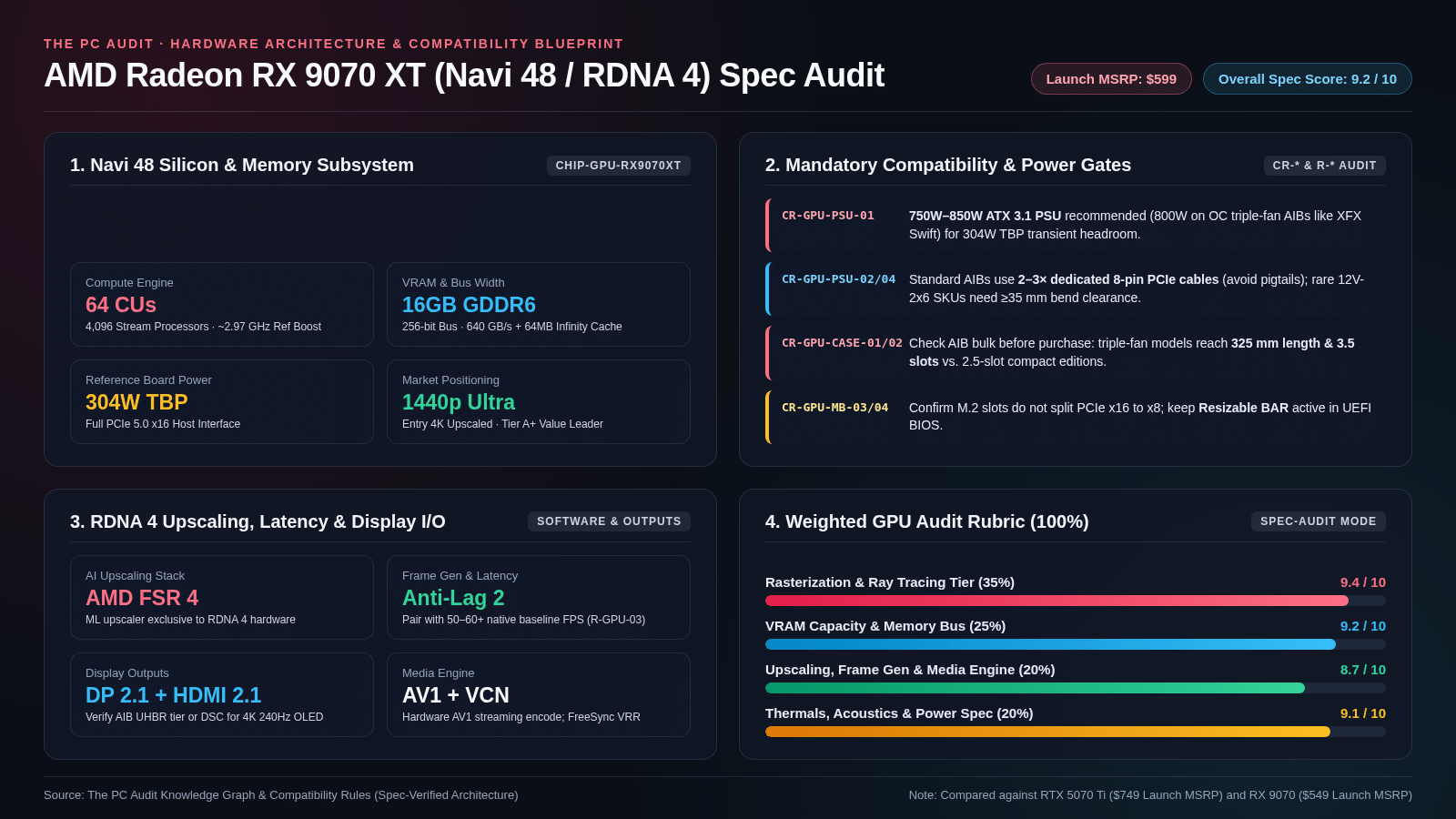
On paper and in specification value, the AMD Radeon RX 9070 XT (CHIP-GPU-RX9070XT) is the cleanest 16GB graphics card value proposition in the upper-midrange market at its $599 Launch MSRP. While NVIDIA’s competing RTX 5070 Ti starts $150 higher at $749 Launch MSRP and the cheaper RTX 5070 drops to 12GB of VRAM, AMD equips Navi 48 with 64 Compute Units (4,096 Stream Processors), a full 256-bit GDDR6 bus, and 64MB of Infinity Cache paired with ML-powered AMD FSR 4.
Overall Spec Audit Score: 9.2 / 10
- Rasterization & Ray Tracing Tier (35%): 9.4 / 10
- VRAM Capacity & Memory Bus (25%): 9.2 / 10
- Upscaling, Frame Gen & Media Engine (20%): 8.7 / 10
- Thermals, Acoustics & Power Spec (20%): 9.1 / 10
Pros
- 16GB GDDR6 on a wide 256-bit bus avoids 8GB/12GB texture bottlenecks
- $599 Launch MSRP undercuts RTX 5070 Ti ($749 Launch MSRP) while matching 16GB capacity
- Conventional dual/triple 8-pin power connectors on most AIB cards simplify PSU swaps
- Exclusive RDNA 4 machine-learning AMD FSR 4 upscaling, Anti-Lag 2, and DisplayPort 2.1
Cons
- GDDR6 trails GDDR7 peak memory bandwidth, and ray-tracing / path-tracing stacks favor Blackwell
- 304W reference TBP runs ~84W hotter than the 220W RX 9070 and demands 750W–850W ATX 3.1 headroom
- Third-party AIB retail markups can push street tiers near RTX 5070 Ti territory, erasing value
Buy It If: You play AAA games at 1440p Ultra or upscaled 4K, want 16GB VRAM longevity near $599 Launch MSRP without paying a Blackwell ray-tracing premium, and prefer proven 8-pin PCIe power cabling. Skip It If: Heavy path tracing, DLSS 4 Multi-Frame Generation, or CUDA workstation pipelines anchor your workflow—or if street markups push a custom RX 9070 XT within striking distance of an RTX 5070 Ti.
Verified Technical Specifications & Navi 48 Architecture
Evaluating the RX 9070 XT cleanly requires separating the base silicon card (CHIP-GPU-RX9070XT) from partner retail cards (PRD-GPU-*). Architecture, compute-unit count, bus width, VRAM capacity, and reference TBP belong to the Navi 48 chip, whereas physical length, slot thickness, fan count, display port mix, and factory boost clocks vary per AIB SKU.
In AMD’s RDNA 4 hierarchy, the RX 9070 XT enables all 64 Compute Units (4,096 Stream Processors) with a ~2.97 GHz reference boost clock and 304W reference TBP over a full PCIe 5.0 x16 host link. Never compare Stream Processor counts directly against NVIDIA’s 8,960 CUDA Cores on the Blackwell GB203 die; shader execution per clock differs fundamentally between RDNA 4 and Blackwell architectures. Likewise, while NVIDIA pairs the RTX 5070 Ti with 28 Gbps GDDR7 (~896 GB/s raw bandwidth), AMD pairs 16GB of GDDR6 across a 256-bit bus (20 Gbps, or 640 GB/s on the ASRock Steel Legend) with 64MB of on-die Infinity Cache to keep 1440p and 4K texture throughput fed while holding down Launch MSRP.
| Specification | AMD Radeon RX 9070 XT | AMD Radeon RX 9070 | NVIDIA RTX 5070 Ti | NVIDIA RTX 5070 |
|---|---|---|---|---|
| Architecture / Die | AMD RDNA 4 (Navi 48) | AMD RDNA 4 (Navi 48) | NVIDIA Blackwell (GB203) | NVIDIA Blackwell (GB205) |
| Shader / Compute | 64 CUs / 4,096 SP | 56 CUs / 3,584 SP | 8,960 CUDA Cores | 6,144 CUDA Cores |
| VRAM & Bus Width | 16GB GDDR6 (256-bit) | 16GB GDDR6 (256-bit) | 16GB GDDR7 (256-bit) | 12GB GDDR7 (192-bit) |
| Host Interface | PCIe 5.0 x16 | PCIe 5.0 x16 | PCIe 5.0 x16 | PCIe 5.0 x16 |
| Reference Power | ~304W TBP | ~220W TBP | 300W TGP | 250W TGP |
| Power Plugs | 2–3× 8-pin (some 12V-2×6) | 2× 8-pin | 1× 16-pin 12V-2×6 | 1× 12V-2×6 or 8-pin |
| Site PSU Tier | 750W–850W ATX 3.1 | 750W ATX 3.1 | 750W–850W ATX 3.1 | 750W–850W ATX 3.1 |
| Upscaling Stack | AMD FSR 4 (ML) | AMD FSR 4 (ML) | DLSS 4 + MFG (2×–4×) | DLSS 4 + MFG (2×–4×) |
| Launch MSRP | $599 Launch MSRP | $549 Launch MSRP | $749 Launch MSRP | $549 Launch MSRP |
That $50 gap between the $599 Launch MSRP RX 9070 XT and the $549 Launch MSRP RX 9070 highlights how aggressively AMD segmented Navi 48: stepping up buys 8 extra Compute Units (~14% more shader hardware) and roughly 450 MHz higher reference boost clocks in exchange for an 84W power increase (304W vs. 220W). Meanwhile, compared with our RTX 5070 Ti vs. RX 9070 XT showdown, AMD keeps full 16GB memory headroom at $150 below NVIDIA’s $749 Launch MSRP, forcing the $549 RTX 5070 to defend the same budget tier with only 12GB GDDR7 on a narrower 192-bit bus.
Workload & Resolution Ceiling: 1080p, 1440p, 4K & Upscaling
Because The PC Audit operates in strict spec-audit mode without claiming first-party lab measurements, exact per-game FPS or decibel figures are not fabricated here (no verified data available yet for cross-SKU thermal/FPS tables). Instead, architectural limits dictate clear resolution ceilings across 1080p, 1440p, and 4K gaming.
1080p Esports & CPU Ceilings
At 1080p high refresh rates, the RX 9070 XT rarely hits its GPU ceiling; instead, single-thread CPU throughput and L3 cache dominate frame pacing and 1% Lows (CR-GPU-CPU-01). Pairing Navi 48 with an older budget processor leaves compute shaders idling during competitive matches, so 1080p buyers should pair this tier with a modern 3D V-Cache or current-gen desktop CPU—or step down to the 220W RX 9070.
1440p Ultra Sweet Spot & 4K Upscaled Headroom
High-refresh 1440p is the RX 9070 XT’s home court. Having 16GB of GDDR6 across a 256-bit bus eliminates the VRAM bottleneck that threatens 8GB and tight 12GB cards when Unreal Engine 5 titles load ultra-resolution texture packs alongside hardware ray tracing (R-GPU-01). At 4K, native rendering pushes 64 Compute Units hard in path-traced scenes, making AMD FSR 4 essential to sustain smooth frame rates.
AMD FSR 4 vs. DLSS 4 Multi-Frame Generation & Baseline FPS Rules
RDNA 4 marks AMD’s transition from shader-based FSR 3.1 to machine-learning-accelerated AMD FSR 4, which officially runs on RX 9000-series silicon only. As detailed in our DLSS 4 vs. FSR 4 vs. XeSS 2 technical breakdown, FSR 4 closes much of the temporal image-stability gap against NVIDIA’s transformer DLSS 4 Super Resolution and decisively outpaces software fallback paths of Intel XeSS 2 (whose XMX path remains strongest on Intel Battlemage Arc cards). However, NVIDIA retains broader native AAA integration plus exclusive 3×/4× DLSS 4 Multi-Frame Generation on RTX 50-series GPUs.
Whichever frame-generation stack you enable, apply our baseline rule (R-GPU-03): frame generation multiplies displayed motion smoothness rather than input responsiveness. Keep native raster performance above a 50–60+ native baseline FPS floor before enabling frame interpolation, and always pair it with AMD Anti-Lag 2 (or NVIDIA Reflex on GeForce) to contain end-to-end latency. For streamers and video editors, RDNA 4’s upgraded VCN media engine provides hardware AV1 encoding, though NVIDIA’s dual 9th-gen NVENC with 4:2:2 10-bit support and CUDA ecosystem still lead heavy creator suites.
Compatibility, Power & Clearance Audit (CR-* & R-* Gates)
Never treat an RX 9070 XT build as “compatible” until every applicable HARD rule clears and every CONDITIONAL or SOFT caveat matches your exact chassis, motherboard, and power supply. Below are the mandatory buyer alerts and rule checks from our Knowledge Model.
Mandatory Buyer Alerts — Power, Connectors & Physical Fit:
1. PSU Wattage & 304W Transients (CR-GPU-PSU-01/03 & R-PSU-01): AMD’s chip-level vendor minimum varies by partner board (VERIFY per AIB spec sheet—for example, PowerColor specifies a 750W Minimum System Power on its Reaper SKU whereas ASRock recommends an 800W PSU on its Steel Legend model). Our site build rule recommends a quality 750W–850W ATX 3.1 / PCIe 5.1 unit so 2×–3× millisecond power excursions never trip legacy over-power protection.
2. Dual/Triple 8-Pin vs. 12V-2×6 Cable Discipline (CR-GPU-PSU-02/04 & ISS-GPU-12V2X6-MELT): Most RX 9070 XT partner models use 2–3× standard 8-pin PCIe plugs—run one dedicated cable per socket and never use daisy-chained pigtails. For the minority of RX 9070 XT SKUs (or RTX 5070 Ti rivals) using 12V-2×6, there are community reports of melted 16-pin connectors (according to community reports, not officially confirmed as a widespread hardware defect); use a native ATX 3.1 cable, seat it until fully latched, and preserve >= 35 mm side-panel clearance (CR-GPU-CASE-04, R-CASE-02).
3. AIB Length & 2.9–3.5-Slot Bulk (CR-GPU-CASE-01/02/03): Reference specs do not govern AIB shroud sizes. While the PowerColor Reaper stays at 289 × 111 × 41 mm, partner models such as the ASRock Steel Legend measure 298 × 131 × 58 mm (2.9-slot) and flagship triple-fan editions exceed 325+ mm and 3.5 slots, requiring anti-sag support and careful subtraction if a front AIO radiator is mounted.
| Rule Code | Level | Audit Condition & Practical Requirement |
|---|---|---|
CR-GPU-MB-01 | HARD | Motherboard must provide a physical PCIe x16 slot (standard on ATX, mATX, and Mini-ITX boards). |
CR-GPU-MB-03 | CONDITIONAL | Verify motherboard manual before filling secondary M.2 slots so GPU PCIe lanes stay at x16 instead of splitting to x8. |
CR-GPU-MB-04 | CONDITIONAL | Keep Resizable BAR (AMD SAM) and Above 4G Decoding enabled in UEFI BIOS for full 16GB VRAM mapping. |
CR-GPU-PSU-01 | HARD / SOFT | Match or exceed AIB SKU wattage recommendation (750W on PowerColor Reaper; 800W on ASRock Steel Legend; 750W–850W ATX 3.1 site tier). |
CR-GPU-PSU-02/04 | HARD / SOFT | Use separate dedicated 8-pin PCIe cables (no pigtails); use a native 12V-2×6 cable if buying a 16-pin AIB model. |
CR-GPU-CASE-01/02 | HARD | Check exact AIB length (289 mm Reaper, 298 mm Steel Legend, up to 325+ mm flagships) and slot width against case limits; use a sag bracket. |
CR-GPU-CASE-03/04 | CONDITIONAL / SOFT | Subtract front radiator + fan thickness (~52–60 mm) from max GPU clearance; maintain >=35 mm power-connector glass clearance (R-CASE-02). |
CR-SSD-GPU-01 | CONDITIONAL | Avoid tall third-party NVMe heatsinks in an M.2 slot tucked directly beneath a 2.9–3.5-slot GPU backplate. |
CR-GPU-MON-01..04 | CONDITIONAL / INFO | Pair with 1440p 165Hz–360Hz or 4K 120Hz+ FreeSync/VRR displays via DisplayPort 2.1 (DSC if bandwidth exceeds UHBR tier); plug into GPU, not motherboard. |
Best System Pairings & Verified AIB Picks / Alternatives
To avoid CPU and PSU bottlenecks, pair an RX 9070 XT with an AMD Ryzen 7 9800X3D (or Ryzen 5 9600X / Ryzen 7 7800X3D) on a B850 motherboard, 32GB (2×16GB) DDR5-6000 CL30 EXPO memory, a 2TB PCIe 4.0 DRAM+TLC NVMe SSD, and a unit from our best 850W ATX 3.1 power supplies guide inside an airflow mesh mid-tower. On the display side, Navi 48 pairs cleanly with panels from our best 1440p gaming monitors roundup.
The four live-verified Amazon US retail graphics cards below cover three distinct-brand AMD Radeon RX 9070 XT AIB designs—a sub-300 mm dual-8-pin Steel Legend build, an ultra-compact 289 mm Reaper edition, and a WINDFORCE triple-fan Gaming OC variant—alongside a compact 16GB GDDR7 NVIDIA RTX 5070 Ti SFF rival.
| Verified Pick & Role | Best For | VRAM & Power | Cooling & Fit | Amazon |
|---|---|---|---|---|
| ASRock RX 9070 XT Steel Legend Sub-300mm Dual-8-Pin Pick | Dual-8-pin mid-tower builds (verify live checkout price) | 16GB GDDR6 (20 Gbps) · 2× 8-pin · 800W PSU | 2.9-Slot Triple Fan (298 mm) | Check Price |
| PowerColor Reaper RX 9070 XT Compact 289 mm SFF Pick | Tighter mATX / ITX trays & 750W PSUs | 16GB GDDR6 · 2× 8-pin · 750W Min PSU | Slim Triple Fan (289 × 111 × 41 mm) | Check Price |
| GIGABYTE RX 9070 XT Gaming OC WINDFORCE Triple-Fan Pick | High-airflow ATX cases & RGB builds | 16GB GDDR6 · PCIe 5.0 (verify AIB specs) | WINDFORCE Hawk Fan + Conductive Gel | Check Price |
| ZOTAC RTX 5070 Ti Solid SFF OC Blackwell 16GB SFF Rival | Heavy RT, DLSS 4 MFG & compact rigs | 16GB GDDR7 (28 Gbps) · PCIe 5.0 | IceStorm 2.0 (3× 90mm BladeLink) | Check Price |
| Buyer Scenario | Recommended Card | Engineering Rationale |
|---|---|---|
| Balanced 1440p Mid-Tower Value | ASRock RX 9070 XT Steel Legend | Sub-300 mm reinforced metal frame, 2,970 MHz boost clock, and 2× 8-pin cabling with 800W PSU spec. |
| Compact Case & 750W PSU Fit | PowerColor Reaper RX 9070 XT | Only 289 × 111 × 41 mm with a 750W minimum PSU spec—buy only when seller markup avoids $900+ pricing. |
| WINDFORCE Cooling Alternative | GIGABYTE RX 9070 XT Gaming OC | Combines Hawk fans with server-grade thermal conductive gel; confirm exact chassis fit and MSRP gap first. |
| Max Ray Tracing & DLSS 4 | ZOTAC RTX 5070 Ti Solid SFF OC | 28 Gbps GDDR7, DLSS 4 MFG, 3× DP 2.1b, and a bundled support stand justify moving up from AMD if prices converge. |
1. ASRock Radeon RX 9070 XT Steel Legend 16GB — Sub-300mm Dual-8-Pin Pick

Quick Specs: 64 CUs (up to 2,970 MHz Boost / 2,400 MHz Game Clock) | 16GB GDDR6 256-bit (20 Gbps) | PCIe 5.0 | 2× 8-Pin PCIe (800W PSU Recommended) | DisplayPort 2.1a + HDMI 2.1b | 298 × 131 × 58 mm (2.9-Slot, Reinforced Metal Frame) | Tier: Mid-upper tier (starting at $599 Launch MSRP; check live cart seller)
The ASRock Steel Legend hits a practical mechanical sweet spot for mid-tower builders: at 298 mm long and 2.9 slots thick, it avoids the 325+ mm sprawl of massive flagship shrouds while retaining triple fans, a reinforced metal frame, and Polychrome SYNC lighting. Using two standard 8-pin PCIe plugs eliminates 16-pin adapter stress on existing modular power supplies, provided your PSU meets ASRock’s 800W recommendation (CR-GPU-PSU-01, CR-GPU-CASE-01/02). Because Amazon buybox stock can fluctuate tightly, verify final checkout pricing before ordering so third-party offers stay near MSRP tiers.
Pros
- Sub-300 mm (298 mm) reinforced metal frame fits most ATX mid-towers cleanly
- Two standard 8-pin PCIe plugs with 2,970 MHz Boost and 20 Gbps GDDR6
Cons
- 2.9-slot thickness (58 mm) blocks tight adjacent expansion slots
- 800W PSU recommendation requires checking legacy 650W–750W units first
Verdict: Buy it when stocked near MSRP if you want full 2,970 MHz Navi 48 specs and dual 8-pin cabling under 300 mm. Skip it if marketplace sellers inflate pricing.
2. PowerColor Reaper AMD Radeon RX 9070 XT 16GB GDDR6 — Compact 289 mm Pick

Quick Specs: AMD RDNA 4 (RX 9070 XT) | 16GB GDDR6 (256-bit) | 2× 8-Pin PCIe (750W Minimum System Power) | 3× DisplayPort 2.1 + 1× HDMI 2.1 | 289 × 111 × 41 mm | Tier: $900+ tier (watch live markup vs. $599 Launch MSRP)
PowerColor’s Reaper is one of the tightest full-spec RX 9070 XT boards in retail circulation, trimming physical dimensions down to just 289 × 111 × 41 mm while listing a 750W Minimum System Power requirement and two standard 8-pin PCIe plugs. That slim 41 mm profile preserves front radiator headroom in compact ATX, mATX, and roomier SFF cases (CR-GPU-CASE-01/03). Keep a strict eye on live Amazon third-party pricing, however: when scarce stock pushes this listing into the $900+ tier, it erases the RX 9070 XT’s MSRP value edge.
Pros
- Compact 289 × 111 × 41 mm chassis footprint clears front radiators and slim trays
- 750W minimum PSU rating and two 8-pin connectors ease existing-build drops
Cons
- Slimmer 41 mm heatsink offers less passive thermal mass than thicker triple-slot shrouds
- Low stock and $900+ third-party pricing overlap RTX 5070 Ti retail tiers
Verdict: Buy it if compact 289 mm length and 750W dual-8-pin compatibility matter and live stock returns near MSRP. Skip it at $900+ markups.
3. GIGABYTE Radeon RX 9070 XT Gaming OC 16G — WINDFORCE Triple-Fan OC Pick

Quick Specs: AMD RDNA 4 (RX 9070 XT) | 16GB GDDR6 (256-bit) | PCIe 5.0 | WINDFORCE Cooling System (Hawk Fan + Server-Grade Thermal Conductive Gel + RGB) | Model: GV-R9070XTGAMING OC-16GD | Tier: $900+ tier (watch live markup vs. $599 Launch MSRP)
GIGABYTE’s Gaming OC pairs AMD’s RX 9070 XT silicon and PCIe 5.0 interface with its revamped WINDFORCE cooling assembly, combining high-pressure Hawk fans, RGB lighting, and server-grade thermal conductive gel in place of conventional thick thermal pads. Because Amazon’s US product bullets omit exact millimeter shroud dimensions, factory OC boost clock, and power connector count, always verify those exact mechanical specifications on GIGABYTE’s official product sheet before buying (we never guess unlisted SKU measurements per guardrail G-09). Watch street pricing closely to avoid $900+ third-party inflation.
Pros
- WINDFORCE Hawk fan assembly paired with server-grade thermal conductive gel
- Full 16GB GDDR6 256-bit Navi 48 performance with integrated RGB styling
Cons
- Amazon listing omits exact mm length and PSU connector specs—verify vendor sheet first
- Live $900+ pricing eliminates AMD’s cost advantage over Blackwell 16GB rivals
Verdict: Buy it if you favor GIGABYTE’s WINDFORCE cooling and find it discounted near MSRP. Verify exact case clearance first, and skip $900+ listings.
4. ZOTAC Gaming GeForce RTX 5070 Ti Solid SFF OC 16GB — Direct Blackwell Alternative

Quick Specs: NVIDIA Blackwell (DLSS 4, 2,482 MHz Boost Clock) | 16GB GDDR7 256-bit (28 Gbps) | PCIe 5.0 | IceStorm 2.0 (3× 90mm BladeLink fans, FREEZE Fan Stop) | 3× DP 2.1b + 1× HDMI 2.1b | Model: ZT-B50710J3-10P | Tier: $900+ tier (starting at $749 Launch MSRP)
Detailed at the architecture level in our NVIDIA RTX 5070 Ti spec audit, ZOTAC’s Solid SFF OC is the direct cross-vendor rival whenever RX 9070 XT markups climb toward $750–$900+ or when heavy ray tracing, DLSS 4 Multi-Frame Generation, and 28 Gbps GDDR7 bandwidth justify NVIDIA’s ecosystem. It pairs IceStorm 2.0 triple 90mm BladeLink cooling, composite heatpipes, and a pass-thru metal backplate with a bundled GPU support stand—though you should still confirm exact SFF case length and ATX 3.1 12V-2×6 power cabling clearances (>=35 mm side panel) on ZOTAC’s spec sheet before ordering.
Pros
- 28 Gbps GDDR7, DLSS 4 MFG, 3× DisplayPort 2.1b, and SFF-focused IceStorm 2.0 shroud
- Metal backplate and GPU support stand included in the box
Cons
- $749 Launch MSRP (and higher $900+ street stock) sits well above $599 RX 9070 XT MSRP
- Blackwell 12V-2×6 cabling requires strict latch seating and >=35 mm panel clearance
Verdict: Buy it if path tracing, DLSS 4 MFG, or CUDA creation justifies paying above AMD’s $599 tier—especially if street RX 9070 XT prices sit too close.
Scoring Methodology & Audited Configurations We Disqualified
Our 9.2 / 10 spec-audit score applies The PC Audit’s mandatory 100% GPU rubric: Rasterization & Ray Tracing Tier (35%), VRAM Capacity & Memory Bus (25%), Upscaling, Frame Gen & Media Engine (20%), and Thermals, Acoustics & Power Spec (20%). All specifications and release statuses are cross-checked strictly against released 2025–2026 retail SKUs in our Knowledge Graph.
Configurations & Listings Disqualified During This Audit (R-GPU-01, R-GPU-02, R-PSU-01):
1. Overpriced 8GB GPUs Above Mid-Range Thresholds (R-GPU-01): Any 8GB SKU priced near or above $350–$400 faces immediate VRAM exhaustion in modern 1440p Ultra texture packs and frame-generation buffers; step up to a 16GB model (RX 9060 XT 16GB / RX 9070 / RX 9070 XT) or 12GB Arc B580 in budget tiers.
2. Inflated $900+ Third-Party RX 9070 XT Listings: Paying $900+ for an RX 9070 XT destroys its $599 Launch MSRP advantage and pushes buyers straight into RTX 5070 Ti ($749 Launch MSRP) and RTX 5080 ($999 Launch MSRP) territory.
3. Legacy Non-ATX 3.1 PSUs & Pigtail 8-Pin Splitting (R-PSU-01, CR-GPU-PSU-03/04): Running a 304W TBP card off an aging sub-750W unit or daisy-chained single-cable pigtails risks nuisance OCP shutdowns under rapid load transients.
4. Rumored / Unreleased GPUs Excluded (R-GPU-02): Reports of an RTX 5070 Super (rumored 18GB GDDR7) and RTX 5080 Super (rumored 24GB GDDR7) remain strictly RUMORED_UNRELEASED (confidence D) and are excluded from retail buying recommendations.
Authoritative Non-Affiliate References & FAQs
- AMD Official Radeon Desktop Graphics Specifications — RDNA 4 architecture, Compute Units, and FSR 4 platform documentation.
- NVIDIA Official DLSS 4 Technology Overview — Cross-vendor upscaling and Multi-Frame Generation architecture reference.
- PCI-SIG Specifications — PCIe 5.0 x16 host interface and mechanical/power connector standards.
- VESA DisplayPort Standards — DisplayPort 2.1 link bandwidth and Display Stream Compression (DSC) specifications.
- Cybenetics PSU Efficiency & Acoustics Certification — ATX 3.1 transient load and acoustic baseline standards for 750W–850W power supplies.
Is 16GB GDDR6 on the RX 9070 XT enough compared with GDDR7 on the RTX 5070 Ti?
Yes for 1440p and upscaled 4K gaming. Having 16GB across a full 256-bit bus prevents texture stutter far better than 12GB cards, while AMD’s 64MB Infinity Cache offsets much of GDDR6’s lower raw pin speed relative to GDDR7.
What PSU wattage do I need for an AMD Radeon RX 9070 XT?
Plan for a quality 750W to 850W ATX 3.1 (80+ Gold or Cybenetics Gold+) power supply. Because Navi 48 draws 304W reference TBP and partner cards range from 750W minimum (PowerColor Reaper) up to 800W recommended (ASRock Steel Legend), 850W provides clean headroom with separate 8-pin cables.
Do all RX 9070 XT graphics cards use 8-pin connectors instead of 12V-2×6?
Most RX 9070 XT partner models use two or three conventional 8-pin PCIe plugs, though a few AIB editions use a 16-pin 12V-2×6 connector. Always verify the exact AIB product page before ordering and seat any 16-pin cable straight with 35 mm side clearance.
Does AMD FSR 4 work on older Radeon RX 7000 or NVIDIA GPUs?
Officially, no. Machine-learning AMD FSR 4 requires RDNA 4 AI hardware found exclusively in RX 9000-series GPUs such as the RX 9070 XT and RX 9070. Older Radeon and third-party GPUs continue using algorithmic FSR 3.1 or Intel XeSS DP4a fallbacks.
Should I buy an RX 9070 XT if street prices exceed $750–$900?
No. The RX 9070 XT earns its value crown near its $599 Launch MSRP. If retail markups push an AIB RX 9070 XT above $750 or into the $900+ bracket, an MSRP RTX 5070 Ti or RTX 5080 becomes the stronger architectural buy.
Final Verdict: Should You Buy the AMD Radeon RX 9070 XT?
When stocked near its $599 Launch MSRP, the AMD Radeon RX 9070 XT earns our 9.2 / 10 spec-audit rating as the standout 1440p Ultra value GPU of its generation. Its 16GB GDDR6 256-bit subsystem, RDNA 4 Navi 48 compute engine, exclusive AMD FSR 4 upscaler, and hassle-free 8-pin power cabling deliver long-term durability without forcing a PSU overhaul—as long as your case clears 289–325+ mm triple-fan AIB dimensions and you refuse inflated third-party markups.


