
Disclosure: As an Amazon Associate, The PC Audit earns from qualifying purchases. If you buy through links on this page, we may earn a small commission at no extra cost to you.
This NVIDIA RTX 5070 Ti spec audit evaluates whether NVIDIA’s upper-midrange Blackwell card earns its place beneath the RTX 5080 in our best graphics cards for gaming guide. Starting at $749 Launch MSRP with 16GB GDDR7 across a 256-bit bus, it targets 1440p Ultra gaming and entry 4K rigs.
Because NVIDIA built zero Founders Edition units, every retail RTX 5070 Ti is an AIB partner card ranging from 2.5-slot SFF-Ready boards to 3.125-slot coolers priced above $900—making silicon specs, 300W 12V-2×6 power tolerances, and case clearance mandatory checks.
In This Audit
NVIDIA RTX 5070 Ti Spec Audit: Summary Verdict & Scorecard
The RTX 5070 Ti hits the memory-bandwidth sweet spot of NVIDIA’s Blackwell lineup. Unlike the 12GB RTX 5070 on a 192-bit bus, it inherits the cut-down GB203 die and 256-bit GDDR7 ring from the RTX 5080, pushing 896 GB/s within a 300W TGP limit.
Overall Spec Audit Score: 9.1 / 10
- Rasterization & Ray Tracing Tier (35%): 9.0 / 10
- VRAM Capacity & Memory Bus (25%): 9.3 / 10
- Upscaling, Frame Gen & Media Engine (20%): 9.5 / 10
- Thermals, Acoustics & Power Spec (20%): 8.5 / 10
Pros
- 16GB GDDR7 across a 256-bit bus (896 GB/s) clears 12GB limits
- DLSS 4 Multi-Frame Generation, Reflex, and DisplayPort 2.1b UHBR20
- Dual NVENC (4:2:2 10-bit / AV1) and full PCIe 5.0 x16 lanes
Cons
- No Founders Edition; OC AIB cards often push above $900
- 3.125-slot coolers require sag brackets and deep case room
- 300W 12V-2×6 plug needs ATX 3.1 PSU safety and bend gap
Buy It If / Skip It If: Buy the RTX 5070 Ti for 1440p Ultra ray tracing, 4K DLSS 4 play, or 4:2:2 editing with 16GB GDDR7 longevity. Skip it if street prices approach the around $999 Launch MSRP RTX 5080—or if pure raster value outweighs ray tracing, where AMD’s RX 9070 XT leads near its around $599 Launch MSRP.
NVIDIA RTX 5070 Ti Spec Audit: GB203 Silicon & Verified Specs
Rather than stretching the RTX 5070’s GB205 chip, NVIDIA’s RTX 50-series specs build the RTX 5070 Ti on a harvested GB203 Blackwell die (TSMC 4NP). Out of 84 SMs on the RTX 5080, 70 remain active—delivering 8,960 CUDA cores, 70 fourth-gen RT cores, and 280 fifth-gen Tensor cores with the 256-bit GDDR7 ring intact (28 Gbps, 896 GB/s). Meanwhile, AMD’s RDNA 4 RX 9070 XT pairs 64 CUs (4,096 SP) with 16GB GDDR6 on a 256-bit bus plus Infinity Cache.
| Spec | RTX 5070 Ti | RTX 5080 | RTX 5070 | RX 9070 XT |
|---|---|---|---|---|
| Die | Blackwell (Cut GB203) | Blackwell (Full GB203) | Blackwell (GB205) | RDNA 4 (Navi 48) |
| Cores | 8,960 CUDA (70 SMs) | 10,752 CUDA (84 SMs) | 6,144 CUDA (48 SMs) | 64 CUs / 4,096 SP |
| VRAM | 16GB GDDR7 (256-bit) | 16GB GDDR7 (256-bit) | 12GB GDDR7 (192-bit) | 16GB GDDR6 (256-bit) |
| Bandwidth | 896 GB/s (28 Gbps) | 960 GB/s | 672 GB/s | 640 GB/s + IC |
| Power | 300W / 1x 12V-2×6 | 360W / 1x 12V-2×6 | 250W / 1x 12V-2×6 | ~304W / 2–3x 8-pin |
| I/O | PCIe 5.0 x16 / DP 2.1b | PCIe 5.0 x16 / DP 2.1b | PCIe 5.0 x16 / DP 2.1b | PCIe 5.0 x16 / DP 2.1a |
| Media | Dual NVENC (4:2:2/AV1) | Dual NVENC (4:2:2/AV1) | Single NVENC | AMD VCN (AV1) |
| MSRP | Starting at $749 | Starting at $999 | Starting at $549 | Starting at $599 |
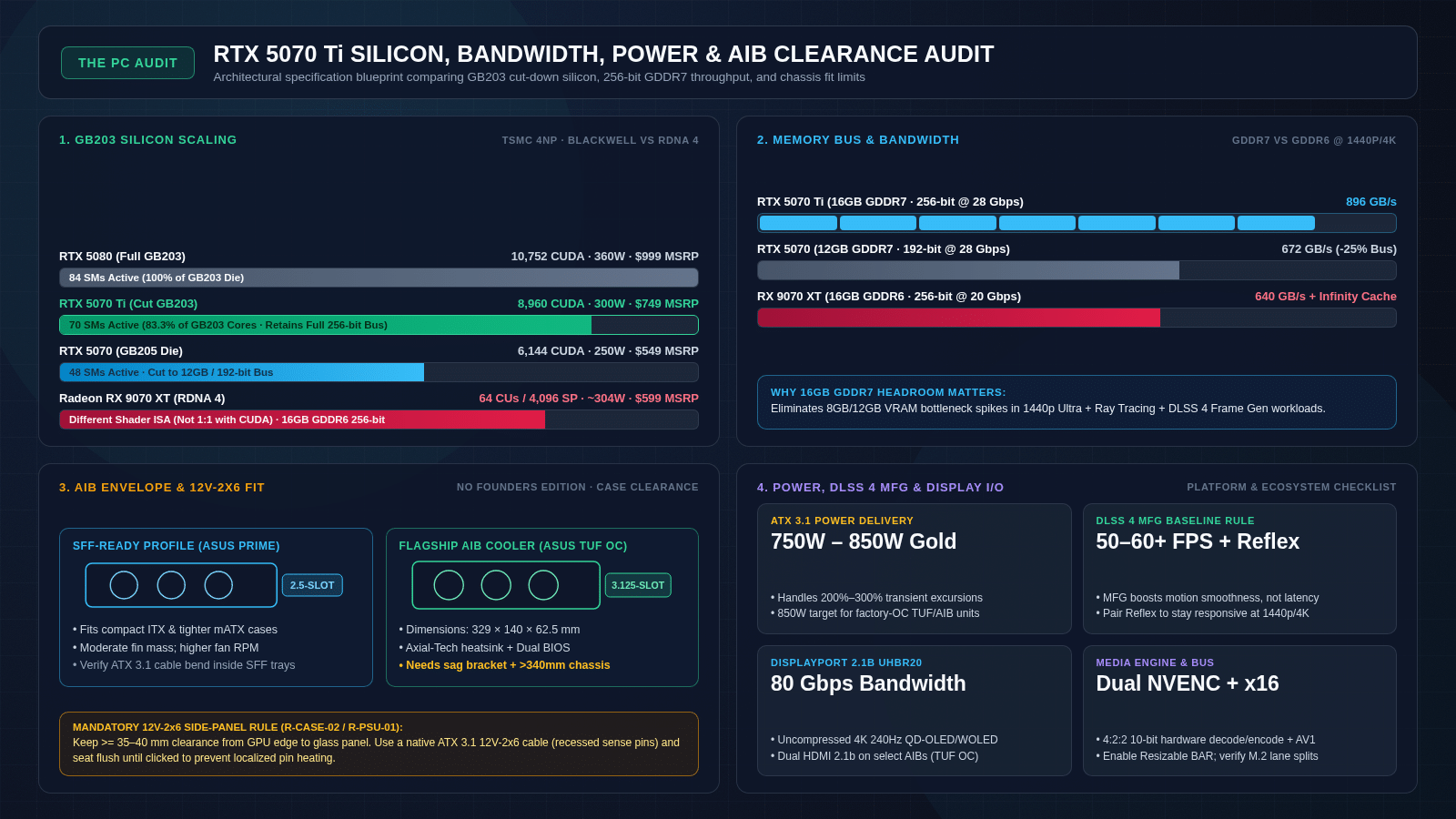
- AIB-Only Launch (No Founders Edition): Cooler dimensions vary by partner: SFF-Ready ASUS Prime cards hold 2.5 slots, whereas ASUS TUF Gaming OC units reach 3.125 slots, 329 mm, and 2,610 MHz boost.
- Dual NVENC (Gen 9) Media Engine: Unlike the single-encoder RTX 5070, the RTX 5070 Ti keeps dual Gen 9 NVENC encoders supporting 4:2:2 10-bit video and split-frame AV1.
- Rumored SKU Alert: Unannounced RTX 5070 Super (18GB GDDR7, 192-bit, 275W) and RTX 5080 Super (24GB GDDR7) SKUs remain unreleased and rumored (late 2026 / Q1 2027) and are excluded from recommendations.
Workload & Resolution Ceiling: 1080p, 1440p, 4K & Creator
1080p High-Refresh: CPU & 1% Lows Limit
At 1080p, a 300W GB203 card shifts limits onto CPU L3 cache and DDR5 latency, governing 1% Lows stability. Unless driving 360Hz+ esports monitors with a Ryzen 7 9800X3D, 1080p builders get better value from 16GB midrange tiers or Xe2 Battlemage GPUs like the Intel Arc B580 (12GB, starting under $250 Launch MSRP).
1440p Ultra + Ray Tracing: Primary Sweet Spot
At 2560×1440 and 3440×1440, Unreal Engine 5 Lumen lighting and ultra textures exceed 10GB–12GB VRAM. Our 2026 gaming VRAM guide shows why 16GB GDDR7 prevents a VRAM bottleneck and PCIe stutters. In our RTX 5070 Ti vs. RX 9070 XT comparison, Radeon matches rasterization near its around $599 Launch MSRP, while GeForce leads in heavy ray tracing.
4K Gaming, DLSS 4 MFG & DisplayPort 2.1b
At 4K, transformer NVIDIA DLSS 4 Super Resolution and DLSS 4 Multi-Frame Generation (MFG) feed high-refresh OLEDs. While AMD FSR 4 and Intel XeSS 2 improve rival upscalers, DLSS 4 holds wider AAA support. Remember the baseline rule: Frame Gen boosts motion smoothness rather than input responsiveness, so keep a 50–60+ native baseline FPS floor and pair NVIDIA Reflex (or Anti-Lag 2 on Radeon). Native DisplayPort 2.1 (UHBR20 80Gbps) and dual 4:2:2 NVENC complete creator builds.
Compatibility, 12V-2×6 PSU & Case Buyer Alerts
Mandatory Buyer Alert — Clearance, Power & Pricing Rules:
1. SFF-Ready vs. 3.125-Slot Dimensions: With no Founders Edition, verify case length: the 2.5-slot ASUS Prime OC fits SFF trays, whereas the 3.125-slot ASUS TUF Gaming OC (329 × 140 × 62.5 mm) needs a sag bracket and >340 mm space.
2. 12V-2×6 ATX 3.1 Safety: Feed the 300W GPU via a native 12V-2×6 cable (recessed sense pins) from an ATX 3.1 PSU rated for 200%–300% transients, keeping >= 35–40 mm glass panel clearance.
3. Street Markup Discipline: Compare listings above $900 against RX 9070 XT stock and the starting at $999 Launch MSRP RTX 5080 before overpaying.
PCI-SIG PCIe 5.0 x16 wiring maintains full speed on PCIe 4.0 x16 boards if secondary M.2 SSDs do not split GPU lanes to x8. Enable Resizable BAR (ReBAR) in BIOS for full 16GB frame-buffer access.
Best System Pairings & Top Verified AIB Picks
Pair an RTX 5070 Ti with a Ryzen 7 9800X3D on AMD B850 (or Core Ultra 7 270K Plus on Z890/B860), 32GB (2×16GB) DDR5-6000 CL30 RAM, a 2TB PCIe 4.0 DRAM+TLC SSD, and a unit from our best 850W ATX 3.1 power supplies guide inside an airflow mesh or dual-chamber chassis.
| Model & Role | Best For | Silicon & VRAM | Cooler Fit | Link |
|---|---|---|---|---|
| ASUS TUF Gaming RTX 5070 Ti OC Flagship Triple-Fan | Quiet acoustics & dual HDMI 2.1b | GB203 · 16GB GDDR7 | 3.125-Slot (329 mm) | View on Amazon |
| ASUS Prime RTX 5070 Ti OC SFF-Ready Compact | Mini-ITX & tight mATX rigs | GB203 · 16GB GDDR7 | 2.5-Slot SFF-Ready | View on Amazon |
| PNY RTX 5070 Ti OC Triple-Fan Streamlined AIB | Zero-RGB ATX & AI builds | GB203 · 16GB GDDR7 | Triple-Fan Shroud | View on Amazon |
| ASUS Prime Radeon RX 9070 XT OC RDNA 4 Alternative | Raster value & 8-pin PSUs | Navi 48 · 16GB GDDR6 | 2.5-Slot Triple-Fan | View on Amazon |
| Scenario | Best Match | Outcome |
|---|---|---|
| Quiet Mid-Tower | ASUS TUF Gaming RTX 5070 Ti OC | 3.125-slot cooler and Dual BIOS run quiet. |
| SFF / ITX Rig | ASUS Prime RTX 5070 Ti OC | 2.5-slot SFF-Ready sizing fits ITX trays. |
| Stealth ATX Rig | PNY RTX 5070 Ti OC Triple-Fan | Flow-through shroud avoids RGB bloat. |
| Raster / 8-Pin | ASUS Prime Radeon RX 9070 XT OC | RDNA 4 + FSR 4 uses 8-pin plugs. |
1. ASUS TUF Gaming GeForce RTX 5070 Ti 16GB GDDR7 OC — Flagship Triple-Fan Pick

Quick Specs: 2,610 MHz OC Boost | 16GB GDDR7 | 300W TBP (850W ATX 3.1 PSU) | 3x DP 2.1b + 2x HDMI 2.1b | 329 × 140 × 62.5 mm (3.125-Slot) | Tier: Upper-midrange (starting at $749 Launch MSRP)
ASUS’s TUF Gaming RTX 5070 Ti OC pairs a metal frame and 3.125-slot Axial-tech cooler with a phase-change thermal pad and Dual BIOS switch. Compared with the slimmer ASUS Prime model, it adds a second HDMI 2.1b port, 2,610 MHz boost clocks, and lower acoustic RPM at 300W.
Pros
- 3.125-slot Axial-tech heatsink and phase-change pad run quietly
- Dual HDMI 2.1b plus triple DP 2.1b UHBR20 ports
Cons
- 329 mm length and 3.125-slot bulk exclude SFF cases
- Requires sag bracket and 850W ATX 3.1 PSU space
Verdict: Buy it if your mid-tower clears 330 mm for peak acoustics and display I/O. Skip it for tight ITX rigs.
2. ASUS Prime NVIDIA GeForce RTX 5070 Ti 16GB GDDR7 OC — SFF-Ready Pick

Quick Specs: SFF-Ready 2.5-Slot Triple-Fan | 16GB GDDR7 | 12V-2×6 | PCIe 5.0 x16 | Tier: Upper retail tier (above $900)
Built to NVIDIA’s SFF-Ready profile, the ASUS Prime RTX 5070 Ti OC trims slot depth to 2.5 slots so ITX and mATX builds keep full 8,960-CUDA GB203 silicon, Dual BIOS, and a phase-change pad. Against the larger TUF unit, fans spin faster at 300W and prices frequently sit above $900.
Pros
- SFF-Ready 2.5-slot frame fits compact ITX and mATX cases
- Full 16GB GDDR7 bus, Dual BIOS, and phase-change pad
Cons
- Slender heatsink runs louder at 300W than 3.1-slot TUF
- Street pricing above $900 narrows value vs. MSRP
Verdict: Buy it for SFF cases rejecting 3.1-slot GPUs. Skip it in spacious ATX towers where thicker coolers run quieter.
3. PNY NVIDIA GeForce RTX 5070 Ti OC Triple-Fan 16GB — Streamlined Pick

Quick Specs: Triple-Fan Flow-Through Shroud | 16GB GDDR7 | 300W TGP (12V-2×6) | PCIe 5.0 x16 | Tier: Upper retail tier (above $900)
PNY’s RTX 5070 Ti OC Triple-Fan skips decorative bulk for a stealth triple-fan shroud and vented backplate. Compared with ASUS’s TUF Gaming card, it omits Dual BIOS and a second HDMI 2.1b port, making it compelling mainly near the starting at $749 Launch MSRP baseline rather than prices above $900.
Pros
- Clean stealth triple-fan shroud with backplate vent
- Full 16GB GDDR7 bandwidth, DLSS 4 MFG, and dual NVENC
Cons
- Lacks Dual BIOS switch and secondary HDMI output
- Uncompetitive above $900 beside TUF OC listings
Verdict: Buy it near Launch MSRP for stealth ATX builds. Skip it if priced identically to the better-cooled ASUS TUF Gaming OC.
4. ASUS Prime Radeon RX 9070 XT 16GB GDDR6 OC — AMD RDNA 4 Alternative

Quick Specs: RDNA 4 (64 CUs) | 16GB GDDR6 | 2.5-Slot Triple-Fan | ~304W TBP (8-pin) | Tier: Upper retail tier (above $900 in tight stock; starting at $599 Launch MSRP)
The ASUS Prime Radeon RX 9070 XT OC provides 16GB GDDR6 on a 256-bit bus inside a 2.5-slot cooler using traditional 8-pin plugs. Against the RTX 5070 Ti, it trails in path tracing, swaps DLSS 4 MFG for AMD FSR 4, and lacks dual 4:2:2 NVENC—yet excels in 1440p raster value near its around $599 Launch MSRP.
Pros
- 16GB 256-bit VRAM and strong 1440p raster value near MSRP
- Standard 8-pin power plugs plus ML-based AMD FSR 4
Cons
- Trails Blackwell in heavy ray tracing and 4:2:2 editing
- GDDR6 carries lower bandwidth than GDDR7 (640 vs. 896 GB/s)
Verdict: Buy it when priced clearly below GeForce for raster-first play. Skip it if street markups match RTX 5070 Ti tiers or you rely on DLSS 4.
AIB Buying Guide: How to Choose an RTX 5070 Ti
Every RTX 5070 Ti shares 8,960-CUDA GB203 silicon and 16GB GDDR7, so upper AIB tiers buy cooler acoustics, HDMI outputs, and chassis fit—not extra VRAM. Keep street markups disciplined against the starting at $999 Launch MSRP RTX 5080, check SFF-Ready vs. 3.125-slot clearances, and cap frames 3–5 FPS below refresh limits to curb coil whine.
Audit Methodology, Scoring Rubric & Rejected Models
The PC Audit scores hardware strictly from verified silicon datasheets, PCI-SIG and VESA standards, ATX 3.1 power specs, and AIB schematics without fabricated benchmarks:
| Criterion | Weight | What We Audited |
|---|---|---|
| Rasterization & Ray Tracing Tier | 35% | 8,960 CUDA / 70 SMs, 4th-gen RT cores, and 1440p/4K tiering. |
| VRAM Capacity & Memory Bus | 25% | 16GB GDDR7 headroom, 256-bit bus, and 896 GB/s throughput. |
| Upscaling, Frame Gen & Media Engine | 20% | DLSS 4 MFG + Reflex rules, FSR 4 / XeSS 2, and dual NVENC. |
| Thermals, Acoustics & Power Spec | 20% | AIB slot fit, 300W 12V-2×6 safety, DP 2.1b, and Dual BIOS. |
Configurations We Audited & Rejected
- 8GB GPUs Above $350 (e.g., RTX 5060 Ti 8GB): Disqualified for 1440p due to texture spillover and 1% Low stutters.
- Non-ATX 3.1 PSUs or <35 mm Clearance: Rejected for 300W transient spikes and stressed 12V-2×6 connectors.
- Rumored RTX 5070 Super / RTX 5080 Super: Excluded as unreleased rumors slated for late 2026 / Q1 2027.
- Marked-Up Cards Near $999 Launch MSRP: Excluded when street pricing erases separation below an RTX 5080.
Our complete scoring rubric and source standards are documented in the The PC Audit Hardware Audit Methodology.
Frequently Asked Questions About the RTX 5070 Ti
Does NVIDIA make a Founders Edition RTX 5070 Ti?
No, NVIDIA skipped a Founders Edition RTX 5070 Ti entirely. Every retail unit is an AIB partner card, making slot thickness, cooler length, and acoustics critical specs to compare.
What PSU wattage and cable does the RTX 5070 Ti require?
It draws 300W TGP via one 16-pin 12V-2×6 plug. Pair it with a 750W to 850W ATX 3.1 80+ Gold PSU—preferring 850W for OC models—using a native 12V-2×6 cable.
Is 16GB GDDR7 worth upgrading over the 12GB RTX 5070?
Yes, for 1440p Ultra ray tracing and 4K builds. Moving from 12GB (192-bit, 672 GB/s) to 16GB (256-bit, 896 GB/s) prevents memory-limit stutters while adding 45% more CUDA cores.
Should I wait for a rumored RTX 5070 Super instead?
No—buy verified retail silicon rather than waiting on rumors. Both the RTX 5070 Super and RTX 5080 Super remain unreleased rumors tied to uncertain late-2026 or Q1 2027 supply schedules.
Does PCIe 4.0 bottleneck the RTX 5070 Ti?
No meaningful loss occurs on PCIe 4.0 x16 slots, since the card wires all 16 lanes and packs 16GB GDDR7—just verify secondary M.2 drives do not split the GPU slot to x8.
NVIDIA RTX 5070 Ti Spec Audit: Final Verdict
Concluding this NVIDIA RTX 5070 Ti spec audit, the card scores 9.1 / 10 as Blackwell’s cleanest 1440p Ultra and entry 4K hardware pick. Inheriting cut-down GB203 silicon, 16GB 256-bit GDDR7 (896 GB/s), dual 4:2:2 NVENC encoders, and DisplayPort 2.1b UHBR20 within 300W resolves the 12GB ceiling found on lower tiers.
Match AIB size to your chassis—SFF-Ready 2.5-slot (ASUS Prime) versus 3.125-slot (ASUS TUF Gaming)—power it via ATX 3.1 850W 12V-2×6, and avoid markups above $900 near RTX 5080 pricing. For full lineup rankings, revisit our best graphics cards for gaming pillar guide.


