
Affiliate & Editorial Disclosure: As an Amazon Associate, The PC Audit earns from qualifying purchases. If you buy through verified affiliate links on this page, we may earn a small commission at no extra cost to you. Every warranty comparison, catalog trap, and component audit below is documented independently with zero sponsored placements.
Direct Buyer Alert: Amazon Renewed vs. New Prebuilt Gaming PC
Evaluating an amazon renewed vs new prebuilt gaming pc comes down to warranty math and hidden hardware risk. Standard Amazon Renewed desktops drop manufacturer coverage for a 90-day replacement guarantee, while third-party refurbishers routinely swap power supplies, ship missing GPU foam, or bundle obsolete 4GB–6GB cards in old office chassis. Lock Condition: New unless a Renewed listing carries a 25%–35% discount and passes every specification checkpoint below.
On Amazon, refurbished gaming towers look tempting on Page 1 because they often sit right beside factory-sealed 2026 builds at lower sticker prices—sometimes surfaced by default when shoppers forget to filter out pre-owned inventory. Yet behind a clean studio photo and a generic “1-Year Warranty” or “Renewed” badge, a refurbished gaming desktop carries drastically different financial and mechanical risk than a retail system shipped new from a major manufacturer or system integrator.
Unlike a small USB accessory or an office monitor, a modern desktop packed with a heavy triple-fan graphics card, an ATX power supply, an NVMe SSD, and liquid cooling tubes faces steep transit, thermal, and warranty hazards if handled outside OEM factory packaging. Using the same 10-axis framework behind The PC Audit’s guide on how to audit every selectable PC component on Amazon, this buyer guide dissects standard Amazon Renewed versus Renewed Premium versus factory-new desktops—showing exactly when a refurbished discount is worth taking and when buying Condition: New protects your wallet.
Inside This Warranty & Risk Audit
- 10-Axis Dissection: Renewed vs. New Amazon Headlines & Hidden Realities
- Warranty & Policy Audit: 90-Day Guarantee vs. Renewed Premium vs. Factory New
- Catalog & Search Traps: Broken Filters, Mixed Condition & Review Pooling
- Silicon, VRAM & Chipset Traps Inside Renewed vs. Budget New Rigs
- Hidden Component Downgrades, Shipping Damage & Silent Hardware Wear
- When Renewed Makes Financial Sense: The 25%–35% Risk-Adjusted Rule
- Pre-Checkout 60-Second & Day-1 Verification Checklist
- Clean Alternatives: 4 Specification-Transparent Condition: New Builds
- Frequently Asked Questions
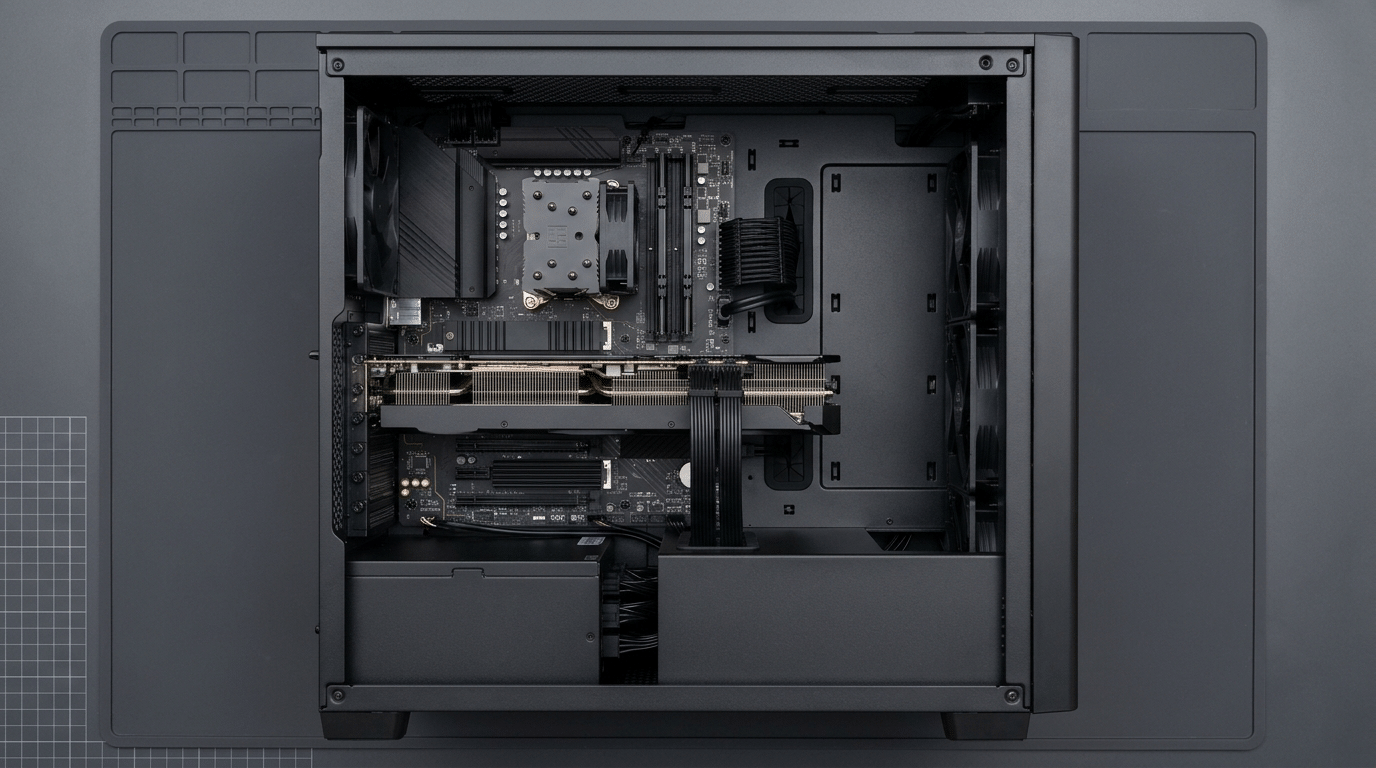
10-Axis Dissection: Renewed vs. New Amazon Headlines & Hidden Realities
Whether a desktop carries an Amazon Renewed badge or ships factory-sealed, the product title only advertises two parts while leaving eight critical subsystems vague or concealed. When comparing an amazon renewed vs new prebuilt gaming pc across our 10-axis hardware model, refurbished listings double the uncertainty because third-party liquidators frequently swap internal parts before resale.
| Component / Listing Element | What Amazon Headline Shows | What Is Often Hidden or Omitted | How to Verify in 30 Seconds |
|---|---|---|---|
| 1. GPU & VRAM | “RTX Graphics”, “12GB Video Card”, or sidebar “8 GB & above” | Legacy 4GB–6GB cards (RX 6500 XT, RTX 3050 6GB), mining wear, or “Brand may vary” | Verify exact chip + VRAM in bullets; avoid 8GB cards above $1,100 and legacy 4GB–6GB tiers |
| 2. CPU & Cache | “Core i7 Gaming”, “Ryzen 7”, or messy selector duplicates | Old 8th–10th Gen office silicon in Renewed towers, or Ryzen 7 8700F 16MB L3 cuts | Match exact SKU string (e.g., 9800X3D vs. 8700F vs. 265F) and generation on active variant |
| 3. Motherboard | Omitted entirely or vague “RGB Gaming Board” | Proprietary Dell/HP office boards, bare VRMs, or i9-14900KF paired with locked B760 | Confirm standard AM5 B850/X870 or ATX Z-series boards via specs, Q&A, and rear I/O photos |
| 4. System RAM | “16GB DDR5” or “32GB High-Speed Memory” | Single-stick 1x16GB bottlenecks, loose DDR5-4800 CL42–46, or mismatched Renewed DIMMs | Require 2-stick dual-channel spacing (A2/B2) and target 32GB DDR5-6000+ in mid/high rigs |
| 5. NVMe SSD | “1TB SSD” or “2TB NVMe Gaming Storage” | Used SSD write-wear/TBW on Renewed units, 500GB caps, or DRAM-less QLC drives | Check for at least 1TB NVMe; run SMART wear diagnostics immediately after delivery on Renewed |
| 6. CPU Cooling | “Liquid Cooled” or “RGB Tower Cooler” | Aged AIO pump wear/evaporation on Renewed units, or tiny 120mm AIOs on 170W+ CPUs | Inspect photos for mesh front airflow plus 240mm/360mm radiators or dual-tower air coolers |
| 7. Power Supply (PSU) | Completely omitted wattage and efficiency badge | Third-party Renewed PSU swaps, non-modular Bronze units, or missing ATX 3.1 / 12V-2×6 | Mandate explicit wattage + 80+ Gold minimum and ATX 3.1 transient protection for modern GPUs |
| 8. Networking | “Wi-Fi Ready” or USB dongle included | Stealth Wi-Fi 5 (802.11ac) cards in $1,500–$3,000 towers or cheap USB dongles on Renewed | Confirm built-in Wi-Fi 6E or Wi-Fi 7 plus 2.5GbE/5GbE Ethernet in specs and rear antenna jacks |
| 9. Case & Packaging | Panoramic glass showcase or sleek black chassis | Choked solid front glass panels, <35mm GPU cable bend room, or missing inner shipping foam | Verify perforated mesh/side intake and molded GPU shipping foam; inspect PCIe slot on arrival |
| 10. OS, Seller & Condition | “Amazon Renewed”, “Renewed Premium”, or “Windows 11” | Mixed New/Renewed search rows, 90-day limit, non-OEM accessories, and void OEM warranties | Lock sidebar Condition to “New” or verify Renewed Premium 365-day terms and seller invoice |
Warranty & Policy Audit: 90-Day Guarantee vs. Renewed Premium vs. Factory New
Most buyers assume “Amazon Renewed” works just like buying a factory-new desktop with a lightly discounted price tag. In reality, clicking the Renewed condition pill fundamentally rewrites who stands behind your hardware when a power supply pops, an AIO cooler pump stalls, or a graphics card develops artifacting in month six.
1. Standard Amazon Renewed (90-Day Guarantee vs. 30-Day + Asurion Variants)
Standard Amazon Renewed desktops are typically sold by third-party liquidators, IT asset disposition firms, or independent refurbishers rather than the original PC maker. Under Amazon’s baseline Renewed program, qualified purchases are backed by the 90-day Amazon Renewed Guarantee—allowing a replacement or full refund within 90 days of receipt if the tower fails to operate, arrives damaged, or differs materially from the listing. Note that specific standard listings instead substitute a 30-day seller return window paired with an 11-month Asurion limited warranty, so read the exact guarantee badge under the Buy Box before purchasing.
Standard Renewed listings span multiple cosmetic grades (Acceptable, Good, and Excellent). While Excellent requires no visible scratches from 12 inches away, Good and Acceptable towers may arrive with chassis dents, scuffed tempered glass, generic third-party mice and keyboards, and plain brown corrugated shipping cartons lacking molded factory foam inserts.
2. Amazon Renewed Premium (365-Day Guarantee)
Amazon Renewed Premium raises the bar meaningfully for desktop buyers: it extends the Amazon-backed replacement and refund window from 90 days to a full 365 days (1 year), restricts cosmetic grading strictly to Excellent (no visible blemishes at 12 inches), enforces stricter refurbisher diagnostic validation, and mandates original OEM-branded peripherals rather than generic dollar-bin accessories. The catch is pricing: Renewed Premium gaming desktops frequently sit only 8% to 15% below brand-new promotional sales—a razor-thin margin that rarely compensates for prior hardware wear.
3. Factory New Prebuilts (First-Owner OEM Warranties & Invoice Provenance)
Buying a factory-sealed Condition: New tower—ideally Shipped & Sold by Amazon or an authorized brand storefront—preserves your original retail invoice. That first-owner invoice unlocks full manufacturer coverage: 1-year parts/labor plus lifetime tech support on major integrators like CyberPowerPC, 2-year parts / 3-year labor on STORMCRAFT systems, 1-year Dell Onsite Service on Alienware desktops, or split component warranties such as ZOTAC’s 1-year system plus 3-year GPU warranty. More importantly, it preserves clean RMA eligibility if an individual retail GPU or motherboard fails well past day 90.
The Non-Transferable OEM Warranty Trap
Never assume that a nearly new 2025 or 2026 PC sold as Amazon Renewed still carries two years of leftover manufacturer warranty. Across major PC hardware brands, warranty terms explicitly target the original retail purchaser:
- System Integrators (e.g., CyberPowerPC): Written warranty policies specify coverage extends solely to the buyer named on the original company invoice; transfer of ownership voids remaining system coverage, and official factory-refurbished outlet units carry strictly short 60-day parts terms.
- Graphics Card & Motherboard Brands (ASUS, MSI, NVIDIA): NVIDIA Founders Edition warranties apply strictly to the original buyer with an original receipt. ASUS and MSI policies formally define coverage as non-transferable from the first retail purchaser; while MSI RMA portals may fall back to serial-number manufacture dates when an invoice is missing, unauthorized refurbished stock or previously registered serial numbers can trigger warranty rejection or severely truncated timelines.
| Protection & Risk Dimension | Standard Amazon Renewed | Amazon Renewed Premium | Condition: New (Authorized Seller) |
|---|---|---|---|
| Core Warranty Window | 90-day Amazon Renewed Guarantee (or 30-day + 11-mo Asurion) | 365-day (1-year) Amazon Renewed Premium Guarantee | 1–3 years OEM system/GPU coverage (3–10 yrs on DIY parts) |
| Manufacturer RMA Eligibility | Usually void or truncated without original first-owner invoice | Covered via Amazon Premium, not direct OEM first-owner policy | Full first-owner invoice coverage + official OEM RMA access |
| Cosmetic & Packaging Standard | Acceptable/Good/Excellent grades; generic box & generic peripherals | Pristine from 12 in; OEM-matched peripherals; upgraded packaging | Factory-sealed retail carton, internal expanding GPU foam, unused |
| Internal Component Integrity | High risk of refurbisher PSU/SSD swaps or leftover thermal wear | Stricter diagnostic compliance, though prior runtime still exists | Zero prior SSD TBW wear, fresh thermal paste, factory wiring |
| Required Discount vs. New | Needs 25%–35%+ savings to offset post-90-day repair liability | Needs 15%–20%+ savings below active New sale pricing | Baseline retail benchmark (best long-term cost-per-year value) |
Catalog & Search Traps: Broken Filters, Mixed Condition & Review Pooling
Before comparing internal hardware specs, buyers have to navigate two storefront behaviors on Amazon that blur the boundary between aging refurbished systems and legitimate 2026 releases.
1. Mixed Condition Search & Broken Left-Sidebar Filters (R-AMZ-01)
Unless you deliberately scroll down the left-hand sidebar and lock Condition: New, Amazon desktop searches blend Renewed, Used, and brand-new listings on the same first page. Compounding the confusion, Amazon’s left-sidebar facets suffer severe technical blind spots documented in our Amazon gaming PC sidebar filter audit: the Graphics Memory filter stops at “8 GB & above” (hiding 8GB vs. 12GB vs. 16GB tiers completely), the Graphics Processor menu still surfaces legacy labels like Radeon RX 500, Vega, and Intel HD, and memory capacity checkboxes merge old DDR4 systems with current DDR5 platforms. Never rely on sidebar checkboxes to guarantee modern specs or new condition.
2. Parent ASIN Review Pooling & Messy CPU Selectors (R-AMZ-02)
On high-traffic /dp/ pages, sellers frequently bundle wildly different hardware generations inside a single Set name or Style selector under one Parent ASIN. As detailed in our investigation of Amazon prebuilt review pooling on /dp/ pages, an outdated configuration like 2600 | 1660Ti often shares the exact same 1,000+ star review pool as a modern 9850X3D | 9070XT system—and third-party Renewed variants sometimes sit on that same parent page or copy duplicated CPU selector strings ("AMD Ryzen 7", "AMD Ryzen 7 8700 F", "AMD Ryzen 7 8700F"). Always click your exact configuration, switch reviews to “This format only”, and inspect recent customer photos to verify whether buyers received New factory units or sloppy Renewed repacks.
Silicon, VRAM & Chipset Traps Inside Renewed vs. Budget New Rigs
Many shoppers wander into the Amazon Renewed aisle because they hold an $800 to $1,100 budget and hope to score higher frame rates than a new entry desktop can deliver. Unfortunately, both Renewed and low-end Page-1 listings harbor severe silicon traps.
Legacy Office Conversions & 4GB–6GB GPU Traps (R-AMZ-04)
Browse Renewed gaming desktops under $800 and you will repeatedly encounter decommissioned corporate office PCs (often running 8th-to-10th Gen Intel CPUs and proprietary non-ATX motherboards) or older AM4 DDR4 builds (Ryzen 5 5500) paired with Radeon RX 6500 XT 4GB, GeForce RTX 3050 6GB, or clearance RTX 3060 Ti 8GB graphics cards. A 4GB or 6GB framebuffer runs out of memory quickly in modern AAA releases even at 1080p, while proprietary office-tower power supplies lock out future GPU upgrades.
Even more telling, current-generation new GPUs have crushed the old Renewed value argument: NVIDIA’s RTX 5060 ($299 Launch MSRP), AMD’s RX 9060 XT ($299 Launch MSRP for 8GB; $349 Launch MSRP for 16GB), and Intel’s 12GB Arc B580 ($249 Launch MSRP, when Resizable BAR is enabled in BIOS) bring modern DLSS 4, FSR 4, or XeSS 2 upscaling and full warranties into affordable brackets. If your budget sits below $1,000, consult our audit of the best prebuilt gaming PCs under $1,000 or weigh a DIY build using our prebuilt vs. custom gaming PC cost and warranty audit rather than buying an outdated 4GB–6GB Renewed rig.
The 8GB VRAM Ceiling Above $1,100 (R-GPU-01)
Above the $1,100 tier, buying either a Renewed RTX 3070/4060 Ti 8GB tower or a New RTX 5060 / 8GB RTX 5060 Ti ($379 GPU Launch MSRP) tower runs into the exact same 8GB VRAM bottleneck. At 1440p Ultra settings or with hardware ray tracing enabled, 8GB cards suffer texture streaming stutters and sharp 1% Low dips. Prioritize 12GB to 16GB VRAM cards (RTX 5070 12GB at $549 Launch MSRP, RX 9070 GRE 12GB OEM/prebuilt, RTX 5060 Ti 16GB at $429 Launch MSRP, RX 9070 16GB at $549 Launch MSRP, or RX 9070 XT 16GB at $599 Launch MSRP) whenever your budget reaches 1440p gaming territory. Also remember that rumors around unreleased models like the RTX 5070 Super and RTX 5080 Super remain unconfirmed—never delay or skew a retail audit around rumored hardware.
OEM CPU Caveats & K-SKU + B760 Mismatches (R-AMZ-03 & R-AMZ-04)
Watch two common processor compromises across both New and Renewed Amazon desktops:
- AMD Ryzen 7 8700F (AM5): Widely used in prebuilts, this 8-core / 16-thread chip sits on the upgradeable AM5 socket, but its Phoenix silicon cuts L3 cache to 16MB (half that of a Ryzen 5 9600X / 9700X and one-sixth of the 96MB L3 on a Ryzen 7 9800X3D) and limits usable PCIe 4.0 connectivity to 16 lanes with no integrated GPU. It still games capably and leaves a drop-in upgrade path to 3D V-Cache later on an AMD B850 motherboard, provided you discount its price against full-cache Zen 5 builds.
- Intel Core Ultra 7 265F (LGA 1851): Common in newer OEM prebuilts, this 20-core processor delivers cool hybrid multi-core output up to 5.3 GHz, but the
Fsuffix strips integrated graphics and Intel Quick Sync hardware video acceleration. - Unlocked Core i9-14900KF on Locked Intel B760 (R-AMZ-04): Especially dangerous in Amazon Renewed condition. Pairing a high-wattage unlocked i9 with a basic B760 motherboard blocks CPU multiplier tuning and often stresses lighter VRM power phases. Buying that combo second-hand introduces unknown prior thermal abuse or microcode history—avoid it completely in Renewed listings.
Hidden Component Downgrades, Shipping Damage & Silent Hardware Wear
Why do Amazon Renewed towers fail at higher rates between month four and month twelve than factory-new desktops? Four physical failure modes account for nearly every post-90-day headache.
1. Omitted Power Supplies, Refurbisher Swaps & ATX 3.1 Safety (R-AMZ-05 & R-PSU-01)
As uncovered in our audit of omitted PSU specs and Brand May Vary listings, countless $1,000–$1,500 pages hide exact PSU wattage, 80+ Bronze versus 80+ Gold ratings, and ATX 3.1 certification—while collapsed #prodDetails tables fill with catalog noise such as Screen Size: 0.01 or Cache Size: 8. On Renewed systems, third-party refurbishers often strip out faulty factory units and install cheap group-regulated replacement power supplies lacking ATX 3.1 transient protection (built to absorb 200%–300% GPU power spikes) and native 12V-2×6 connectors with recessed sense pins. Never assume a refurbished rig contains an 80+ Gold ATX 3.1 PSU unless the sticker is physically verified through the shroud.
2. Stealth Wi-Fi 5, Single-Stick 1x16GB RAM & DDR5-4800 (R-AMZ-06 & R-RAM-01)
Even expensive $1,500–$3,000 desktops frequently ship hidden Wi-Fi 5 and DDR5-4800 downgrades. Shipping a single 1x16GB DDR5 stick instead of dual-channel 2x16GB DDR5-6000 CL30 cuts memory bandwidth in half and drops 1% Low framerates by 15% to 30%, while outdated Wi-Fi 5 (802.11ac) wireless cards throttle home gigabit fiber connections. Worse, Renewed units missing internal PCIe wireless cards often ship with tiny USB 2.0 Wi-Fi dongles tossed into the accessory pouch—turning an apparent bargain into an immediate $80–$150 upgrade bill.
3. Missing GPU Internal Foam & Fractured PCIe Slots
Modern RTX 5070, RTX 5070 Ti, RX 9070 XT, and RTX 5080 graphics cards weigh several pounds. Factory-new builders inject expanding polyurethane foam packs inside the chassis cavity to brace the GPU heatsink against parcel carrier drops. Third-party Amazon Renewed resellers regularly re-box towers in plain corrugated cardboard with loose bubble wrap on the outside only—leaving heavy graphics cards cantilevering off the motherboard PCIe x16 slot during transit. Even a hairline PCB trace crack around the PCIe retention latch can behave normally at idle and trigger random black screens weeks later.
4. Silent NVMe Wear, Dried Thermal Paste & Choked Glass Airflow (R-SSD-02 & R-CASE-01)
A brand-new 1TB or 2TB PCIe 4.0 TLC NVMe drive starts at 100% endurance health. A refurbished drive may carry heavy prior terabytes written (TBW) on a cheap DRAM-less QLC drive already nearing its write-cliff performance collapse—especially when sellers clone Windows onto budget 500GB replacement SSDs during refurbishment. Simultaneously, pre-owned 120mm or 240mm AIO liquid coolers accumulate pump bearing wear and fluid permeation over years of prior ownership, while solid unvented front glass cases trap heat and push GPU and CPU temperatures past thermal throttling limits.
When Renewed Makes Financial Sense: The 25%–35% Risk-Adjusted Rule
We do not reject every refurbished desktop blindly—but you should apply strict risk-adjusted math rather than getting hypnotized by a generic percentage badge next to a crossed-out list price.
- Skip Standard Renewed Under 20% Savings: If a Standard 90-day Amazon Renewed gaming desktop only saves 10% to 15% versus a comparable Condition: New tower in the same budget bracket (such as $1,100–$1,500), pass immediately. One out-of-warranty PSU replacement, 1TB TLC SSD swap, or Wi-Fi 6E card erases the entire savings while leaving zero OEM GPU warranty.
- Target at Least 25%–35% True Discount Against Current New Alternatives: Standard Renewed only pencils out when verified savings equal at least 25% to 35% below an equivalent current-generation New desktop (not against inflated old MSRP claims on discontinued RTX 30-series stock), leaving enough cash cushion to cover a fresh 750W ATX 3.1 PSU or dual-channel DDR5 upgrade if needed.
- Verify Standard ATX Architecture Before Considering Any Renewed Tower: Only consider refurbished towers built with off-the-shelf ATX/mATX parts (such as CyberPowerPC, Skytech, MSI Codex, or ZOTAC MEK) rather than proprietary Dell, Alienware, HP, or Acer chassis where a post-90-day PSU or motherboard failure totals the entire PC. Review our 10 prebuilt gaming PC red flags checklist before finalizing any used or renewed order.
Pre-Checkout 60-Second & Day-1 Verification Checklist
Follow these seven non-negotiable steps on every Amazon desktop product page—plus our Day-1 arrival audit—to eliminate surprise downgrades and protect your return window:
- Lock Condition & Check Warranty Badge: Set the search sidebar strictly to Condition: New unless intentionally hunting Renewed Premium (365-day guarantee). On Renewed pages, confirm whether the guarantee is 90 days, 365 days, or 30-day + Asurion.
- Audit Seller Fulfillment: Prefer “Shipped & Sold by Amazon” on New systems so your invoice carries clean first-owner provenance for direct manufacturer warranties.
- Isolate the Exact Variant & Filter Reviews: Select your exact CPU, GPU, and RAM tier in the Set name dropdown, then filter reviews to “This format only” to strip out pooled legacy ratings.
- Scrub
#prodDetailsCatalog Noise: Ignore glitched auto-populated lines (Screen Size: 0.01,Cache Size: 8) and confirm real specs inside manufacturer bullet points and Q&A. - Verify All 10 Hardware Axes: Confirm 12GB–16GB VRAM for 1440p+, full-cache AM5/LGA 1851 CPU model, non-proprietary motherboard, 2-stick dual-channel DDR5, at least 1TB NVMe SSD, 240mm/360mm AIO or dual-tower air cooler, explicit 80+ Gold ATX 3.1 PSU, Wi-Fi 6E/7, and perforated front mesh airflow.
- Inspect the Interior Upon Arrival (Day 1): Before powering on any prebuilt—especially Renewed—open the side panel to verify internal protective foam removal, unbent
12V-2x6GPU power seating, solid PCIe retention latch alignment, two RAM sticks seated in slots A2/B2, and the physical PSU label wattage. - Run Day-1 Software & SMART Validation: Immediately after setup, follow our post-build BIOS and Windows optimization checklist to verify EXPO/XMP speed and Resizable BAR, inspect SSD health/power-on hours via CrystalDiskInfo (critical on Renewed drives), and monitor temperatures and 12V rail stability with HWiNFO64 under sustained OCCT or 3DMark load loops well inside your return window.
Clean Alternatives: 4 Specification-Transparent Condition: New Builds
Rather than gambling on a 90-day Amazon Renewed lottery with unknown SSD wear and voided OEM coverage, these four verified Condition: New desktops deliver transparent ATX hardware, modern Blackwell or RDNA 4 silicon, and clean first-owner warranty protection across mainstream to enthusiast budget brackets.
1. MSI Codex R2 Gaming Desktop (A14NVL5-454US) — Best Sub-$1,200 Amazon-Direct New Pick

Budget Tier: Value mid-range (under $1,200; roughly $1,100–$1,200) | Audited Specs: Intel Core i5-14400F (10C/16T: 6P+4E, up to 4.7 GHz, 20MB L3) | NVIDIA GeForce RTX 5060 8GB GDDR7 | 16GB DDR5-6000 | 1TB M.2 NVMe SSD | 80+ Gold PSU (650W class) | ARGB Air Cooler | Wi-Fi 6E, Front & Rear USB-C | Shipped & Sold by Amazon.
Renewed vs. New Audit Verdict: Priced tightly against many inflated Amazon Renewed RTX 30-series towers, the MSI Codex R2 eliminates every major refurbished risk upfront. Because it is Shipped & Sold by Amazon in factory-new condition, you lock in an authorized MSI retail invoice, untouched NVMe SSD longevity, a documented 80+ Gold 650W-class PSU, fast DDR5-6000 memory instead of 4800 MT/s cuts, and built-in Wi-Fi 6E inside a standard MSI ATX chassis. Honest Caveat: Its 8GB RTX 5060 ($299 GPU Launch MSRP) targets 1080p High/Ultra gaming rather than texture-heavy 1440p Ultra settings, and LGA 1700 lacks multi-gen CPU socket longevity compared to AM5.
Audit Passes: Shipped & Sold by Amazon invoice; documented 80+ Gold PSU; DDR5-6000; Wi-Fi 6E; standard MSI ATX parts.
Watch Items: 8GB VRAM limit at 1440p Ultra (R-GPU-01); 16GB RAM fits 1080p today with space to expand later.
2. ZOTAC MEK Gaming PC White — Best Multi-Year Manufacturer Warranty Transparency
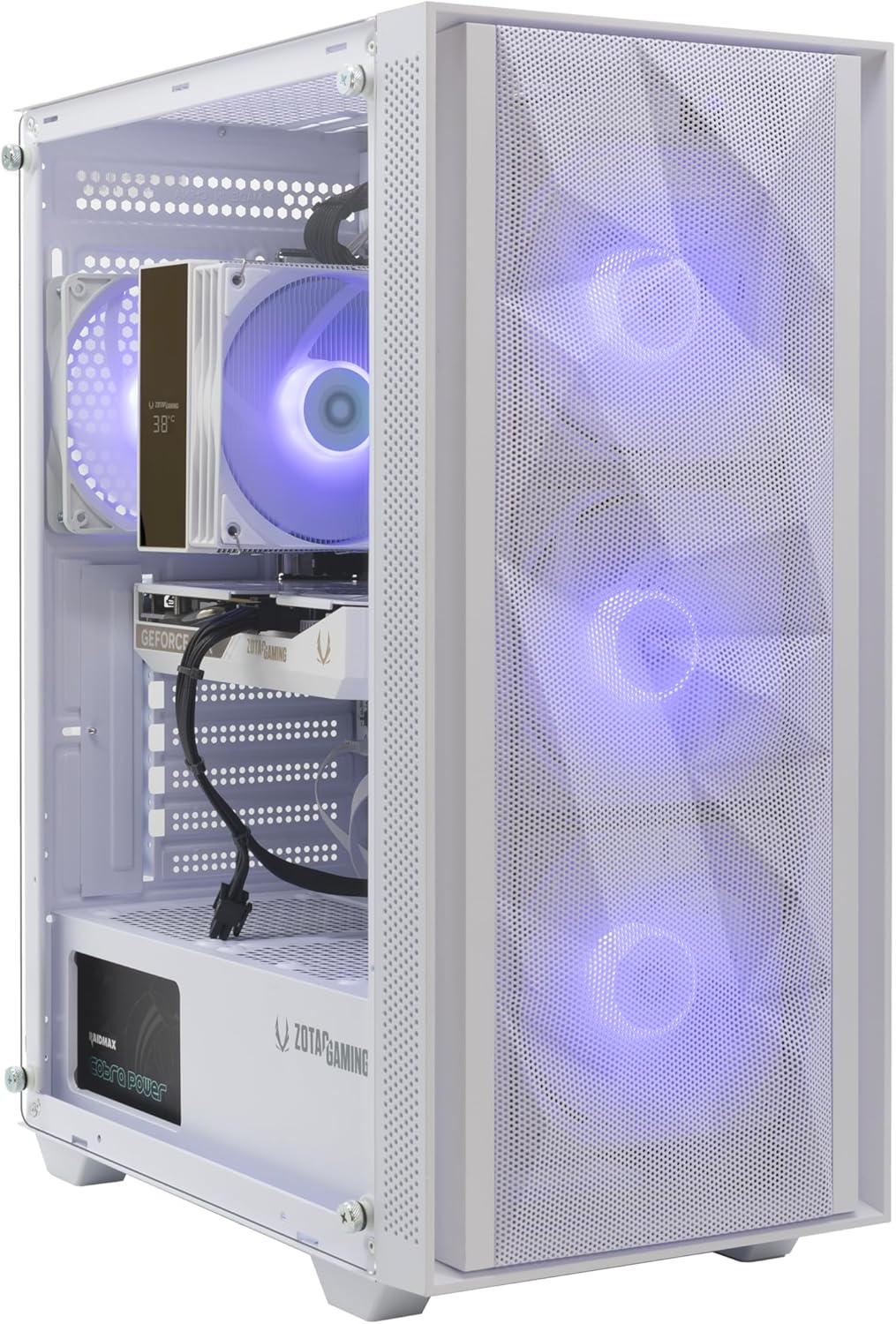
Budget Tier: Mid-upper tier (roughly $1,200–$1,350) | Audited Specs: AMD Ryzen 5 9600X (6C/12T Zen 5, up to 5.4 GHz, 32MB L3, AM5) | ZOTAC GAMING GeForce RTX 5060 8GB GDDR7 | 16GB Dual-Channel DDR5-5200 RGB | 1TB NVMe M.2 SSD | 650W 80+ Gold PSU | Mesh Front, 4x 120mm RGB Fans, Temp Display | Wi-Fi 6E, 5GbE LAN | 1-Yr System + 3-Yr ZOTAC GPU Warranty.
Renewed vs. New Audit Verdict: Few prebuilt pages illustrate the warranty gap against 90-day Amazon Renewed units as starkly as the ZOTAC MEK White. Buying new secures a 1-year full system warranty plus a 3-year ZOTAC GPU warranty—twelve times longer graphics protection than Standard Renewed. Under the hood, ZOTAC discloses a full-cache Zen 5 Ryzen 5 9600X (32MB L3 on AM5, dodging 8700F cuts), explicit Dual-Channel DDR5, a 650W 80+ Gold PSU, perforated mesh airflow, and Wi-Fi 6E + 5GbE LAN. Honest Caveat: Like other 8GB RTX 5060 towers, 8GB VRAM remains best suited to 1080p gaming, and DDR5-5200 leaves room to step up to 32GB DDR5-6000 CL30 later.
Audit Passes: 1-Yr System + 3-Yr GPU Warranty; explicit Dual-Channel RAM; 650W 80+ Gold PSU; Zen 5 AM5 CPU; Mesh airflow + Wi-Fi 6E/5GbE.
Watch Items: 8GB VRAM ceiling above $1,100; DDR5-5200 trails optimal 6000 CL30 AM5 speeds.
3. MSI Codex Z2 (A8NVP-436US) — Best 12GB VRAM & 2TB Storage New AM5 Upgrade Platform

Budget Tier: Upper Prebuilt Tier (Under $1,850) | Audited Specs: AMD Ryzen 7 8700F (8C/16T, 16MB L3, 16 Usable PCIe 4.0 Lanes, AM5) | NVIDIA GeForce RTX 5070 12GB GDDR7 | 32GB DDR5 | 2TB NVMe SSD | Standard MSI ATX AM5 Motherboard | 4-Fan Airflow + ARGB Air Cooler | Windows 11 Home, USB Type-C.
Renewed vs. New Audit Verdict: Shoppers tempted by Renewed $1,500+ RTX 4070 towers gain far cleaner longevity stepping into a factory-new RTX 5070 12GB ($549 GPU Launch MSRP) build with 32GB DDR5, an untouched 2TB NVMe SSD, and DLSS 4 Multi-Frame Generation support (remembering to maintain a 50–60 base FPS baseline paired with NVIDIA Reflex). MSI builds on a 100% standard retail ATX AM5 motherboard, avoiding proprietary OEM lock-in. Honest Caveat: Apply rules R-AMZ-03 and R-AMZ-05 strictly—the Ryzen 7 8700F trims L3 cache to 16MB without an iGPU, and the listing omits PSU wattage on the headline. Still, standard ATX AM5 lets you swap in a Ryzen 7 9800X3D ($479 CPU Launch MSRP) or ATX 3.1 PSU cleanly down the road.
Audit Passes: 12GB GDDR7 RTX 5070 clears 8GB ceilings; 32GB DDR5 + fresh 2TB NVMe; standard MSI ATX AM5 upgrade path.
Watch Items: Ryzen 7 8700F carries 16MB L3 cache ceiling; verify PSU label wattage and dual-channel RAM speed on Day 1.
4. Lenovo Legion Tower 5 (2026) — Best 16GB VRAM, 9800X3D & Wi-Fi 7 Enthusiast New Rig

Budget Tier: Enthusiast tier (around $2,250–$2,350) | Audited Specs: AMD Ryzen 7 9800X3D (8 cores / 16 threads, 96MB L3 3D V-Cache, AM5) | AMD Radeon RX 9070 XT 16GB GDDR6 | 32GB DDR5 | 1TB NVMe SSD | 850W PSU | Wi-Fi 7 (802.11be) + 2.5GbE LAN | Eclipse Black Tower 5 Chassis | Windows 11 Home.
Renewed vs. New Audit Verdict: At the $2,000+ mark, buying an unverified Renewed machine is financial Russian roulette—especially when a brand-new Legion Tower 5 pairs AMD’s premier Ryzen 7 9800X3D (96MB 3D V-Cache for razor-flat 1% Lows) with the 16GB Radeon RX 9070 XT ($599 GPU Launch MSRP), 32GB DDR5, a disclosed 850W PSU, and flagship Wi-Fi 7 + 2.5GbE Ethernet. Unlike legacy OEM shells, this Eclipse Black Tower 5 layout avoids proprietary lock-in and clears every R-AMZ-06 wireless and memory downgrade cleanly. Honest Caveat: A 1TB SSD fills fast with modern 150GB titles, so plan a secondary 2TB PCIe 4.0 DRAM+TLC NVMe drive later, and verify factory EXPO status on first boot.
Audit Passes: 96MB 3D V-Cache + 16GB RDNA 4 VRAM; 32GB DDR5; 850W PSU headroom; Wi-Fi 7 + 2.5GbE LAN; full new warranty.
Watch Items: 1TB base SSD warrants future secondary M.2 storage; confirm dual-channel RAM profile upon setup.
Final Verdict: Choosing Between Renewed Discounts and New Protection
Buy Condition: New When…
- Discount Is Under 25%: Narrow savings never justify losing 1-to-3-year OEM system and GPU coverage for a 90-day return window.
- Buying Heavy 1440p/4K GPUs or AIO Coolers: Factory expanding foam protects RTX 5070 / RX 9070 XT / RTX 5080 cards and untouched AIO pumps in transit.
Only Buy Renewed When…
- Discount Clears 25%–35%+ (or Renewed Premium 365-Day): Substantial upfront cash savings cover out-of-pocket upgrades or replacement parts past day 90.
- 100% Standard ATX Chassis + Day-1 Inspection: Non-proprietary ATX parts allow cheap PSU, RAM, or TLC SSD swaps if an aging component fails later.
Continue exploring verified buying protection across our marketplace series inside Guides & Optimization: return to the 10-Axis Amazon PC Component Audit Hub, compare budget tiers in Best Prebuilt Gaming PC Under $1,000 (2026), check DIY economics in Prebuilt vs. Custom Gaming PC (2026), and map long-term part swaps with our Amazon Prebuilt Gaming PC Upgrade Roadmap.
How We Audited This Guide
- Steps were validated against official BIOS, driver, and platform vendor documentation and ordered from lowest-risk to highest-risk so readers can stop as soon as the issue is resolved.
- Every specification claim was cross-checked against official OEM datasheets, platform vendor documentation, and published industry standards (PCI-SIG, JEDEC, VESA, Intel ATX) rather than marketplace listing copy.
- Recommendations were evaluated against our weighted audit rubric and documented compatibility rules; we do not publish fabricated FPS, thermal, or acoustic numbers.
Frequently Asked Questions
How long is the warranty on an Amazon Renewed gaming PC compared to a new one?
Standard Amazon Renewed desktops carry a 90-day replacement or refund guarantee (or a 30-day return plus 11-month Asurion plan on select listings), and Renewed Premium extends Amazon coverage to 365 days. Condition: New systems typically include 1-to-3-year manufacturer warranties from the builder or GPU brand.
Do manufacturer warranties transfer if I buy an Amazon Renewed prebuilt PC?
Generally no. Major builders like CyberPowerPC and GPU makers like NVIDIA limit coverage strictly to the original first-owner invoice holder, while ASUS and MSI policies also exclude second-hand transfers. Without an authorized first-owner receipt, claims can be denied or truncated to manufacture dates.
Is Amazon Renewed Premium worth buying over a brand-new prebuilt gaming PC?
Only if Renewed Premium undercuts comparable new builds by 15% to 20% or more. Because Renewed Premium often prices close to seasonal Condition: New sales, paying slightly more for a Shipped & Sold by Amazon new system usually yields better long-term warranty value and untouched SSD health.
What hidden risks should I inspect on Day 1 if I order an Amazon Renewed PC?
Open the side glass immediately to check for PCIe slot damage from missing shipping foam, confirm dual-channel RAM stick spacing, and verify the physical PSU wattage label. Then run CrystalDiskInfo for SSD wear health and HWiNFO64 stability loops inside your return window.
Why does “Shipped & Sold by Amazon” matter when buying a new gaming PC?
Buying Condition: New directly from Amazon ensures clean authorized-retailer invoice provenance when filing future manufacturer RMAs, avoids third-party refurbisher component swaps, and locks factory packaging standards—including internal GPU support foam—that protect heavy cards during delivery.
Official Standards & Technical References
- NVIDIA GeForce RTX 50-Series Blackwell Specifications: nvidia.com/en-us/geforce/graphics-cards/50-series/
- AMD Ryzen Desktop Processors & AM5 Platform Specs: amd.com/en/products/processors/desktops/ryzen.html
- Intel Core Ultra Desktop Processors Series 2 Documentation: intel.com/content/www/us/en/products/details/processors/core-ultra.html
- PCI-SIG PCIe CEM 5.1 & 12V-2×6 Power Connector Standards: pcisig.com/specifications
- Cybenetics PSU ETA Efficiency & Lambda Acoustic Database: cybenetics.com
- MSI Official Service & Product Warranty Policy Documentation: us.msi.com/page/warranty


