
On This Page
Affiliate Disclosure: As an Amazon Associate, The PC Audit earns from qualifying purchases. Product links marked as Amazon recommendations generate a commission at no added cost to you and help support our independent hardware catalog audits.
Direct Buyer Alert: Common amazon gaming pc filter sidebar mistakes stem from three structural search blind spots: Amazon’s Graphics Memory facet stops at “8 GB & above”, its Graphics Processor menu surfaces obsolete chips, and its RAM Size filter mixes DDR4 with slow single-channel DDR5. Never trust sidebar checkboxes—always verify the exact GPU model, VRAM capacity, CPU L3 cache, active Set name variant, dual-channel memory, and Condition: New status before checkout.
Shopping for a prebuilt desktop on Amazon feels straightforward until you click the left-hand navigation filters. On paper, checking boxes for Dedicated Graphics, 8 GB & above VRAM, 16 GB or 32 GB RAM, and a brand-name processor should narrow hundreds of towers down to modern, well-balanced rigs. In practice, Amazon’s catalog taxonomy was built for broad consumer electronics rather than precision PC hardware auditing. As we document across our complete 10-axis Amazon PC component audit hub, trusting the filter sidebar without inspecting the underlying specification sheet routinely funnels shoppers into 8GB VRAM bottlenecks, obsolete AM4 platforms, omitted power supplies, and multi-generation review pooling.
This marketplace guide dissects every major Amazon sidebar failure mode observed across live 2026 US catalog listings, maps what headline titles advertise against what sellers omit, and walks through a 60-second pre-checkout audit you can apply to any /dp/ page—followed by four specification-transparent builds that pass full hardware verification.
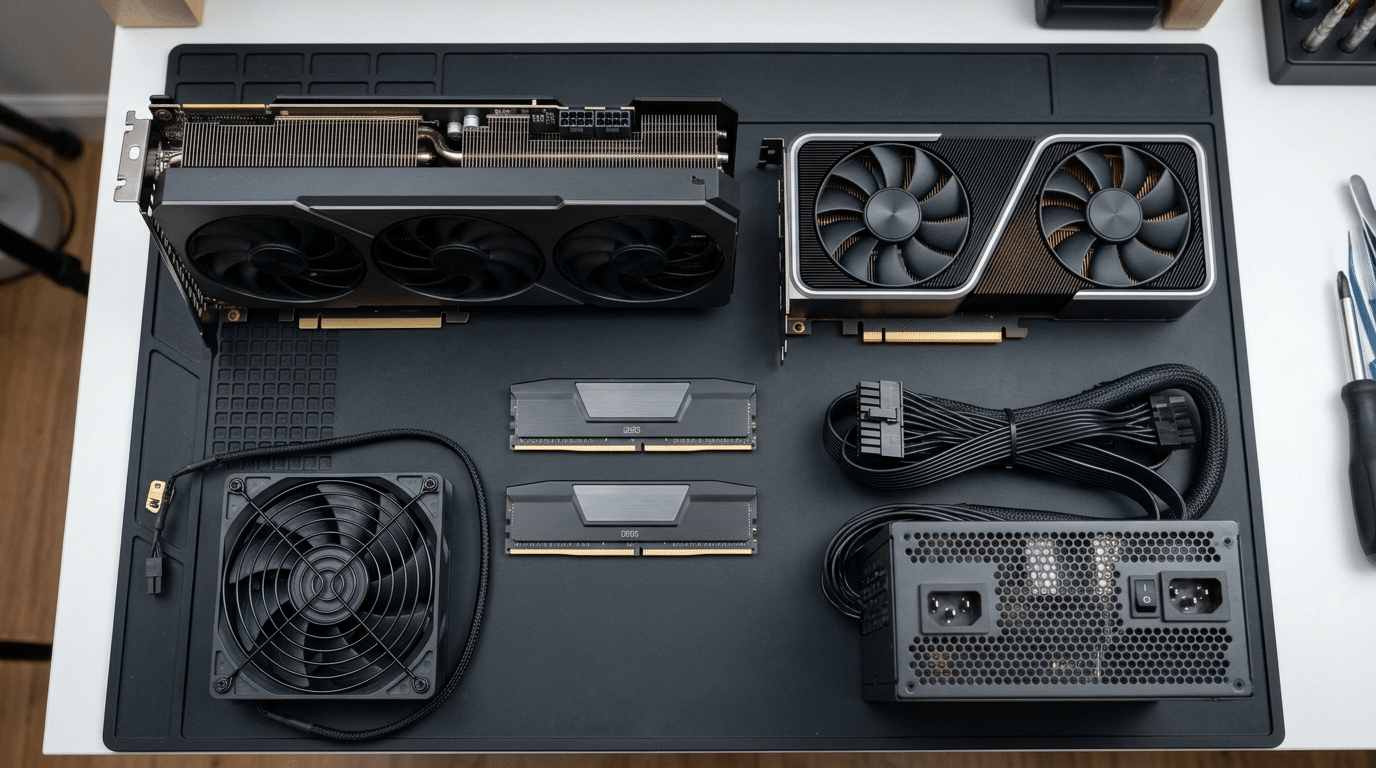
Amazon Listing Headlines vs. Hidden Hardware Reality (10-Axis Dissection)
Before diving into each sidebar trap, use this 10-axis reference table to translate what an Amazon product title or filter facet displays into what may actually be concealed inside the tower—and how to confirm the truth in thirty seconds.
| Component / Listing Element | What Amazon Headline Shows | What Is Often Hidden / Omitted | How to Verify in 30 Seconds |
|---|---|---|---|
| 1. Graphics Card (GPU) | “RTX 5070,” “RX 9070,” or sidebar “8 GB & above” | 8GB vs. 16GB variant split (RTX 5060 Ti / RX 9060 XT), OEM 12GB RX 9070 GRE vs. 16GB RX 9070, or “Brand may vary” AIB swaps | Confirm exact GPU suffix and VRAM count (8GB vs. 12GB vs. 16GB) in title bullets; check reviews for cooler size |
| 2. Processor (CPU) | “AMD Ryzen 7,” “Intel Core Ultra 7,” or duplicate 8700 F / 8700F labels | Ryzen 7 8700F carries 16MB L3 cache and 16 usable PCIe 4.0 lanes; Core Ultra 7 265F lacks iGPU and Intel Quick Sync | Check exact 4- or 5-digit SKU code; avoid vague “Ryzen 7” dropdown selections without full model string |
| 3. Motherboard Chipset | Frequently omitted entirely or listed simply as “AM5” / “Gaming Board” | Unlocked Intel i9-14900KF paired with locked B760 chipset, legacy AM4 DDR4 boards, or proprietary OEM PCBs | Expand bullet points and #prodDetails for AMD B850/X870 or Intel Z890/B860; inspect interior photos for standard ATX layout |
| 4. System Memory (RAM) | “16GB DDR5” or “32GB RAM” under merged capacity filters | DDR4 vs. DDR5 mix, single-channel 1x16GB sticks, slow DDR5-4800 MT/s, or loose CL42–CL46 timings | Look for explicit “2x16GB” and “DDR5-6000” wording; inspect customer photos for two populated DIMMs in slots A2/B2 |
| 5. Storage (NVMe SSD) | “1TB NVMe SSD” or multi-drive “5TB” bundles | SSD controller brand, presence of DRAM cache, TLC vs. DRAM-less QLC NAND endurance, and 500GB starter squeezes | Confirm PCIe 4.0 NVMe and at least 1TB capacity; check buyer Q&A for drive model or plan a secondary TLC + DRAM upgrade |
| 6. CPU Cooling | “ARGB Cooling,” “Liquid Cooled,” or omitted altogether | Undersized 120mm AIOs or slim 92mm air coolers fitted onto 170W–250W TDP/MTP CPUs | Inspect product photos: count radiator fans (two for 240mm, three for 360mm) or verify dual-tower heatpipe count |
| 7. Power Supply (PSU) | Often absent in $1,000–$1,500 listings or vaguely tagged “ATX 3” | Exact wattage, 80+ Gold efficiency, ATX 3.1 transient excursion compliance, native 12V-2×6 cable, or proprietary pinouts | Search Q&A and review photos for PSU shroud labels; prioritize listings explicitly stating 650W–850W 80+ Gold ATX 3.1 |
| 8. Networking & Wi-Fi | “Wi-Fi Ready” or “High-Speed Wireless” | Legacy Wi-Fi 5 (802.11ac) cards shipped inside $1,500–$3,000 rigs instead of Wi-Fi 6E/7 and 2.5GbE LAN | Scan #prodDetails Wireless Type line; reject $1,500+ builds stuck on 802.11ac unless budgeting for an adapter upgrade |
| 9. Case, Airflow & Extras | “Tempered Glass Panoramic,” “RGB Tower,” or “11.3-inch LCD” | Solid unvented front glass choking intake fans, tight side-panel bend space for 12V-2×6 cables, or proprietary OEM frames | Zoom into front/side panel edges for fine mesh or ventilated dual-chamber side vents and standard ATX PSU mounts |
| 10. OS & Condition | “Gaming PC Desktop,” “Windows 11,” promotional discount badges | Amazon search interleaving Renewed/refurbished units with factory-new rigs under misleading discount anchors | Lock sidebar Condition filter to “New,” confirm “Ships from / Sold by Amazon” or authorized brand store, and check Windows 11 Home/Pro |
1. Why Amazon’s “8 GB & Above” Graphics Memory Filter Traps 1440p and 4K Buyers
The single most damaging entry in any list of amazon gaming pc filter sidebar mistakes sits inside the Graphics Memory section. Amazon caps its highest dedicated video memory checkbox at “8 GB & above.” There is no separate facet for 12GB, 16GB, or 32GB graphics cards. Once you check that single box, Amazon merges entry-level 1080p cards, VRAM-constrained mid-range splits, upper-midrange 1440p boards, and flagship 4K accelerators into one undifferentiated search grid.
In 2026, treating all “8 GB & above” cards as interchangeable leads directly to buyer remorse. Modern AAA titles running high-resolution texture packs, hardware ray tracing, and frame interpolation regularly exceed 8GB of framebuffer allocation even at 1440p. Furthermore, both NVIDIA and AMD sell identically named mid-range SKUs split across 8GB and 16GB capacities: the RTX 5060 Ti ships in both 8GB and 16GB GDDR7 versions, and the RX 9060 XT ships in 8GB and 16GB GDDR6 variants. Under Amazon’s sidebar filter, a prebuilt priced above $1,100 carrying an 8GB RTX 5060 or RTX 5060 Ti 8GB looks identical at the filter level to a rig equipped with a 16GB RX 9070 XT or 16GB RTX 5080.
To make matters murkier, OEM-focused variants sit between standard retail tiers. For example, the AMD Radeon RX 9070 GRE (48 Compute Units / 3,072 stream processors, 220W TBP) carries 12GB GDDR6 on a 192-bit bus and ranks noticeably below the retail RX 9070 16GB (256-bit bus) and RX 9070 XT 16GB. Likewise, older RTX 3060 12GB systems still show up alongside current-generation Blackwell and RDNA 4 towers simply because both satisfy the “8 GB & above” bucket. And if you see product hype around rumored refreshes like the RTX 5070 Super (rumored 18GB GDDR7) or RTX 5080 Super (rumored 24GB GDDR7), remember that those models remain unreleased/rumored for late 2026 or Q1 2027—never base an active retail purchase on speculative naming.
| GPU Model (2026 Catalog) | VRAM & Memory Bus | Target Gaming Tier | Standalone Launch MSRP | Amazon Sidebar Filter Risk |
|---|---|---|---|---|
| RTX 5090 | 32GB GDDR7 (512-bit) | 4K / 8K Path Tracing + AI | Launch MSRP: $1,999 | Rarely separated from 8GB rigs in facet filtering; verify at least 1000W–1200W ATX 3.1 PSU |
| RTX 5080 | 16GB GDDR7 (256-bit) | 4K High-Refresh + RT | Launch MSRP: $999 | Often bundled on shared parent pages with older GPUs; confirm exact active variant |
| RTX 5070 Ti | 16GB GDDR7 (256-bit) | 1440p Ultra RT / Entry 4K | Launch MSRP: $749 | Frequently confused with 12GB RTX 5070 when headlines truncate “Ti” on mobile cards |
| RX 9070 XT | 16GB GDDR6 (256-bit) | 1440p Ultra Value Leader | Launch MSRP: $599 | Requires 750W–850W PSU verification; confirm 16GB XT vs. 12GB GRE OEM cards |
| RTX 5070 | 12GB GDDR7 (192-bit) | 1440p High-Refresh + DLSS 4 | Launch MSRP: $549 | Solid 1440p compute, though 12GB VRAM sits tighter than 16GB RDNA 4 alternatives |
| RX 9070 GRE | 12GB GDDR6 (192-bit) | 1440p OEM / Prebuilt | OEM / Prebuilt Only | Shares “9070” branding with 16GB RX 9070 despite 48 CUs and 12GB memory pool |
| RTX 5060 Ti (16GB vs. 8GB) | 16GB or 8GB GDDR7 (128-bit) | 1080p Ultra / 1440p (16GB) | Launch MSRP: $429 (16GB) / $379 (8GB) | High risk: 8GB models dominate $1,200–$1,650 prebuilts; flag 8GB for 1440p limits |
| RX 9060 XT (16GB vs. 8GB) | 16GB or 8GB GDDR6 (128-bit) | 1080p / Value 1440p (16GB) | Launch MSRP: $349 (16GB) / $299 (8GB) | Check exact 16GB vs. 8GB label; do not assume 16GB from “RX 9060 XT” alone |
| RTX 5060 | 8GB GDDR7 (128-bit) | 1080p Gaming & Esports | Launch MSRP: $299 | Strictly 1080p headroom; avoid overpaying above $1,100–$1,350 unless fully transparent |
| Intel Arc B580 | 12GB GDDR6 (192-bit) | Budget 1080p / 1440p | Launch MSRP: $249 | Great sub-$1,000 VRAM value only if Resizable BAR (ReBAR) is enabled in BIOS |
| RX 6500 XT / RTX 3050 | 4GB / 6GB GDDR6 | Legacy Entry Only | Legacy / Discontinued | Surfaces on Page 1 under “Dedicated Graphics”; unacceptable for modern AAA games |
Feature marketing amplifies this VRAM confusion. Many listings tout DLSS 4 Multi-Frame Generation (MFG) on 8GB cards as a cure-all for 1440p Ultra gaming. In reality, Frame Generation and DLSS 4 MFG consume additional VRAM overhead and require a clean 50 to 60+ native base FPS paired with NVIDIA Reflex (or AMD Anti-Lag 2) to preserve crisp mouse responsiveness. Running out of 8GB VRAM while turning on Frame Generation degrades frame pacing rather than fixing it. For a full resolution-by-resolution breakdown of memory allocation, review our 2026 gaming VRAM capacity guide comparing 8GB, 12GB, and 16GB GPUs.
2. Legacy “Graphics Processor” Labels, Page-1 Traps, and Mixed Renewed Listings
Scroll slightly lower in Amazon’s left-hand panel and the Graphics Processor menu introduces a second trap. Alongside newer NVIDIA and Radeon names, the sidebar continues highlighting ancient chip designations such as AMD Radeon RX 500, Vega, Intel HD Graphics, and Intel UHD Graphics. Clicking generic graphics filters—or leaving Dedicated unchecked—regularly returns integrated-graphics office towers dressed in RGB LED fans alongside genuine gaming PCs.
Even when you filter strictly for dedicated graphics cards, Amazon’s Page 1 search rankings heavily reward historical sales velocity over generational value. In the Under $800 and $1,000–$1,500 brackets, three outdated configuration patterns continue capturing top search placements:
- 4GB and 6GB Page-1 Starter Traps (Under $800–$950): Towers built on older AM4 DDR4 boards with a Ryzen 5 5500, AMD Radeon RX 6500 XT 4GB, 8GB DDR4, and a 500GB SSD—or compact chassis housing an RTX 3050 6GB—frequently rank on Page 1 thanks to low headline prices. Both GPUs run into severe VRAM and bandwidth walls in modern 1080p releases.
- Misleading 12GB Legacy Rigs ($900–$1,200): Shoppers trying to avoid 8GB cards sometimes fall into older RTX 3060 12GB desktops paired with legacy AM4 Ryzen 3000/5000 processors, DDR4-3200 memory, and 500GB drives. While 12GB VRAM looks appealing on a spec badge, buying into a dead-end DDR4 platform at near-Blackwell pricing sacrifices CPU speed, modern AV1/DLSS 4 features, and platform longevity.
- Unlocked i9-14900KF + Budget B760 Pairings: In mid-to-upper search results, several builders pair an unlocked high-wattage Core i9-14900KF with an entry Intel B760 motherboard. Because B760 locks CPU multiplier overclocking and often pairs weaker VRM heatsinks with sustained 250W+ loads, that combination risks thermal/power throttling while negating the point of an unlocked K-series processor.
Equally important is Amazon’s Condition facet. Unless you deliberately check Condition: New in the sidebar, Amazon blends Amazon Renewed and third-party refurbished towers directly into search pages next to brand-new builds. Renewed systems typically carry a shorter 90-day Amazon Renewed Guarantee instead of a full 1-to-3-year manufacturer warranty, may arrive with swapped generic drives or non-original cooling fans, and often anchor inflated “List Price” strike-through comparisons to mimic steep holiday discounts.
3. Duplicate CPU Strings, Parent ASIN Review Pooling, and the 8700F / 265F Caveats
Click into Amazon’s Processor Type filter and you will encounter messy catalog normalization: identical chips split across separate checkboxes like "AMD Ryzen 7", "AMD Ryzen 7 8700 F", and "AMD Ryzen 7 8700F". Filtering by a broad checkbox like AMD Ryzen 7 drops five entirely different architectural tiers into the same view—ranging from legacy Ryzen 7 5700X (AM4 DDR4) and OEM-focused Ryzen 7 8700F systems up to flagship Ryzen 7 9800X3D and 9850X3D rigs.
Once you click onto a promising /dp/ product page, an even stealthier catalog mechanic takes over: Parent ASIN review pooling via the Set name or Style selector. Multiple high-volume system integrators attach twenty or more hardware configurations under a single parent product page. As detailed in our dedicated breakdown of Amazon prebuilt review pooling and legacy Set name variants, a newly released 2026 configuration such as 9850X3D | 9070XT can inherit 1,000+ star ratings originally earned by discontinued 2600 | 1660Ti builds years earlier. Always filter customer reviews by Current Format and Verified Purchase rather than trusting the aggregate badge at the top of the page.
On top of catalog pooling, buyers auditing 2026 Amazon prebuilts must understand two OEM-heavy processors that dominate the $1,200–$2,000 tier:
- AMD Ryzen 7 8700F (AM5 Caveat): Because the Ryzen 7 8700F sits in the modern AM5 socket (8 cores / 16 threads, up to 5.0 GHz, 65W TDP), listings market it alongside full Zen 5 chips. However, its Phoenix die carries only 16MB of L3 cache (half the 32MB L3 on a Ryzen 5 9600X or Ryzen 7 9700X, and one-sixth of the 96MB L3 3D V-Cache on the Ryzen 7 9800X3D) and limits discrete expansion to 16 usable PCIe 4.0 lanes with no integrated GPU. While an 8700F machine built on a standard AMD B850 motherboard remains cleanly upgradable to an X3D CPU later, out-of-the-box 1% Lows lag behind genuine Zen 5 and X3D parts.
- Intel Core Ultra 7 265F (Arrow Lake Prebuilt Caveat): Frequently featured in upper-midrange towers such as the ASUS ROG G700 and Alienware Aurora ACT1250, the Core Ultra 7 265F delivers cool, efficient 20-core (8P + 12E) LGA 1851 performance (65W base / 182W turbo, 66MB total cache). Its critical omission lies in the
Fsuffix: Intel disables the integrated graphics engine, stripping away Intel Quick Sync hardware acceleration for H.264/HEVC/AV1 video editing timelines and removing fallback display output if you ever diagnose your discrete GPU.
4. Merged RAM Filters, Omitted PSUs, Catalog Noise, and “Brand May Vary”
Checking 16 GB or 32 GB under Amazon’s RAM Size sidebar filter hides just as much as the VRAM cap. First, the facet merges older DDR4 kits with modern DDR5. Second, even within DDR5 prebuilts across the $1,000–$1,850 tier, sellers routinely leave stick count and timing undisclosed—shipping either a single 1x16GB stick (crippling dual-channel memory bandwidth and dropping gaming 1% Lows by 15%–30%) or slow DDR5-4800 CL42–CL46 memory. On AMD AM5, the sweet spot for 1:1 UCLK:MCLK latency remains 32GB (2x16GB) DDR5-6000 CL30, while Intel LGA 1851 platforms favor 32GB (2x16GB) DDR5-6400 CL32 (or CUDIMM 7200+ on Z890) without populating four DIMM slots, which forces lower memory frequencies.
When you scroll down to Amazon’s collapsed #prodDetails specification table to look for answers, you will often encounter automated catalog scraping noise—entries like Screen Size: 0.01 Inches on a desktop tower or contradictory Cache Size: 8 / Cache Size: 16 strings. Ignore malformed automated attributes and pay close attention to what sellers deliberately leave blank:
- Omitted PSU Wattage, Efficiency, and ATX 3.1 Compliance: Dozens of $1,000–$1,500 listings state zero power supply specifications—no wattage, no 80+ Gold rating, and no confirmation of ATX 3.1 / PCIe 5.1 support or a native 12V-2×6 GPU cable. Modern Blackwell and RDNA 4 GPUs produce brief 200%–300% transient power excursions; never assume an undisclosed PSU is ATX 3.1 compliant.
- “Brand May Vary” Component Lotteries & Proprietary Lock-In: Many retail integrators write “GPU Brand May Vary” because they source triple-fan or dual-fan partner boards based on weekly warehouse inventory. While standard ATX builders (CyberPowerPC, Skytech Gaming, MSI, Thermaltake LCGS, ASUS ROG G700, STORMCRAFT, ZOTAC) let you swap coolers, RAM, SSDs, and PSUs effortlessly later, major OEM desktops (Alienware, HP OMEN, Acer Nitro, Dell) frequently employ a proprietary motherboard or non-standard PSU pinout that restricts future upgrades.
- Silent SSD and Cooling Cuts: Unbranded “1TB NVMe SSD” bullets often hide DRAM-less QLC drives prone to write-speed cliffs rather than durable PCIe 4.0 TLC drives with DRAM cache (while primary 500GB drives fill up after three modern AAA installs). Similarly, omitted cooler specs can mask tiny 92mm downdraft heatsinks or 120mm AIOs mounted behind choked solid glass front panels—patterns we cover inside our guide to 10 prebuilt gaming PC red flags to audit before buying.
5. Hidden $1,500–$3,000 Downgrades: Wi-Fi 5 and Slow DDR5 Memory
Perhaps the least obvious omission across Amazon’s filter sidebar involves wireless networking and memory speed scaling in upper-tier desktops. Because Amazon provides no dependable sidebar checkbox separating Wi-Fi 5 (802.11ac) from Wi-Fi 6E or Wi-Fi 7 (802.11be), multiple high-margin towers in the $1,500–$3,000 bracket—including configurations found in series like the iBUYPOWER Element and Skytech Azure 3—continue shipping with outdated Wi-Fi 5 adapters and baseline 16GB DDR5-4800 or DDR5-5600 kits despite carrying upper-tier graphics cards.
Those silent compromises create immediate hidden upgrade costs. Replacing a single-channel 16GB DDR5-4800 kit with a clean 32GB (2x16GB) DDR5-6000 CL30 dual-channel kit, adding a PCIe Wi-Fi 6E/7 card or 2.5GbE adapter, or swapping an undisclosed non-modular PSU easily erases any headline bundle savings. If you already own an under-specced Amazon desktop or plan to buy a discounted chassis with strong GPU bones, follow our priority upgrade roadmap for Amazon prebuilt gaming PCs to replace memory, storage, Wi-Fi, and power supplies in the right order.
Pre-Checkout 60-Second Verification Checklist for Any Amazon /dp/ Page
Before you click Add to Cart on any gaming desktop, bypass the flawed sidebar workflow entirely by running through this five-step audit sequence in sixty seconds:
- Lock Condition and Budget Brackets Only: In Amazon’s left sidebar, select Condition: New and choose your target price bracket (such as $1,000–$1,500 or $1,500–$2,000). Leave Graphics Memory, Graphics Processor, and RAM Size unchecked so the catalog stops hiding 12GB/16GB builds or dumping obsolete chips into your feed.
- Search Exact GPU & CPU Strings Directly: Type the exact GPU and VRAM tier into Amazon’s search bar—for example,
"RTX 5070 gaming pc","RX 9070 XT gaming pc", or"RTX 5060 Ti 16GB"—to separate true 12GB and 16GB towers from 8GB lookalikes. - Verify the Active
Set name/StyleVariant: On the/dp/page, read the highlighted dropdown option next to the product images, confirm the CPU SKU (for example, Ryzen 7 9800X3D vs. Ryzen 7 8700F) and VRAM match the headline, and switch reviews to Current Format + Verified Purchase. - Audit #prodDetails Without Falling for Scraper Noise: Expand the technical details table, ignore obvious glitches like
Screen Size: 0.01, and confirm Wireless Type (Wi-Fi 6E or Wi-Fi 7), chipset (AMD B850 / X870 or Intel Z890), and 1TB–2TB NVMe SSD capacity. - Inspect Buyer Photos for ATX Standards & Airflow: Scroll through verified buyer photos to check for two populated RAM sticks (slots A2 and B2), front mesh or dual-chamber intake vents, a clean 24-pin ATX motherboard header (not proprietary OEM plugs), and an explicit 650W–850W 80+ Gold PSU label.
How We Score Audited Amazon Builds & Patterns We Disqualify
Every prebuilt gaming PC we recommend at The PC Audit is evaluated against a transparent 100% four-pillar marketplace audit rubric rather than Amazon star averages:
- GPU & VRAM Headroom (35%): Rasterization and ray-tracing tier, 8GB vs. 12GB vs. 16GB framebuffer longevity, DLSS 4 / FSR 4 upscaling support, and target 1080p/1440p/4K ceiling.
- CPU & Platform Runway (25%): Core architecture, L3 / 3D V-Cache capacity, AM5 vs. LGA 1851 upgrade potential, and motherboard VRM / PCIe lane integrity.
- Memory & Storage Balance (20%): Dual-channel 32GB DDR5-6000 CL30 (or verified dual-channel DDR5) and at least 1TB–2TB NVMe SSD throughput versus single-stick DDR5-4800 or 500GB QLC compromises.
- Cooling, PSU & Warranty Support (20%): Mesh or dual-chamber chassis airflow, cooler capacity matched to PPT/MTP wattage, 80+ Gold / ATX 3.1 PSU transparency, and clear OEM/SI warranty terms.
Disqualified Sidebar-Trap Configurations to Skip
- Sub-$800 Legacy 4GB/6GB & 8GB DDR4 Towers (RX 6500 XT 4GB / RTX 3050 6GB): Disqualified for severe framebuffer limits, outdated AM4/DDR4 memory, and 500GB starter drives despite high Page-1 visibility.
- $1,500–$3,000 Wi-Fi 5 + DDR5-4800 Stealth Downgrades: Disqualified whenever upper-midrange GPUs ship alongside 802.11ac wireless cards, unverified PSUs, or single-channel DDR5-4800 memory.
- Unlocked i9-14900KF + Locked Intel B760 Combinations: Disqualified for pairing 250W+ unlocked enthusiast silicon with entry chipsets that block CPU multiplier tuning and constrain sustained VRM thermals.
- Legacy AM4 DDR4 + RTX 3060 12GB Rigs Near Current-Gen Pricing: Disqualified when buyers seeking more than 8GB VRAM get redirected into older Zen 2/Zen 3 platforms lacking DDR5 bandwidth and modern Blackwell/RDNA 4 upscaling.
Clean Alternatives: 4 Audited, Spec-Transparent Amazon Builds That Beat Sidebar Traps
If you want to skip manual catalog decoding, the four verified Amazon US desktops below cleanly declare their GPU, VRAM capacity, CPU architecture, platform socket, power headroom, and wireless hardware—spanning 1080p entry, 1440p sweet spot, enthusiast X3D, and 4K flagship tiers. You can also compare how these rank across our broader 2026 audited prebuilt gaming PC rankings.
1. Lenovo Legion Tower 5 (2026 — Ryzen 7 9800X3D & RX 9070 XT 16GB) — Best Verified 16GB VRAM Enthusiast Pick

Budget Tier: Enthusiast tier (around $2,250–$2,350) · Best For: Enthusiast 1440p and 4K buyers who want verified 16GB VRAM, 32GB DDR5, 850W power headroom, and Wi-Fi 7 without proprietary dead-end lock-in.
- CPU: AMD Ryzen 7 9800X3D (8 cores / 16 threads, 96MB L3 3D V-Cache, AM5)
- GPU & VRAM: AMD Radeon RX 9070 XT 16GB GDDR6
- Memory & Storage: 32GB DDR5 · 1TB NVMe SSD
- Power & Networking: 850W PSU, Wi-Fi 7 (802.11be), 2.5GbE LAN, Eclipse Black Tower 5 Chassis, Windows 11 Home
Why It Beats Sidebar Mistakes: Instead of leaving buyers guessing behind an “8 GB & above” VRAM label or slipping in a cache-cut Ryzen 7 8700F, Lenovo pairs a full 96MB L3 3D V-Cache Ryzen 7 9800X3D with a verified 16GB RX 9070 XT, 32GB DDR5, an 850W PSU, and modern Wi-Fi 7 + 2.5GbE LAN. Note that heavy game libraries will appreciate adding a second 2TB PCIe 4.0 TLC NVMe drive down the road.
2. ASUS ROG G700 (Core Ultra 7 265F & RTX 5070 12GB) — Best Standard-ATX 12GB 1440p Tower
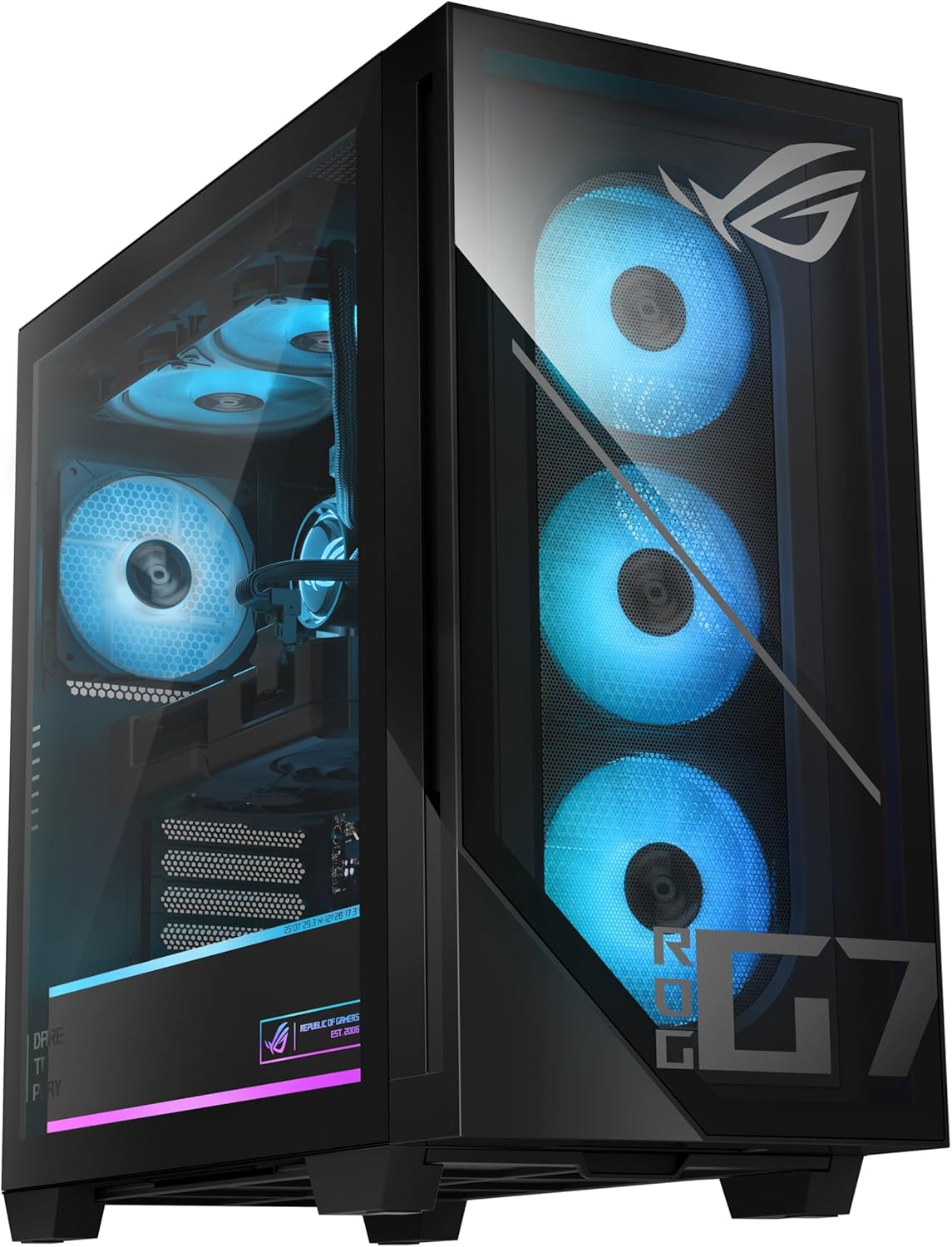
Budget Tier: Upper mid-range (under $1,900) · Best For: 1440p buyers under $1,900 who want a spacious 58L tool-less airflow chassis, 850W power headroom, 12GB VRAM, and standard ATX upgrade room.
- CPU: Intel Core Ultra 7 265F (20 cores, up to 5.3 GHz, 30MB L3 / 66MB total cache, LGA 1851)
- GPU & VRAM: NVIDIA GeForce RTX 5070 12GB GDDR7
- Memory & Storage: 16GB DDR5 · 1TB M.2 PCIe 4.0 NVMe SSD
- Chassis & Power: 58L tool-less dual-glass ROG chassis, quad-fan airflow, 850W PSU, Wi-Fi 6, 2.5GbE LAN, Dolby Atmos
Why It Beats Sidebar Mistakes: Sub-$1,900 Amazon searches are flooded with 8GB GPUs and unrated power supplies. The ROG G700 steps up cleanly to 12GB GDDR7 VRAM via the RTX 5070 and discloses an 850W PSU inside a standard-layout 58L chassis with quad-fan ventilation and 2.5GbE LAN. Two transparent caveats apply: the 265F processor omits iGPU/Quick Sync for video editors, and moving from 16GB to 32GB dual-channel DDR5-6400 makes an easy future upgrade.
3. STORMCRAFT Phantom (Ryzen 7 9800X3D & RTX 5080 16GB) — Best 10-Axis Spec-Transparent 4K Flagship

Budget Tier: Flagship tier (over $3,500) · Best For: 4K gaming enthusiasts seeking RTX 5080 GDDR7 power, Ryzen 7 9800X3D 3D V-Cache, fast DDR5-6000, and transparent B850 components.
- CPU: AMD Ryzen 7 9800X3D (8 cores / 16 threads, up to 5.2 GHz, 96MB L3 3D V-Cache)
- GPU & VRAM: NVIDIA GeForce RTX 5080 16GB GDDR7
- Memory & Storage: 32GB DDR5-6000 RGB · 2TB NVMe Gen4 SSD
- Motherboard, Cooling & PSU: AMD B850 chipset, 360mm AIO Liquid Cooler, 7x ARGB fans, 850W 80+ Gold PSU, 2-Yr Parts / 3-Yr Labor warranty
Why It Beats Sidebar Mistakes: STORMCRAFT removes every classic high-ticket omission on Amazon by explicitly specifying its AMD B850 platform, DDR5-6000 memory speed, 2TB Gen4 NVMe SSD, 360mm AIO cooler, and 850W 80+ Gold PSU alongside the RTX 5080 16GB and Ryzen 7 9800X3D—with zero proprietary lock-in.
4. ZOTAC MEK Gaming PC White (Ryzen 5 9600X & RTX 5060 8GB) — Best Spec-Transparent 1080p Entry AM5 Build
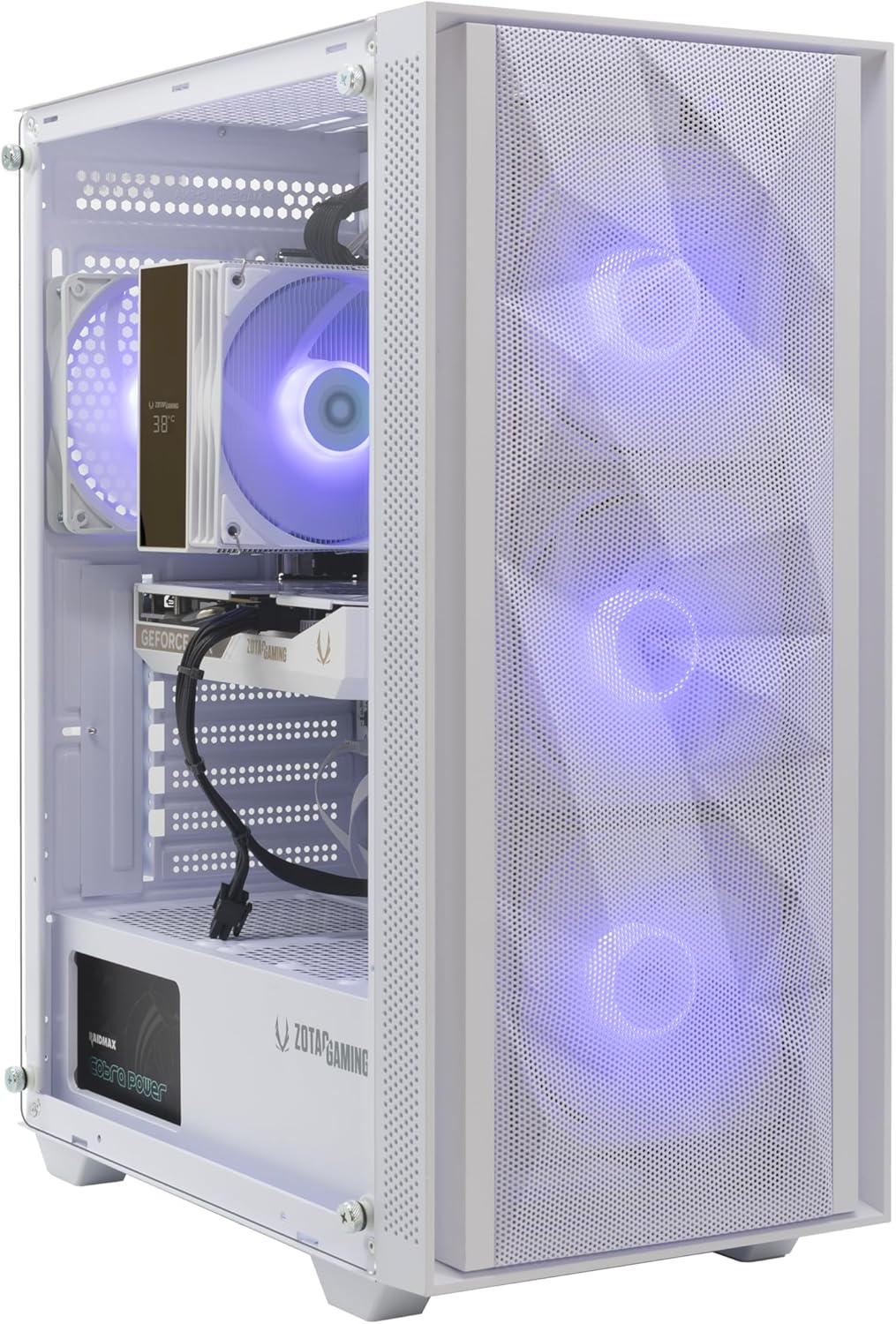
Budget Tier: Mid-upper tier (roughly $1,200–$1,350) · Best For: 1080p gaming buyers who want full component transparency—a 650W 80+ Gold PSU, mesh front airflow, Wi-Fi 6E, 5GbE LAN, and full-cache Zen 5 Ryzen 5 9600X—directly from Amazon.
- CPU: AMD Ryzen 5 9600X (6C/12T Zen 5, up to 5.4 GHz, 32MB L3, AM5)
- GPU & VRAM: ZOTAC GAMING GeForce RTX 5060 8GB GDDR7
- Memory & Storage: 16GB Dual-Channel DDR5-5200 RGB · 1TB NVMe M.2 SSD
- Cooling, PSU & Warranty: 650W 80+ Gold PSU, Mesh Front + 4x 120mm RGB fans, Wi-Fi 6E, 5GbE LAN, 1-Yr System + 3-Yr ZOTAC GPU Warranty
Why It Beats Sidebar Mistakes: Where competing sub-$1,350 listings rely on cache-reduced 8700F chips, single-stick RAM, and blank PSU lines, ZOTAC delivers full 32MB L3 Zen 5 silicon, confirmed dual-channel DDR5, a 650W 80+ Gold PSU, mesh front airflow, Wi-Fi 6E, and 5GbE LAN. Just keep expectations calibrated: its 8GB RTX 5060 targets crisp 1080p gaming, not 1440p Ultra ray tracing.
The PC Audit Bottom Line: Audit the Spec Sheet, Never the Sidebar
Amazon’s filter sidebar is useful only for setting Condition: New and narrowing a rough budget tier. Once you open a listing, treat “8 GB & above” VRAM badges, generic “Ryzen 7” CPU labels, and 1,000+ pooled parent-ASIN reviews as unverified marketing until you confirm the exact GPU memory size, dual-channel DDR5 stick count, 80+ Gold PSU rating, and Wi-Fi 6E/7 hardware. If you want an audited 1440p/4K system that clears all ten checks straight out of the box, the Lenovo Legion Tower 5 (Ryzen 7 9800X3D & RX 9070 XT 16GB) sets the cleanest blueprint.
Official Hardware Standards & Specification References
Whenever an Amazon seller leaves chipset lanes, memory support, or PSU transient ratings ambiguous, cross-check exact SKU architecture against these official non-affiliate engineering sources:
- NVIDIA GeForce RTX 50-Series Architecture & VRAM Specifications — Official Blackwell memory bus, GDDR7 VRAM capacities, and DLSS 4 platform specifications.
- AMD Radeon RX Series Official Specifications — Official RDNA 4 Compute Unit counts, memory configurations, and DisplayPort standards.
- Intel Core Ultra Desktop Processor Documentation — Official Arrow Lake LGA 1851 core layouts, turbo power limits, and F-series iGPU exclusions.
- PCI-SIG PCI Express Specifications — Official PCIe 4.0 and PCIe 5.0 lane bandwidth standards governing GPU and NVMe SSD routing.
- Cybenetics PSU Efficiency & Acoustic Certification Database — Independent ATX 3.1 power supply efficiency (ETA) and acoustic noise (Lambda) verification records.
Frequently Asked Questions About Amazon Gaming PC Filters
Why does Amazon’s Graphics Memory filter stop at 8 GB & above?
Amazon’s retail taxonomy groups desktop graphics cards into legacy capacity buckets capped at 8 GB & above. As a result, 8GB 1080p cards, 12GB midrange models, and 16GB–32GB flagship GPUs all appear together unless you search the exact GPU SKU directly.
How do I filter for 12GB or 16GB gaming PCs on Amazon accurately?
Skip the Graphics Memory sidebar completely. Lock Condition to New, select your target budget bracket, and type the exact GPU model—such as RTX 5070, RX 9070 XT, RTX 5070 Ti, or RTX 5060 Ti 16GB—directly into Amazon’s main search bar.
Why do RX 500 or Intel UHD labels show up under Graphics Processor?
Third-party merchants populate Amazon catalog attributes inconsistently and leave older product listings active for years. That catalog lag keeps outdated labels like RX 500, Vega, Intel HD, and Intel UHD visible inside desktop sidebar facets alongside modern Blackwell and RDNA 4 systems.
Is the AMD Ryzen 7 8700F bad inside an Amazon prebuilt PC?
Not necessarily, provided the price fits an entry AM5 rig. While its 16MB L3 cache and 16 usable PCIe 4.0 lanes trail 96MB X3D processors in 1% Lows, pairing it with a standard AMD B850 board keeps a clean AM5 CPU upgrade path open.
How can I verify PSU wattage and dual-channel RAM before buying on Amazon?
Read every bullet point for explicit 650W–850W 80+ Gold ATX 3.1 and 2x16GB DDR5 disclosures. When listings omit those specs, inspect verified buyer photos for two populated RAM sticks and PSU shroud ratings, or browse our 10-axis Amazon component audit guide.


