
Disclosure: As an Amazon Associate, The PC Audit earns from qualifying purchases. If you buy through links on this page, we may earn a small commission at no extra cost to you.
Evaluating the rx 9070 gre vs rx 9070 matchup uncovers one of the sharpest specification splits in AMD’s RDNA 4 lineup. Prebuilt listings and regional desktop flyers often display the two badges side by side as near-equals because both carry the same 9070 name and 220W Typical Board Power rating. Beneath the shroud, however, AMD trims the OEM-focused Radeon RX 9070 GRE down to 48 Compute Units, 96 ROPs, 48MB of Infinity Cache, and 12GB of GDDR6 over a narrower 192-bit memory bus—leaving the retail 16GB RX 9070 with a huge architectural advantage.
Within our broader hierarchy of the best graphics cards for gaming and our best 1440p graphics cards guide, the standard Radeon RX 9070 holds Tier A status ($549 Launch MSRP), while the OEM-heavy RX 9070 GRE drops to Tier A-. This spec audit compares both cards using our 100-point GPU rubric: Rasterization & Ray Tracing Tier (35%), VRAM Capacity & Memory Bus (25%), Upscaling, Frame Gen & Media Engine (20%), and Thermals, Acoustics & Power Spec (20%).
In This Comparison
- TL;DR Winner Matrix: Quick Verdict
- Side-by-Side Verified Spec Table
- Battleground 1: 48 vs. 56 Compute Units, ROPs & Clock Scaling (35%)
- Battleground 2: 12GB (192-Bit, 432 GB/s) vs. 16GB (256-Bit, 640 GB/s) Memory Subsystem (25%)
- Battleground 3: AMD FSR 4, Anti-Lag 2 & Upscaling Rivals (20%)
- Battleground 4: Identical 220W TBP, Dual 8-Pin Simplicity & DisplayPort 2.1 (20%)
- Battleground 5: The OEM Prebuilt Audit — Amazon Catalog Traps & Market Context
- Decisive Verdict: RX 9070 GRE (12GB) vs. RX 9070 (16GB)
- Verified Amazon US Retail Graphics Cards to Consider
- Frequently Asked Questions
TL;DR Winner Matrix: Quick Verdict
When comparing the rx 9070 gre vs rx 9070 across verified silicon counts, memory bandwidth, and multi-year 1440p longevity, there is no ambiguity about which GPU carries stronger hardware fundamentals. Here is the clear winner across every audit criterion.
| Evaluation Category | Declared Winner | Decisive Technical Reason |
|---|---|---|
| Overall 1440p & OEM Value Winner | AMD Radeon RX 9070 (16GB) | Pairs 56 Compute Units with 16GB GDDR6 on a 256-bit bus (640 GB/s) and 64MB Infinity Cache at $549 Launch MSRP, eliminating premature 12GB VRAM ceilings. |
| Raw Rasterization & Pixel Fill | AMD Radeon RX 9070 (16GB) | 3,584 Stream Processors (+16.7% over GRE) and 128 ROPs (+33.3% over GRE) outmuscle the RX 9070 GRE’s higher boost clock in demanding 1440p pipelines. |
| Memory Bandwidth & Longevity | AMD Radeon RX 9070 (16GB) | Delivers 640 GB/s raw bandwidth (+48.1% vs. the GRE’s 432 GB/s) alongside 16GB capacity and 64MB Infinity Cache for ultra-resolution textures and ray tracing. |
| Ray Tracing & FSR 4 AI Silicon | AMD Radeon RX 9070 (16GB) | Equips 56 3rd-Gen Ray Accelerators and 112 2nd-Gen AI Accelerators compared to 48 RT and 96 AI units on the GRE, leaving deeper margin for ray tracing + FSR 4. |
| Efficiency & Power-Per-Watt | AMD Radeon RX 9070 (16GB) | Both share a 220W TBP and dual 8-pin PCIe plugs, but running 56 CUs at 2,070–2,520 MHz yields superior efficiency over pushing 48 CUs to 2,790 MHz inside 220W. |
Side-by-Side Verified Spec Table
Because both graphics cards share AMD’s RDNA 4 Navi 48 architecture, direct unit-to-unit comparisons are completely valid here—unlike cross-vendor comparisons between NVIDIA CUDA Cores and AMD Stream Processors. Every cut on the OEM-targeted RX 9070 GRE directly reduces execution width, pixel output, cache capacity, or memory bandwidth relative to the full retail RX 9070.
| Specification | AMD Radeon RX 9070 GRE (12GB) | AMD Radeon RX 9070 (16GB) |
|---|---|---|
| Architecture & Node | AMD RDNA 4 (Navi 48, TSMC 4nm) | AMD RDNA 4 (Navi 48, TSMC 4nm) |
| Distribution & Launch MSRP | OEM / Prebuilt & Regional Rollout (No Official US Standalone MSRP) | Global Retail Launch — $549 Launch MSRP (March 2025) |
| Compute Units / Stream Processors | 48 CUs / 3,072 Stream Processors | 56 CUs / 3,584 Stream Processors |
| Ray & AI Accelerators | 48 3rd-Gen Ray Accelerators / 96 2nd-Gen AI Accelerators | 56 3rd-Gen Ray Accelerators / 112 2nd-Gen AI Accelerators |
| Render Output Units (ROPs) | 96 ROPs | 128 ROPs |
| Game / Boost Clock | 2,220 MHz Game / Up to 2,790 MHz Boost | 2,070 MHz Game / Up to 2,520 MHz Ref Boost (Up to 2,610 MHz OC) |
| VRAM Capacity & Memory Type | 12GB GDDR6 (up to 18 Gbps) | 16GB GDDR6 (up to 20 Gbps) |
| Memory Bus & Raw Bandwidth | 192-bit / up to 432 GB/s | 256-bit / up to 640 GB/s |
| 3rd-Gen Infinity Cache | 48MB | 64MB |
| Typical Board Power (TBP) | 220W | 220W |
| Power Connectors & PSU Class | 2x 8-pin PCIe / 650W Minimum (650W–750W ATX 3.1 Gold Advised) | 2x 8-pin PCIe / 650W Minimum (650W–750W ATX 3.1 Gold Advised) |
| Upscaling & Latency Stack | AMD FSR 4 (ML) + Frame Gen + Anti-Lag 2 | AMD FSR 4 (ML) + Frame Gen + Anti-Lag 2 |
| Display I/O & Media Engine | DisplayPort 2.1a + HDMI 2.1b / AMD VCN (AV1, HEVC, H.264) | DisplayPort 2.1a + HDMI 2.1b / AMD VCN (AV1, HEVC, H.264) |
| Host Bus Interface | PCIe 5.0 x16 (Requires Resizable BAR Enabled) | PCIe 5.0 x16 (Requires Resizable BAR Enabled) |
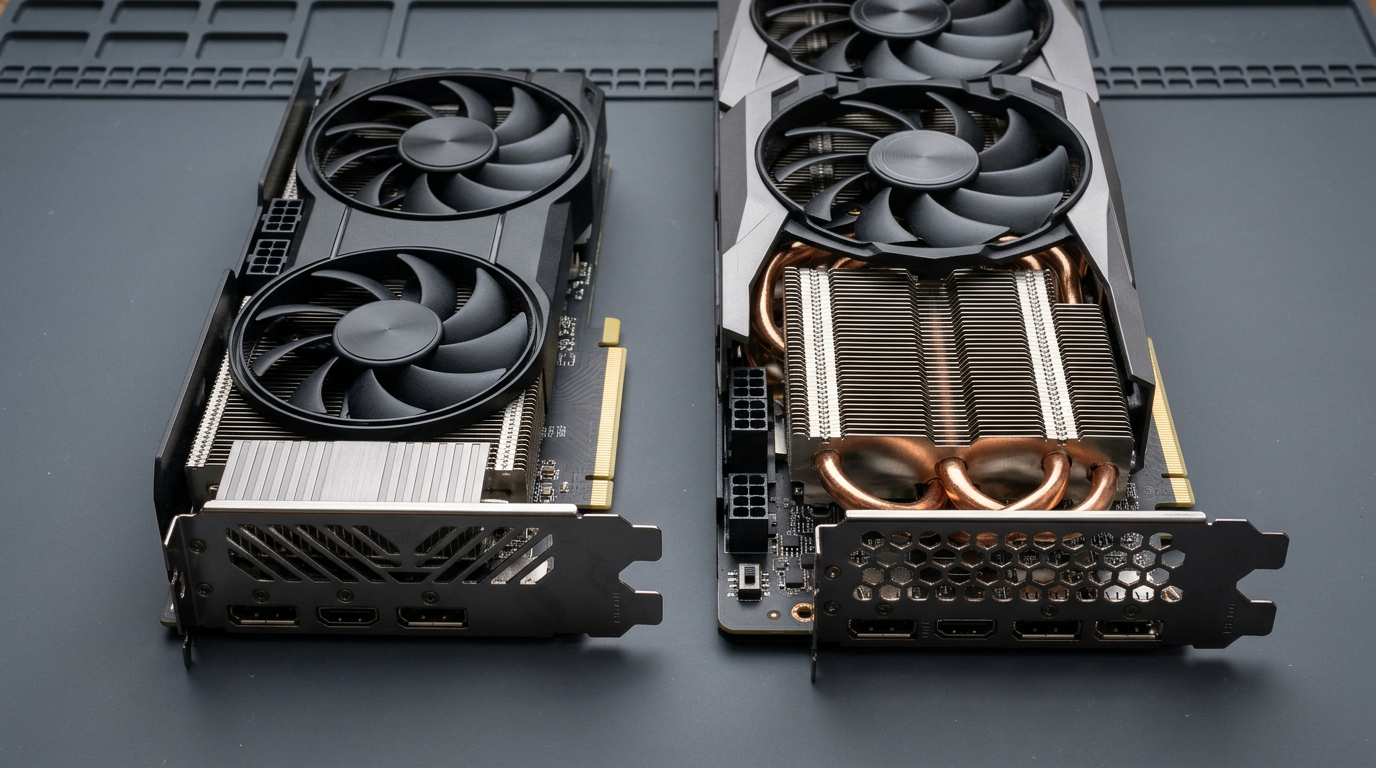
Battleground 1: 48 vs. 56 Compute Units, ROPs & Clock Scaling (35%)
Looking closely at the AMD Radeon RX 9000-series RDNA 4 specifications reveals how AMD carved out the RX 9070 GRE below the standard RX 9070. Both cards descend from Navi 48 silicon on TSMC’s 4nm process node, yet the RX 9070 GRE disables eight Compute Units—dropping from 56 CUs (3,584 Stream Processors) to 48 CUs (3,072 Stream Processors). That represents a 14.3% cut in raw shader count—or conversely, the retail RX 9070 brings 16.7% more shading hardware to every frame.
Even more telling for high-resolution 1440p and entry 4K pipelines is the Render Output Unit (ROP) budget. While the RX 9070 keeps all 128 ROPs active, the RX 9070 GRE trims ROP count down to 96—a steep 25% drop in pixel fill and anti-aliasing throughput (or a 33.3% advantage for the full RX 9070). At 1080p, shader clocks often carry smaller silicon further, whereas 1440p Ultra rendering with dense post-processing, volumetric lighting, and screen-space reflections hammers ROPs and memory controllers simultaneously.
AMD attempts to compensate on paper by setting noticeably higher clock targets on the RX 9070 GRE: 2,220 MHz Game Clock and up to 2,790 MHz Boost Clock versus 2,070 MHz Game and 2,520 MHz reference Boost on the RX 9070. That looks like a +7.2% Game Clock and +10.7% Boost Clock lift, but two physical walls restrict how much real-world performance those clocks can claw back:
- Fixed 220W Power Ceiling: Because both GPUs share an identical 220W TBP envelope, pushing 48 CUs near 2.7–2.79 GHz pushes silicon up the steeper side of the voltage-frequency curve. Under sustained AAA 1440p shader saturation, boost behavior hits board-power governors rather than hovering endlessly at peak clock, whereas the RX 9070’s 56 CUs execute wider parallel math at lower voltage.
- Ray Accelerator & AI Core Reductions: The RX 9070 GRE drops from 56 3rd-Gen Ray Accelerators and 112 2nd-Gen AI Accelerators down to 48 Ray Accelerators and 96 AI Accelerators. Although RDNA 4 substantially upgrades ray-intersection efficiency over older AMD architectures, cutting RT hardware alongside a narrower memory bus leaves the GRE noticeably softer once hardware ray-traced lighting or reflections are switched on.
Buyers cross-shopping NVIDIA’s mid-range Blackwell lineup should keep clear perspective here as well. Even the full 56-CU RX 9070 trails the $549 Launch MSRP GeForce RTX 5070 in heavy ray tracing (where NVIDIA’s 4th-Gen RT Cores deliver 94 TFLOPS), as detailed in our RTX 5070 vs. Radeon RX 9070 comparison. Stripping another 8 Ray Accelerators and 4GB of VRAM off the GRE widens that ray-tracing deficit further—making our companion RX 9070 GRE vs. RTX 5070 audit essential reading if you see both 12GB cards inside competing prebuilt desktops.
Battleground 2: 12GB (192-Bit, 432 GB/s) vs. 16GB (256-Bit, 640 GB/s) Memory Subsystem (25%)
Memory architecture is where the RX 9070 GRE takes its deepest hit—and where long-term 1440p buyers face the biggest risk of buyer’s remorse. AMD did not simply drop 4GB of capacity between these two GPUs; it executed three compounding cuts across capacity, bus width, pin speed, and cache. For a full breakdown of modern engine texture footprints, consult our dedicated guide on how much VRAM you need for gaming in 2026.
- 25% Less VRAM Capacity (12GB vs. 16GB): Twelve gigabytes of GDDR6 covers esports shooters and 1440p High settings comfortably today. Once you enable Ultra texture pools, Unreal Engine 5 Nanite/Lumen geometry buffers, ray tracing BVH structures, and Frame Generation simultaneously, allocations frequently brush past 11GB–12GB. Crossing that limit creates a classic VRAM bottleneck: the driver pages assets across PCIe to system DDR5 memory, causing sudden frame-time spikes, collapsed 1% Lows, or delayed texture streaming.
- 32.5% Less Raw Memory Bandwidth (432 GB/s vs. 640 GB/s): Because the RX 9070 GRE pairs a trimmed 192-bit interface with slower 18 Gbps GDDR6 modules, peak external bandwidth falls from 640 GB/s (256-bit @ 20 Gbps on the RX 9070) all the way down to 432 GB/s. Viewed from the retail card’s side, the RX 9070 commands 48.1% more raw memory bandwidth. Contrast that with NVIDIA’s 12GB GeForce RTX 5070: NVIDIA uses 28 Gbps GDDR7 over its 192-bit bus to reach 672 GB/s, whereas the RX 9070 GRE keeps GDDR6 at 18 Gbps—leaving it short on both capacity and raw throughput.
- 25% Smaller Infinity Cache (48MB vs. 64MB): AMD’s 3rd-Gen Infinity Cache shields the narrower GDDR6 pool from constant external DRAM trips. Cutting that on-die cache from 64MB down to 48MB means more texture and frame-buffer requests miss the cache at 1440p and 4K, forcing traffic onto the 432 GB/s bus right when shaders need peak bandwidth.
In practical buying terms, 16GB GDDR6 on a 256-bit bus represents the durability baseline for 2026–2029 1440p gaming. Even if an RX 9070 GRE performs closely enough in older 1080p or lightweight rasterized games, its triple memory cut ensures the 16GB RX 9070 ages far more gracefully across upcoming AAA releases.
Battleground 3: AMD FSR 4, Anti-Lag 2 & Upscaling Rivals (20%)
Both graphics cards unlock AMD’s complete RDNA 4 software and media stack, creating a wide generational leap over older Radeon GPUs that relied strictly on shader-based FSR 3. Specifically, both the RX 9070 GRE and RX 9070 support AMD FSR 4—AMD’s machine-learning upscaling pipeline powered by dedicated 2nd-Generation AI Accelerators—alongside Frame Generation, AMD Anti-Lag 2 latency reduction, and AMD VCN hardware media acceleration covering AV1, HEVC, and H.264 encode/decode.
Where do the two RDNA 4 siblings diverge in upscaling and capture? First, the RX 9070 houses 112 AI Accelerators versus 96 on the GRE, providing ~16.7% higher AI inference headroom so FSR 4 reconstruction adds slightly less frame-time overhead on the 16GB model. Second—and far more consequential at 1440p—enabling Frame Generation allocates extra intermediate frame-buffer surfaces inside VRAM. On a 16GB RX 9070, allocating those buffers alongside Ultra textures leaves generous breathing room. On a 12GB RX 9070 GRE, turning on Frame Generation in memory-heavy titles can actually push the card closer to VRAM spillover.
Remember our mandatory Frame Generation rule regardless of GPU vendor: whether using AMD FSR Frame Generation, NVIDIA DLSS 4 Multi-Frame Generation on Blackwell, or Intel XeSS 2 Frame Generation on Intel’s Battlemage architecture, interpolated frames only smooth visual motion—they do not accelerate mouse or controller responsiveness. Always establish at least a 50–60+ native base FPS baseline paired with AMD Anti-Lag 2 (or NVIDIA Reflex / Intel XeLL) before engaging Frame Generation.
Across the broader competitive landscape, AMD FSR 4’s ML reconstruction dramatically narrows the image-clarity gap with NVIDIA DLSS 4 Transformer upscaling, though NVIDIA still leads in ecosystem adoption, Multi-Frame Generation multipliers, and 9th-Gen NVENC 10-bit 4:2:2 video editing support. Meanwhile, budget Intel Arc B580 cards ($249 Launch MSRP) leverage 160 XMX engines for hardware XeSS 2 and AV1 streaming, and every modern RDNA 4 and Battlemage GPU expects Resizable BAR (ReBAR) enabled in motherboard BIOS so the CPU accesses the entire GPU memory aperture cleanly via PCIe 5.0 x16.
Battleground 4: Identical 220W TBP, Dual 8-Pin Simplicity & DisplayPort 2.1 (20%)
On paper, power delivery looks like a dead heat: both cards carry a 220W Typical Board Power rating, require a 650W minimum PSU, and bypass NVIDIA’s 12V-2×6 connector in favor of familiar dual 8-pin PCIe power headers. Avoiding the 16-pin 12V-2×6 plug eliminates tight side-panel cable bend radius anxiety (where narrow mid-tower chassis risk <35mm clearance stress) and keeps upgrades painless on existing quality power supplies.
Still, smart buyers look beyond the raw 220W label in two critical areas:
- Silicon Efficiency Per Watt: Delivering higher frame rates at the same 220W power limit makes the standard 16GB RX 9070 strictly more efficient per watt. Because the RX 9070 GRE drives fewer Compute Units at markedly higher clocks (up to 2,790 MHz), it spends its entire 220W thermal budget chasing frequency rather than wider parallel compute.
- Cooler Class & OEM Shroud Compromises: Retail RX 9070 boards such as the ASUS Prime EVO OC pair that mild 220W load with massive 2.5-slot triple-fan Axial-Tech shrouds, phase-change GPU thermal pads, dual-ball bearings, and a hardware Dual BIOS switch (Quiet vs. Performance). Conversely, OEM RX 9070 GRE cards tucked inside prebuilt desktops frequently rely on shorter dual-fan blowers or cost-reduced aluminum fin blocks that spin fans faster and louder under load.
- PSU Transient Headroom (ATX 3.1): Even though 220W GPUs use standard 8-pin plugs, verify that any custom or prebuilt PSU complies with PCI-SIG PCIe CEM 5.1 / ATX 3.1 transient standards and carries 80+ Gold or Cybenetics ETA/Lambda efficiency and acoustic certification in the 650W–750W class so 2x–3x millisecond power excursions never trip over-current protection.
Both cards output via DisplayPort 2.1a and HDMI 2.1b over a full PCIe 5.0 x16 link, meeting VESA DisplayPort 2.1 standards for high-refresh 1440p 240Hz–360Hz OLED and IPS gaming monitors. (Note that NVIDIA’s Blackwell GeForce RTX 50-series pushes further to DisplayPort 2.1b UHBR20 at 80 Gbps for uncompressed 4K 240Hz QD-OLED panels, though neither 220W RDNA 4 card targets native 4K 240Hz ultra settings.)
Battleground 5: The OEM Prebuilt Audit — Amazon Catalog Traps & Market Context
Because the Radeon RX 9070 GRE debuted as an OEM, prebuilt, and regional SKU without an official US standalone Launch MSRP, most North American shoppers encounter it while browsing Amazon prebuilt gaming desktops—typically alongside vague badges in the $1,100 to $1,700 tier. Applying our hardware audit rules prevents several costly Amazon catalog mistakes:
- Amazon Sidebar Graphics Memory Cap: Amazon’s left-hand shopping sidebar caps its Graphics Memory filter at “8 GB & above,” lumping 12GB RX 9070 GRE desktops directly alongside 16GB RX 9070 and 16GB RX 9070 XT machines. Always verify the exact GPU model string and VRAM allocation inside the product title and technical description rather than trusting search facets.
- Parent ASIN Review Pooling & “Brand May Vary” Clauses: Many Amazon prebuilt listings pool multiple CPU|GPU combinations inside a shared “Set name” selector, letting 1,000+ historical star ratings from older generations mask newly added RX 9070 GRE configurations. Worse, OEM GPU listings frequently state “Brand may vary” while omitting cooler fan count, PSU wattage, 80+ rating, or motherboard chipset entirely.
- The Ryzen 7 8700F + RX 9070 GRE Trap: Numerous budget-angled OEM prebuilts pair an RX 9070 GRE with an OEM AMD Ryzen 7 8700F processor. Although the 8700F rides on an upgradable AM5 socket with 8 cores and 16 threads, it carries only 16MB of L3 cache (half of a Ryzen 7 9700X and one-sixth of a 96MB L3 X3D chip), lacks integrated graphics, and offers 16 usable PCIe 4.0 lanes. Compounding a cache-trimmed 8700F with a bandwidth-trimmed 12GB GPU creates a double drag on 1% Lows compared to a balanced Ryzen 5 9600X or Ryzen 7 7800X3D / 9800X3D on an AMD B850 motherboard with dual-channel 32GB (2x16GB) DDR5-6000 CL30.
- Hidden Memory, Wi-Fi & SSD Downgrades: Before buying any OEM desktop advertising an RX 9070 GRE, confirm it does not ship with single-stick 1x16GB DDR5-4800 memory (which slashes dual-channel 1% Lows by 15%–30%), a 500GB DRAM-less QLC NVMe SSD, a choked solid front-glass chassis, or a legacy Wi-Fi 5 adapter hiding inside a modern mid-range budget tier.
Market & Rumor Status Warning (November 2026): On the standalone retail side, the $549 Launch MSRP RX 9070 16GB also faces immediate internal pressure from AMD’s own $599 Launch MSRP Radeon RX 9070 XT (64 CUs, 4,096 SP, 16GB GDDR6, 304W TBP). Whenever street pricing puts the RX 9070 XT close to $599 and your build houses a 750W–850W PSU plus 325mm+ case clearance, stretching $50 buys substantial extra compute. Meanwhile, shoppers wondering whether to hold off for an RTX 5070 Super (widely rumored at 18GB GDDR7 on a 192-bit bus and 275W TBP) or RTX 5080 Super (24GB GDDR7) should note that both models remain strictly unreleased and rumored as of November 2026, with unconfirmed supply windows pointing toward late 2026 or Q1 2027. Build around verified, shipping 2025–2026 GPUs rather than unannounced rumors.
Decisive Verdict: RX 9070 GRE (12GB) vs. RX 9070 (16GB)
Unless an OEM prebuilt carrying the RX 9070 GRE sells at an unmistakable discount with clean standard ATX parts, the AMD Radeon RX 9070 (16GB) wins this head-to-head across every technical pillar. More Compute Units, 33% more ROPs, 48% higher memory bandwidth, a larger 64MB Infinity Cache, and 16GB VRAM inside the exact same 220W envelope make the retail RX 9070 dramatically better positioned for multi-year 1440p gaming.
Accept Radeon RX 9070 GRE (12GB OEM) Only If…
- It ships inside a deeply discounted prebuilt clearly priced below equivalent 16GB RX 9070 or RTX 5070 systems.
- You verify 32GB (2x16GB) dual-channel DDR5, an ATX 3.1 Gold PSU, mesh airflow, and Wi-Fi 6E/7 (no hidden OEM downgrades).
- Your gaming stays centered on 1080p Ultra, esports, or 1440p High settings without ultra ray-traced texture packs.
- Alternatively, compare the compact MSI RTX 5070 12G Ventus 2X OC if buying a 12GB retail card separately.
Choose AMD Radeon RX 9070 (16GB, $549 Launch MSRP) If…
- You want future-proof 16GB GDDR6 on a 256-bit bus (640 GB/s) and 64MB Infinity Cache for 4–5 years at 1440p Ultra.
- You refuse 14.3% CU cuts and 25% ROP cuts while paying the exact same 220W power bill.
- You want verified triple-fan AIB cooling, phase-change thermal pads, Dual BIOS switching, and transparent retail warranty coverage.
- You also plan to cross-check $599 Launch MSRP XFX Swift RX 9070 XT 16GB pricing if your PSU supports 304W.
Verified Amazon US Retail Graphics Cards to Consider
Because the Radeon RX 9070 GRE circulates predominantly inside OEM prebuilt systems and regional partner bundles without a standardized US standalone MSRP, DIY builders and GPU upgraders on Amazon US should evaluate verified in-stock retail cards below. These four models span our top 16GB RX 9070 retail pick, the $599 Launch MSRP RX 9070 XT step-up, the direct 12GB GDDR7 Blackwell rival, and a $349 Launch MSRP 16GB RDNA 4 value fallback.
1. ASUS Prime Radeon RX 9070 EVO 16GB OC — Best Overall 16GB 1440p Efficiency Pick

Budget Tier: Mid-range tier (starting at $549 Launch MSRP) | Audited Specs: AMD RDNA 4 | 56 Compute Units (3,584 SP) | Up to 2,610 MHz OC Boost | 16GB GDDR6 | 256-bit Bus | Phase-Change Thermal Pad | 220W Reference TBP Class | 2x 8-Pin PCIe | 650W-750W PSU Recommended | 3x DisplayPort 2.1a + 1x HDMI 2.1b | Dual BIOS Switch | 312 x 130 x 50 mm 2.5-Slot Triple Axial-Tech Dual-Ball Fan Bearings.
Comparison Audit: Delivering the complete 56-CU, 128-ROP, 16GB 256-bit RDNA 4 configuration inside a quiet 220W power draw, the ASUS Prime RX 9070 EVO OC outclasses every OEM RX 9070 GRE board on both silicon specs and thermal longevity. Its phase-change GPU thermal pad avoids traditional paste pump-out over multi-year ownership, while the hardware Dual BIOS toggle and standard 2x 8-pin headers keep installation straightforward.
Pros: Full 16GB GDDR6 on a 256-bit bus (640 GB/s) + 64MB Infinity Cache; cool 220W TBP with triple Axial-Tech fans, dual-ball bearings, and phase-change thermal pad; standard dual 8-pin connectors.
Cons: 312mm board length requires verifying mid-tower case clearance and pairing a GPU sag bracket; trails NVIDIA Blackwell in heavy path tracing.
2. XFX Swift AMD Radeon RX 9070 XT Triple Fan 16GB — Best 1440p High-Refresh Upgrade

Budget Tier: Mid-upper tier (starting at $599 Launch MSRP) | Audited Specs: AMD RDNA 4 | 64 Compute Units (4,096 SP) | Up to 2,970 MHz Boost | 16GB GDDR6 | 256-bit Bus | 640 GB/s + 64MB Infinity Cache | 304W Class TBP | 2x PCIe 8-Pin Connectors | 800W PSU Recommended | 3x DisplayPort 2.1 + 1x HDMI 2.1 | 325 x 150 x 65 mm 3.5-Slot Triple 100mm Double Ball-Bearing Fans.
Comparison Audit: Whenever Amazon street pricing places the RX 9070 XT close to $599 Launch MSRP, stepping up from the RX 9070 or skipping an OEM RX 9070 GRE prebuilt makes compelling sense. Unlocking all 64 RDNA 4 Compute Units (4,096 Stream Processors) alongside a 2,970 MHz boost clock turns 1440p Ultra high-refresh gaming into effortless territory while retaining standard dual 8-pin connectors.
Pros: Full 64-CU Navi 48 flagship RDNA 4 die with 4,096 SP; 16GB GDDR6 over 256-bit bus + 64MB Infinity Cache; familiar dual 8-pin PCIe power without 12V-2×6 adapters.
Cons: Massive 325mm x 65mm 3.5-slot footprint demands a roomy airflow chassis and GPU support bracket; 304W TBP pushes recommended PSU capacity to 800W.
3. MSI GeForce RTX 5070 12G Ventus 2X OC — Best Compact 12GB SFF & Ray Tracing Rival

Budget Tier: Mid-range tier (starting at $549 Launch MSRP) | Audited Specs: NVIDIA Blackwell | 6,144 CUDA Cores | 2,542 MHz Boost (2,557 MHz OC) | 12GB GDDR7 | 192-bit Bus | 28 Gbps Memory Speed (672 GB/s) | 250W TDP | 1x 16-pin 12V-2×6 (2x 8-Pin Adapter Included) | 650W+ PSU | 3x DisplayPort 2.1b + 1x HDMI 2.1b | 236 x 126 x 50 mm NVIDIA SFF-Ready Dual-Fan.
Comparison Audit: If a compact Mini-ITX chassis or heavy ray-tracing workload draws you toward a 12GB 192-bit card, the MSI GeForce RTX 5070 Ventus 2X OC shows why GDDR7 matters: 28 Gbps GDDR7 delivers 672 GB/s on a 192-bit bus—over 55% more memory bandwidth than the 192-bit GDDR6 RX 9070 GRE—plus DLSS 4 Multi-Frame Generation and 9th-Gen NVENC inside a tiny 236mm footprint.
Pros: Short 236mm NVIDIA SFF-Ready length fits compact cases; 672 GB/s GDDR7, DLSS 4 MFG, DisplayPort 2.1b UHBR20, and strong 4th-Gen RT hardware.
Cons: Shares the 12GB VRAM capacity ceiling against 16GB RDNA 4 alternatives; dual-fan 250W cooler runs warmer and louder under sustained stress than triple-fan boards.
4. XFX Swift AMD Radeon RX 9060 XT OC Triple Fan 16GB — Best Value 16GB RDNA 4 Alternative
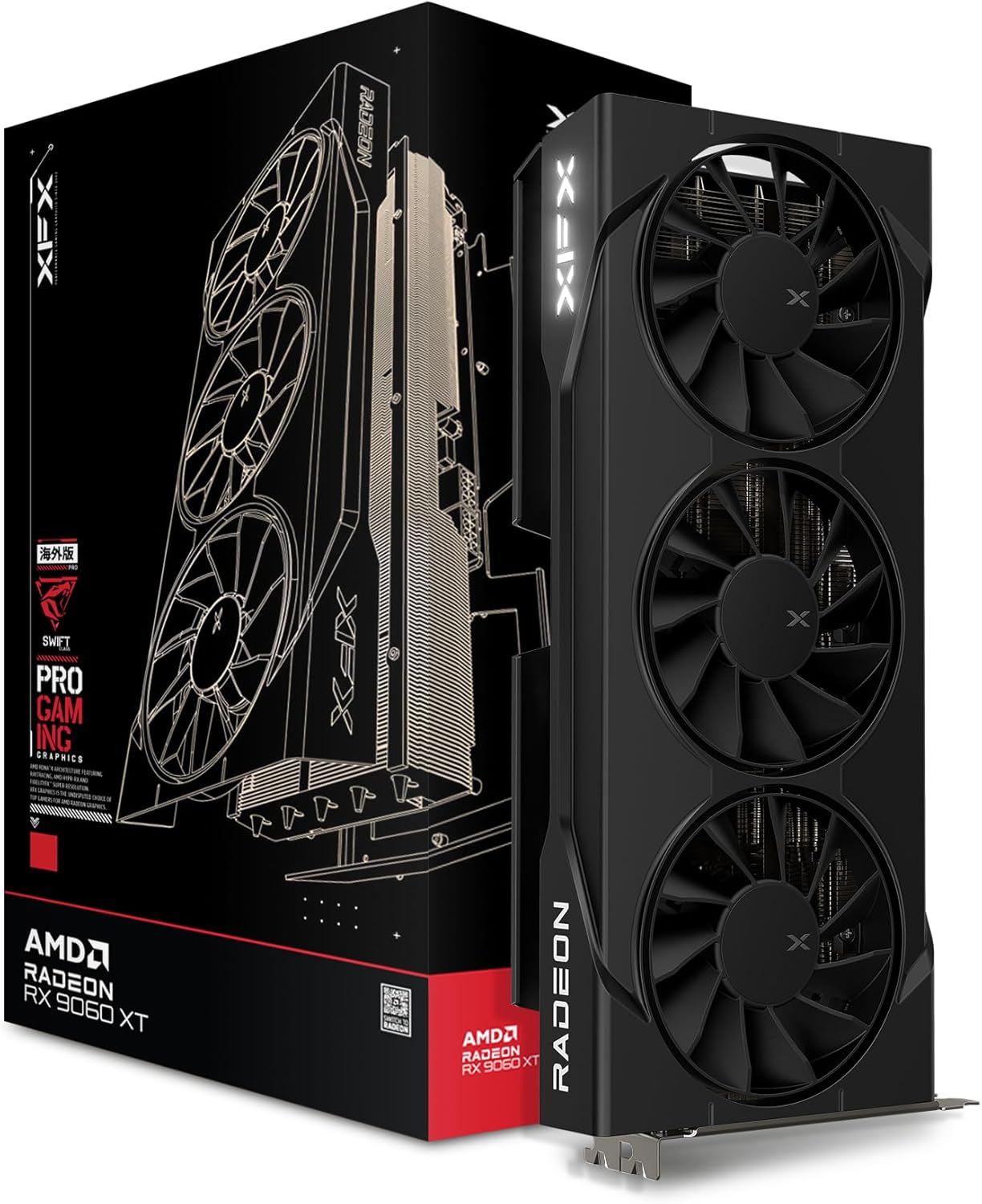
Budget Tier: Value tier (starting at $349 Launch MSRP) | Audited Specs: AMD RDNA 4 | 32 Compute Units (2,048 SP) | Up to 3,320 MHz Boost | 16GB GDDR6 | 128-bit Bus | 20 Gbps | 160W Class TBP | 1x PCIe 8-Pin | 450W-650W PSU Recommended | 2x DisplayPort 2.1 + 1x HDMI 2.1 | Dual-Slot Triple-Fan 290 x 124 x 49 mm | PCIe 5.0 x16 Full Interface.
Comparison Audit: Builders who dislike paying a prebuilt premium for a 12GB RX 9070 GRE—and want RDNA 4 FSR 4 alongside a full 16GB framebuffer at much lower cost—can look at the XFX Swift RX 9060 XT 16GB. While its 32 CUs and 128-bit bus trail the 9070-class cards in raw 1440p raster speed, its cool 160W single 8-pin draw, full PCIe 5.0 x16 lanes, and 16GB capacity give value builders zero 8GB texture compromises.
Pros: Generous 16GB GDDR6 VRAM around the $349 Launch MSRP bracket; ultra-efficient 160W single 8-pin power draw with cool triple-fan acoustics; full PCIe 5.0 x16 bus.
Cons: 32 CUs and 128-bit memory bus step down one tier in native 1440p Ultra frame rates compared to 48–56 CU RX 9070-series silicon.
How We Audited This Guide
- Graphics cards were evaluated by VRAM capacity, memory bus, power connector and PSU requirements, slot width and length clearance, and display output standards.
- Every specification claim was cross-checked against official OEM datasheets, platform vendor documentation, and published industry standards (PCI-SIG, JEDEC, VESA, Intel ATX) rather than marketplace listing copy.
- Recommendations were evaluated against our weighted audit rubric and documented compatibility rules; we do not publish fabricated FPS, thermal, or acoustic numbers.
Frequently Asked Questions
What is the exact specification difference in the rx 9070 gre vs rx 9070 matchup?
The standard Radeon RX 9070 packs 56 Compute Units (3,584 shaders), 128 ROPs, 64MB Infinity Cache, and 16GB GDDR6 on a 256-bit bus (640 GB/s). The OEM-oriented RX 9070 GRE cuts down to 48 CUs (3,072 shaders), 96 ROPs, 48MB Infinity Cache, and 12GB GDDR6 on a 192-bit bus (432 GB/s).
Does 12GB VRAM and a 192-bit bus hurt the RX 9070 GRE at 1440p?
Yes, particularly over a 3–5 year horizon. While 12GB handles current 1440p High presets, combining Ultra texture packs, ray tracing, and Frame Generation pushes allocations close to 12GB—triggering VRAM bottleneck stutters and weaker 1% Lows amplified by the GRE’s 32.5% lower raw memory bandwidth.
Why do both cards share a 220W TBP if the RX 9070 GRE has fewer Compute Units?
AMD pushes the RX 9070 GRE’s frequencies up to 2,220 MHz Game and 2,790 MHz Boost to partially offset having eight fewer Compute Units. Running smaller silicon at higher voltage and frequency consumes the full 220W budget, making the wider 56-CU RX 9070 (2,070–2,520 MHz) more efficient per watt.
Is an OEM prebuilt with an RX 9070 GRE and Ryzen 7 8700F worth buying?
Only at a steep discount with clean supporting parts. The OEM Ryzen 7 8700F restricts L3 cache to 16MB and usable PCIe 4.0 lanes to 16, which compounds 1% Low softness alongside a 12GB GPU. Verify dual-channel DDR5-6000, an ATX 3.1 Gold PSU, and Wi-Fi 6E/7 before buying.
Should I buy an RX 9070 16GB now or wait for the rumored RTX 5070 Super 18GB?
Buy verified 2025–2026 retail hardware now rather than waiting on rumors. Both the RTX 5070 Super (rumored 18GB GDDR7, 275W) and RTX 5080 Super remain unreleased and unconfirmed as of November 2026, with unverified windows pointing toward late 2026 or Q1 2027.
Official Standards & Technical References
- AMD Radeon RX 9000-Series RDNA 4 Architecture & Desktop Specifications: amd.com/en/products/graphics/desktops/radeon.html
- NVIDIA GeForce RTX 50-Series Blackwell Specifications: nvidia.com/en-us/geforce/graphics-cards/50-series/
- PCI-SIG PCIe CEM 5.1 & ATX 3.1 Power Delivery Standards: pcisig.com/specifications
- VESA DisplayPort 2.1 Signaling Specifications: displayport.org
- Cybenetics PSU ETA Efficiency & Lambda Acoustic Database: cybenetics.com
Continue exploring our GPU hierarchy in the best graphics cards for gaming hub, see every tier pick in our best 1440p graphics cards guide, compare 12GB rivals in Radeon RX 9070 GRE vs. RTX 5070 and RTX 5070 vs. Radeon RX 9070, or check all Graphics Cards audits.


