
Disclosure: As an Amazon Associate, The PC Audit earns from qualifying purchases. If you buy through links on this page, we may earn a small commission at no extra cost to you.
Budget desktop graphics buyers searching for an honest intel arc b580 b570 review face a stark choice in 2026: settle for tight 8GB frame buffers around the $300 threshold, or look at Intel’s second-generation Xe2 Battlemage lineup. Priced at $249 Launch MSRP for the 12GB Intel Arc B580 and $219 Launch MSRP for the 10GB Intel Arc B570, Intel’s BMG-G21 silicon attacks the exact memory shortage that plagues entry-level NVIDIA Blackwell and entry-tier AMD RDNA 4 cards.
Yet generous VRAM specifications only tell half the ownership story. Battlemage runs across a PCIe 4.0 x8 host interface, mandates active Resizable BAR support in UEFI firmware, and pairs maturing DirectX 12 and Vulkan drivers with hardware-accelerated Intel XeSS 2 upscaling and AV1 encoding. This specification audit breaks down the silicon architecture, driver trajectory, platform rules, and real-world value against rival GPUs featured in our best graphics cards for gaming hub and best budget graphics cards under $350 guide.
In This Hardware Audit
- Summary Verdict & Weighted Scorecard
- Verified Technical Specifications & Silicon Architecture
- Driver Maturity, Resizable BAR & CPU Overhead Rules
- Workload & Resolution Ceiling (1080p / 1440p / 4K + Creator)
- Compatibility, Prebuilt Traps & Buyer Alerts
- Best System Pairings & Audited GPU Alternatives
- Frequently Asked Questions
- Final Audit Verdict
Summary Verdict & Weighted Scorecard
Unlike cut-down 8GB entry cards that lean heavily on fast memory clocks to mask narrow capacity ceilings, Intel engineered Battlemage around a wide 192-bit memory controller on the Arc B580 (456 GB/s) and a 160-bit controller on the Arc B570 (380 GB/s). In modern DirectX 12 and Vulkan releases where high-resolution textures push past 8GB even at 1080p, that extra memory pool prevents catastrophic 1% Lows drops and texture pop-in. At the same time, Battlemage’s reliance on Resizable BAR and slightly higher driver CPU overhead on aging host processors keeps it from being a thoughtless drop-in upgrade for decade-old towers.
Weighted GPU Audit Scorecard — Intel Arc B580 (8.3 / 10) & Arc B570 (7.9 / 10)
| Evaluation Criterion (Weight) | Arc B580 / B570 | Architectural Audit Summary |
|---|---|---|
| Rasterization & Ray Tracing Tier (35%) | 7.8 / 7.1 | Competitive 1080p Ultra and entry 1440p throughput in DX12/Vulkan with 20/18 dedicated RT units, though legacy DX9/DX11 titles and aging non-ReBAR CPUs trim consistency. |
| VRAM Capacity & Memory Bus (25%) | 9.0 / 8.2 | 12GB GDDR6 on a 192-bit bus (456 GB/s) at $249 Launch MSRP and 10GB on a 160-bit bus (380 GB/s) at $219 Launch MSRP easily outlast 8GB rivals against a VRAM bottleneck. |
| Upscaling, Frame Gen & Media Engine (20%) | 8.4 / 8.2 | XMX-accelerated Intel XeSS 2, XeSS Frame Generation, Xe Low Latency, and dual hardware AV1 media engines beat budget peers, though game adoption trails DLSS 4. |
| Thermals, Acoustics & Power Spec (20%) | 8.1 / 8.4 | Clean single 8-pin PCIe power (190W B580 / 150W B570), DisplayPort 2.1 output, and compact 2-slot reference cooling avoid 12V-2×6 cable bends, though PCIe 4.0 x8 limits old Gen 3 slots. |
Intel Arc B580 & B570 Pros
- 12GB GDDR6 (192-bit, 456 GB/s) on B580 and 10GB GDDR6 (160-bit, 380 GB/s) on B570 avert 8GB VRAM bottleneck stutter under $250
- Hardware-accelerated Intel XeSS 2 Super Resolution, XeSS Frame Generation, and Xe Low Latency via dedicated XMX AI engines
- Dual media engines with hardware AV1 encoding plus modern DisplayPort 2.1 and HDMI 2.1 outputs for budget creators
- Simple single 8-pin PCIe power connector (190W / 150W TBP) eliminates 12V-2×6 adapter clearance stress in compact cases
Intel Arc B580 & B570 Cons
- Strictly requires UEFI boot mode, Above 4G Decoding, and active Resizable BAR—unsuitable for pre-10th Gen Intel or CSM legacy rigs
- PCIe 4.0 x8 bus and CPU driver overhead reduce 1% Lows if paired with aging PCIe 3.0 processors or single-channel memory
- Smaller library of native XeSS 2 Frame Generation titles than DLSS 4 Multi-Frame Generation, plus occasional quirks in niche DX9/DX11 games
Buy It If / Skip It If: Buy the Intel Arc B580 (or discounted Arc B570) if you are building or upgrading a modern ReBAR-enabled 1080p Ultra or entry 1440p rig under $250 that needs 10GB–12GB of GDDR6 and AV1 streaming headroom without paying $350+ for 16GB cards. Skip Battlemage if your PC lacks Resizable BAR support, relies on older PCIe 3.0 budget CPUs, centers around niche legacy DX9/DX11 titles, or requires CUDA for 3D and local AI production—where stepping up to an RX 9060 XT 16GB or RTX 5060 Ti 16GB prevents compatibility friction.
Verified Technical Specifications & Silicon Architecture
Evaluating Battlemage accurately requires putting Intel’s Arc B580 specifications and the Intel Arc B-Series lineup side by side against AMD’s RDNA 4 and NVIDIA’s Blackwell budget entries. While raw shader or core counts cannot be compared cross-vendor due to vastly different instruction pipelines, memory bus width, VRAM capacity, PCIe lane allocation, and power draw reveal exactly where each card sits.
| Audited Specification | Intel Arc B580 | Intel Arc B570 | Radeon RX 9060 XT (16GB) | GeForce RTX 5060 (8GB) | GeForce RTX 5060 Ti (16GB) |
|---|---|---|---|---|---|
| Microarchitecture | Xe2 Battlemage (BMG-G21) | Xe2 Battlemage (BMG-G21) | AMD RDNA 4 | NVIDIA Blackwell | NVIDIA Blackwell |
| Core / AI Array | 20 Xe-Cores / 160 XMX | 18 Xe-Cores / 144 XMX | 32 CUs / 2,048 SP | 3,840 CUDA Cores | 4,608 CUDA Cores |
| Reference Clock | 2,670 MHz | 2,500 MHz | Up to 3,130 MHz (OC 3,320) | ~2,500 MHz Boost | ~2,572 MHz (OC 2,632) |
| VRAM & Memory Type | 12 GB GDDR6 | 10 GB GDDR6 | 16 GB GDDR6 | 8 GB GDDR7 | 16 GB GDDR7 |
| Bus Width & Bandwidth | 192-bit (456 GB/s) | 160-bit (380 GB/s) | 128-bit (340 GB/s) | 128-bit (448 GB/s) | 128-bit (448 GB/s) |
| Host PCIe Interface | PCIe 4.0 x8 (ReBAR req.) | PCIe 4.0 x8 (ReBAR req.) | PCIe 5.0 x16 | PCIe 5.0 x8 | PCIe 5.0 x8 |
| TBP / TDP & Power Plug | 190W / 1x 8-Pin PCIe | 150W / 1x 8-Pin PCIe | 160W / 1x 8-Pin PCIe | 145W / 1x 8-Pin PCIe | 180W / 1x 8-Pin PCIe |
| Display I/O | 3x DP 2.1 + 1x HDMI 2.1 | 3x DP 2.1 + 1x HDMI 2.1 | 2x DP 2.1 + 1x HDMI 2.1 | 3x DP 2.1b + 1x HDMI 2.1b | 3x DP 2.1b + 1x HDMI 2.1b |
| Upscaling & Frame Gen | Intel XeSS 2 (XMX) + XeLL | Intel XeSS 2 (XMX) + XeLL | AMD FSR 4 ML + Anti-Lag 2 | DLSS 4 MFG + Reflex | DLSS 4 MFG + Reflex |
| Launch MSRP | $249 Launch MSRP | $219 Launch MSRP | $349 Launch MSRP | $299 Launch MSRP | $429 Launch MSRP |
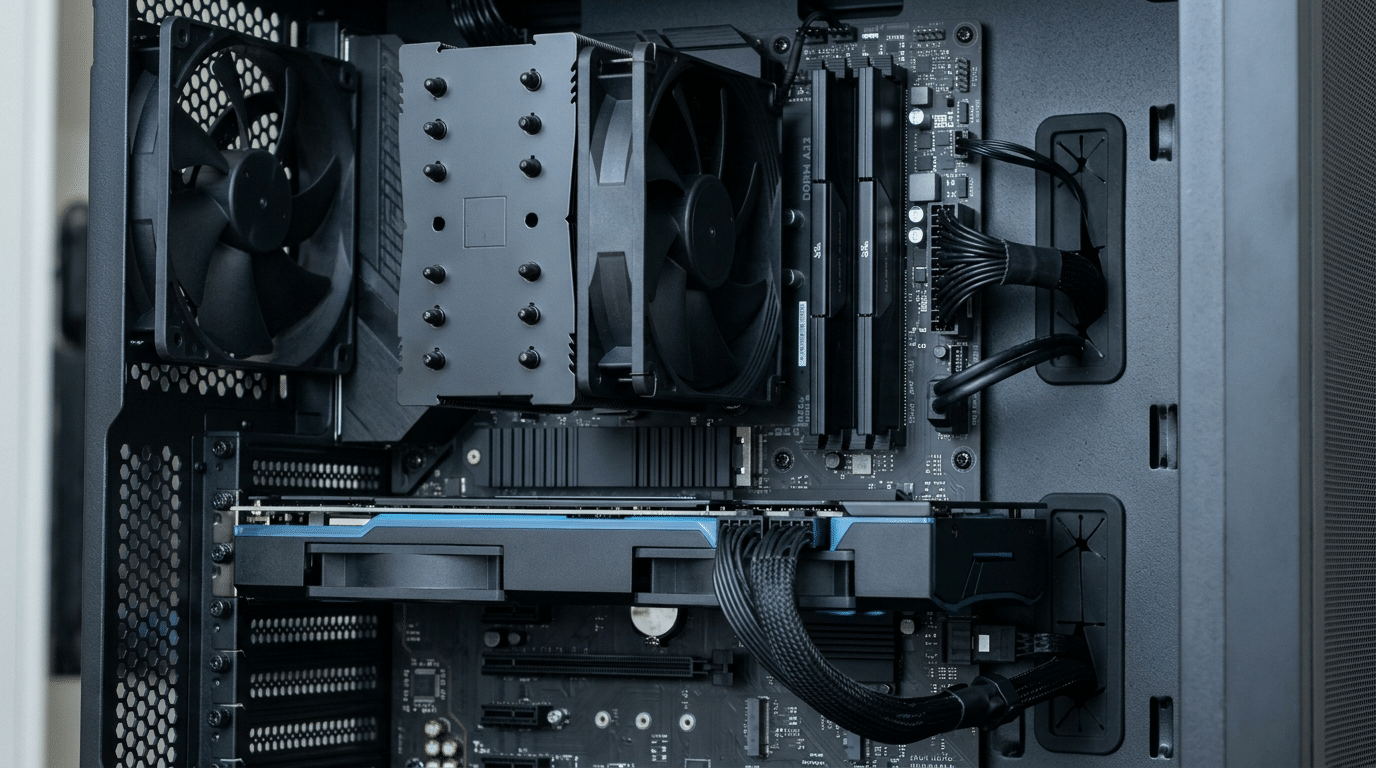
1. BMG-G21 Silicon Scaling: Comparing the Arc B580 vs. Arc B570 Cuts
Both graphics cards share Intel’s BMG-G21 die built around the completely redesigned Xe2 Battlemage architecture. Compared with the first-generation Alchemist Xe-HPG cores—which frequently struggled with low execution-unit occupancy and scheduling inefficiencies in real games—Xe2 switches to native SIMD16 execution, widens L1/L2 caches, boosts clock efficiency, and overhauls the ray-tracing traversal pipeline with dedicated RT units.
Between the two Battlemage retail SKUs, the Intel Arc B580 represents the full-fat BMG-G21 configuration: 20 Xe2-cores, 20 Ray Tracing Units, 160 XMX AI matrix engines delivering 233 Peak Int8 TOPS, a 2,670 MHz graphics clock, and a 192-bit memory controller paired with 12 GB of 19 Gbps GDDR6 (456 GB/s). To hit the $219 Launch MSRP tier, the Intel Arc B570 trims exactly 10% of the compute array (down to 18 Xe2-cores, 18 RT units, 144 XMX engines, and 203 Peak Int8 TOPS), trims clock speed slightly to 2,500 MHz, and disables one 32-bit memory controller channel—dropping the bus to 160-bit, VRAM to 10 GB GDDR6, and memory bandwidth to 380 GB/s alongside a cooler 150W Total Board Power.
Look closely at the bandwidth math: because the B580 uses a wider 192-bit bus than the 128-bit controllers on the RX 9060 XT, RTX 5060, and RTX 5060 Ti, its 456 GB/s raw memory bandwidth actually edges out 128-bit 28 Gbps GDDR7 (448 GB/s) on entry Blackwell cards and easily clears the 128-bit 20 Gbps GDDR6 (340 GB/s) on the RX 9060 XT (which relies on Infinity Cache to compensate). Even the pruned B570 out-muscles standard 128-bit GDDR6 designs on raw bandwidth while carrying two extra gigabytes of capacity over 8GB cards.
2. 12GB and 10GB GDDR6 vs. the 8GB VRAM Bottleneck
VRAM capacity remains the single starkest differentiator in an intel arc b580 b570 review. In 2026, Unreal Engine 5 releases, dense open-world texture packs, hardware ray tracing BVH structures, and Frame Generation intermediate buffers routinely consume between 8.5 GB and 11.5 GB even at 1080p High or Ultra settings. Once a graphics card overflows an 8GB buffer, assets spill across the PCIe bus into slower system DDR5 memory—triggering hitching, degraded 1% Lows, or blurry mip-mapped textures.
By giving the B580 12 GB of GDDR6 at $249 Launch MSRP and the B570 10 GB at $219 Launch MSRP, Intel sidesteps the 8GB VRAM bottleneck that penalizes the $299 RTX 5060 and $299 RX 9060 XT 8GB, and makes overpriced 8GB mid-range SKUs like the $379 RTX 5060 Ti 8GB impossible to justify. Still, buyers should remain realistic about upper limits: while 12 GB handles 1080p Ultra and standard 1440p High textures cleanly, stacking 1440p Ultra settings alongside heavy ray tracing and Frame Generation pushes right up against a 12 GB ceiling. Gamers intending to keep one card for four or more years at 1440p Ultra gain meaningful extra headroom by stepping up to 16 GB options in our Arc B580 vs. RTX 5060 vs. RX 9060 XT budget GPU showdown.
3. Intel XeSS 2, Xe Low Latency & Dual AV1 Media Engines
Software upscaling in 2026 is a three-way race between NVIDIA DLSS 4 Multi-Frame Generation on Blackwell, AMD FSR 4 machine-learning upscaling on RDNA 4, and Intel XeSS 2 on Battlemage. Unlike cross-vendor DP4a fallback mode used on non-Intel GPUs, the Arc B580 and B570 execute XeSS Super Resolution natively on 160 and 144 dedicated XMX systolic matrix engines—preserving fine hair, chain-link fences, and particle stability far better than legacy spatial or basic shader upscalers.
XeSS 2 adds two critical pillars on top of Super Resolution: XeSS Frame Generation (interpolating AI frames between natively rendered frames) and Xe Low Latency (XeLL) (synchronizing the CPU render queue to curb input lag, mirroring NVIDIA Reflex and AMD Anti-Lag 2). Follow one strict editorial rule before turning Frame Generation on in any budget build: interpolated frames smooth visual motion, not physical mouse or controller responsiveness. If native base performance falls below 45–50 FPS, enabling Frame Generation introduces sluggish steering and interpolation artifacts; aim for a 60+ FPS native baseline paired with XeLL before engaging XeSS Frame Generation.
Beyond gaming, Battlemage carries Intel’s dual MFX media transcoders with hardware AV1 encode/decode and 10-bit HEVC 4:2:2 support—an unusually capable media engine at the $200-$250 tier for OBS streamers, capture workstations, and clip editors working without Quick Sync on F-series CPUs.
4. PCIe 4.0 x8 Lanes, Single 8-Pin Power & DisplayPort 2.1 Output
Physically and electrically, both Battlemage cards use a PCIe 4.0 x8 interface rather than a full x16 link (matching Blackwell’s x8 approach on the RTX 5060 family, whereas the RX 9060 XT provides full PCIe 5.0 x16). On any modern PCIe 4.0 or PCIe 5.0 motherboard, eight Gen 4 lanes supply ~16 GB/s bidirectional bandwidth—completely sufficient when assets stay inside 10 GB or 12 GB of VRAM. Trouble only arises if an x8 GPU drops into an old PCIe 3.0 motherboard (halving slot bandwidth to Gen 3 x8) simultaneously with a heavy memory overflow.
Power delivery is refreshingly simple. The Arc B580 Limited Edition requires one traditional 8-pin PCIe power cable for its 190W TBP (recommended 600W–650W PSU), while the B570 pulls just 150W TBP—avoiding the 12V-2×6 cable bend clearance rules required on 250W–575W RTX 5070/5080/5090 cards. Reference Display I/O also beats budget expectations: three DisplayPort 2.1 ports (1x UHBR13.5 plus 2x UHBR10 on the B580 Limited Edition) alongside HDMI 2.1 drive modern high-refresh 1440p and 4K displays effortlessly.
Driver Maturity, Resizable BAR & CPU Overhead Rules
Two factors determine whether a buyer’s Battlemage experience feels seamless or frustrating: software driver stability across different DirectX generations and strict adherence to motherboard Resizable BAR rules.
- Driver Maturity From Alchemist to Battlemage: First-generation Arc Alchemist GPUs arrived with erratic frame pacing, broken DirectX 9 rendering paths, and frequent shader-cache hitches. Over three years of relentless driver engineering—culminating in the Xe2 Battlemage software stack—Intel stabilized core DirectX 12 and Vulkan pipelines, shipped timely Game On launch drivers for major AAA releases, and cleaned up desktop idle power behavior when ASPM power management is enabled. Modern Unreal Engine 5, DX12, and Vulkan titles now launch reliably without the constant manual workarounds Alchemist required.
- Where Driver Gaps Still Persist: Legacy DirectX 9, DirectX 10, and older single-threaded DirectX 11 games rely on translation layers and driver-side scheduling optimizations rather than native legacy hardware paths. While popular esports classics run smoothly, obscure older PC titles, niche indie mods, and OpenGL emulation edge cases still show occasional texture glitches or uneven 1% Lows compared with GeForce drivers. Similarly, 3D rendering suites, Stable Diffusion workflows, and video plug-ins built strictly around CUDA still favor NVIDIA Blackwell.
- Why Resizable BAR Is Strictly Mandatory: Under PCI-SIG PCI Express specifications, legacy PCIe addressing limits the CPU to mapping GPU memory through small 256 MB Base Address Register windows. Resizable BAR exposes the entire 10 GB or 12 GB frame buffer simultaneously to the processor. Because Intel engineered both Alchemist and Battlemage around large-aperture CPU-to-GPU memory transfers rather than legacy 256 MB batching, running an Arc B580 or B570 with ReBAR disabled causes severe frame-time stalls and dramatically depressed framerates.
- CPU Driver Overhead on Older Platforms: Even with ReBAR enabled, Battlemage drivers generate slightly higher CPU draw-call overhead than Radeon RDNA 4 and GeForce Blackwell drivers in DX12 games. Pairing a $249 Arc B580 with an older low-IPC quad-core or budget six-core PCIe 3.0 processor (such as an entry Ryzen 5 5500 or 10th-Gen i3/i5 on slow single-channel RAM) constrains the GPU before it hits full utilization, eroding 1% Lows in open-world games.
Before ever installing an Intel Arc card, verify four non-negotiable firmware conditions covered in our post-build BIOS and Windows optimization checklist: (1) OS drive partitioned as GPT rather than legacy MBR, (2) CSM (Compatibility Support Module) switched to Disabled so pure UEFI boot is active, (3) Above 4G Decoding set to Enabled, and (4) Re-Size BAR Support (or AMD Smart Access Memory) set to Enabled on Intel 10th-Gen+ or AMD Ryzen 3000/500-series+ platforms.
Workload & Resolution Ceiling (1080p / 1440p / 4K + Creator)
Matching either Battlemage card to the right display target prevents unrealistic expectations. Examining memory bandwidth, Xe-core density, and upscaling headroom maps clear boundaries across four distinct workloads:
- 1080p High / Ultra & Competitive Esports: This is Battlemage’s home turf. The Arc B580’s 12 GB buffer lets players leave Ultra texture pools enabled in modern AAA campaigns without tripping an 8GB VRAM bottleneck, while the B570’s 10 GB frame buffer comfortably clears 8GB constraints at High presets. In modern DX12 and Vulkan competitive shooters, pairing either card with a snappy modern AM5 or LGA 1851 CPU maintains crisp high-refresh pacing—provided Xe Low Latency is active and legacy DX9 quirks do not affect your main game.
- 1440p Entry-to-Mid Gaming: Thanks to its 192-bit memory bus (456 GB/s) and 12 GB capacity, the Arc B580 punches above its $249 Launch MSRP at 1440p High—especially in titles supporting XeSS 2 Quality or Balanced upscaling. The Arc B570 (160-bit, 380 GB/s, 10 GB) handles lighter 1440p workloads with Medium-to-High textures, though its 10% smaller compute array and narrower bus visibly trail the B580 at 2560×1440. Neither card is built for 1440p Ultra plus Path Tracing; once ray tracing and Frame Generation push past 12 GB or drop native baseline speed under 45 FPS, 16 GB cards like the RX 9060 XT 16GB or RTX 5060 Ti 16GB take clear control.
- 4K Desktop & Casual Living-Room Displays: Despite featuring HDMI 2.1 and DisplayPort 2.1 UHBR13.5 ports capable of driving high-refresh 4K panels, BMG-G21 silicon lacks the shading throughput for native 4K AAA gaming. Restrict 4K usage to older catalog games, indie titles, or heavy XeSS Performance upscaling, and look toward 16GB RDNA 4 or Blackwell cards for genuine 4K targets.
- Streaming, Video Editing & Entry Local AI: Dual hardware AV1 encoders turn both the B580 and B570 into standout budget workstation companions for Twitch/YouTube streamers, OBS multi-track recording, and DaVinci Resolve / Premiere Pro H.264, HEVC, and AV1 timeline acceleration—particularly useful if your desktop uses an iGPU-less F-series processor. Meanwhile, 160 XMX engines (233 Peak Int8 TOPS on B580) run Intel AI Playground image generation and lightweight local LLMs cleanly within 10–12 GB, though specialized CUDA-dependent ML frameworks still require NVIDIA Blackwell silicon.
Compatibility, Prebuilt Traps & Buyer Alerts
Critical Buyer Alert — 4 Mandatory Hardware Checks Before Purchasing an Arc B580 or B570
- Never Drop Battlemage Into a Non-ReBAR Legacy PC: Older Intel 8th/9th Gen boards without vendor BIOS updates, Windows installations booting via MBR/CSM Legacy mode, and certain early AMD APUs lack functional Resizable BAR. Confirm UEFI + Above 4G Decoding + ReBAR support in motherboard specifications before ordering.
- Watch the B580 vs. B570 Street Pricing Gap: At $249 vs. $219 Launch MSRP, the $30 official step-up buys +2 Xe2-cores, +2 GB GDDR6, +32-bit bus width (+76 GB/s), and faster clocks. Whenever AIB partner street pricing pushes an Arc B570 within $15–$20 of an Arc B580, skip the B570 completely.
- Verify PSU Headroom & Case Fit for Dual- vs. Triple-Fan Editions: While the Intel Arc B580 Limited Edition uses a tidy 272 mm, 2-slot shroud and one 8-pin connector (600W–650W ATX 3.1 PSU recommended), oversized triple-fan partner models stretch past 300 mm and occasionally add a second 8-pin plug. Always measure GPU length clearance inside compact mATX cases.
- Run DDU Cleanly When Switching GPU Vendors: Moving from GeForce or Radeon to Intel Arc without running Display Driver Uninstaller (DDU) in Windows Safe Mode leaves stale shader caches and registry hooks that cause micro-stutter. Perform a full DDU sweep before installing Intel Arc graphics drivers.
Audited & Disqualified Configurations (Rejected Picks)
Applying our vertical GPU rejection criteria disqualifies four common buying mistakes around this budget bracket:
- Arc B580 / B570 Upgraded Into Non-ReBAR or PCIe 3.0 Legacy Office Towers: Locked OEM office machines with small proprietary PSUs and disabled Above 4G Decoding trigger severe draw-call stuttering and insufficient 8-pin power margins.
- Overpriced 8GB Cards Above $350 (Such as the RTX 5060 Ti 8GB at $379 Launch MSRP): Paying over $350 for 8GB VRAM guarantees early texture compromises in new AAA releases compared with either the 12GB B580 ($249 Launch MSRP) or 16GB RX 9060 XT ($349 Launch MSRP).
- Arc B570 Bought Near Arc B580 Pricing: Paying nearly $240+ for a cut-down 10GB 160-bit B570 throws away 20% of memory bandwidth and 2 GB VRAM for negligible up-front savings.
- Arc B580 Selected for CUDA-Locked Workstations or Niche DX9 Libraries: Creators locked into CUDA render engines or gamers exclusively running older DX9/DX11 niche software gain cleaner compatibility from an RTX 5060 Ti 16GB.
Best System Pairings & Audited GPU Alternatives
To keep an Intel Arc B580 or B570 operating without CPU driver bottlenecks, single-channel memory hitches, or PCIe Gen 3 limits, build around a clean modern foundation rather than pairing a current-gen GPU with recycled bargain parts. Our target balanced DIY platform pairs an AMD Ryzen 5 9600X (6C/12T Zen 5, 65W TDP / 88W PPT) on a value AMD B850 motherboard with PCIe 5.0 M.2 support, native ReBAR/Smart Access Memory enabled out of the box, BIOS Flashback, and VRM heatsinks. Populate exactly two DIMM slots with 32GB (2x16GB) DDR5-6000 CL30 memory (avoiding single-stick 1x16GB setups that crater 1% Lows), install a 1TB or 2TB PCIe 4.0 DRAM+TLC NVMe SSD (delivering identical load behavior to hot Gen 5 drives without extra cost), cool the CPU with a budget dual-tower air cooler, and power everything via a reliable 650W ATX 3.1 80+ Gold PSU inside an open-mesh airflow chassis.
Below are three verified Amazon US graphics cards covering the audited Intel Arc B580 reference retail model and the two strongest 16GB step-up alternatives for builders whose budgets stretch into the $350–$450 tier.
1. Intel Arc B580 Limited Edition 12GB (WEELIAO) — Best Sub-$250 VRAM & AV1 Value

Budget Tier: Budget tier ($249 Launch MSRP) | Audited Specs: Intel Xe2 Battlemage (BMG-G21) | 20 Xe-Cores / 160 XMX AI Engines | 12GB GDDR6 on 192-bit Bus (456 GB/s Bandwidth) | 190W TBP (1x 8-Pin PCIe; 600W-650W PSU Recommended) | 3x DisplayPort 2.1 (1x UHBR13.5 + 2x UHBR10) + 1x HDMI 2.1 | 272 x 115 x 44 mm 2-Slot PCIe 4.0 x8 (Requires ReBAR).
Audit Summary: As the flagship BMG-G21 retail design, Intel’s Arc B580 Limited Edition packs 12GB of fast 192-bit GDDR6, dual hardware AV1 transcoders, XeSS 2 Frame Generation, and clean single 8-pin power inside a compact 2-slot shroud. Provided your modern platform supports UEFI Resizable BAR, it outclasses every 8GB competitor near the $249 Launch MSRP bracket for texture-heavy 1080p Ultra and entry 1440p gaming.
Pros: 12GB GDDR6 with 456 GB/s bandwidth avoids 8GB VRAM bottleneck stutter; XMX-accelerated XeSS 2 and dual AV1 engines; sleek 272 mm dual-slot single 8-pin build.
Cons: Strictly requires active Resizable BAR and UEFI boot; PCIe 4.0 x8 bus and CPU driver overhead trail rivals on legacy PCIe 3.0 CPUs.
2. XFX Swift AMD Radeon RX 9060 XT OC Triple Fan 16GB — Best Step-Up Under $400 for 16GB & Full PCIe x16
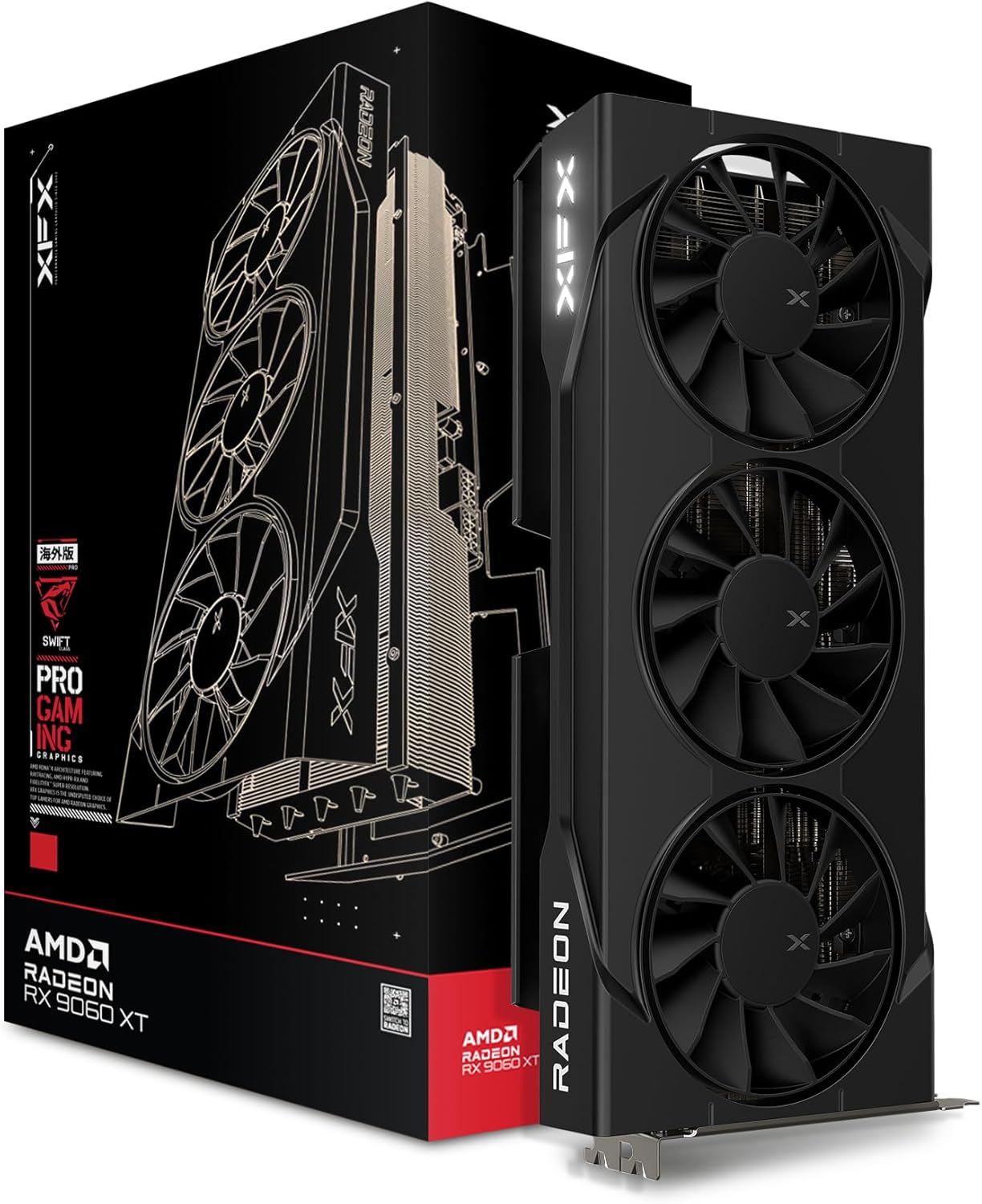
Budget Tier: Value tier ($349 Launch MSRP; $350-$400 bracket) | Audited Specs: AMD RDNA 4 | 32 Compute Units (2,048 SP) up to 3,320 MHz Boost | 16GB GDDR6 on 128-bit Bus (20 Gbps, 340 GB/s) | 160W Class TBP (1x PCIe 8-Pin; 450W-650W PSU Recommended) | 2x DisplayPort 2.1 + 1x HDMI 2.1 | 290 x 124 x 49 mm Triple-Fan | Full PCIe 5.0 x16 Interface.
Audit Summary: If your budget stretches roughly $100 past the Arc B580, the XFX Swift RX 9060 XT 16GB resolves Battlemage’s biggest platform caveats in one move. Built on AMD RDNA 4 with a full PCIe 5.0 x16 bus, 16GB GDDR6 capacity, cool 160W triple-fan acoustics, and ML-driven AMD FSR 4 upscaling, it handles older platforms smoothly without suffering x8 Gen 3 bus penalties or legacy-API edge cases.
Pros: 16GB VRAM clears 1440p texture headroom cleanly; full PCIe 5.0 x16 lane width avoids x8 slot penalties; low 160W TBP with quiet triple-fan cooling.
Cons: Costs roughly $100 more than Arc B580 Launch MSRP; 290 mm length requires checking compact mATX chassis clearance.
3. ASUS Dual GeForce RTX 5060 Ti 16GB GDDR7 OC — Best Blackwell Step-Up for DLSS 4 MFG & CUDA

Budget Tier: Lower-midrange tier ($429 Launch MSRP; $400-$450 bracket) | Audited Specs: NVIDIA Blackwell | 4,608 CUDA Cores / 2,632 MHz OC Boost | 16GB GDDR7 on 128-bit Bus (28 Gbps, 448 GB/s) | 180W TBP (1x 8-Pin PCIe; 550W-650W PSU Recommended) | 3x Native DisplayPort 2.1b + 1x HDMI 2.1b | 229 x 120 x 50 mm Dual Axial-Tech Fans.
Audit Summary: Buyers upgrading older systems without ideal ReBAR support, gamers wanting the broadest DLSS 4 Multi-Frame Generation and Reflex library, or creators dependent on CUDA and 4:2:2 Blackwell NVENC should bypass the compromised 8GB variant and step up to the ASUS Dual RTX 5060 Ti 16GB GDDR7. Its short 229 mm chassis drops straight into small form-factor towers while keeping single 8-pin simplicity.
Pros: 16GB high-speed GDDR7 eliminates VRAM anxiety; industry-leading DLSS 4 MFG, Reflex, and CUDA ecosystem support; compact 229 mm single 8-pin footprint.
Cons: Significantly higher $429 Launch MSRP than the $249 Arc B580; uses a PCIe 5.0 x8 interface.
How We Audited This Guide
- Graphics cards were evaluated by VRAM capacity, memory bus, power connector and PSU requirements, slot width and length clearance, and display output standards.
- Every specification claim was cross-checked against official OEM datasheets, platform vendor documentation, and published industry standards (PCI-SIG, JEDEC, VESA, Intel ATX) rather than marketplace listing copy.
- Recommendations were evaluated against our weighted audit rubric and documented compatibility rules; we do not publish fabricated FPS, thermal, or acoustic numbers.
Frequently Asked Questions: Intel Arc B580 & B570 Audit
Does the Intel Arc B580 or B570 require Resizable BAR (ReBAR)?
Yes. Both Battlemage GPUs strictly require Resizable BAR (or AMD Smart Access Memory), Above 4G Decoding, pure UEFI boot with CSM disabled, and a GPT system drive. Without active ReBAR on Intel 10th-Gen+ or AMD Ryzen 3000+ platforms, memory transfers bottleneck severely and 1% Lows drop sharply.
Should you buy the Intel Arc B580 or save money with the Arc B570?
Choose the Arc B580 ($249 Launch MSRP) unless the Arc B570 ($219 Launch MSRP) maintains its full $30 discount or you strictly need a 150W board power ceiling. Paying only slightly more secures 12GB GDDR6, a wider 192-bit bus (456 GB/s), and two extra Xe2-cores.
Are Intel Arc Battlemage drivers stable enough for gaming in 2026?
Yes for modern DirectX 12 and Vulkan games, where Intel’s Xe2 driver stack has matured substantially with reliable Game On releases and smooth shader pacing. Only older niche DirectX 9 or DirectX 11 titles and CUDA-dependent production tools still favor GeForce or Radeon cards.
How does the Intel Arc B580 compare to 8GB cards like the RTX 5060 and RX 9060 XT 8GB?
At $249 Launch MSRP, the Arc B580 gives builders 12GB GDDR6 and 456 GB/s bandwidth for $50 less than the $299 RTX 5060 and $299 RX 9060 XT 8GB. That 4GB capacity cushion prevents texture stuttering and 1% Low crashes in modern VRAM-hungry 1080p Ultra games.
What CPU, motherboard, and PSU pair best with an Intel Arc B580 or B570?
Pair either card with a modern PCIe 4.0 or 5.0 platform such as an AMD Ryzen 5 9600X on an AMD B850 board, 32GB (2x16GB) DDR5-6000 CL30 dual-channel memory, and a 650W ATX 3.1 80+ Gold power supply using one standard 8-pin PCIe cable.
Final Verdict: Where Battlemage Stands in 2026
Evaluating every detail in this intel arc b580 b570 review confirms why Intel’s second-generation discrete graphics architecture commands genuine respect in the sub-$250 bracket. By putting 12GB GDDR6 on a 192-bit bus inside the $249 Launch MSRP Arc B580—and 10GB GDDR6 on a 160-bit bus inside the $219 Launch MSRP Arc B570—Intel gives budget PC builders real texture longevity, dual hardware AV1 encoders, DisplayPort 2.1 outputs, and AI-accelerated XeSS 2 rather than forcing another 8GB compromise.
Battlemage only asks for one disciplined check in return: verify modern UEFI Resizable BAR support, run dual-channel DDR5 or DDR4 memory on an adequate CPU to avoid driver overhead, and avoid older PCIe 3.0 non-ReBAR office systems. When your platform checks those boxes, the Arc B580 stands as one of the sharpest value GPUs in our sub-$350 graphics card guide; when your budget expands to $350–$450 or demands zero legacy API caveats, stepping up to the 16GB RX 9060 XT or RTX 5060 Ti 16GB inside our full graphics card rankings delivers the cleaner long-term path.
Official Standards & Technical References
- Intel Arc B580 Graphics Official Specifications: intel.com/content/www/us/en/products/sku/241598/intel-arc-b580-graphics/specifications.html
- Intel Arc B-Series Desktop Graphics Architecture Overview: intel.com/content/www/us/en/products/details/discrete-gpus/arc/b-series.html
- Intel XeSS 2 Upscaling, Frame Generation & XeLL Documentation: intel.com/content/www/us/en/developer/topic-technology/graphics/xess.html
- AMD Radeon RX 9060 XT Official Specifications: amd.com/en/products/graphics/desktops/radeon/9000-series/amd-radeon-rx-9060xt.html
- NVIDIA GeForce RTX 5060 Family Official Specifications: nvidia.com/en-us/geforce/graphics-cards/50-series/rtx-5060-family/
- PCI-SIG PCI Express Architecture & Resizable BAR Specifications: pcisig.com


