
Disclosure: As an Amazon Associate, The PC Audit earns from qualifying purchases. If you buy through links on this page, we may earn a small commission at no extra cost to you.
Direct Answer: When evaluating 80 plus vs cybenetics eta lambda ratings, 80 Plus audits AC-to-DC efficiency at only three or four static checkpoints in a 23°C room with zero noise data. Cybenetics ETA averages 1,450+ load combinations inside a 30°C+ chamber with standby and power-factor caps, while Lambda grades acoustic output in dB(A).
Walk down any power supply aisle and nearly every box flaunts the same metallic gold octagon. Yet two 850W power supplies carrying identical 80 Plus Gold stickers can behave like completely different components once bolted inside a modern gaming chassis: one runs nearly inaudible under a 304W graphics card while keeping standby power negligible, whereas the other ramps an aggressive 120mm fan past 38 dB(A) and drops efficiency outside narrow static load points.
Understanding how CLEAResult’s legacy 80 Plus framework differs from Cybenetics’ dual ETA and Lambda certifications prevents buyers from mistaking a basic efficiency stamp for a complete acoustic and electrical endorsement. Whether you are configuring a silent 1440p build from our audited 850W ATX 3.1 power supply guide or browsing our main best gaming power supplies hub under the Cases, Cooling & Power category, pairing efficiency metrics with real sound-pressure grades and ATX 3.1 / 12V-2×6 architecture gives you complete visibility before purchasing.
In This Guide
- 80 Plus vs. Cybenetics (ETA & Lambda): Quick Comparison Matrix
- How 80 Plus Works — And Why 3-Point Audits Leave Blind Spots
- Inside Cybenetics ETA: Efficiency Across 1,450+ Load Combinations
- Inside Cybenetics Lambda: Decoding Real Fan Noise (A++ to Standard)
- Beyond Efficiency Badges: ATX 3.1 Transients, 12V-2×6 & Protections
- Myth vs. Engineering Reality: Five PSU Rating Myths Busted
- Actionable PSU Efficiency & Noise Buying Checklist
- Audited ATX 3.1 PSUs Demonstrating 80 Plus vs. Cybenetics Differences
- Frequently Asked Questions
80 Plus vs. Cybenetics (ETA & Lambda): Quick Comparison Matrix
Both certification bodies score how cleanly a desktop power supply converts AC wall electricity into regulated DC rails for your motherboard, processor, and graphics card. However, their sampling density, chamber heat, standby rules, and acoustic transparency diverge sharply:
| Audit Dimension | 80 Plus (CLEAResult) | Cybenetics ETA (Efficiency) | Cybenetics Lambda (Acoustics) |
|---|---|---|---|
| Primary Metric | Conversion efficiency (%) at fixed load checkpoints | Overall weighted efficiency (%) across full operational curve | Logarithmic energy-averaged sound pressure in dB(A) |
| Load Sampling Density | 3 points (20%, 50%, 100%) on Bronze–Platinum; adds 10% on Titanium and 5% on Ruby | 1,450+ load combinations interpolated up to 25,000 points | Full 1,450+ load sweep plus High-Load Index (70%–100% load) |
| Ambient Chamber Temp | ~23°C (cool room-temperature lab baseline) | Starts near 30°C inside hot-box (rises to 32°C–34°C, plus 35°C–47°C thermal checks) | Recorded inside the same 30°C+ hot-box thermal environment |
| 5VSB & Vampire Power | Not factored into consumer Bronze–Titanium tiers | Mandatory +5VSB rail efficiency sweep & strict EN 50564 / IEC 62301 no-load caps | Not applicable (covered under ETA companion report) |
| Power Factor (PF) | ≥0.90 at 50%–100% load (≥0.95 at 20%–50% on Platinum–Ruby) | Strict overall average PF (≥0.950 to ≥0.985 at 115V) with automatic class downgrade | Evaluated concurrently across the ETA load matrix |
| Noise Transparency | None (fan speed and dB(A) output unmeasured) | Tracked alongside electrical sweeps for full report transparency | 7 clear brackets from Standard (40–45 dB(A)) to A++ (<15 dB(A)) |
| Tier Structure | Standard, Bronze, Silver, Gold, Platinum, Titanium, Ruby | Bronze, Silver, Gold, Platinum, Titanium, Diamond | Standard, Standard+, Standard++, A-, A, A+, A++ |
The clearest takeaway sits in the acoustic and thermal columns. Because desktop power supplies reside inside warm lower chassis compartments rather than chilled laboratory rooms, Cybenetics’ 30°C+ hot-box and sound-pressure sweeps expose how units perform when your GPU dumps sustained wattage during multi-hour 1440p or 4K gaming sessions.
How 80 Plus Works — And Why 3-Point Audits Leave Blind Spots
Introduced in 2004 and administered by CLEAResult, the 80 Plus program transformed PC power supplies by driving active Power Factor Correction (PFC) and eliminating wasteful linear designs that converted 30%–35% of wall electricity into waste heat. Every badge guarantees at least 80% conversion efficiency across defined static loads alongside a Power Factor of 0.90 or higher.
115V and 230V 80 Plus Thresholds (Standard Through Ruby)
CLEAResult evaluates desktop units under both North American 115V and European 230V EU mains grids. Because higher AC input voltage lowers primary-side resistive conduction losses, 230V targets sit roughly 2% to 3% higher than equivalent 115V levels. Per CLEAResult’s official 80 Plus PSU rating breakdown, internal non-redundant desktop power supplies must clear these minimum percentages:
| 80 Plus Certification (115V / 230V) | 5% Load | 10% Load | 20% Load | 50% Load | 100% Load | 115V Power Factor Floor |
|---|---|---|---|---|---|---|
| 80 Plus Standard | — | — | 80% (82% at 230V) | 80% (85% at 230V) | 80% (82% at 230V) | ≥0.90 at 100% load |
| 80 Plus Bronze | — | — | 82% (85% at 230V) | 85% (88% at 230V) | 82% (85% at 230V) | ≥0.90 at 50% load |
| 80 Plus Silver | — | — | 85% (87% at 230V) | 88% (90% at 230V) | 85% (87% at 230V) | ≥0.90 at 50% load |
| 80 Plus Gold | — | — | 87% (90% at 230V) | 90% (92% at 230V) | 87% (89% at 230V) | ≥0.90 at 50% load |
| 80 Plus Platinum | — | — | 90% (92% at 230V) | 92% (94% at 230V) | 89% (90% at 230V) | ≥0.95 at 50% load |
| 80 Plus Titanium | — | 90% (90% at 230V) | 92% (93% at 230V) | 94% (95% at 230V) | 90% (91% at 230V) | ≥0.95 at 20% load |
| 80 Plus Ruby | 85% (85% at 230V) | 91% (91% at 230V) | 93% (94% at 230V) | 95% (96% at 230V) | 91% (92% at 230V) | ≥0.95 at 20% load |
Notice two practical realities in that matrix. First, peak conversion efficiency occurs uniformly at 50% rated capacity—the exact engineering reason our gaming PC PSU wattage guide sizes power supplies so typical gaming draw lands near 50%–60% capacity. Second, 80 Plus Gold remains the mainstream cost-to-efficiency sweet spot because moving from 90% Gold to 94% Titanium saves only modest wall electricity on typical gaming rigs while costing substantially more up front. Even CLEAResult’s newest ultra-high-efficiency 80 Plus Ruby tier primarily targets AI workstations and high-density servers, adding a 5% low-load requirement while still operating under legacy 23°C chamber assumptions.
Three Structural Blind Spots in 80 Plus Badges
While 80 Plus keeps sub-80% junk off mainstream retail shelves, relying solely on its logo leaves three major gaps for modern gaming PC builders:
- Sparse Checkpoint Tuning: Bronze, Silver, Gold, and Platinum require verification at just three points—20%, 50%, and 100% load. A manufacturer can optimize switching frequency around those exact checkpoints while allowing efficiency to sag at 10% desktop idle (80W–100W on a 1000W unit) or across the 65%–90% heavy gaming zone.
- 23°C Idealized Room Ambient: Standard 80 Plus runs at roughly 23°C (73°F). Inside a closed PC PSU shroud warmed by an RTX 5080 or RX 9070 XT, intake air frequently reaches 32°C–42°C. MOSFET switching losses and copper resistance climb with temperature, so a unit barely skimming 90% at 23°C can drop below Gold targets inside real builds.
- Zero Noise, Ripple, or Longevity Grading: 80 Plus never measures fan dB(A), sleeve-bearing versus fluid dynamic bearing (FDB) longevity, DC voltage ripple, hold-up time, capacitor temperature ratings, or protection trip thresholds. Two units can share identical Gold badges while sitting miles apart in noise and electrical polish.
Inside Cybenetics ETA: Efficiency Across 1,450+ Load Combinations
Named after the Greek letter η (eta), the universal engineering symbol for efficiency, Cybenetics ETA was engineered specifically to close 80 Plus’s blind spots. Instead of evaluating three static checkpoints in cool laboratory air, Cybenetics’ official ETA protocol drives automated programmable loads across more than 1,450 distinct rail combinations, generating up to 25,000 interpolated data points across the power supply’s entire operational envelope.
Equally important, Cybenetics places each power supply inside a controlled hot-box starting near 30°C, allowing enclosure temperature to rise naturally toward 32°C–34°C by the conclusion of the main sweep—and supplements that run with elevated thermal evaluations between 35°C and 47°C. That methodology prevents point-tuning tricks and mirrors real chassis thermals closely.
| Cybenetics ETA Tier | Overall Efficiency (115V) | Overall Efficiency (230V) | Min Power Factor (115V / 230V) | Min +5VSB Efficiency (115V / 230V) | Max Vampire Power (115V / 230V) |
|---|---|---|---|---|---|
| ETA Bronze | ≥82% to <85% | ≥84% to <87% | ≥0.950 / ≥0.910 | >71% / >70% | <0.25W / <0.25W |
| ETA Silver | ≥85% to <87% | ≥87% to <89% | ≥0.960 / ≥0.920 | >73% / >72% | <0.22W / <0.23W |
| ETA Gold | ≥87% to <89% | ≥89% to <91% | ≥0.970 / ≥0.930 | >75% / >74% | <0.19W / <0.20W |
| ETA Platinum | ≥89% to <91% | ≥91% to <93% | ≥0.975 / ≥0.935 | >76% / >75% | <0.16W / <0.18W |
| ETA Titanium | ≥91% to <93% | ≥93% to <95% | ≥0.980 / ≥0.940 | >77% / >76% | <0.13W / <0.15W |
| ETA Diamond | ≥93% | ≥95% | ≥0.985 / ≥0.950 | >79% / >78% | <0.10W / <0.12W |
Three secondary enforcement rules separate Cybenetics ETA even further from legacy badges:
- +5VSB Standby Rail Sweeps: Your +5VSB rail stays energized whenever your PC is plugged in—powering wake-on-LAN, standby RAM states, and USB charging. Cybenetics steps +5VSB load in 0.05A increments up to maximum output and averages every measurement, requiring >75% to >79% overall standby efficiency on Gold through Diamond 115V units.
- Vampire Power Limits (EN 50564 / IEC 62301): No-load idle consumption with +5VSB unloaded cannot exceed 0.19W for 115V ETA Gold or 0.10W for ETA Diamond.
- Automatic Downgrade Penalty: Even if a PSU achieves Platinum-level average efficiency on its primary +12V rail, failing the corresponding Power Factor, +5VSB efficiency, or vampire power limit automatically downgrades the unit to the lower certification tier.
Why “80 Plus Gold” PSUs Frequently Earn Cybenetics ETA Platinum (Or Drop Down)
Shoppers often feel confused when an 80 Plus Gold PSU box also carries a Cybenetics Platinum badge—or vice versa. That split happens because the two programs measure different mathematical objects. Under 80 Plus 115V, reaching Platinum requires hitting exactly 90% at 20% load, 92% at 50%, and 89% at 100%. If a unit scores 90.2% at 20%, 91.7% at 50%, and 89.6% at 100%, it misses 80 Plus Platinum by 0.3% at the 50% mark and must settle for 80 Plus Gold.
Yet when Cybenetics averages that exact same power supply across 1,450+ hot-box load combinations—assuming strong light-load efficiency, tight +5VSB performance, and ≥0.975 Power Factor—its overall weighted average easily exceeds 89.0%, earning Cybenetics ETA Platinum. Conversely, a budget Gold unit tuned specifically to clear 90% at 50% load but featuring weak 10% efficiency or sluggish +5VSB conversion can fall into ETA Silver or lower. That is why several hardware leaders, as explained in Corsair’s official engineering transition overview from 80 Plus to Cybenetics, now prioritize Cybenetics certification on newer ATX 3.1 releases.
Inside Cybenetics Lambda: Decoding Real Fan Noise (A++ to Standard)
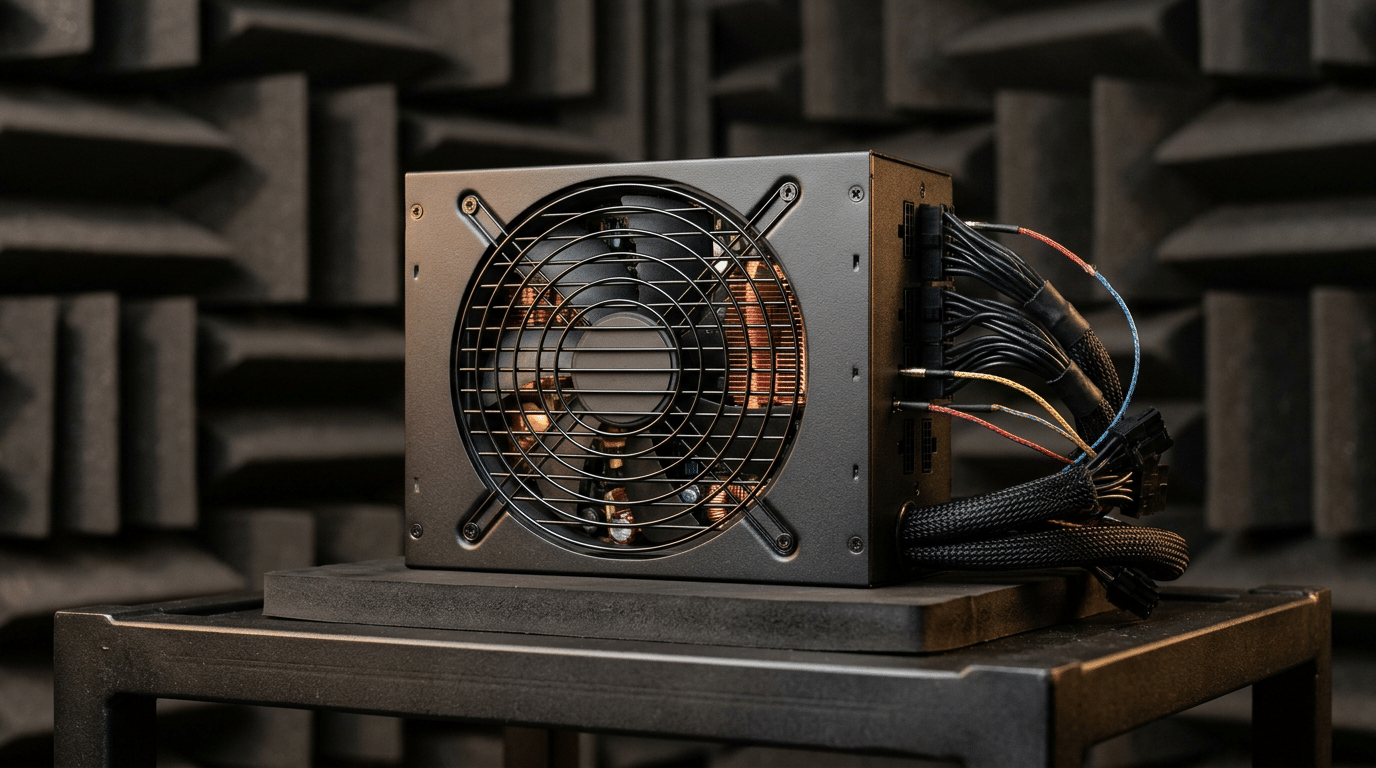
While ETA fixes efficiency blind spots, Cybenetics Lambda solves the single biggest missing specification on PSU packaging: how loud the cooling fan actually gets across your system’s real wattage range. Named after the Greek symbol λ (wavelength), Cybenetics’ official Lambda acoustic methodology records calibrated A-weighted sound pressure inside an anechoic chamber during the exact same 30°C+ hot-box load sweep.
Crucially, Cybenetics does not compute a naive arithmetic mean of decibel numbers. Because decibels follow a logarithmic scale—where an extra +3 dB doubles acoustic sound power and +10 dB roughly doubles perceived loudness—Cybenetics converts every dB(A) measurement back into physical sound pressure in Pascals (Pa), averages the sound pressure energy across all load points, and converts the result back into dB(A). That guarantees heavy acoustic spikes count properly against a loud fan curve.
| Cybenetics Lambda Grade | Average Acoustic Output (115V / 230V) | Real-World Room & Chassis Perception | Ideal 2026 Gaming Rig Fit |
|---|---|---|---|
| Lambda A++ | <15 dB(A) | Virtually imperceptible in quiet rooms; well below typical ambient room floor | Ultra-silent RTX 5090 / studio audio workstations & living-room builds |
| Lambda A+ | ≥15 dB(A) & <20 dB(A) | Whisper-quiet; blends seamlessly behind slow-spinning 120mm/140mm case fans | Quiet 1440p & 4K gaming rigs positioned directly on the desktop |
| Lambda A | ≥20 dB(A) & <25 dB(A) | Very quiet; softer than open-air GPU coolers under normal gaming load | Sweet-spot quiet gaming builds (750W–1000W ATX 3.1) |
| Lambda A- | ≥25 dB(A) & <30 dB(A) | Audible gentle airflow up close; unobtrusive inside mesh cases under headphones | Mainstream compact 140mm-depth 850W performance builds |
| Lambda Standard++ | ≥30 dB(A) & <35 dB(A) | Noticeable low-frequency fan hum above 50%–60% sustained system load | Budget builds or rigs tucked underneath desks |
| Lambda Standard+ | ≥35 dB(A) & <40 dB(A) | Distinct fan rush under sustained gaming; typically uses smaller 120mm fans | Value-oriented ATX 3.1 builds prioritizing cost over acoustics |
| Lambda Standard | ≥40 dB(A) & <45 dB(A) | Loud; clearly audible over moderate GPU and AIO cooler noise | Avoid for quiet desktop rooms; keep for isolated utility chassis |
Load Ranges and the High-Load Index (Why Zero-RPM Curves Can Mislead)
Even a single Lambda average can hide how a PSU behaves once your graphics card sustains 300W to 575W for hours. Suppose Unit A uses a gentle constant-spin fan holding 22.3 dB(A) almost flat from idle through 100% capacity, whereas Unit B relies on a Zero-RPM mode that keeps the fan stopped until 40% load before spinning aggressively past 30 dB(A) under heavy gaming. Both units might post an overall Lambda average near 22.5 dB(A) and earn the identical Lambda A badge.
To prevent that blind spot, Cybenetics supplements each desktop PSU report with two informational breakdowns:
- Five Load-Range Windows (0–<20%, 20–<40%, 40–<60%, 60–<80%, and 80–100%): Shows the energy-averaged dB(A), peak single-point loudness, and exact percentage of points where Zero-RPM stops the fan completely.
- High-Load Index (70%–100% Capacity): Averages noise exclusively across the top 30% of the power curve. Always compare the High-Load Index alongside the primary Lambda badge if your gaming load pushes past 60% of rated PSU wattage—or size your PSU upward into the 50%–60% sweet spot so your fan stays inside its calmest bracket.
Beyond Efficiency Badges: ATX 3.1 Transients, 12V-2×6 & Protections
High conversion efficiency and quiet fans represent only 25% of our hardware audit framework. Across modern gaming desktops, our primary architecture rule holds true: ATX 3.1 / PCIe 5.1 PSU --[SUPPLIES_TRANSIENT_SAFE_POWER]--> GPU. Neither an 80 Plus Gold badge nor a Cybenetics ETA Platinum stamp alone guarantees compliance with Intel’s ATX 3.1 and PCI-SIG PCIe 5.1 specifications.
That is why Cybenetics introduced its separate ATX v3.x Pass certification program, verifying dynamic power excursion endurance, timing tolerances, and hold-up stability alongside ETA and Lambda metrics. Before ordering any PSU, pair efficiency and acoustic badges with these four physical and electrical safeguards:
- 200%–300% Transient Power Excursions & Native 12V-2×6: ATX 3.1 units absorb 200% total PSU spikes and 300% PCIe GPU microsecond bursts without tripping protection circuits, and pair with
H++native 12V-2×6 connectors featuring 1.5mm recessed sense pins that sever full power delivery if a plug is partially unseated. Always reserve at least 35mm to 40mm of straight side-panel bend clearance outside the GPU header. - Japanese 105°C Capacitors & Six Protection Circuits: Require Japanese 105C capacitors across primary bulk and secondary filtering stages paired with complete OCP OVP OPP / UVP / SCP / OTP safety circuits and a 10-year warranty on midrange through flagship units.
- Full Modular Cabling & Zero Cross-Unit Cable Mixing: Full modular harnesses streamline case routing and eliminate unused cable clutter, yet PSU-side connector pinouts differ across brands and model revisions. Mixing modular cables between different power supplies feeds +12V into ground or +5V pins and causes immediate short circuits and component failure.
- Physical PSU Clearance (140mm vs. 160mm vs. 200mm & SFX): Higher efficiency and quiet 140mm fans often expand chassis length. While compact 850W–1000W ATX units fit comfortably at 140mm–150mm, flagship 1200W+ models stretch up to 200mm (and Small Form Factor builds require 100mm SFX designs). Measure shroud PSU clearance before choosing high-capacity quiet units—especially if pairing with 1000W and 1200W+ ATX 3.1 models.
Myth vs. Engineering Reality: Five PSU Rating Myths Busted
- Myth 1: “An 80 Plus Gold sticker means the power supply is quiet and uses top-shelf Japanese capacitors.”
Engineering Reality: 80 Plus checks efficiency at just 20%, 50%, and 100% static loads in a 23°C room and ignores acoustics, capacitor grade, and ripple completely. Two 80 Plus Gold 850W units can differ by 10 to 15 dB(A) under Cybenetics Lambda evaluation. - Myth 2: “Cybenetics Platinum and 80 Plus Platinum require identical efficiency percentages.”
Engineering Reality: 80 Plus Platinum enforces 90%/92%/89% at three fixed 115V checkpoints, whereas Cybenetics ETA Platinum demands ≥89% to <91% overall averaged efficiency across 1,450+ combinations at 30°C+, plus ≥0.975 Power Factor, >76% +5VSB efficiency, and <0.16W vampire power. - Myth 3: “Buying an 80 Plus Titanium ATX 2.x unit covers RTX 5080 or RTX 5090 transient spikes.”
Engineering Reality: Conversion efficiency does not equal dynamic excursion tolerance. Legacy ATX 2.x designs—even Titanium-rated ones—were never validated for 300% PCIe GPU microsecond excursions and lack native 12V-2×6 recessed sense-pin safety. - Myth 4: “Upgrading from Gold to Titanium cuts a gaming PC’s electric bill in half.”
Engineering Reality: Moving from 90% Gold to 94% Titanium at a 400W gaming load reduces wall AC draw from ~444W to ~426W—saving roughly 18W during gameplay. Buy Platinum or Titanium primarily for lower internal waste heat, calmer fan curves, and superior component topologies rather than rapid utility payback. - Myth 5: “Zero-RPM fan mode guarantees silent operation during heavy 4K gaming.”
Engineering Reality: Zero-RPM pauses the fan only during light desktop or low-wattage loads. Once GPU and CPU draw climb past 45%–55% capacity, a unit with an aggressive thermal fan curve can spike sharply in noise—check the Cybenetics Lambda grade and High-Load Index rather than relying on Zero-RPM marketing bullet points.
Actionable PSU Efficiency & Noise Buying Checklist
Apply these six quick checks before buying any retail power supply or evaluating a prebuilt PC specification sheet:
- Look Past Generic “80+ Gold” Labels: Cross-check Cybenetics’ database or box badges for both Cybenetics ETA (Gold or Platinum sweet spot) and Cybenetics Lambda (aim for Lambda A-, A, or A+ for quiet rooms).
- Verify the High-Load Index & Fan Hardware: Favor 135mm–140mm fluid dynamic bearing (FDB) fans over compact 120mm fans when choosing 850W–1200W models, and inspect Lambda’s 60%–100% load-range behavior if you game for long stretches.
- Lock ATX 3.1 / PCIe 5.1 & Native 12V-2×6 First: Never sacrifice transient excursion compliance or native
H++12V-2×6 cabling just to chase a higher efficiency badge on an outdated ATX 2.x platform. - Size Capacity for 50%–60% Gaming Load: Landing typical gaming draw near 50%–60% keeps your PSU inside peak efficiency and beneath steep acoustic fan ramps (750W for RTX 5070/RX 9070, 850W for RTX 5070 Ti/RX 9070 XT, 1000W for RTX 5080, 1200W+ for RTX 5090).
- Confirm Internal Reliability Anchors: Require 100% Japanese 105C capacitors, full OCP OVP OPP / UVP / SCP / OTP protections, full modular cabling, and a 10-year warranty (treating omitted prebuilt PSU specs under audit rule
R-AMZ-05as a warning flag). - Check PSU Depth & Cable Bend Clearance: Match 140mm, 160mm, or 200mm PSU lengths against your chassis shroud spec, leave ≥35mm straight clearance beside the GPU 12V-2×6 header, and never reuse modular cables from any prior PSU.
Audited ATX 3.1 PSUs Demonstrating 80 Plus vs. Cybenetics Differences
Comparing real 2025–2026 ATX 3.1 retail units side by side illustrates why reading Cybenetics ETA and Lambda alongside 80 Plus transforms buying decisions. Each model below is verified on Amazon US and links back to our wider category recommendations in our best gaming power supplies roundup and best 850W ATX 3.1 units guide.
1. Corsair RM1000x (2024 ATX 3.1) — 80 Plus Gold That Clears Cybenetics ETA Platinum & Lambda A

Budget Tier: High-end 1000W tier | Audited Specs: 1000W Continuous | ATX 3.1 & PCIe 5.1 | Native 16-Pin 12V-2×6 (600W) | 80 Plus Gold / Cybenetics ETA Platinum | Cybenetics Lambda A (20–25 dB(A)) | 140mm FDB Fan (Zero RPM + Manual Speed Knob) | 100% Japanese 105C Capacitors | 10-Year Warranty.
Why It Illustrates Certification Differences: Although labeled 80 Plus Gold under static three-point thresholds, the 2024 RM1000x delivers broad-curve efficiency strong enough to achieve Cybenetics ETA Platinum (≥89% 115V average at 30°C+) alongside whisper-quiet Cybenetics Lambda A acoustics (20–25 dB(A)). Flexible embossed cables and a manual fan-speed override knob give quiet RTX 5080 builders exceptional acoustic control.
2. Seasonic Focus GX-850 (ATX 3.1 / V4) — Compact 140mm Build With Cybenetics Lambda A- Quietness
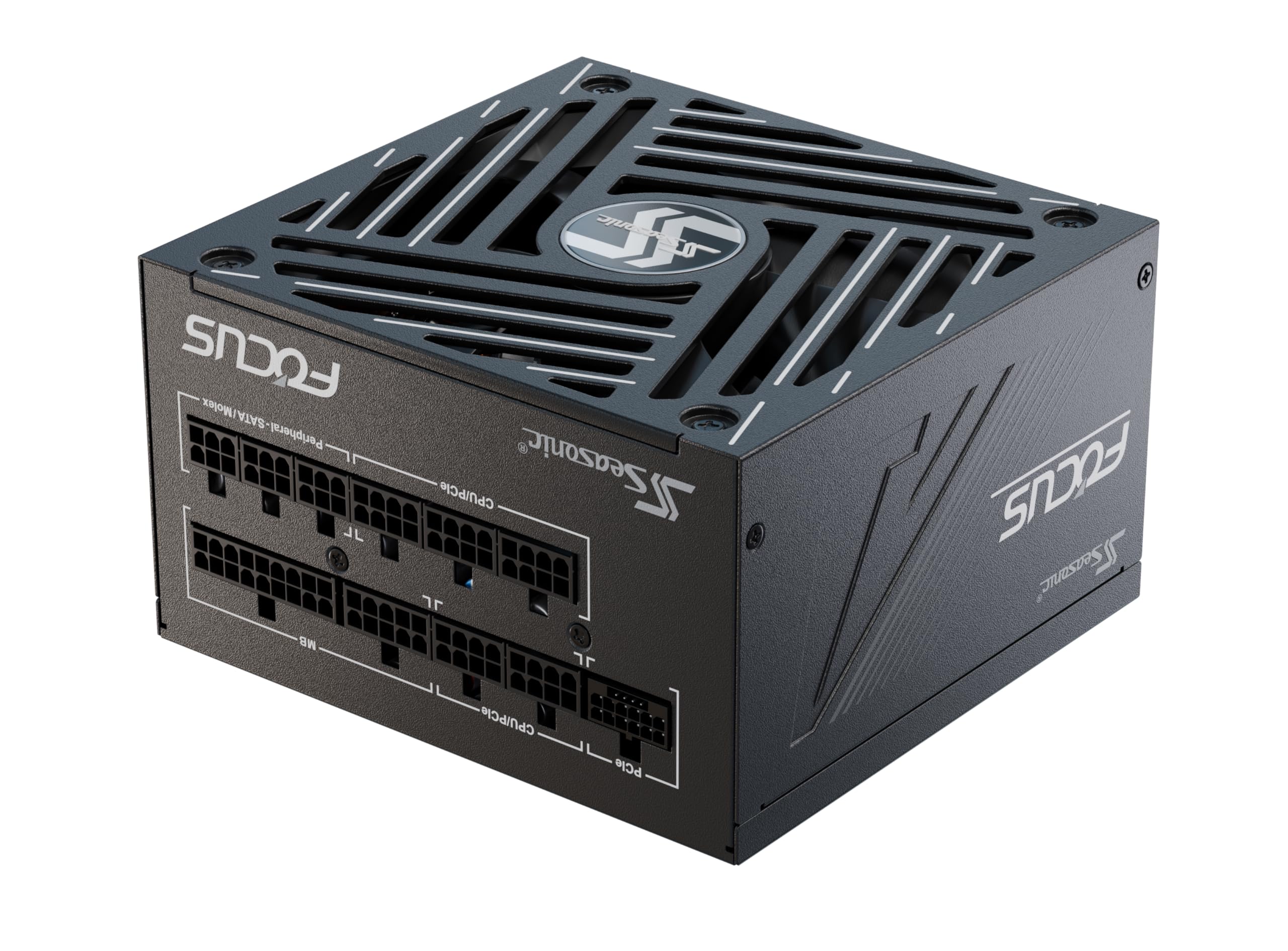
Budget Tier: Midrange 850W tier | Audited Specs: 850W Continuous | ATX 3.1 & PCIe 5.1 | Native 16-Pin 12V-2×6 (600W) | 80 Plus Gold / Cybenetics ETA Gold+ | Cybenetics Lambda A- (25–30 dB(A)) | 135mm FDB Digital Hybrid Fan | 140mm Depth | 100% Japanese 105C Capacitors | 10-Year Warranty.
Why It Illustrates Certification Differences: Utilizing Seasonic’s OptiSink internal cooling layout inside a short 140mm frame, the Focus GX-850 pairs standard 80 Plus Gold efficiency with verified Cybenetics Lambda A- noise restraint (25–30 dB(A)). That makes it an ideal benchmark for compact 1440p ATX towers running an RTX 5070 Ti or RX 9070 XT without excess cable or shroud crowding.
3. MSI MAG A850GL PCIE5 — Same 80 Plus Gold Badge, Louder Lambda Standard+ Acoustics

Budget Tier: Budget-midrange 850W tier | Audited Specs: 850W Continuous | ATX 3.1 Ready & PCIe 5.1 Ready | Dual-Color Yellow 12V-2×6 Seating Indicator | 80 Plus Gold / Cybenetics ETA Gold | Cybenetics Lambda Standard+ (35–40 dB(A)) | 120mm FDB Fan | 140mm Depth | 10-Year Warranty.
Why It Illustrates Certification Differences: On paper, the MAG A850GL carries the exact same 80 Plus Gold efficiency tier and 10-year warranty as competing 850W units—plus full 2x/3x ATX 3.1 transient protection and MSI’s helpful yellow 12V-2×6 latch indicator. However, its smaller 120mm FDB fan curves earn Cybenetics Lambda Standard+ (35–40 dB(A)), proving why acoustic-sensitive buyers must read Lambda rather than stopping at 80 Plus Gold.
4. CORSAIR HX1200i (2025) 1200W — Flagship Shift to Cybenetics Platinum Without 80 Plus

Budget Tier: Enthusiast 1200W tier | Audited Specs: 1200W Continuous | ATX 3.1 & PCIe 5.1 Ready | Native 12V-2×6 Connector | Cybenetics Platinum | 140mm FDB Zero RPM Fan | 200mm Chassis Depth.
Why It Illustrates Certification Differences: Reflecting the broader industry transition, the 2025 HX1200i drops legacy 80 Plus branding entirely in favor of Cybenetics Platinum verification across realistic 30°C+ operational sweeps. Built for sustained 575W RTX 5090 workloads alongside flagship processors, its 200mm depth requires checking chassis shroud clearance prior to purchase.
Certification Traps Disqualified Under Audit Rule R-PSU-01
- Unverified Prebuilt Listings Claiming Only “80+ Gold” Without Model or ATX Revision: Prebuilt product pages that conceal PSU OEM, wattage margins, ATX 3.1 transient rating, and Lambda acoustics frequently ship outdated ATX 2.x platforms or budget non-modular units.
- Outdated ATX 2.x Group-Regulated Bronze Units on High-Draw GPUs: Missing 200%–300% transient excursion headroom and native
12V-2x6cabling triggers nuisance shutdowns and forces risky multi-8-pin adapter harnesses. - Short Sub-5-Year Warranty Units Using Aggressive Fan Curves: Pairing lower-temperature 85°C bulk capacitors with loud 120mm Standard-tier fans compromises thermal lifespan inside compact gaming rigs.
Official Standards & Engineering References
- Cybenetics Labs: ETA Efficiency Methodology, 115V/230V Thresholds & 5VSB Caps
- Cybenetics Labs: Lambda Acoustic Grades (A++ to Standard) & High-Load Index
- Cybenetics Labs: ATX v3.x Dynamic Power Excursion Certification Criteria
- CLEAResult: Official 80 Plus PSU Ratings Explained (115V & 230V Desktop Matrix)
- Corsair Engineering Explorer: Why Power Supplies Transitioned From 80 Plus to Cybenetics
How We Audited This Guide
- Power supplies, coolers, and cases were audited for ATX 3.1 / PCIe 5.1 compliance, 12V-2x6 support, efficiency certification, radiator and GPU clearance, and fan configuration.
- Every specification claim was cross-checked against official OEM datasheets, platform vendor documentation, and published industry standards (PCI-SIG, JEDEC, VESA, Intel ATX) rather than marketplace listing copy.
- Recommendations were evaluated against our weighted audit rubric and documented compatibility rules; we do not publish fabricated FPS, thermal, or acoustic numbers.
Frequently Asked Questions
What is the difference between 80 Plus and Cybenetics ETA?
80 Plus evaluates conversion efficiency at three or four fixed load points inside a cool 23°C room. Cybenetics ETA averages over 1,450 load combinations inside a 30°C+ chamber and enforces strict Power Factor, +5VSB standby efficiency, and no-load vampire power caps.
What does Cybenetics Lambda mean on a power supply?
Cybenetics Lambda measures a power supply’s true acoustic noise output in dB(A) across its full load curve using logarithmic sound-pressure averaging. Grades span from loud Standard (40–45 dB(A)) down through quiet Lambda A- (25–30 dB(A)), A (20–25 dB(A)), A+ (15–20 dB(A)), and A++ (<15 dB(A)).
Why is an 80 Plus Gold PSU sometimes rated Cybenetics Platinum?
80 Plus Platinum requires clearing exact static thresholds like 92% at 50% load at 115V. A unit averaging 91.7% at 50% load falls back to 80 Plus Gold, yet its high overall weighted efficiency across 1,450+ points, strong +5VSB conversion, and tight Power Factor still clear Cybenetics ETA Platinum (≥89%).
Does 80 Plus or Cybenetics ETA verify ATX 3.1 transient spikes and 12V-2×6 safety?
No—standard 80 Plus and ETA efficiency labels do not guarantee ATX 3.1 compliance. Always confirm explicit ATX 3.1 / PCIe 5.1 certification (or Cybenetics’ separate ATX v3.x Pass badge) alongside a native H++ 12V-2×6 connector for 200%–300% GPU excursion resilience.
Which PSU efficiency and noise tier should gaming PC builders target in 2026?
Most 1080p and 1440p builds hit the best value at ATX 3.1 80 Plus Gold or Cybenetics ETA Gold–Platinum paired with Lambda A- or Lambda A acoustics. High-end 4K RTX 5080 and RTX 5090 systems benefit from Cybenetics Platinum–Titanium and Lambda A or A+ quietness.


